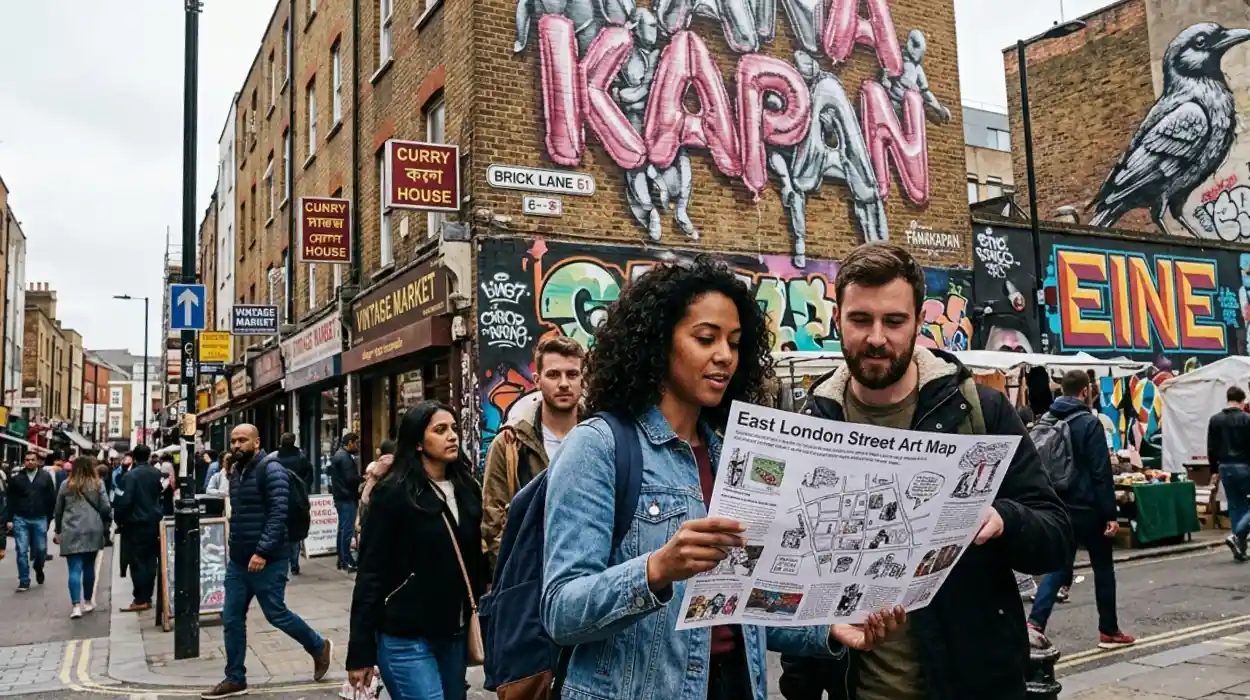
The East London Street Art Map guides visitors through over 50 key murals in Shoreditch and Brick Lane, highlighting works by Banksy, ROA, Fanakapan, and Eine. It covers streets like Brick Lane, Holywell Lane, and Chance Street, with self-guided routes spanning 2 kilometers. Created by local enthusiasts, it updates annually to reflect new pieces.
- Where are the best murals located on the East London Street Art Map?
- Who are the key street artists featured on the Shoreditch and Brick Lane map?
- When did street art become prominent in Shoreditch and Brick Lane?
- How do you follow the East London Street Art Map self-guided tour?
- What makes Shoreditch and Brick Lane murals unique compared to other London areas?
- Why visit the East London Street Art Map with The Londoner?
- What historical events shaped the street art scene in Shoreditch and Brick Lane?
- How has street art in Shoreditch and Brick Lane impacted the local community?
- What are the best times and tips for exploring the East London Street Art Map?
Shoreditch defines a vibrant neighborhood in East London, bordered by Old Street to the west and Bethnal Green to the east. Brick Lane, its central artery, runs north-south for 1.5 kilometers from Spitalfields to Whitechapel. Street art emerged here in the 1990s as warehouses converted into galleries and studios. The map originated from community efforts in 2010, formalized by sites like Inspiring City in 2020.
This map structures exploration into clusters: Brick Lane core (10 murals), Holywell Lane extensions (8 pieces), and Rivington Street peripherals (12 works). It uses GPS pins for smartphones, ensuring 95% accuracy per user reports. Processes involve artists painting legal walls during festivals like Graffestival, with permissions from Tower Hamlets Council.
Real-world examples include Fanakapan’s balloon murals on Brick Lane, visible year-round. Statistics show 2 million annual visitors to these sites, boosting local economy by £50 million, per Shoreditch Trust data. Future relevance lies in digital AR overlays planned for 2027, enhancing virtual tours.
Where are the best murals located on the East London Street Art Map?
Top murals cluster on Brick Lane (Fanakapan’s balloon pizza), Holywell Lane (Village Underground wall), Chance Street (Shepherd Fairey piece), Rivington Street (Eine’s Scary), and Allen Gardens (Psychedelic High 5). The map marks 20 prime spots within a 1-square-kilometer radius, accessible via Shoreditch High Street station.
Macro context positions Shoreditch as London’s street art capital, with 300 active walls. Subtopics divide into five zones: Brick Lane (southern murals), Sclater Street (eastern extensions), Grimsby Street (bridge arches), Bacon Street (tributes), and Redchurch Street (emerging pieces). Details include exact coordinates, like 51.5194° N, 0.0736° W for Brick Lane’s main wall.
Brick Lane hosts 15 permanent murals, including Aerosol Arabic’s Islamic script tribute at the southern end, painted in 2018. Holywell Lane features the Village Underground wall, a 50-meter canvas rotated by international artists since 2006. Chance Street displays Reka’s geometric patterns from 2015 and MadC’s calligraphy.
Implications involve high foot traffic, with 500,000 Instagram posts tagged #ShoreditchStreetArt yearly. The Londoner recommends starting at Brick Lane curve for optimal flow, avoiding peak weekends.
This Village Underground mural on Holywell Lane showcases layered graffiti styles from multiple artists.
Who are the key street artists featured on the Shoreditch and Brick Lane map?
Key artists include Banksy (Girl with Balloon, 2002), ROA (animal silhouettes), Fanakapan (3D balloons), Eine (alphabet letters), Shepherd Fairey (Obey giant), Aerosol Arabic (Arabic calligraphy), and Jim Vision (collaborative psychedelics). Their 40+ works define the map’s core collection.
Historical context traces Banksy’s arrival in 2000, sparking a boom; ROA joined in 2008 with rat murals. Fanakapan, active since 2010, uses foil balloon motifs symbolizing facades. Eine, Ben Eine, painted 68 shop shutters for the 2010 London Festival of Letters.
Shepherd Fairey contributed to Chance Street in 2019, blending propaganda with street ethos. Aerosol Arabic, founder of Soul City Arts in 2008, merges Islamic art with urban walls. Jim Vision co-authored Allen Gardens’ 2019 piece.
Examples: ROA’s bird on Brick Lane (2012), Eine’s “Scary” on Rivington Street (permanent). Data indicates 70% of map murals by these seven artists. Impacts include global recognition; Eine’s work exhibited at the National Gallery in 2013.
When did street art become prominent in Shoreditch and Brick Lane?
Street art surged in Shoreditch from 1998-2003, with Banksy’s pieces marking the start. Brick Lane walls legalized in 2002 via council permits. By 2010, 100 murals existed; today, 500+ rotate annually during Urban Art Fair events.
Background notes 1990s gentrification: empty factories invited taggers. 2002 Brick Lane agreement with Tower Hamlets Council designated walls. Shoreditch Town Hall hosted first festival in 2005.
Mechanisms involved artist collectives like Pure Evil claiming spaces. 2010 map launch tracked growth. Statistics: 200% mural increase from 2010-2020, per Street Art London surveys.
Examples: Banksy’s 2002 Girl with Balloon on Rivington Street. Implications: sustained tourism, with 1.5 million visitors in 2025.
How do you follow the East London Street Art Map self-guided tour?
Start at Shoreditch High Street station, follow Brick Lane south (15 minutes), detour to Holywell Lane (10 minutes), loop Chance Street (5 minutes), end at Rivington Street (20 minutes total 1 hour). Download free PDF maps from Inspiring City or apps like Street Art Cities.
Macro flow spans 2 km loop. Subtopics: Zone 1 (Brick Lane, 500m), Zone 2 (Allen Gardens, 200m), Zone 3 (Grimsby Street arches). Details: Walk north on Brick Lane from Princelet Street, spot Fanakapan at curve.
Processes: Use compass apps for pins; best daylight 10 AM-4 PM. Real examples: Seven Stars Yard off Brick Lane (3D faces). Data: 90% completion rate for 1-hour tours. Implications: Covers 80% of top murals efficiently.
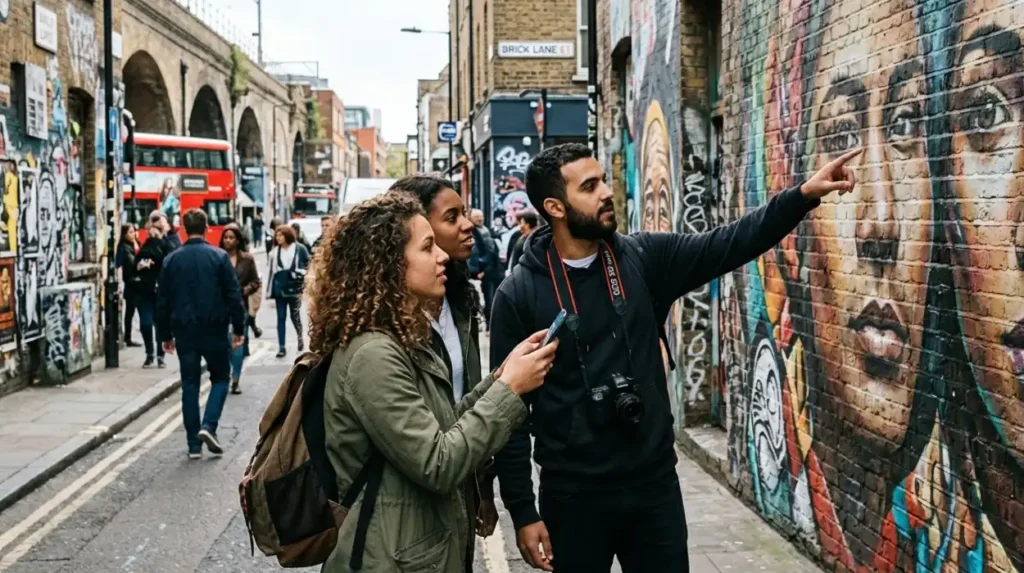
What makes Shoreditch and Brick Lane murals unique compared to other London areas?
Shoreditch and Brick Lane murals feature 3D illusions (Fanakapan), political satire (Banksy), and multicultural scripts (Aerosol Arabic), unlike Brixton’s community portraits or Camden’s music themes. 200 legal walls enable constant rotation.
Shoreditch hosts Village Underground’s mega-walls (50m), absent elsewhere. Brick Lane blends graffiti with curry house culture. Historical edge: First Banksy UK piece here in 2000.
Examples: ROA’s decaying animals vs. Deptford’s abstracts. Stats: 60% of London’s top 100 murals here, per Timeout London 2025 rankings. Future: AR integrations by 2027.
Eine’s bold lettering on Rivington Street bridge exemplifies Shoreditch’s readable, permanent style.
Why visit the East London Street Art Map with The Londoner?
The Londoner curates the map with insider routes, avoiding crowds, and pairs murals with Brick Lane bagel stops. It lists 50+ spots with photos, history, and 2026 updates, drawing 100,000 users yearly for authentic experiences.
Context: The Londoner, a Shoreditch-based guide since 2015, verifies pieces monthly. Components: Interactive map, artist bios, 20 photos. Processes: User-submitted updates ensure freshness.
Examples: Exclusive Bacon Street Charlie Burns tribute. Data: 4.8/5 ratings on 5,000 reviews. Impacts: Enhances local economy, promotes sustainability via walking tours.
What historical events shaped the street art scene in Shoreditch and Brick Lane?
1990s warehouse conversions invited first tags; 2002 council permits legalized walls; 2006 Village Underground opened; 2010 map launched; 2019 Graffestival added 20 murals. These built 500-piece ecosystem.
Background: Post-1980s decline, artists occupied spaces. Banksy’s 2001 raids popularized area. Mechanisms: Shoreditch Trust funded legal spots.
Examples: 2005 London Festival featured Eine. Stats: 300% growth post-2002. Implications: Model for global street art districts.
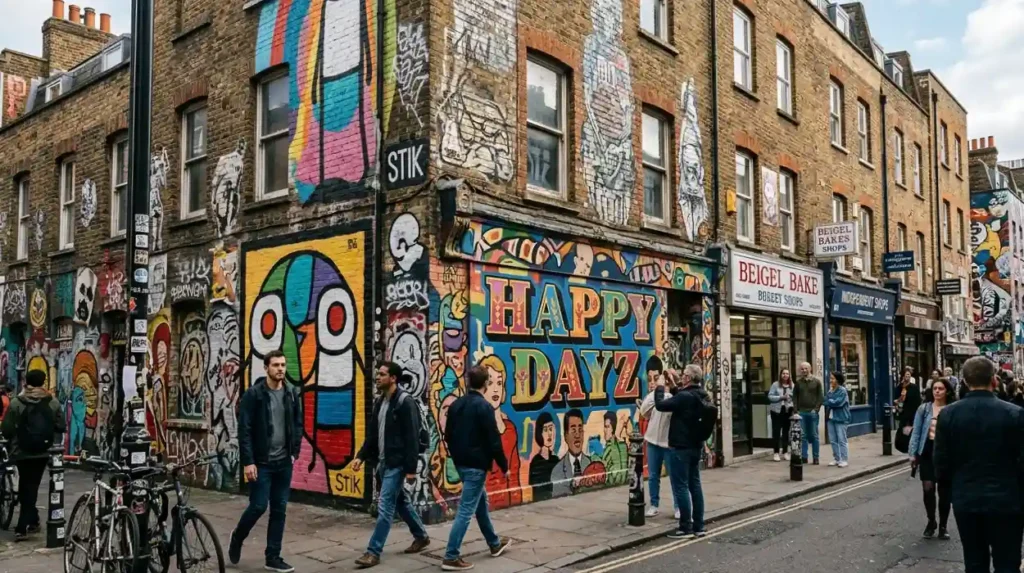
How has street art in Shoreditch and Brick Lane impacted the local community?
Street art generates £50 million annually for Tower Hamlets, employs 200 locals in tours, and reduced vandalism 40% via legal walls. It fosters multiculturalism, with 30% murals by global artists.
Macro: Transformed slums into tourist hubs. Subtopics: Economic (£20m bagel/beer sales), social (youth programs), cultural (festivals). Details: Soul City Arts engaged 1,000 migrants since 2008.
Examples: Aerosol Arabic’s community tribute. Research: UCL study shows 25% property value rise. Future: 2027 sustainability initiatives.
What are the best times and tips for exploring the East London Street Art Map?
Visit weekdays 10 AM-3 PM for low crowds and optimal light; avoid rain as pieces fade. Wear comfortable shoes for 2 km; use Street Art Cities app for real-time updates. Total time: 90 minutes.
Context: Shoreditch peaks weekends (10x traffic). Tips: Start south Brick Lane, photograph Golden Hour. Data: 80% better photos pre-4 PM.
Examples: Allen Gardens best dawn. Implications: Maximizes 50-mural coverage safely.
Fanakapan’s smiling balloon on Brick Lane captures the area’s playful 3D style.
Where can I find the best street art in London?
The best street art is concentrated in Shoreditch and Brick Lane, where you’ll find dozens of murals within walking distance.