Key Points
- Permanent Traffic Ban Proposed: Camden Council has launched a six-week public consultation proposing a permanent ban on motor vehicles through a busy section of Camden High Street.
- Expansion of Existing Trial: The permanent scheme would build on a trial pedestrianisation first implemented on 3 May 2025, which redirected traffic away from the crowded tube station area.
- Proposed Extension to Camden Lock: The council is seeking feedback on extending the car-free zone northward across Camden Lock Bridge up to the junction with Castlehaven Road, as well as pedestrianising adjoining Jamestown Road.
- Environmental and Safety Benefits: Monitoring data from the 18-month trial shows clear improvements in air quality on the high street, reduced crime rates, and stable levels of business spending and footfall.
- Congestion and Journey-Time Trade-offs: While supporters praise the cleaner air and safety, local residents and critics have raised concerns about vehicle displacement onto adjacent roads and increased journey times for buses and cars.
- Mitigation Measures: To address transit delays, the local authority plans to install a new northbound bus lane on Kentish Town Road in autumn 2026.
- Funding and Strategy: The project is part of a larger £22 million council investment in active travel and forms part of the Camden Town Low Emission Neighbourhood, backed by £5 million in Transport for London (TfL) funding.
London (The Londoner News) July 15, 2026 – Camden Council has formally launched a landmark public consultation proposing a permanent ban on all motor vehicles across a highly congested stretch of Camden High Street, following an 18-month trial pedestrianisation scheme. The local authority aims to completely transform the world-famous thoroughfare—famed for its markets and alternative culture—into a healthier, safer, and more pedestrian-friendly space. Under the new proposals, the council is not only seeking to make the existing trial area permanently vehicle-free, but is also asking residents and businesses for their views on a major northern extension that would see the traffic ban cross the iconic Camden Lock Bridge. While monitoring data indicates that air quality has improved and local business spending has remained stable during the trial, the plan faces scrutiny over the displacement of traffic onto residential side roads and increased travel times for local bus routes.
- Key Points
- What is the proposed permanent car ban on Camden High Street?
- Why did Camden Council implement the trial pedestrianisation in May 2025?
- What does the monitoring data reveal about the 18-month trial?
- How do local businesses and residents feel about the proposed pedestrianisation?
- How will the proposed traffic diversion affect London bus and car journey times?
- What are the future expansion plans for the Camden Lock pedestrian zone?
- How does this plan fit into Camden’s wider environmental and transport strategy?
What is the proposed permanent car ban on Camden High Street?
The current proposal put forward by Camden Council seeks to permanently formalise a trial traffic-free zone that has been in place since May 2025. As reported by Josef Steen, a Local Democracy Reporter for MyLondon, the council’s plan aims to prevent motor vehicles from passing through the heart of the high street to create a public realm that is “safer and more pleasant”.
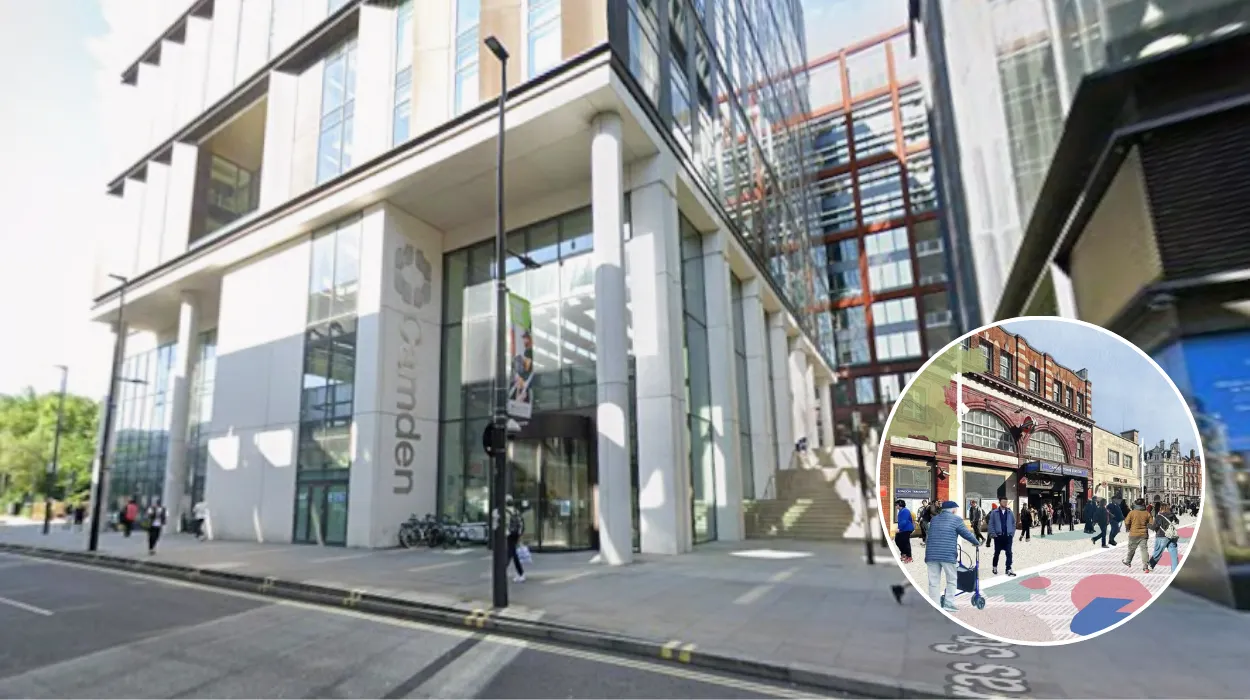
The original trial shut down motor traffic on Camden High Street from the bustling junction with Parkway and Kentish Town Road—directly in front of Camden Town Underground station—extending up to the junction of Jamestown Road and Hawley Crescent. Under the permanent scheme, the temporary barriers would be replaced with a smart bollard system. Furthermore, the local authority is proposing to introduce extensive public realm improvements, including new plants, trees, benches, level surfaces, and outdoor seating areas to support local hospitality businesses.
The scope of the project does not stop at the current boundaries. The council is consulting on extending the pedestrianised area further north. This potential expansion would include the stretch of Camden High Street running across the iconic Camden Lock Bridge up to the junction with Castlehaven Road, along with a new pedestrianised zone on Jamestown Road and Hawley Crescent, situated between Arlington Road and Stucley Place.
Why did Camden Council implement the trial pedestrianisation in May 2025?
Prior to the introduction of the trial, Camden High Street was notorious for extreme pedestrian congestion, particularly on weekends when tourists flocked to the world-renowned markets. As detailed by the editorial team at the Ham & High, the high volume of motor vehicles on the narrow thoroughfare frequently resulted in “conflict with pedestrians overspilling from the pavement,” which in turn severely degraded air quality and negatively impacted the overall visitor experience.
To address these safety and environmental hazards, the council implemented an Experimental Traffic Order on 3 May 2025. The temporary 18-month trial was initiated to gather empirical data and real-world feedback. In a statement released by Camden Council, Cllr James Slater, the Cabinet Member for Planning and a Sustainable Camden, explained the rationale behind the trial, stating:
“Camden Town is an important shopping and transport hub for local residents as well as being an internationally recognised destination that draws people in from across London, the rest of the UK, and the world. The trial has made the area safer and more pleasant for pedestrians and reduced air pollution on the street. The extra space has also allowed us to hold events and activities that showcase the best of Camden’s culture and communities.”
What does the monitoring data reveal about the 18-month trial?
Over the course of the trial, Camden Council monitored various environmental, economic, and safety metrics to evaluate the impact of the traffic restrictions. The findings published by the council present a largely positive case for the permanent transition:
- Air Quality Improvements: There was a “clear improvement” in air quality levels on Camden High Street itself, and notably, monitoring stations recorded “no significant effect on air quality on nearby roads,” assuaging fears that pollution was merely being shifted to adjacent streets.
- Economic Resilience: Despite concerns that banning cars would hurt local commerce, data showed that consumer spending at businesses within the pedestrianised area remained highly consistent. Additionally, overall visitor footfall on the high street remained stable throughout the trial period.
- Crime Reduction: The council reported that general levels of crime, including anti-social behaviour and pickpocketing, actually fell over the course of the trial, defying initial worries that a larger public space would attract more illicit activity.
- Surrounding Traffic Stability: Traffic monitoring indicated that the surrounding road networks did not see a significant, permanent spike in overall traffic levels.
How do local businesses and residents feel about the proposed pedestrianisation?
Public opinion on the scheme remains highly supportive but is not without local friction. As reported by Josef Steen of MyLondon, a public consultation held in 2024 prior to the trial showed that over 70 per cent of respondents supported the pedestrianisation and the idea of a motor traffic-free test zone.
However, support varied depending on proximity to the high street. While wider borough residents strongly favoured the plans, support among those living inside the immediate consultation zone dropped to 62 per cent.
As noted in the reporting by Josef Steen, several local respondents raised concerns that restricting vehicular access on the high street would “simply displace vehicles on adjacent roads, creating bottlenecks and pushing traffic and pollution elsewhere”. Others expressed apprehension that the addition of street furniture, benches, and sheltered alcoves would serve as a magnet for anti-social behaviour.
Writing for Time Out, contributing writer Alice Saville pointed out the stark division in how Londoners perceive the area, noting that while some see it as a vibrant cultural hub, others associate the congested high street with being “trampled by hordes of feral European teenagers” or caught in a “drunken crush”. Saville observed that while the pedestrianisation has made the street a “more pleasant place to be” and reduced overcrowding, “there’s a trade-off… bus and car journey times have both got longer, as traffic is diverted away from the high street”.
How will the proposed traffic diversion affect London bus and car journey times?
The removal of motor vehicles from a key artery in North London has necessitated major changes to local transport routes. Under the current system, vehicles and buses travelling towards Chalk Farm have been diverted away from Camden Town station, instead travelling along Kentish Town Road and Hawley Crescent before continuing their journey northward.
To counter the resulting transit delays and support public transport efficiency, Camden Council has developed targeted mitigations. According to Alice Saville of Time Out, the council intends to install a brand-new northbound bus lane on Kentish Town Road. This bus priority measure is scheduled for installation in autumn 2026 and is designed to ease the bottleneck created by the diverted bus routes.
Additionally, the proposed permanent designs feature two-way cycling paths to maintain active travel connectivity, linking Arlington Road directly with Castlehaven Road and Chalk Farm Road.
Explore more North London News:
Brent Council Slashes Autistic Man’s Care Against Expert Advice: Brent 2026
Muswell Hill Baptist Church Leader John Grant Convicted: London 2026
What are the future expansion plans for the Camden Lock pedestrian zone?
Should the current consultation yield a positive decision to make the trial permanent, the council has laid out a clear roadmap for further expansion. Cllr James Slater emphasized that the local authority is actively responding to public demand for a wider car-free network. In his statement to the Ham & High, Slater noted:
“Many residents have told us that they want to go even further on pedestrianising Camden High Street, so we will also be seeking views on extending the area across Camden Lock bridge and up to the junction with Castlehaven Road. This could include a range of improvements for people walking, wheeling and cycling, as well as more public space and outdoor seating for local businesses.”
If the council decides this September to make the core pedestrian zone permanent, they will use the feedback from the current consultation to draft detailed visual and structural designs for the extended northern zone. The council has confirmed that these designs will be presented to the public for a secondary, dedicated public consultation in 2027 before any physical work begins on the extended section.
How does this plan fit into Camden’s wider environmental and transport strategy?
The Camden High Street pedestrianisation project is not an isolated initiative. Instead, it serves as the crown jewel of Camden Council’s broader environmental and transport policy. The scheme directly supports the establishment of the Camden Town Low Emission Neighbourhood (LEN), which aims to reduce toxic emissions, improve public health, and encourage active travel.
According to reports from the Ham & High, the Low Emission Neighbourhood scheme has been heavily funded by a £5 million grant from Transport for London’s (TfL) Borough Safer Streets fund. This forms part of a massive, long-term capital commitment by the local authority; since 2024, Camden Council has funnelled a total of £22 million into infrastructure investments explicitly designed to promote walking, cycling, public transport use, and the creation of “healthier streets”.
The current public consultation on the permanent future of Camden High Street runs for six weeks, having commenced on Monday, 13 July, and is scheduled to close on Sunday, 23 August. Local residents, business owners, and regular visitors are being strongly encouraged to submit their feedback via the council’s online portal. A final decision on whether to make the pedestrian zone a permanent fixture of North London is expected to be made by council leadership this September.