Key Points
- An important celestial phenomenon: There was a partial solar eclipse on Wednesday, 12 August 2026, providing the UK with its greatest coverage of the Sun since 1999.
- High obscuration: The city of London had a very deep partial eclipse with about 90% to 91% of the Sun being covered by the moon.
- Sunset eclipse: As compared to other daytime eclipses, the occurrence of this eclipse was rare because it took place in the evening when the Sun was at a low level on the western horizon.
- Difference among regions: Although there was a partial eclipse in the UK, some parts of Greenland, Iceland, Spain, and northern Russia witnessed a total eclipse.
- Importance of precautions: Professionals like the UK Health Security Agency (UKHSA) made serious warnings about the dangers of staring directly at the Sun without any ISO certified filters that could cause damage to the retina.
- Importance for researchers and astronomy lovers: NASA and ESA took the opportunity of conducting research related to the solar corona, whereas various astronomy societies organized public viewing events in the UK.
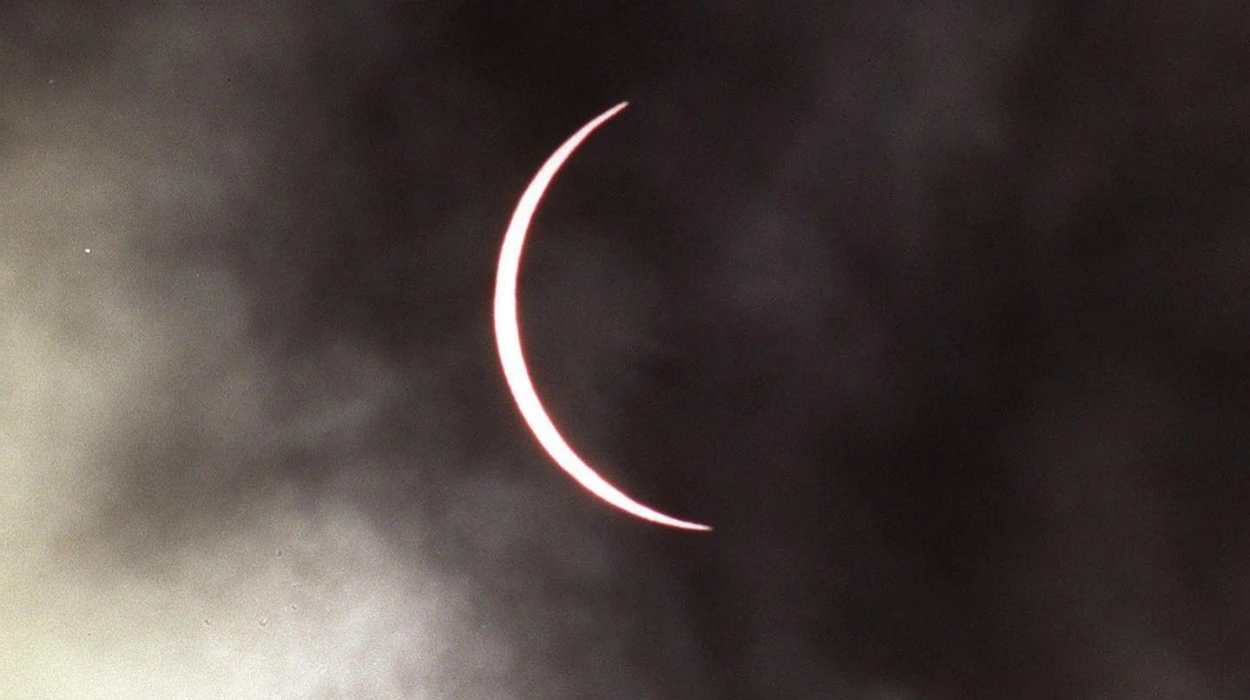
London (The Londoner News) August 12, 2026 – A rare and dramatic partial solar eclipse swept across the United Kingdom on Wednesday evening, treating millions of observers to a celestial display that saw the Moon obscure more than 90% of the Sun. As the Sun descended toward the western horizon, the event provided a unique sunset spectacle that has not been witnessed with such intensity in the region since 1999. While the path of totality—where the Sun is completely blocked—passed over Greenland, Iceland, and northern Spain, residents across the British Isles were treated to one of the most significant astronomical phenomena of the century.
- Key Points
- How did the partial solar eclipse unfold across London?
- Why was this specific eclipse considered a “rare spectacle”?
- What were the safety risks associated with viewing the eclipse?
- How did the scientific community leverage the eclipse?
- What is the difference between a partial and total solar eclipse?
- What were the best viewing conditions across the UK?
- Are there any other celestial events to watch for?
How did the partial solar eclipse unfold across London?
As reported by LiveMint, the eclipse began its journey across the UK around 6:00 pm BST. For observers in London, the Moon began its transit across the solar disc shortly after 6:17 pm. The phenomenon reached its maximum obscuration at approximately 7:13 pm, at which point roughly 90% to 91% of the Sun was masked, casting a distinct, eerie twilight across the capital.
The event concluded with “last contact” around 8:06 pm. Unlike standard solar eclipses that occur high in the sky, this event was defined by its low-altitude position. As noted by UKEclipse, the Sun remained only 10–15 degrees above the horizon for much of the UK during the peak, creating a dramatic sunset silhouette that required an unobstructed western view to fully appreciate.
Why was this specific eclipse considered a “rare spectacle”?
The significance of the 12 August 2026 eclipse lies in both its rarity and its timing. As Catherine Muller, an astronomer at the Royal Observatory Greenwich, explained to TIME, while solar eclipses occur during a new moon phase, the specific orbital alignment required for such deep coverage is infrequent.
According to Royal Museums Greenwich, as cited by TIME and the UK Health Security Agency (UKHSA), this was the most extensive coverage visible from the UK and Ireland since the total solar eclipse of 1999. Furthermore, Muller noted that for the UK and Ireland, which will have to wait until September 2090 to experience another total solar eclipse, this event represented the best opportunity for skywatchers to witness a near-total obscuration in the current century.
What were the safety risks associated with viewing the eclipse?
Despite the awe-inspiring nature of the event, health authorities maintained a strict focus on public safety. The UK Health Security Agency (UKHSA) issued clear guidelines ahead of the event, warning that even with 90% coverage, looking directly at the Sun without certified protection can cause permanent, irreversible retinal damage.
As reported by TIME, the UKHSA cited data from the Royal College of Ophthalmologists following the 1999 eclipse, which recorded approximately 70 cases of vision problems among individuals who had looked directly at the Sun, often for less than a minute.
“The reduced brightness can override the body’s natural reflex to look away, allowing intense sunlight to reach and damage the retina,” the UKHSA warned in its official blog. Experts emphasized that ordinary sunglasses—regardless of how dark they are—do not provide sufficient protection. Recommended methods included using ISO 12312-2:2015(E) certified eclipse glasses, pinhole projectors, or viewing projections through common household items like colanders.
How did the scientific community leverage the eclipse?
While the public looked to the skies for the spectacle, global space agencies were engaged in critical data collection. As reported by the Indian Express, both NASA and the European Space Agency (ESA) announced plans to use the 2026 eclipse to study the solar corona.
The corona, the Sun’s outer atmosphere, is usually rendered invisible by the overwhelming glare of the Sun’s face. During the total eclipse experienced in regions like Spain and Iceland, the Moon effectively acted as a shield, allowing researchers to gather data on the corona’s million-degree temperature patches. This provided a rare, fleeting window to observe solar features that are otherwise impossible to study from Earth without specialized, heavy equipment.
What is the difference between a partial and total solar eclipse?
The 2026 event highlighted the nuances between different types of solar phenomena. As detailed by the Indian Express, there are four primary types of solar eclipses: total, annular, partial, and hybrid.
- Total Solar Eclipse: Occurs when the Moon entirely blocks the Sun, revealing the solar corona. This is visible only to those within the narrow path of the umbra, or the darkest part of the Moon’s shadow.
- Annular Solar Eclipse: Takes place when the Moon is near its farthest point from Earth, appearing smaller and leaving the outer ring—or “ring of fire”—of the Sun visible.
- Partial Solar Eclipse: Occurs when the Moon blocks only a portion of the Sun, resulting in a crescent shape. This is the most common form of eclipse and was the experience for most of the UK.
- Hybrid Solar Eclipse: A rare occurrence where an eclipse shifts between total and annular as the Moon’s shadow moves across the Earth’s surface.
Explore more Local London News:
West London NHS Trust Shortlisted for Three HSJ Awards, Ealing 2026
Bayeux Tapestry Exhibition Arrives in London 2026
What were the best viewing conditions across the UK?
Visibility remained a primary concern for local observers. Reports from LiveMint indicated that while much of the UK enjoyed a clear view, cloud cover remained a risk for parts of northern England, Scotland, and north Wales during the 6:00 pm to 7:00 pm window.
Those in the South West of England, specifically Cornwall and Devon, were positioned to see the greatest obscuration, with some estimates reaching up to 95%. Astronomical societies, such as the Plymouth Astronomical Society and various university departments, facilitated public viewing events to ensure enthusiasts had access to the necessary equipment and guidance.
Are there any other celestial events to watch for?
Following the eclipse, interest in astronomy remains high. As noted by TIME, the eclipse was followed by the peak of the Perseid meteor shower. Catherine Muller of the Royal Observatory Greenwich suggested that with the new moon conditions providing a dark background, the night of the eclipse offered an ideal opportunity for observers to witness the meteor shower after midnight, provided they could travel to areas with low light pollution.
The 12 August 2026 eclipse will undoubtedly be remembered as a landmark event for UK skywatchers. From the safety precautions advised by the UKHSA to the scientific observations conducted by international agencies, the “deep” partial eclipse provided a rare moment of unity and wonder, as millions across the country turned their eyes—safely—to the western sky.