Key Points
- Former
London City Hall, dubbed the “glass testicle” by ex-Mayor Ken Livingstone,
is undergoing a major transformation. - Work
includes lift shaft renovation, greenery terraces, and retail
reconfiguration at the base level. - The
redevelopment is expected to continue until early 2026. - The
design by architects Gensler aims for sustainability, circularity, and
inclusivity. - The
redesign will reportedly reduce steel use by 27%, cutting CO₂ emissions by
812 tonnes. - Historic
England raised heritage concerns and sought listing for the building but
was unsuccessful. - The
transformation has sparked mixed reactions from Londoners and former
Assembly members. - The
building has been renamed “110 The Queen’s Walk” and will feature urban
greenery, shops, restaurants, and cultural spaces.
Once the symbolic seat of London’s governance, the iconic
glass-curvedty Hall building on the Thames—mockingly dubbed the “glass
testicle”—is being transformed into a lush, green retail and leisure space
under a radical new redevelopment set to complete by early 2026.
- Key Points
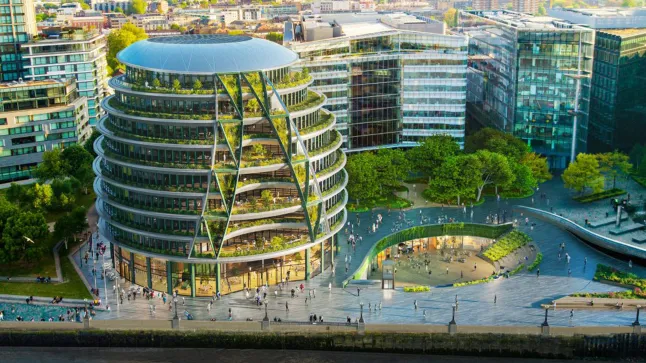
- What Is Happening to the ‘Glass Testicle’ Building?
- Why Is the Redevelopment Taking Place Now?
- How Will the New Design Transform the Landmark?
- Who Supports and Who Opposes the Plan?
- What Role Has Historic England Played in the Redevelopment Debate?
- What Does the Building’s Future Hold?
- Could the Redevelopment Set a New Precedent for London Architecture?
What Is Happening to the ‘Glass Testicle’ Building?
As reported by Molly Lee of Metro (20
October 2025), deconstruction work is already in progress at the former City
Hall site, officially renamed 110 The Queen’s Walk. The project
will reshape the once politically charged structure into a hub for urban retail
and cultural activity.
The extensive works have so far included the removal of the
building’s 3,000 glass panes and the distinctive 500-metre spiral staircase
that wound through the heart of the structure. According to Lee, the new design
will involve “straightening of the exterior to create terraces for greenery”
and the addition of shrubs and trees to soften its stark geometric form along
the Thames.
Architects Gensler, who are leading the redesign, detailed
that the lift shaft’s material treatment will extend the blue-green enamelled
finish across its full height. “This allows it to integrate more harmoniously
with the overall architecture,” a spokesperson from Gensler said, as quoted
by Metro.
Why Is the Redevelopment Taking Place Now?
The building has stood empty since 2020, when
then-Mayor Sadiq Khan made the controversial decision to
relocate the London Assembly to the Royal Victoria Dock in Newham—a move partly
justified as a cost-saving measure to support regeneration in East London. As
reported by The Standard in 2012, cleaning the City Hall’s
vast glass façade alone cost taxpayers around £140,000 per year.
Built in 2002 and officially opened by Queen
Elizabeth II, the iconic structure was designed by Lord Norman
Foster as a contemporary emblem of London governance. For many years,
it was the venue where Assembly members publicly questioned the Mayor and
senior officials about city policies, budgets, and performance.
How Will the New Design Transform the Landmark?
According to Metro’s visual documentation,
designers have planned a “leaf-lined” environment, blending sustainability with
urban vibrancy. The upcoming renovation will accommodate shops and restaurants
at the building’s base, complemented by terraces lined with vegetation.
Gensler’s design philosophy is explicitly rooted in “reuse,
material circularity, passive design, biodiversity, and inclusivity.” The firm
also stated that its revised construction plan includes a “27% reduction in
steel usage,” saving “812 tonnes of CO₂” compared with earlier redevelopment
proposals.
Such figures represent a tangible nod to the city’s wider
sustainability agenda, mirroring trends across London that pivot toward
eco-conscious urban design.
Who Supports and Who Opposes the Plan?
Reaction to the redevelopment has been mixed across
political and public circles.
In comments cited by ITV News, former Conservative Assembly
member Brian Coleman described the redevelopment as “cultural
vandalism of the worst sort,” arguing that the building should have remained
the seat of London’s governance. Coleman added: “This was built as City Hall,
seat of London governance. Instead, Sadiq moved the assembly and the mayor to
some warehouse downriver in Newham – it’s outrageous.”
By contrast, former Green Party Assembly member Jenny
Jones expressed cautious optimism. Also speaking to ITV News,
she said, “I think initially it looks absolutely amazing because you really
don’t want a derelict building right on the banks of the Thames. Better to use
it than leave it empty.”
Members of the public at a recent exhibition voiced both
enthusiasm and scepticism. Some criticised the emphasis on “lots of pot plants”
and questioned whether the transformation’s expense was justified—particularly
amid cost-of-living concerns. Others feared the new greenery might obstruct the
panoramic views along the riverbank.
Online commentary has also been prominent. Ben
McKnight, who worked in the building until 2016, commented on Facebook that
“whatever people think, having lost County Hall, it [City Hall] brought
visibility and prominence to the GLA. Now we see it move from public service to
private economic imperative.”
What Role Has Historic England Played in the
Redevelopment Debate?
Redevelopment Debate?
As reported by Metro, Historic England registered
“modest concerns regarding the application on heritage grounds.” The heritage
body reportedly attempted twice to secure a listed status for the building to
preserve its distinctive design features but ultimately failed.
A spokesperson for Historic England told ITV News that
listing such a recent building requires “demonstrable architectural
significance and preservation of original context.” The attempts reflected
apprehension about altering one of London’s recognisable riverside silhouettes
so soon after its construction.
Historic England and Gensler have both been approached for
further comment.
What Does the Building’s Future Hold?
When completed, 110 The Queen’s Walk is expected to serve as
a multi-use cultural and commercial venue, integrating retail units, dining
areas, and exhibition spaces framed by lush greenery. Some local
media—including The Londonist—have whimsically proposed giving it a
new nickname: the “mossed ribcage.”
This marks a stark departure from its political origins.
Since its opening by Queen Elizabeth II two decades ago, the
building—originally a high-tech beacon of transparency and accessibility under
the Greater London Authority—will now evolve into a symbol of adaptive reuse in
urban architecture.
While critics decry the “privatisation” of a civic space,
proponents argue the adaptive redevelopment prevents neglect and keeps the site
relevant to modern Londoners’ lifestyle and economy.
Could the Redevelopment Set a New Precedent for London
Architecture?
Architecture?
Urban planners view the City Hall transformation as
emblematic of a city constantly negotiating the line between heritage and
progress. If successful, the project may inspire similar adaptive reuse efforts
across other modern-era landmarks.
As Metro reported, the developers have
pledged that the project will achieve not just aesthetic renewal but also
deliver strong environmental credentials. Yet, the debate continues over
whether architectural reimagination should trump cultural memory.
For now, the so-called “glass testicle” remains one of the
Thames’s most famous architectural curiosities—soon to bloom anew as a green
oasis in the heart of London’s South Bank.