Key Points
- Event Controversy: An Israeli real estate exhibition held in North London featured promotional pamphlets advertising the sale of land and residential properties located in illegal Israeli settlements across East Jerusalem and the occupied West Bank.
- Breach of Assurances: The presentation of these territories directly contradicted prior public assertions and explicit denials by the event organizers, who had insisted that no properties beyond the Green Line would be marketed to British buyers.
- Parliamentary and Civic Opposition: The controversial exhibition proceeded despite a coordinated campaign by civil society organizations and a joint letter signed by more than 100 UK parliamentarians demanding its immediate cancellation.
- Government Intervention: The British Government has officially intervened, with Foreign Office Minister Hamish Falconer requesting that the Advertising Standards Authority (ASA) urgently investigate the promotional materials under UK advertising codes.
- Public Unrest and Arrests: Undercover activists infiltrating the venue gathered evidence of the settlement listings, while concurrent demonstrations outside the venue culminated in minor clashes and 14 arrests by the Metropolitan Police.
- Regulatory Inquiries: The Charity Commission has confirmed it is actively assessing regulatory concerns regarding the venue, a synagogue affiliated with the United Synagogue group, which has since filed a serious incident report.
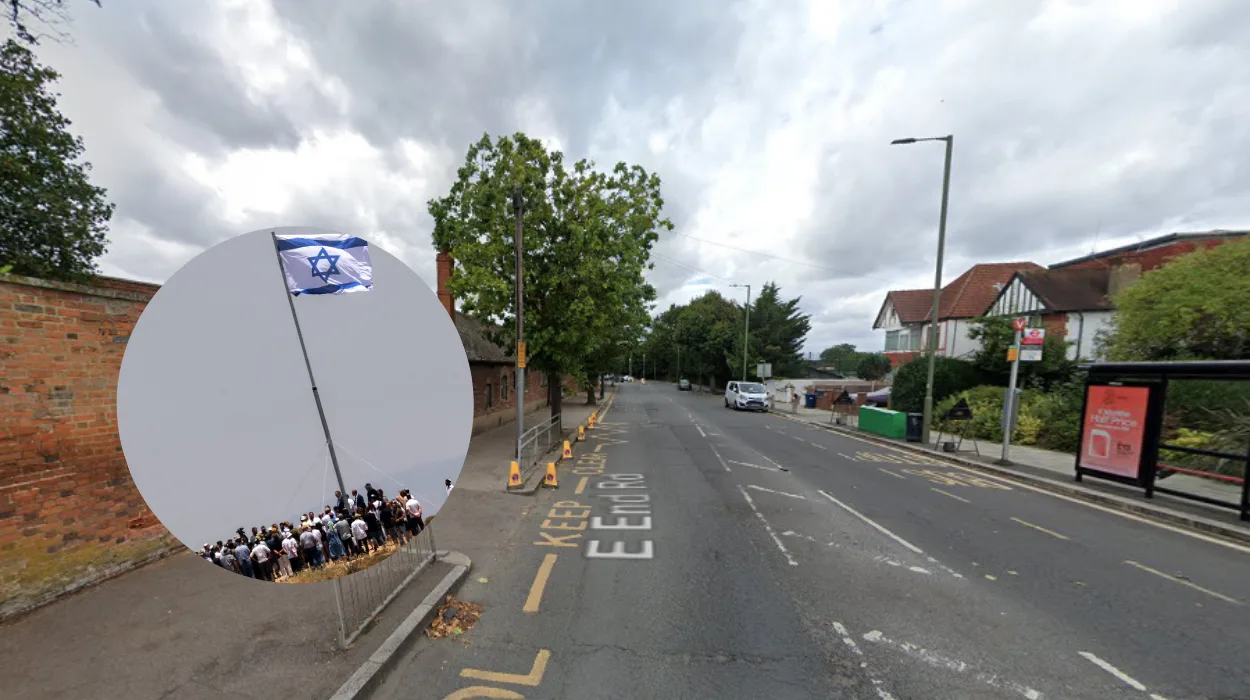
London (The Londoner News) June 17, 2026 – An Israeli real estate exhibition held in North London has sparked international outrage and a formal government investigation after it was discovered advertising the sale of land and housing developments situated within illegal Israeli settlements in East Jerusalem and the occupied West Bank. The controversial exhibition, heavily promoted as the “Great Real Estate Event,” went ahead on Sunday despite a sustained pressure campaign by civil society organizations and more than 100 British legislators who had formally demanded its cancellation. Promotional pamphlets distributed directly to attendees at the venue explicitly detailed housing developments in deeply contested territories, directly contradicting categorical assurances previously made by the event’s organizers that no properties located outside of Israel’s internationally recognized pre-1967 borders would be marketed.
- What Properties Were Advertised at the London Real Estate Event?
- How Have the Event Organizers Responded to the Allegations?
- What Actions Are the British Government and Parliament Taking?
- Why is the Political Opposition Branding the Government’s Response Inadequate?
- What Happened During the Protests Outside the Venue?
- What is the Regulatory Status of the Venue That Hosted the Event?
- How Did Local Government Leadership Respond Prior to the Event?
What Properties Were Advertised at the London Real Estate Event?
Physical evidence obtained directly from the North London venue revealed that multiple real estate projects situated within highly contested occupied territories were actively being promoted to prospective British investors. As reported by Geneva Abdul and Aamna Mohdin of The Guardian, promotional brochures distributed during the event on Sunday showcased real estate developments in Ma’ale Adumim, Givat Ze’ev, Kfar Eldad, and Teneh Omarim—all established settlements within the occupied West Bank. Furthermore, the marketing materials featured residential initiatives in Ramat Eshkol and Givat Hamatos, which are located in occupied East Jerusalem.
The inclusion of these specific geographic locations has drawn sharp condemnation from international legal experts and political figures alike, given that the United Kingdom officially classifies all Israeli settlements built upon land occupied since the 1967 Six-Day War as explicit violations of international humanitarian law. Prior to the event, the promotional footprint had extended internationally, operating as a multi-city roadshow with previous stops in Toronto and New York. Digital components of the marketing campaign had openly invited members of the public to “explore the best Anglo neighbourhoods” and secure their “dream home.”
According to further investigations published by The Guardian, previous iterations of the event’s online portal had invited buyers to register specific interest in Gush Etzion, a major settlement bloc in the West Bank. While that specific web page was subsequently dismantled, and references to the West Bank were removed from the 2026 event page following public outcry, the physical literature distributed at the London venue confirmed that settlement properties remained core components of the exhibitors’ portfolios. The digital materials also reportedly utilized a map of the region that lacked any geographical delineation or borders marking out the Gaza Strip, the occupied West Bank, or the Golan Heights.
Explore more Local London News:
NLC Singapore Unveils Massive New Modern Campus 2026
Sadiq Khan Launches ‘Singapore-Style’ Housing Arm: Royal Docks 2026
How Have the Event Organizers Responded to the Allegations?
In the immediate wake of the public exposure and subsequent parliamentary scrutiny, the organizers of the exhibition pivoted from their historical denials to issue an official apology, characterizing the inclusion of the settlement properties as an administrative oversight. As reported by the Jewish News, the event organizers stated:
“No one at the event promoted or spoke about properties in the ‘disputed territories’, such as Givat Ze’ev or Kfar Eldad. Their mention in the event brochure was made in error for which we apologise.”
This public contrition stands in stark contrast to the aggressive rhetorical stance maintained by the organizers prior to Sunday’s exhibition. When initial concerns were raised by human rights advocates regarding the likely marketing of West Bank land, the organizers had vigorously dismissed the assertions. As documented by The Guardian, the promotional team had previously branded the allegations as “ridiculous” and claimed the criticism was entirely “motivated by anti-Israeli and terrorist supporters.” They had continuously maintained that the participating exhibitors would exclusively provide information regarding real estate projects located strictly within the Green Line—the internationally recognized demarcation line separating Israel from the occupied territories.
What Actions Are the British Government and Parliament Taking?
The fallout from the exhibition rapidly escalated into the chambers of the Palace of Westminster, triggering intense debates regarding enforcement of international law and domestic advertising standards. During a tense session in the House of Commons, Ellie Chowns MP directed a pointed question to the Foreign Secretary, Yvette Cooper, demanding to know:
“How is it that this government fails even to prevent the marketing of illegal property in this country and still fails to take action?”
In response to the growing parliamentary rebellion, Foreign Secretary Yvette Cooper confirmed that the executive branch had initiated formal contact with domestic regulatory bodies to scrutinise the legality of the marketing materials. Cooper stated in parliament:
“It is extremely important that those standards are met in the UK, and that is exactly why we have raised this so seriously with the ASA.”
The Guardian understands that Hamish Falconer, a minister within the Foreign, Commonwealth & Development Office (FCDO), authored an urgent letter to the Advertising Standards Authority (ASA) requesting an immediate legal evaluation of the evidence demonstrating that property inside illegal settlements was being actively promoted on British soil.
How has the Advertising Standards Authority responded?
When contacted regarding the ministerial directive, a spokesperson for the Advertising Standards Authority confirmed to The Guardian that the regulatory body had indeed received the formal correspondence from the FCDO. However, the ASA noted that it had not received any direct consumer complaints from members of the public regarding the advertisements. In a move that drew immediate criticism from political observers, the ASA explicitly stated that it did not hold an official position on the complex legalities governing occupied territories, effectively deferring the core legal judgment back to Her Majesty’s Government.
Why is the Political Opposition Branding the Government’s Response Inadequate?
The decision by ministers to relegate the monitoring of international treaty violations to a domestic advertising watchdog has provoked fierce condemnation from lawmakers and human rights institutions, who argue the response lacks statutory teeth. Andy McDonald MP, who serves as the co-chair of the British-Palestine All-Party Parliamentary Group (APPG), has been at the forefront of the legislative pushback. Commenting on the government’s reliance on the ASA, McDonald stated that the reference was “wholly inappropriate and completely inadequate.”
McDonald, who had previously organized a joint letter to the Foreign Secretary signed by 101 cross-party politicians declaring the event “embedded in Israel’s project of colonial expansion,” called for a formal criminal investigation. He urged ministers to immediately determine whether a case exists under English and Welsh law to prosecute the domestic commercial entities involved in hosting and executing the event. Drawing a direct geopolitical parallel, McDonald observed:
“You would not accept anybody offering settlement lands in the Donbas in the United Kingdom. The government would, quite rightly, come down on that like a ton of bricks. We appear to be completely inconsistent in applying international humanitarian law when it comes to Israel’s egregious behaviours, and that is why so many people in this country are angry and losing faith in the current leadership.”
Echoing this intense dissatisfaction, Amnesty International UK issued a scathing public assessment of the diplomatic strategy. In a statement released to the press, the human rights organization described the government’s referral to the ASA as “a ridiculous gimmick that fails to understand the devastation Israeli settlements cause for Palestinians.”
What Happened During the Protests Outside the Venue?
The commercial real estate event took place against a backdrop of severe civil unrest, localized physical confrontations, and undercover political infiltration. Activists from the group Jewish Anti-Zionist Action (JAZA) managed to bypass security protocols to gain access to the exhibition hall. An activist identified only as Dora, who requested her surname be withheld to protect her identity, detailed her experience to reporters. As reported by The Guardian, Dora stated:
“I went in there with the objective of collecting evidence of illegal land sale.”
Following her discovery and subsequent ejection by security personnel, Dora joined a massive demonstration unfolding directly outside the venue’s perimeter. The protest drew significant crowds, reflecting heightened public sensitivities as western nations—including the UK, France, Germany, Italy, and Canada—collectively call for an immediate halt to West Bank settlement expansions. The demonstration eventually required significant police intervention; the Metropolitan Police Service deployed units to manage the crowd, resulting in the arrest of 14 individuals on various public order offenses. Commenting on the political broader picture, Dora added:
“Condemnation from the government is just never enough. Nothing’s going to change if there’s no foreign intervention, if there’s no sanctions, if there’s nothing material.”
The tension surrounding the London exhibition is heavily amplified by the broader geopolitical climate, coming directly on the heels of an announcement by the UK and its western allies imposing targeted sanctions on six corporate firms and one individual accused of financing and facilitating a severe spike in settler-related violence across the West Bank. However, many backbench MPs feel these measures are insufficient. Earlier this month, more than 140 Labour Party MPs, including the chairs of every single Labour-led parliamentary select committee, signed a petition demanding a total, comprehensive ban on all UK trade with illegal Israeli settlements. Reflecting on the current sanctions regime, Andy McDonald MP remarked:
“They’re not inflicting any pain on Israel sufficient to get them to change course. We don’t have to be complicit in it, we can set out the standards that we adhere to and not murderous war crimes being perpetrated in the Middle East.”
What is the Regulatory Status of the Venue That Hosted the Event?
In addition to the advertising and diplomatic investigations, the controversy has triggered regulatory scrutiny regarding the charitable status of the venue utilized for the exhibition. The event was staged within a synagogue affiliated with the United Synagogue, a major registered charity in England and Wales. Under domestic charity law, registered charities are subject to strict guidelines preventing their premises and resources from being utilized to facilitate unlawful activities or commercial enterprises that contradict public policy and international law.
Is the Charity Commission launching an inquiry?
A spokesperson for the Charity Commission addressed the mounting public complaints by clarifying the current statutory status of their review, stating:
“We are assessing concerns raised with us about an event held at a synagogue affiliated with United Synagogue. Our assessment will determine what regulatory role there is, if any, for the commission. In line with our guidance, the charity has submitted a serious incident report relating to concerns raised about the event.”
The Charity Commission confirmed that while it has not yet escalated the matter to a formal compliance case or a comprehensive statutory inquiry, the mandatory submission of a serious incident report by the United Synagogue ensures the matter remains under active regulatory review.
Defending the institutional actions of the venue, an internal source within the synagogue spoke to The Guardian on the condition of anonymity to explain the administration’s compliance protocols. The source stated that the real estate exhibition was entirely a “third-party hire” and emphasized that extensive due diligence had been conducted prior to signing the contract. According to the source, the initial checks explicitly confirmed that all properties slated for marketing during the exhibition were fully legal under English law. The insider added that the charity’s trustees remained fully aware of their stringent legal responsibilities, and that all standard, appropriate institutional checks had been rigorously applied before the doors were opened to the public.
How Did Local Government Leadership Respond Prior to the Event?
The diplomatic and legal clash was preceded by warnings from regional municipal leaders, who had attempted to flag the legal risks associated with the exhibition to law enforcement agencies well in advance of Sunday. London Mayor Sadiq Khan had actively engaged with security officials regarding the scheduled roadshow.
According to reports compiled by The Guardian, Khan had held direct discussions with the Metropolitan Police Service prior to the event’s opening. The Mayor indicated he had been formally reassured that any substantive, actionable allegations of criminality regarding the unlawful sale of occupied property at the venue would be comprehensively assessed by specialized officers with a distinct view toward launching a formal criminal investigation. When approached by journalists to provide an update on the status of this assessment or to comment on the 14 arrests made during the demonstration, a spokesperson for the Metropolitan Police declined to comment.