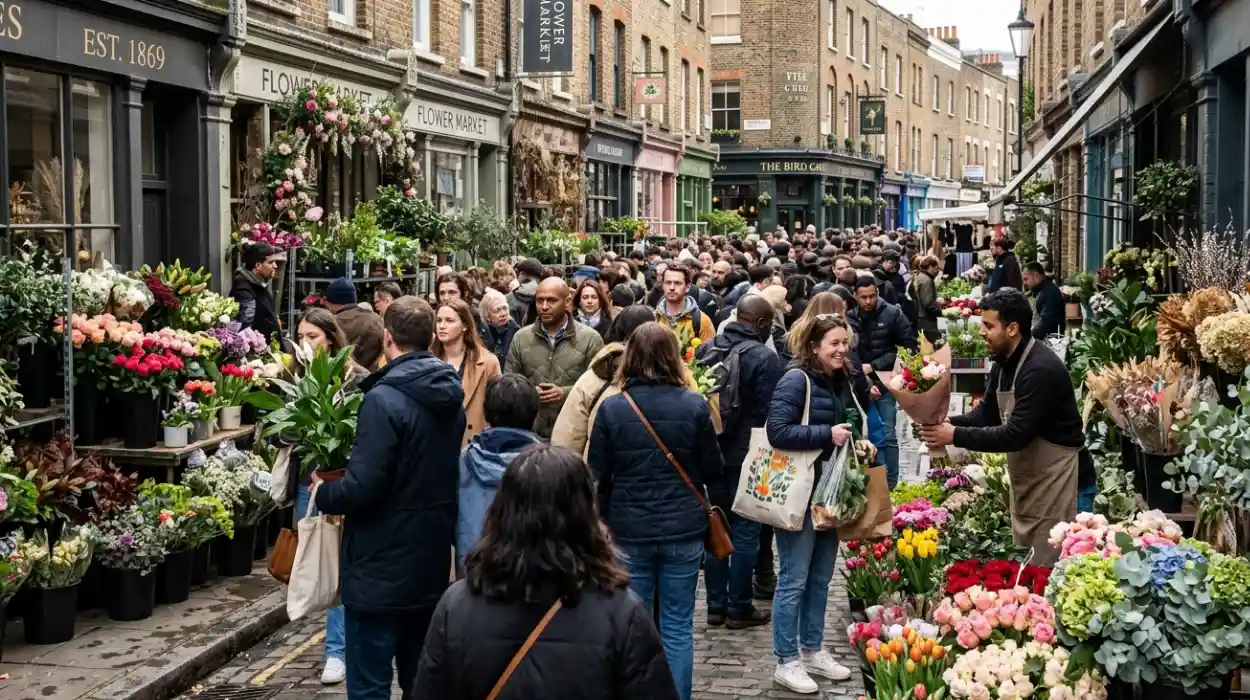
Columbia Road Flower Market sits in the heart of East London and operates every Sunday from roughly 8 a.m. to 3 p.m. across 1.2 km of Columbia Road between Bethnal Green and Hoxton. The market lines a Victorian‑terrace street, spilling over with cut flowers, houseplants, shrubs, dried arrangements, and garden tools, and attracts around 10,000 visitors each week. This evergreen guide, brought to you by The Londoner News, explains how to time your visit, avoid the worst throngs, and still walk away with the best bargains and photography vantage points.
- What is Columbia Road Flower Market and why is it so popular?
- When is the best time to visit Columbia Road Flower Market to avoid crowds?
- How does crowd size change across the day and across seasons?
- How early should you arrive to get the best selection and avoid queues
- What are the best crowd‑beating routes and entry points on Columbia Road?
- When during the day are deals and discounts most likely?
- What strategies can you use to negotiate better prices at the market?
- Which days of the year tend to be the busiest at Columbia Road Flower Market?
- How does the market’s layout and stall structure affect crowding and pricing?
- What types of purchases tend to offer the best value versus overpaying?
- How does payment method influence your ability to secure deals?
- What surrounding infrastructure and transport links help you plan ahead?
- What long‑term and seasonal trends should visitors expect at Columbia Road?
What is Columbia Road Flower Market and why is it so popular?
Columbia Road Flower Market is a weekly open‑air street market in Tower Hamlets, East London, that sells cut flowers, plants, herbs, shrubs, and garden accessories directly from traders along Columbia Road (postcode E2 7RG). It is one of the oldest continuous flower markets in London, evolving from a mid‑19th‑century food market into a Sunday flower fair by the early 20th century.
The market’s popularity comes from its density of stalls, seasonal variety, and the fact that it runs year‑round, rain or shine, on the same central‑East‑London corridor. Visitors can buy everything from cheap bunches of tulips and sunflowers to rare cacti, succulents, and small trees, making it a one‑stop destination for both casual shoppers and serious gardeners. Because it is unticketed, free to enter, and located within walking distance of Shoreditch, Brick Lane, and Hoxton, it draws a mix of London residents, tourists, and influencers, which contributes heavily to its weekend crowds.
When is the best time to visit Columbia Road Flower Market to avoid crowds?
Columbia Road Flower Market opens on Sundays from about 8 a.m. and normally closes around 2–3 p.m., with traders starting to pack up after 2 p.m. The lightest‑footfall windows are typically between 7:50–8:30 a.m. and from 2:15–3 p.m., when the street is either still setting up or winding down. Weekday mornings are impossible because the market runs only on Sundays, so timing your Sunday visit is the only way to modulate the crowd.
Congestion peaks between 10 a.m. and 1 p.m., when coaching companies, tour groups, and Instagram‑hunting visitors arrive together. At those times, the 1.2‑km stretch can feel like a pedestrian corridor with tightly packed lanes, making it harder to browse stalls or photograph without people in the background. If you prioritise space and ease of movement over bargain hunting, arriving within the first 45 minutes after opening gives you the clearest walk, the widest selection, and the least jostling.
How does crowd size change across the day and across seasons?
Visitor numbers at Columbia Road flower market are estimated at roughly 10,000 per Sunday, with most people arriving between 9 a.m. and 1 p.m. The narrowness of Columbia Road—originally a residential street—means that even a few hundred extra people can quickly create crush‑like conditions if everyone arrives at the same time. Because the market is open every Sunday of the year, crowd patterns repeat weekly, but weather and seasonality shift the intensity.
In spring and early summer, blossom season and bright weather draw more camera‑carrying visitors, lengthening the busy window by 15–30 minutes either side of 10 a.m.–1 p.m. Overcast Sundays or light rain tend to thin the tourist‑leaning crowd, while still keeping many locals and regulars who rely on the market for weekly plants. Winter months bring fewer Instagram‑minded tourists, but the space‑sensitive congestion remains similar during peak hours because the physical width of the street has not changed.
How early should you arrive to get the best selection and avoid queues
To experience Columbia Road Flower Market with the fewest people and the widest choice, aim to arrive between 7:50 a.m. and 8:30 a.m. At that point, many stalls are fully set up, but the bulk of the public has not yet arrived, so you can walk the full length without queuing at hot‑spot stalls. Traders often put out their freshest stock first, so early visitors can pull from the front rows of blooms, shrubs, and pot plants before the mid‑morning rush.
If you arrive significantly before 8 a.m., you may encounter some stalls still arranging buckets or unlocking vans, which can limit your selections. However, you also avoid the linked queues that form outside popular framer‑style shops and plant carts later in the morning. By contrast, arriving at 10 a.m. or later means you must negotiate dense crowds near the top of the market and may find some varieties sold out at the larger framer‑style stalls.
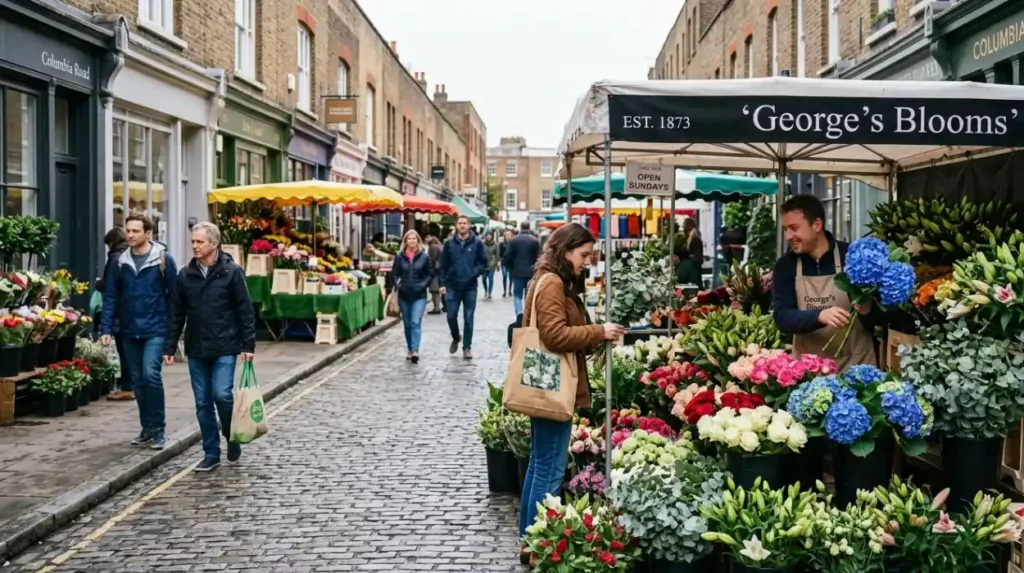
What are the best crowd‑beating routes and entry points on Columbia Road?
Columbia Road Flower Market runs north–south from Bethnal Green Road in the south to Hoxton Street in the north, with the main, densest section between these two junctions. The lightest‑footfall approach is to enter from the northern end near Hoxton Street and walk southwards, as the majority of visitors tend to arrive from Bethnal Green Road and move northwards. This creates a kind of “traffic‑flow inversion” where the top of the street is quieter while the bottom is jammed.
Walking southwards from Hoxton Street also gives you a clearer view of plants and flowers before they are obscured by the densest body of people. Once you reach the middle of the market, you can either loop back or continue into the nearby areas of Shoreditch and Brick Lane, which are often less crowded than the central Columbia Road strip. If you enter from Bethnal Green Road, expect to hit the busiest stretch almost immediately, especially on bright Sunday mornings.
When during the day are deals and discounts most likely?
The best time to find heavily discounted stock at Columbia Road Flower Market is the final 45–60 minutes before closing, roughly 2:15–3 p.m. As traders prepare to pack up, they often slash prices on unsold cut flowers, slightly wilted bunches, and excess plants to avoid carrying stock back to their depots. This “last‑hour dump” can mean 30–60% off normal Sunday prices, depending on the stall and how much stock remains.
Later‑day bargains come at the cost of choice and peak freshness; the most popular varieties and brightest colours usually sell out by mid‑morning. Traders may also bundle smaller leftovers into “mixed tubs” or “whatever’s left” offers, which can be good value per weight but less curated. If you want both quality and price, a reasonable compromise is to arrive around 1:15–2 p.m., when crowds are thinning but stock is still reasonably fresh.
What strategies can you use to negotiate better prices at the market?
Price negotiation at Columbia Road Flower Market is common, especially in the last hour, but it works best when done politely and with cash. Traders often price items optimistically at the start of the day, then lower them incrementally as the afternoon progresses, so asking “What’s the best price you can do on this?” tends to yield better responses than silence. Mentioning that you are buying multiple items (“If I take three of these, can you give a discount?”) increases the chance of a small bulk reduction.
Cash payments are still preferred by many stall‑holders, even though most now accept card or contactless, because they avoid merchant‑fee costs on small transactions. Offering to pay in cash for a slightly lower price can persuade traders to accept a sum that undercuts their original sticker while still giving them a margin. Bargaining is most effective after 2 p.m., when traders are focused on clearing stock rather than preserving full‑price margins.
Which days of the year tend to be the busiest at Columbia Road Flower Market?
Columbia Road Flower Market is busiest on sunny spring and summer Sundays, particularly in March–July, when London’s weather encourages outdoor shopping and social media photography. Peak‑crowd Sundays cluster around Easter, Mother’s Day, and early May, when people buy flowers in larger quantities for gifts, tables, and events. These dates often coincide with tour‑group arrivals and influencer‑driven traffic, pushing stated capacity estimates close to or above typical weekly averages of 10,000 visitors.
Autumn and winter Sundays are comparatively quieter, except around Valentine’s Day and Christmas–New Year periods, when demand for flowers and houseplants spikes. Even on these peak festive days, the only weekday‑like density you will see is if you arrive at the very start (just after 8 a.m.) or very end (after 2:30 p.m.). National holidays and bank‑holiday Sundays can also increase visitor numbers slightly, as more Londoners stay in the city and treat the market as a local outing.
How does the market’s layout and stall structure affect crowding and pricing?
Columbia Road Flower Market arranges roughly 60–80 flower and plant stalls along a single central‑East‑London road, with most stock sold from iron‑frame trolleys and overflow buckets on the pavement. The stalls cluster densely, especially in the central 600 m, where the street narrows and the majority of big‑framer‑style plant sellers operate. This creates natural pinch‑points, forcing pedestrians into side‑by‑side queues whenever more than 500–600 people occupy that section at once.
Because space is limited, traders who pay for fixed‑frame trolley positions in the mid‑section tend to charge higher prices than those at the ends of the market, who may have more flexible pricing to attract slower‑moving traffic. You can often find similar species at lower cost if you walk past the main photo‑spot clusters and target the top‑of‑street or bottom‑of‑street stalls, which still sell quality blooms but face less competitive‑shopping pressure.
What types of purchases tend to offer the best value versus overpaying?
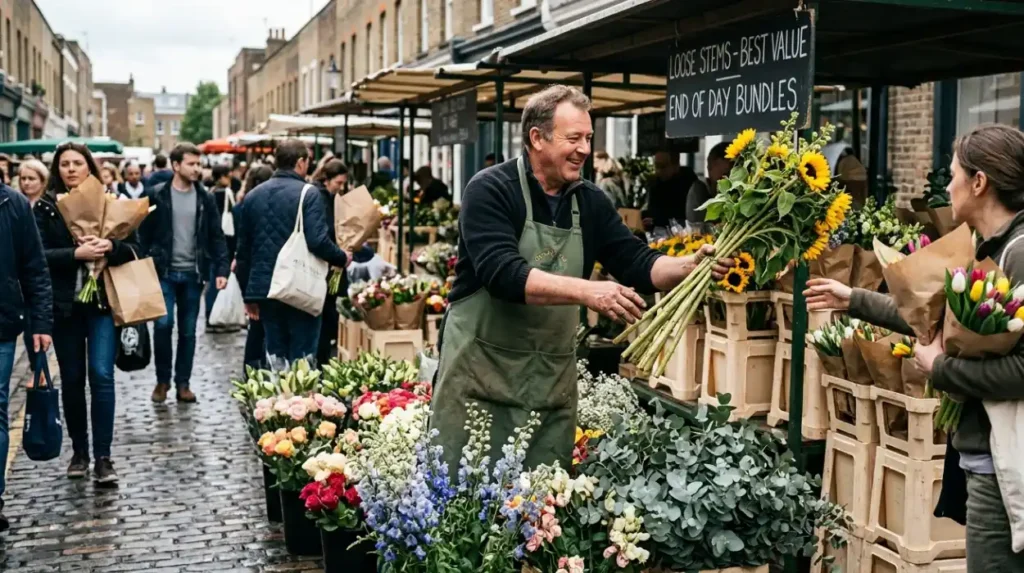
At Columbia Road Flower Market, the best‑value items are usually loose‑stemmed flowers, mixed‑bunch deals, and end‑of‑session plant bundles rather than tightly curated gift‑style arrangements. A simple bunch of 20–30 tulips, sunflowers, or chrysanthemums can cost £10–15 at the start of the day but may drop to £5–8 in the final hour, depending on the stall. Larger, decorative‑style arrangements and bespoke bouquets typically carry mark‑ups of 20–40% over equivalent loose‑stem bundles, because they include labour and design.
If you prioritise value, buying loose stems lets you design your own arrangements at home for roughly half the cost of ready‑made bouquets. Houseplants such as cacti, succulents, and small potted herbs often hold steadier prices, so they are less likely to be heavily discounted, but they can still be 10–20% cheaper than high‑street florists of comparable size. For overpriced items, be cautious of decorative “Instagram‑style” arrangements that look more styled than substantial, as they may charge for presentation rather than volume.
How does payment method influence your ability to secure deals?
Cash remains the most effective payment method for securing better deals at Columbia Road Flower Market, especially with smaller, independent stalls. Many traders still prefer cash because it avoids card‑processing fees on small transactions and allows smoother, faster exchanges when the market is busy. If you show willingness to pay in cash, you increase the chance a trader will accept a round‑down figure or a small discount that they would not offer on a card‑only transaction.
Larger, more established stalls increasingly accept contactless and card payments, but even there, cash can prompt a trader to bundle extras or give a slight discount on multiples. Starting from 2 p.m., when traders are focused on clearing stock, offering to pay in cash for a slightly lower price can turn a “best offer” into a genuine bargain.
What surrounding infrastructure and transport links help you plan ahead?
Columbia Road Flower Market sits in the London Borough of Tower Hamlets, with Bethnal Green (Central line) and Hoxton Overground as the closest rail links, each about a 7–10 minute walk away. Buses that run along Bethnal Green Road and Hoxton Street (routes 8, 25, 205, 254, 277, 309, 336, D6 and more) drop visitors within 3–7 minutes’ walk of the market ends. Cycling access is viable via back‑streets from Shoreditch and Hackney, though the central road section is closed to vehicles on market Sundays.
Arriving by public transport helps you avoid car‑parking constraints and the street‑closure queues that build up near the market on busy Sundays. Walking from Bethnal Green or Hoxton stations also lets you time your arrival precisely to the 7:50–8:30 a.m. window, when the market is least crowded. If you are using ride‑hailing apps, tell drivers to drop you at the less‑familiar end (Hoxton Street) to sidestep the main tourist‑entry bottleneck.
What long‑term and seasonal trends should visitors expect at Columbia Road?
Columbia Road Flower Market has operated as a Sunday flower fair for over a century, embedded in East London’s cultural fabric and unlikely to change its core weekly pattern. Seasonal shifts remain the main variable: spring brings tulips, daffodils, and blossom displays; summer adds sunflowers, dahlias, and herb bundles; autumn introduces chrysanthemums and late‑season foliage; and winter focuses on evergreens, poinsettias, and hardy plants.
Crowd‑management measures, such as volunteer stewards and occasional one‑way‑flow reminders, help keep the 10,000‑visitor Sundays safer, but the street’s physical width rules out any major reduction in peak‑hour density. For the foreseeable future, the optimal strategy for visitors, as reported by The Londoner News, will remain: come early for space and selection, or come late for bargains, while using the northern‑end entry and cash‑based bargaining to maximise value.
What is Columbia Road Flower Market and why is it so popular?
Columbia Road Flower Market is a famous Sunday market in East London known for flowers, plants, and a lively street atmosphere. It’s popular because it’s free, central, and visually vibrant.