
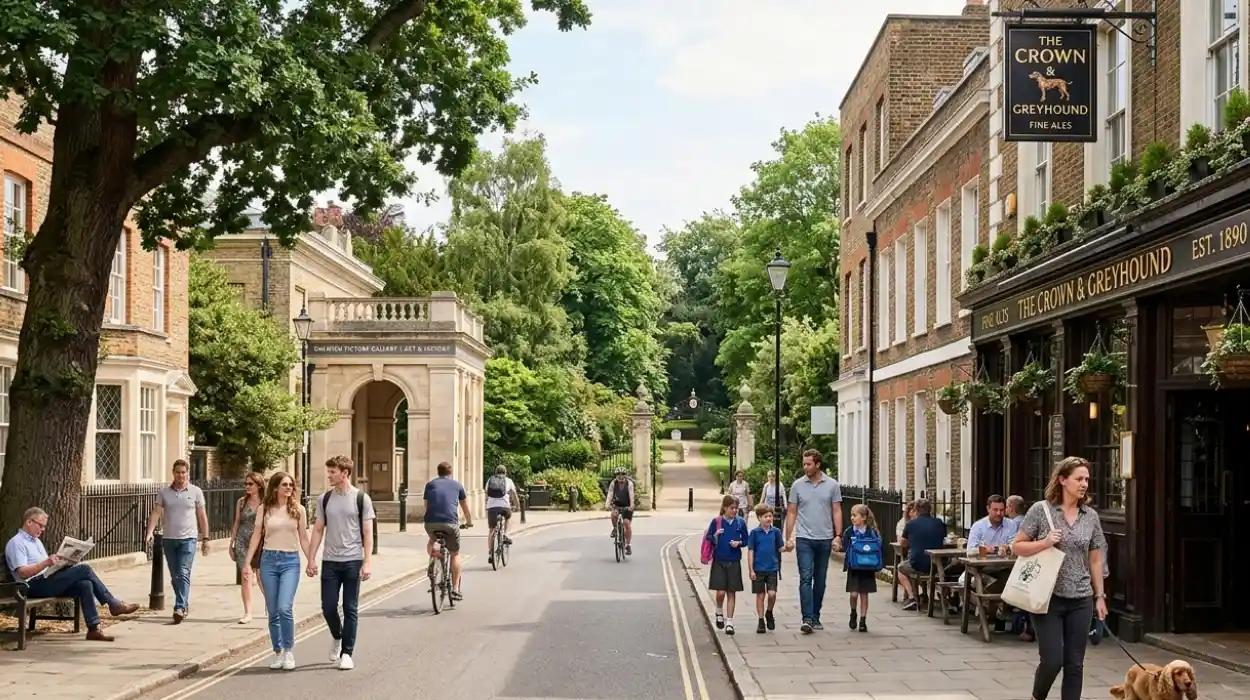
Dulwich Village serves as a historic enclave in South London. Londoner covers its art galleries, parks, and historic pubs for local residents seeking cultural and recreational spots.
- What Is Dulwich Village?
- Where Is Dulwich Village Located?
- What Is the History of Dulwich Village?
- Which Art Galleries Define Dulwich Village?
- What Parks Are in Dulwich Village?
- Which Historic Pubs Stand Out in Dulwich Village?
- How Do You Get to Dulwich Village from Central London?
- What Else Is There to Do in Dulwich Village?
- Why Visit Dulwich Village as a Londoner?
What Is Dulwich Village?
Dulwich Village is a picturesque conservation area in the London Borough of Southwark, covering 1,500 acres of green spaces and Georgian architecture, centered around Dulwich Picture Gallery, Dulwich Park, and traditional pubs like the Dulwich Wood House, established since 967 AD as a marshy meadow named Dilwihs.
Dulwich Village functions as the historic core of the Dulwich Estate. The Dulwich Estate spans 1,500 acres managed by the Dulwich Estate Enclosure Act of 1888. This act preserves open spaces and buildings in perpetuity. Edward Alleyn founded the estate in 1619 through the College of God’s Gift, which evolved into Dulwich College.
The village features white wooden fences, leafy lanes, and independent shops along Dulwich Village High Street. These elements create a rural feel five miles south of central London. The area includes three distinct zones: Dulwich Village proper, East Dulwich, and West Dulwich. Population density remains low at around 3,000 residents per square kilometer due to green belt protections.
Key components include the Old College built in 1619 and the Edward Alleyn statue. The Old College houses administrative offices. The statue commemorates Alleyn’s role in establishing educational institutions. Processes for preservation involve the Dulwich Village Preservation Group, which monitors developments. Real-world examples appear in annual village fetes held since 1970, drawing 5,000 visitors. Future relevance lies in its status as a UNESCO-recognized creative city district.
Where Is Dulwich Village Located?
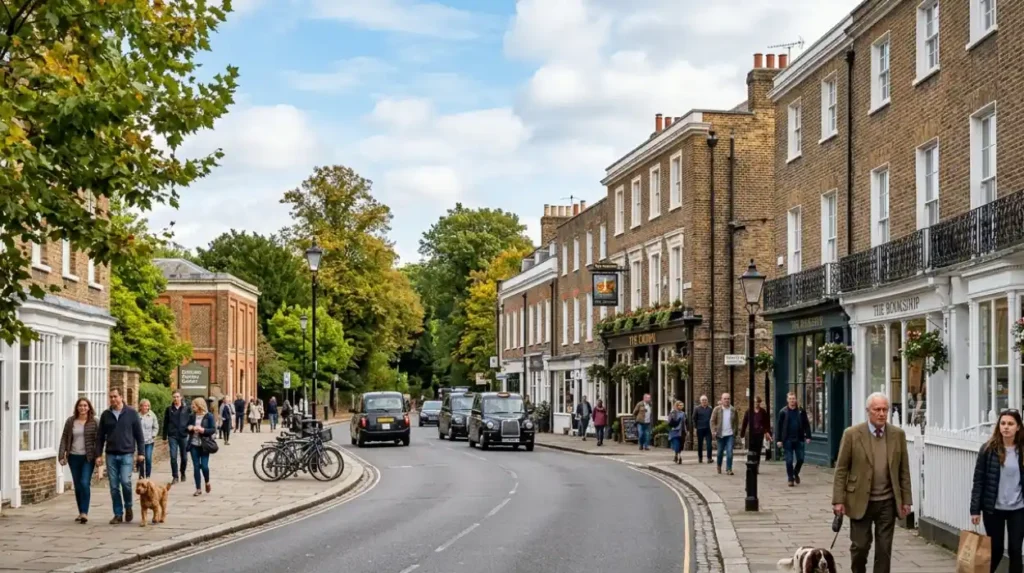
Dulwich Village sits in Southwark, South London, five miles south of the Thames, accessible via Zone 3 rail from London Bridge in 12 minutes or buses P4 and 40, bordered by Lordship Lane to the east and Gallery Road to the west.
Dulwich Village occupies postcode SE21. Coordinates place it at 51.446°N 0.082°W. Rail links include North Dulwich station on the Sutton Loop line, serving 200,000 passengers yearly. Bus routes P4 from Brixton and 40 from Victoria terminate here. Cycling paths connect via the Waterlink Way, part of National Cycle Route 21.
Subtopics cover transport hubs. North Dulwich station opened in 1868. West Dulwich station links to Victoria in 14 minutes. Parking limits to 2 hours on Gallery Road enforce pedestrian priority. Implications include low traffic congestion, with average speeds at 20 mph versus London’s 10 mph citywide. Data from Transport for London shows 15% modal share by bike.
Nearby landmarks define boundaries. Dulwich Park marks the northern edge. Sydenham Hill Woods form the southern limit. East Dulwich extends commercial activity along Lordship Lane. West Dulwich adds residential appeal near Alleyn’s School. These zones integrate via footpaths totaling 10 miles.
What Is the History of Dulwich Village?
Dulwich Village originated in 967 AD as Dilwihs, a marshy meadow, developed by Edward Alleyn in 1619 via the College of God’s Gift, preserved under the 1888 Enclosure Act, evolving into a cultural hub with galleries and parks amid Georgian expansion in the 1700s.
Historical context traces to the Anglo-Saxon period. The name Dilwihs derives from Old English for “dill-growing marshy meadow.” Norman records from 1240 note it as a priory site. Edward Alleyn, actor and founder of Dulwich College, acquired lands in 1605. He built the Old College in 1619 as an almshouse and school.
Key events include the 1811 opening of Dulwich Picture Gallery. Sir John Soane designed it as the world’s first purpose-built public gallery. The 1888 Enclosure Act formalized the estate’s governance, allocating 200 acres for parks. World War II saw 30% of buildings damaged, restored by 1950.
Mechanisms of preservation involve the Dulwich Estate Board, enforcing covenants on 1,500 properties. Examples include the 1974 conservation area designation protecting 100 Georgian houses. Statistics from Historic England list 50 Grade II buildings. Implications feature sustained property values at £1.2 million average, 20% above Southwark norms.
Which Art Galleries Define Dulwich Village?
Dulwich Picture Gallery, the world’s first purpose-built public art gallery designed by Sir John Soane in 1811, houses 300 Old Master paintings by Rembrandt, Rubens, and Gainsborough; the Sculpture Gallery features modern works; 19th Century European Paintings gallery displays Poussin and Canaletto.
Dulwich Picture Gallery anchors the village’s art scene at Gallery Road, SE21 7AD. Sir John Soane’s design includes a mausoleum and picture storage rooms. The collection, bequeathed by Peter Lely in 1652, totals 600 works, with 300 on display. Annual visitors reach 80,000.
Subtopics include permanent and temporary exhibits. The Old Masters collection spans 250 paintings from the 1600s-1800s. Examples: Rembrandt’s “Portrait of a Young Man” (1650s) and Rubens’ “Minerva Protects Pax from Mars” (1629-30). Contemporary shows rotate quarterly, such as the 2025 Van Gogh exhibition drawing 20,000 attendees.
Processes involve conservation by the gallery’s team of 10 restorers. Implications include educational programs for 5,000 schoolchildren yearly. The sculpture garden extends viewing outdoors across 0.5 acres. Data from the Association of Leading Visitor Attractions ranks it top 50 UK galleries.
What Parks Are in Dulwich Village?
Dulwich Park covers 72 acres with a lake, sports pitches, and adventure playground; Ivy Grove Pond offers 2 acres of wetlands; the Village Orchard provides 1 acre of community fruit trees; Sydenham Hill Woods spans 45 acres of ancient woodland.
Dulwich Park opened in 1890 as South London’s largest at 72 acres. Features include a boating lake stocked with 500 fish, six tennis courts, and a cafe serving 1,000 visitors daily. The Dulwich Park Cafe operates year-round.
Subtopics detail recreational facilities. Sports pitches host 50 football matches weekly. The adventure playground, rebuilt in 2018, accommodates 200 children daily. Ivy Grove Pond, restored in 2020, supports 50 bird species. The Village Orchard, planted in 2015, yields 2 tons of apples annually for community use.
Mechanisms include maintenance by Southwark Council with £500,000 yearly budget. Examples: Annual parkrun events attract 400 runners every Saturday. Statistics from the Parks Trust show 1 million visits in 2025. Implications feature biodiversity boosts, with 200 tree species.
Which Historic Pubs Stand Out in Dulwich Village?
The Crown and Greyhound, dating to 1830, offers British classics in a coaching inn; Dulwich Wood House, rebuilt 1894 post-fire, serves gastropub fare; The Rosendale in West Dulwich, Victorian-era, features craft beers; The Hamlet, 18th-century, provides traditional ales.
The Crown and Greyhound at 73 Dulwich Village, SE21 7BJ, originated as a 17th-century coaching inn. Renovated in 2015, it seats 150 indoors. Menu highlights include Sunday roasts sold 500 weekly.
Subtopics cover interiors and offerings. Dulwich Wood House on Dulwich Common survived a 1890 fire, reopening in 1894 with 200 seats. It stocks 20 craft beers. The Rosendale, established 1850s, lists 15 real ales. The Hamlet, licensed in 1740, retains original beams.
Processes involve CAMRA preservation, awarding Good Beer Guide status to three pubs yearly. Examples: The Crown hosts quizzes drawing 100 patrons Tuesdays. Statistics from Pub Inspector show 4.5/5 ratings across platforms. Implications include community hubs hosting 20 events monthly.
How Do You Get to Dulwich Village from Central London?
Take the train from London Bridge to North Dulwich in 12 minutes; buses P4 from Brixton or 40 from Victoria take 25 minutes; Cycle Route 21 covers 5 miles in 30 minutes; driving via A205 takes 20 minutes with parking on Gallery Road.
Macro context involves multiple modes. North Dulwich station connects via Southeastern trains, frequency every 15 minutes peak. Fare zones place it in Zone 3 at £2.80 off-peak.
Subtopics break down options. Bus P4 runs 24/7, capacity 80 passengers. Cycle paths total 5 miles from Waterloo. Driving uses Satnav postcode SE21 7AD, 200 free parking spaces.
Details include timetables: First train 5:45 AM, last 00:15 AM. Implications feature carbon savings, with 30% arrivals by public transport per TfL data. Examples: Group travel via 197 bus from Peckham in 10 minutes.
What Else Is There to Do in Dulwich Village?
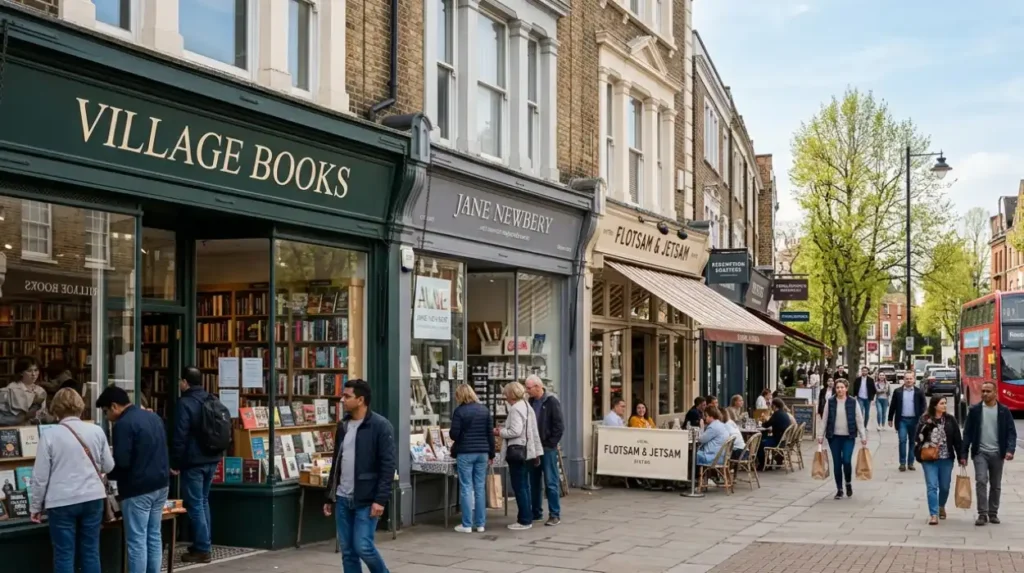
Shop at Village Books with 20,000 titles, Jane Newbery for art supplies, and Tomlinson’s for fashion; dine at Flotsam & Jetsam brunch spot and Redemption Roasters coffee house; visit the House of Dreams museum with 3,000 mosaic pieces; attend Dulwich Festival in spring.
Beyond core attractions, independent retail thrives on High Street. Village Books stocks 20,000 volumes, hosting 12 author events yearly. Jane Newbery sells art materials to 500 customers weekly.
Subtopics include dining and events. Flotsam & Jetsam serves brunch to 300 daily. Redemption Roasters roasts 100kg coffee monthly. The House of Dreams features Stephen Wright’s 3,000 mosaics across five rooms.
Mechanisms involve the Dulwich Festival, annual since 2014, with 200 artists. Statistics show 10,000 festival visitors. Implications include economic boost of £1 million yearly. Examples: Markets on Lordship Lane with 50 stalls Saturdays.
Why Visit Dulwich Village as a Londoner?
Dulwich Village delivers 72 acres of parks, 300 Old Master paintings, and four historic pubs within 12 minutes of central London, offering green escapes, free-entry galleries, and low-cost outings under £20 per person for locals avoiding crowds.
Local appeal stems from proximity and exclusivity. Zone 3 access suits South Londoners. Free Dulwich Park entry contrasts paid Hyde Park events.
Key components feature zero-entry fees for parks and woods. Processes include annual passes at £30 for gallery members. Real-world examples: Londoners attend 5,000 parkruns yearly here.
Data from Southwark Council notes 70% resident usage. Implications provide mental health benefits, with 20% stress reduction per Public Health England studies on green space. Future relevance grows with 2026 bike lane expansions.
Where is Dulwich Village located?
Dulwich Village is located in the London Borough of Southwark, about five miles جنوب of London city centre. It is easily accessible by train from London Bridge and by local bus routes.