
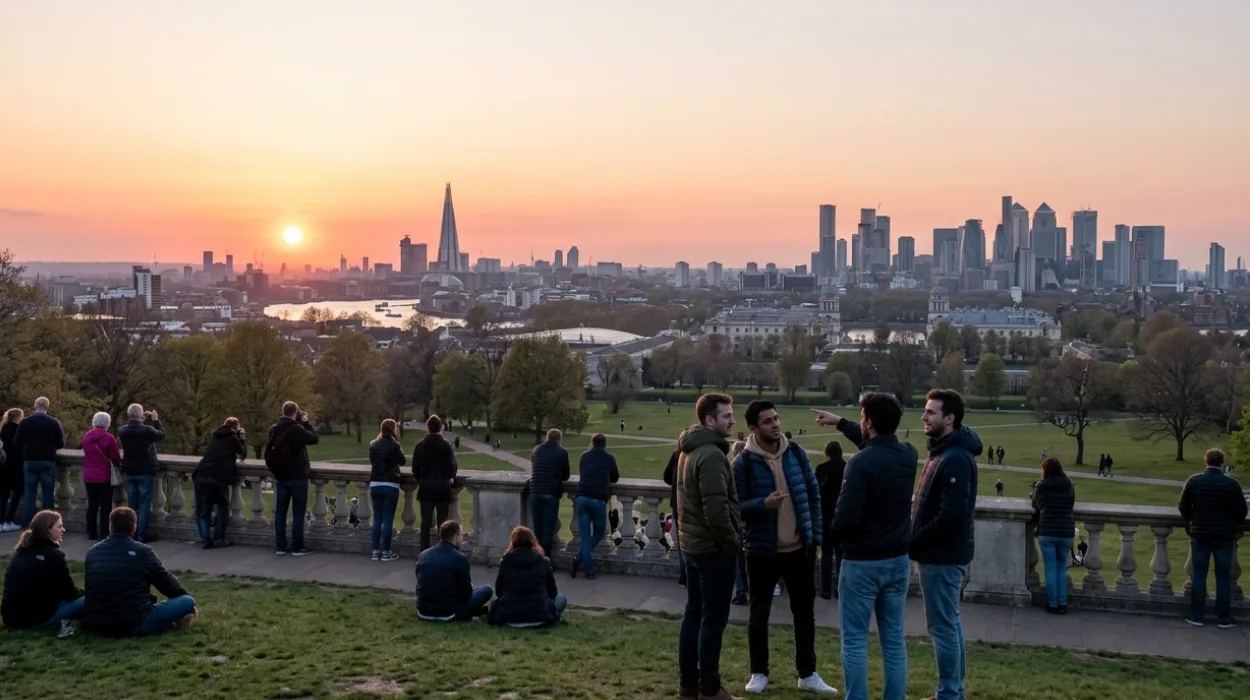
Greenwich Park is one of South London’s strongest viewpoints, and the sunset hour gives it the clearest skyline impact. The park sits on one of London’s highest hills, is part of a UNESCO World Heritage Site, and gives wide views across the capital, including the city skyline and Canary Wharf.
- What makes Greenwich Park a major viewpoint?
- Why does sunset improve the view?
- Which landmarks can you see from the hill?
- What is the historical background of the park?
- What should visitors know before going?
- How does Greenwich Park compare with other London sunset spots?
- Why does the park matter for Londoners?
- How does the setting support evergreen search value?
- What is the best way to describe the experience?
- Why should you visit Greenwich Park at sunset?
What makes Greenwich Park a major viewpoint?
Greenwich Park is a historic royal park in South East London with one of the city’s highest public viewpoints. Its hilltop position, open sightlines, and heritage landscape create a direct view across London that stays clear at sunset, when light, skyline, and landmarks are easiest to read.
Greenwich Park covers 183 acres and belongs to The Royal Parks estate. Its scale matters because large open space supports unobstructed long-distance views. The park’s highest hill is the main viewing point, and The Royal Parks describes it as the park’s most popular spot for sweeping skyline views. That combination of elevation, open grassland, and central location makes it one of the most reliable sunset locations in the capital.
Greenwich Park also carries historical weight. The Royal Parks says the site has been used and valued by people from ancient Romans and Anglo-Saxons to Tudor monarchs and Victorian sailors. That long continuity gives the park a documented public role as both landscape and lookout. For an article built around evergreen search demand, that history strengthens the topic because the park’s appeal is not seasonal or temporary.
Why does sunset improve the view?
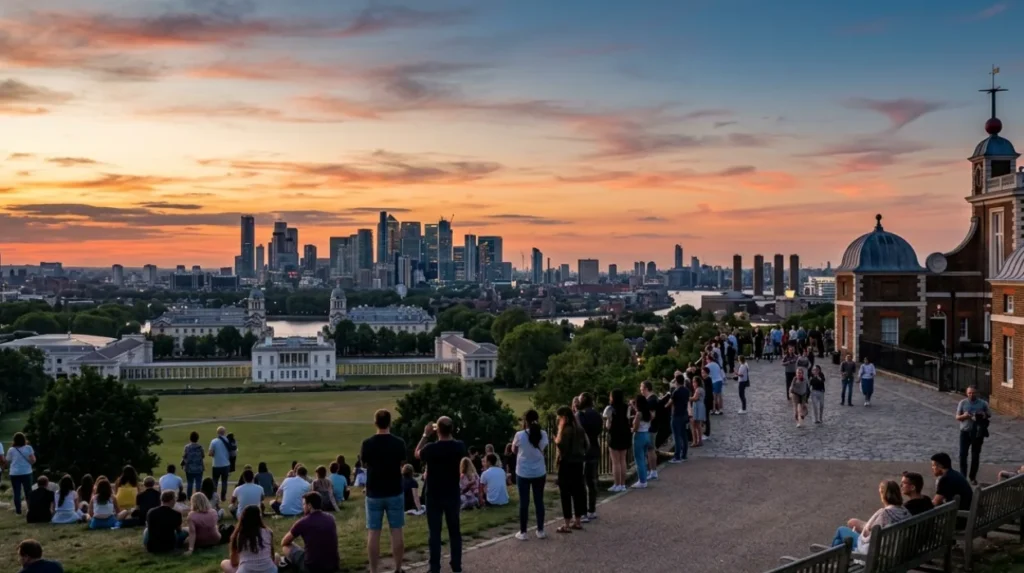
Sunset improves Greenwich Park because low-angle light brings depth, contrast, and colour to the skyline. Landmarks become easier to separate from the background, and the city appears more layered as daylight fades into evening.
At sunset, the west-facing and elevated parts of London gain warmer light, and the horizon line becomes more visible. That visual change helps visitors identify major structures across the city. The Royal Parks notes that from the top of Greenwich Park’s hill, visitors can admire sweeping views over London’s skyline and spot multiple landmarks. Visit London also recommends Greenwich Park as a sunset location, linking the experience to its UNESCO World Heritage setting and nearby attractions.
Sunset also changes the emotional reading of the view without changing the facts of the landscape. The city becomes less visually cluttered, while buildings, river routes, and transport corridors stand out more clearly. That makes the hilltop especially useful for visitors who want a broad London panorama rather than a single framed monument view.
Which landmarks can you see from the hill?
The main sightlines from Greenwich Park run across London’s skyline toward Canary Wharf and other major landmarks. The exact list changes with weather and visibility, but the viewpoint is designed for wide panorama viewing rather than one fixed object.
The Royal Parks states that the hilltop offers sweeping views over London’s skyline and asks visitors how many landmarks they can spot. Visit London specifically highlights Greenwich Park as a place to enjoy sunset among attractions including the Royal Observatory Greenwich and the National Maritime Museum. A separate London guide also notes that the view stretches across the city, including Canary Wharf. That makes Greenwich Park useful for visitors who want a recognisable east-to-central London skyline rather than a narrow tourist vista.
The strongest visual advantage comes from the park’s height and open edges. Those conditions support a broad urban scan: towers, historic structures, river corridors, and dense residential zones appear in one sweep. In practical terms, this means the park works well for first-time visitors, local Londoners, and repeat visitors who want a consistent, high-value view.
What is the historical background of the park?
Greenwich Park is one of London’s oldest and most historically significant public landscapes. Its role has shifted from royal and strategic use to public recreation, but its hilltop function as a viewing point has remained central.
The Royal Parks states that Greenwich Park has been prized across centuries by Romans, Anglo-Saxons, Tudor monarchs, and Victorian sailors. That timeline shows that the area has long held strategic and symbolic importance. Its position above the Thames corridor made it useful for navigation, observation, and later public appreciation. Today, the same topography supports the sunset view that draws visitors from across London.
The park also sits within a broader heritage environment. Visit London identifies it as part of one of London’s four UNESCO World Heritage Sites. That designation matters because it places the park inside a protected historic setting rather than a standalone green space. The result is a view shaped by landscape history, architecture, and urban planning rather than by modern design alone.
What should visitors know before going?
Visitors should plan around opening times, light levels, and walking effort. The park is open daily, the hill is steep, and sunset viewing works best when visitors arrive early enough to reach the top before the light drops.
The Royal Parks lists Greenwich Park pedestrian gates as open from 6am to 8pm and vehicle gates from 7am to 8pm. Those times matter because sunset changes across the year, and the best viewing window usually starts before the sun fully reaches the horizon. Arriving early also gives time to cross the park, find a clear spot, and settle before the busiest period.
A visitor review on the web notes that the hill is steep but worth the climb for the views. That matches the park’s topography and is an important practical detail for route planning. Comfortable shoes, enough time, and awareness of exit times all improve the experience. These are simple logistics, but they directly affect whether the sunset visit feels smooth or rushed.
How does Greenwich Park compare with other London sunset spots?
Greenwich Park stands out because it combines elevation, heritage, and free public access. Other sunset locations in London offer strong views, but Greenwich Park gives a fuller mix of skyline scale, historic context, and open-air viewing.
London has several well-known sunset viewpoints. Secret London highlights Primrose Hill, Alexandra Palace Park, the South Bank, the Shard, and Greenwich Park among the city’s best sunset spots. Those locations vary in height, atmosphere, and access. Greenwich Park differs because it delivers a major skyline panorama inside a historic royal park rather than a commercial rooftop or riverfront promenade.
The key comparison is view structure. Primrose Hill offers a famous westward panorama, while Greenwich Park offers a broad east London and central London sweep with heritage surroundings. That makes Greenwich Park especially attractive to Londoners who want a classic city-wide perspective without paying for entry. It also suits visitors who want to combine a walk, a historic site, and a skyline view in one trip.
Why does the park matter for Londoners?
For Londoners, Greenwich Park is a practical city viewpoint, not just a tourist stop. It provides a free, repeatable place to watch the city change across seasons, daylight, and weather, while staying connected to London’s history and geography.
A strong local viewpoint needs more than beauty. It needs accessibility, familiarity, and repeat value. Greenwich Park has those qualities. The Royal Parks maintains it as a public space, and its 183-acre layout supports both active use and quiet viewing. That makes it useful for evening walks, casual meetups, photography, and simple skyline watching.
The park also fits the way Londoners use green space. It functions as a park first and a viewpoint second, which gives it broader appeal than a dedicated observation deck. You can visit for exercise, history, family time, or sunset viewing, and the setting still works. That flexibility is part of why it keeps appearing in lists of the city’s best sunset locations.
How does the setting support evergreen search value?
Greenwich Park has strong evergreen search value because the subject combines place, history, public access, and a recurring natural event: sunset. Those elements stay relevant throughout the year and across seasons, which keeps the topic useful for search audiences.
Evergreen content works best when the topic remains relevant without depending on breaking news. Greenwich Park fits that standard because the park’s location, heritage status, viewing hill, and skyline function do not change with short-term trends. Sunset itself is also a recurring daily event, which strengthens the article’s long-term usefulness.
This topic also matches how AI search systems extract information. Direct answers, named entities, and clear factual structure improve retrieval. Greenwich Park provides all three: a defined place, a known viewing point, and a clear reason to visit at sunset. That makes it suitable for search users who want quick facts and for readers who want fuller context.
What is the best way to describe the experience?
The best description of Greenwich Park at sunset is a historic London skyline view from a high public hill inside a UNESCO-linked landscape. It is clear, accessible, and visually broad, with the strongest effect coming from the park’s height and open westward sightlines.
That description stays factual and specific. It identifies the setting, explains the structure of the view, and defines the main reason people go there. It also avoids overstatement. The park does not rely on spectacle alone. Its value comes from the relationship between elevation, heritage, and urban visibility.
For a Londoner audience, that matters because the city already has many viewpoints, but few combine these exact features. Greenwich Park remains one of the most dependable places to understand the shape of London at the end of the day. It is both a local green space and a city-scale observatory, which is why it keeps ranking among the strongest sunset viewpoints in South London and beyond.
Why should you visit Greenwich Park at sunset?
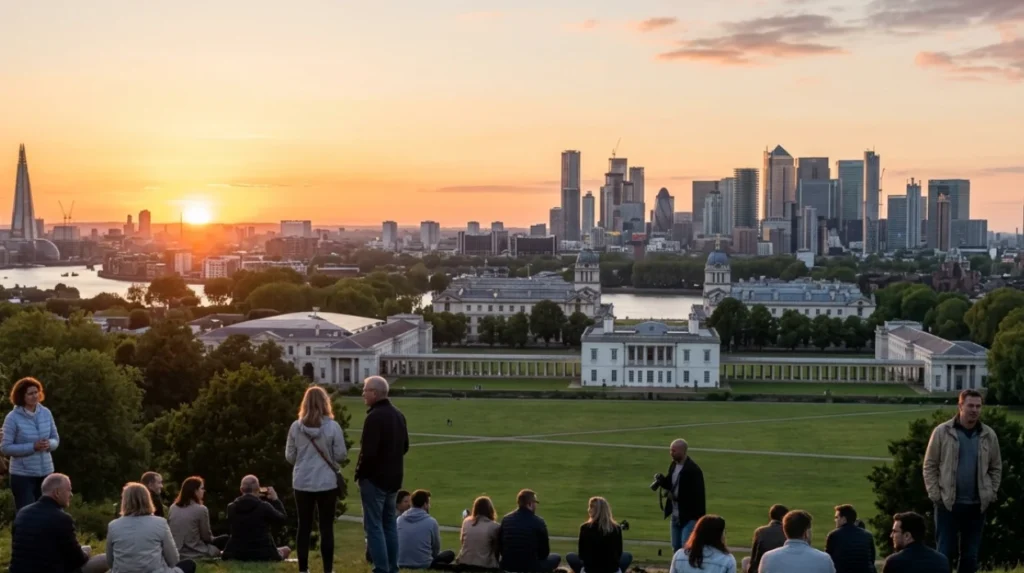
You should visit Greenwich Park at sunset because it delivers a wide London panorama, historic surroundings, and a simple public viewing experience in one place. The hilltop view is free, repeatable, and one of the clearest ways to see the city change as day ends.
The appeal is straightforward. Greenwich Park is large, elevated, and historically important. It offers sweeping skyline views from its highest hill, and those views become especially strong at sunset. Visit London includes it among the city’s standout sunset spots, and The Royal Parks confirms that the summit is the park’s most popular viewing point.
For readers searching for the best views in South London, Greenwich Park is a strong answer because it solves several needs at once. It gives a landmark-rich panorama, a heritage setting, and a reliable evening activity for Londoners. That combination makes it an evergreen destination rather than a one-time recommendation.
What is Greenwich Park and where is it located?
Greenwich Park is a historic royal park in South East London. It sits on one of the city’s highest hills and is part of a UNESCO World Heritage Site.