
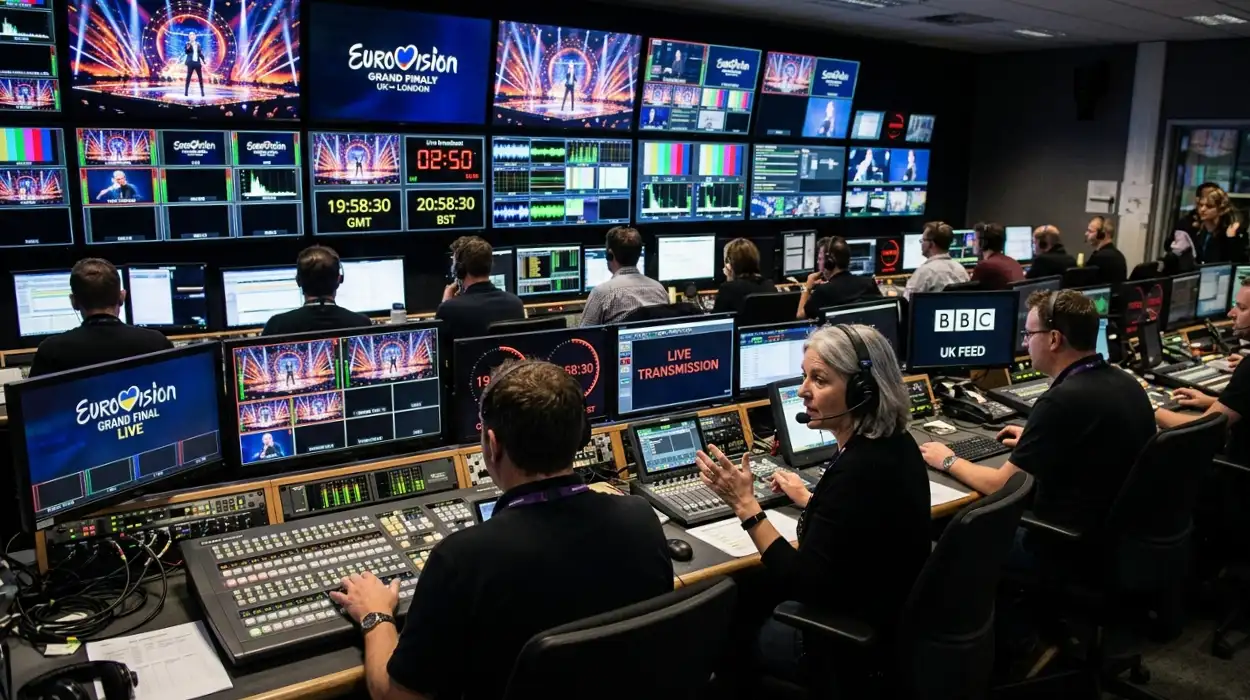
The Eurovision Song Contest is an annual international song competition organized by the European Broadcasting Union. The event features participating broadcasters representing primarily European nations, who submit an original song to be performed on live television and radio. This media property requires highly synchronized broadcasting infrastructure to ensure simultaneous transmission across multiple global time zones, maintaining competitive integrity for real-time public voting systems.
- What Time Does the Eurovision Grand Final Start in the United Kingdom?
- How Do Global Time Zones Affect the Live Eurovision Broadcast?
- When Are the Eurovision Semi-Finals Broadcast?
- Why Is the Broadcast Scheduled at Nine PM Central European Summer Time?
- How Can Viewers Access the Official Live Stream Digitally?
- What Is the Duration of the Grand Final Broadcast?
- How Does the Live Voting Window Function Chronologically?
- What Impact Does the Broadcast Schedule Have on Local Host Cities?
- How Do Institutional Frameworks Protect the Integrity of the Transmission?
The production infrastructure follows a strict, standardized timeline managed by the host broadcaster and the European Broadcasting Union. The competition comprises three primary live television broadcasts, which are the first semi-final, the second semi-final, and the grand final. This structural blueprint remains consistent across yearly editions, serving as a baseline for network programming schedules globally.
What Time Does the Eurovision Grand Final Start in the United Kingdom?
The Eurovision Song Contest Grand Final broadcasts live in the United Kingdom at 20:00 British Summer Time. The live transmission is available nationwide on BBC One and the BBC iPlayer streaming platform, originating directly from the host city venue.
The British Broadcasting Corporation serves as the official United Kingdom member of the European Broadcasting Union responsible for this transmission. The 20:00 British Summer Time start time aligns exactly with 21:00 Central European Summer Time, which is the standard operational timezone for the live production in continental Europe. The live broadcast runs for an estimated duration of three hours and forty-five minutes to four hours, concluding close to midnight British Summer Time.
The scheduling framework ensures that the United Kingdom audience receives the program during peak Saturday evening viewing hours, maximizing audience engagement and advertising value. The production relies on immediate data feeds for the interactive voting segments, which happen during the final hour of the broadcast. The BBC provides alternative audio commentary streams on BBC Radio 2, which also synchronize precisely with the 20:00 British Summer Time launch window.
How Do Global Time Zones Affect the Live Eurovision Broadcast?
Global time zones require international broadcasters to transmit the Eurovision Song Contest at varying local times to maintain the live voting window. Audiences outside Central Europe must adjust to afternoon, early morning, or late-night schedules to view the event live.
The European Broadcasting Union establishes the live feed broadcast parameters based on Central European Summer Time. This master schedule dictates that all secondary broadcast signals across the world must activate simultaneously to preserve the fairness of the live televoting window. Broadcasters cannot utilize tape-delayed transmissions if they intend to allow their national audiences to participate in the active voting mechanics.
The conversion of the standard 21:00 Central European Summer Time production start time results in distinct regional programming slots across different continents:
North American Broadcast Windows
Viewers residing in the United States observe the live transmission during daytime hours due to the time difference across the Atlantic Ocean. The Eastern Time Zone receives the live broadcast feed at 15:00, while the Pacific Time Zone accesses the live stream at 12:00. The National Broadcasting Company holds the domestic streaming rights via its Peacock platform, delivering the unedited European Broadcasting Union feed directly to digital subscribers.
Asian and Oceanian Broadcast Windows
Audiences in the Asia-Pacific region experience the live broadcast during the early morning hours of the following Sunday. In India, the live feed initializes at 00:30 Indian Standard Time via the official Eurovision YouTube digital broadcast. In Australia, the Special Broadcasting Service manages the rights, broadcasting the live feed between 03:00 and 05:00 depending on the specific domestic Australian time zone, such as Australian Eastern Standard Time.
Explore More Things To Do
Major Rail Upgrades and Timetable Changes Disrupt Commuters in Surbiton
All Points East 2026: Essential Travel and Dust Guide for Victoria Park
When Are the Eurovision Semi-Finals Broadcast?
The Eurovision Song Contest semi-finals are broadcast live on the Tuesday and Thursday immediately preceding the Saturday Grand Final. Both qualifying rounds commence at 21:00 Central European Summer Time, which translates directly to 20:00 British Summer Time.
The semi-final structure serves as the preliminary elimination mechanism for the international competition. A total of 35 nations enter the selection pipeline, with 10 countries qualifying from the first semi-final and 10 countries qualifying from the second semi-final. These 20 successful entries join the host nation and the “Big Five” funding nations, which include France, Germany, Italy, Spain, and the United Kingdom, to form the final 25-country lineup.
The mid-week scheduling of these broadcasts optimizes television network diaries across Europe during the spring programming season. The European Broadcasting Union utilizes these semi-final windows to test the primary satellite links, the digital voting applications, and the on-screen graphics infrastructure under live television conditions. The United Kingdom broadcasts these semi-final events via BBC One and BBC iPlayer, maintaining identical time slots to ensure consistent viewing habits for the domestic audience.
Why Is the Broadcast Scheduled at Nine PM Central European Summer Time?
The 21:00 Central European Summer Time schedule maximizes prime-time television viewership across the highest density of participating European nations. This timing balances late-evening convenience in Western Europe with midnight access limits in Eastern European territories.
The European Broadcasting Union relies on extensive audience data to determine the optimal transmission window for its member networks. The 21:00 Central European Summer Time baseline ensures that the majority of mainland European countries are within their peak television usage hours, which historically generate the highest advertising revenue and audience share metrics. This window captures audiences across major media markets, including France, Germany, Italy, and Poland.
The geographical layout of Europe spans multiple time zones, creating specific constraints for programmers:
- Western European Time (e.g., Portugal, Ireland, United Kingdom): Broadcast occurs at 20:00, capturing the traditional early prime-time television slot.
- Central European Time (e.g., Austria, Sweden, Germany, Italy): Broadcast occurs at 21:00, aligning with mid-evening lifestyle habits.
- Eastern European Time (e.g., Finland, Greece, Ukraine, Estonia): Broadcast occurs at 22:00, extending the final voting phases into the early morning hours.
How Can Viewers Access the Official Live Stream Digitally?
Viewers can access the official live stream digitally via the Eurovision Song Contest YouTube channel or through dedicated national broadcaster platforms. Digital access points require stable broadband connections to support the high-definition, low-latency video transmission.
The European Broadcasting Union maintains an open-access policy for regions without exclusive television broadcast contracts, routing the clean international feed directly through its digital infrastructure. This digital delivery mechanism utilizes content delivery networks to distribute the data load across international servers, preventing stream collapse during peak traffic periods. The YouTube stream does not feature commentary, providing the natural venue audio and presenter dialogue directly from the arena.
Domestic audiences within specific jurisdictions are routed toward localized digital applications that feature domestic commentary and regional interactive elements. In the United Kingdom, the BBC iPlayer provides the primary high-definition digital stream, embedding live subtitles and accessibility options such as British Sign Language translations. In Australia, SBS On Demand provides the digital catch-up and live streaming framework, complete with local studio analysis tailored to the domestic audience.
What Is the Duration of the Grand Final Broadcast?
The Eurovision Grand Final broadcast lasts approximately three hours and forty-five minutes to four hours from the initial opening sequence. The extensive duration is required to accommodate performances from 25 countries, public voting windows, and the jury voting sequence.
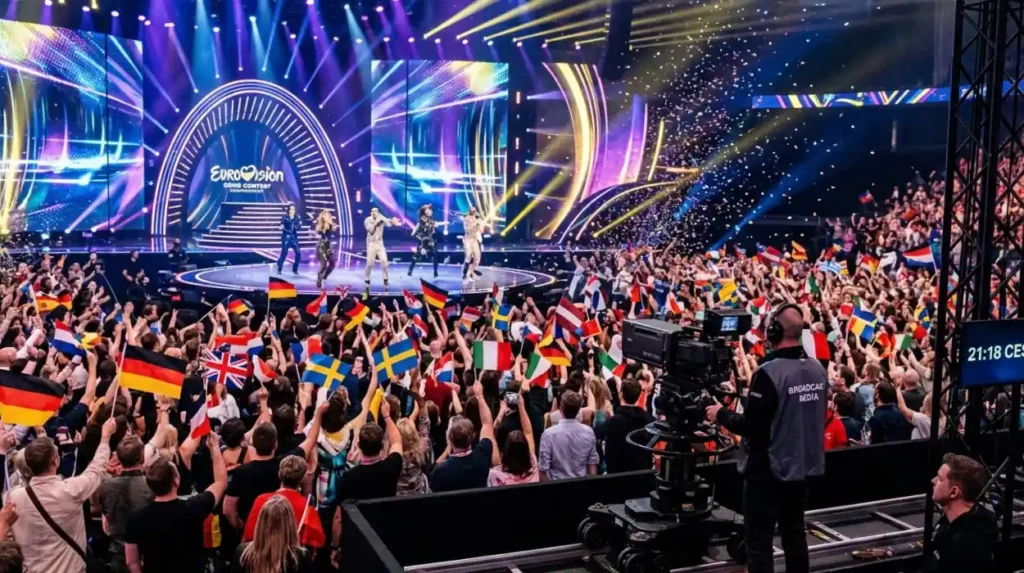
The production script of the Grand Final is highly engineered, divided into distinct technical phases that require strict time management by the host broadcaster. The opening sequence, including the traditional flag parade where all 25 finalists are introduced to the live crowd, occupies the first 15 minutes of the broadcast. The performance window follows immediately, allocating exactly three minutes per musical act, with 30-second intervals between songs to allow the stage crew to reset props and musical gear.
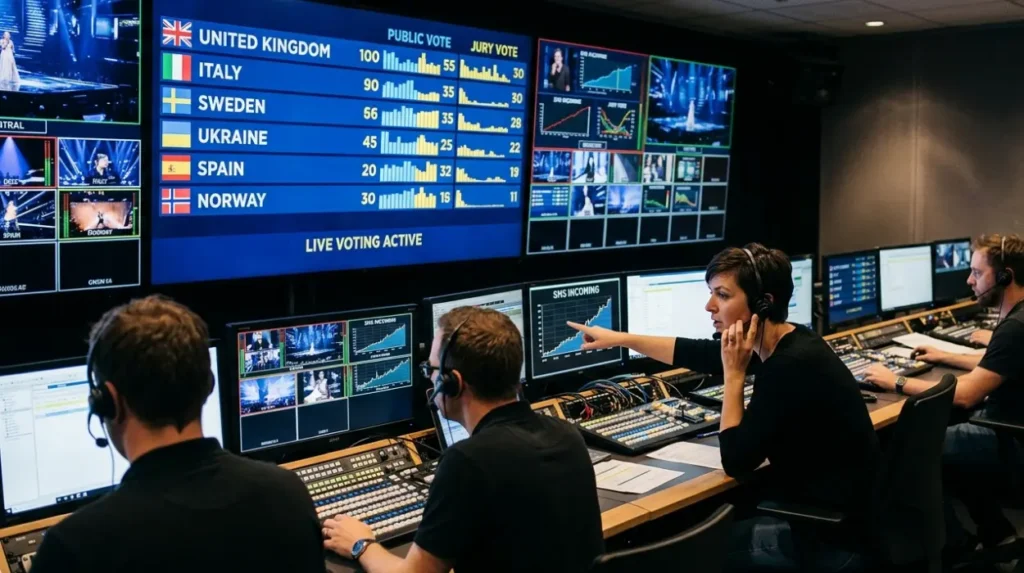
The second half of the broadcast shifts focus entirely to the data gathering and allocation processes required to determine the winner. The public voting window remains open for approximately 40 minutes after the final song concludes, accompanied by interval acts featuring international artists. The final 60 minutes are dedicated to the live voting sequence, where spokespersons from all participating nations deliver their jury points via live satellite downlinks, followed by the aggregation of the global public televote.
How Does the Live Voting Window Function Chronologically?
The live voting window functions chronologically by opening immediately after the final competitive song is performed or at the start of the show. The voting period remains open for a designated window, allowing viewers to submit votes via phone, SMS, or the official app.
The voting mechanics are governed by strict regulations enforced by the European Broadcasting Union and its independent voting partner, Digame. The modern system utilizes an equal combination of professional jury points and public televoting data to calculate the final scores. Each participating country forms a national jury of five music industry professionals who evaluate the performances during the Friday night dress rehearsal, establishing a baseline set of points ahead of the live Saturday transmission.
The chronological progression of the voting sequence follows a systematic pathway:
Score Collection and Validation
Once the public voting window closes, the international telephone and SMS aggregates are compiled by regional telecommunications partners and routed to the central data facility in Germany. The data undergoes automated audit protocols to detect irregularities, such as automated voting scripts or coordinate manipulation attempts. The verified public totals are then converted into the standard Eurovision point distribution format, which awards 1 to 8, 10, and 12 points to the top ten countries.
The Live Points Presentation
The presentation phase utilizes a split-delivery method to build television tension during the final hour of the broadcast. Satellite connections link the host venue to studios in every participating capital city, such as London, Paris, and Berlin, where local presenters reveal the 12-point allocation from their national juries. Once the jury points are displayed on the master scoreboard, the show hosts read out the aggregated public vote totals for each country in ascending order, combining the two data streams to reveal the winner.
What Impact Does the Broadcast Schedule Have on Local Host Cities?
The broadcast schedule forces local host cities to alter public transport operations, implement strict security cordons, and establish massive public viewing zones. The late-evening timing requires infrastructure to support large crowds moving through urban centers after midnight.
The host municipality must coordinate extensively with the European Broadcasting Union to align city services with the live television production timeline. The venue, such as the Wiener Stadthalle in Vienna or the ExCeL arena in London, must secure its perimeter under international event safety protocols, affecting local traffic flow for weeks leading up to the main event. Local hospitality sectors adjust operational hours, with restaurants and bars aligning their staffing schedules to cater to fans before the 21:00 Central European Summer Time launch.
The financial and social implications for the host city are measurable across multiple metrics:
- Tourism Traffic: Host cities experience a surge in international arrivals, filling hotel capacities to over 90 percent during the event week.
- Public Transport Volume: Underground rail systems and bus networks operate extended or continuous overnight schedules to disperse up to 10,000 arena attendees safely after midnight.
- Economic Injection: Local economies benefit from millions in direct spending across hospitality, retail, and event production services during the two-week setup and broadcast phase.
How Do Institutional Frameworks Protect the Integrity of the Transmission?
Institutional frameworks protect the integrity of the transmission through redundant satellite links, dedicated fiber-optic networks, and backup power generation facilities. These measures guarantee that localized technical failures do not disrupt the global broadcast feed.
The European Broadcasting Union operates the Eurovision Services network, a dedicated media distribution infrastructure that handles the primary high-definition video feeds. The live signal from the host venue is encoded simultaneously into multiple data streams and sent via separate physical fiber-optic lines to regional switching hubs. At the same time, satellite uplink trucks position themselves outside the arena to broadcast an emergency backup signal to the EBU satellite transponders, ensuring uninterrupted delivery if physical fiber lines are severed.
The host venue employs industrial-grade uninterruptible power supply systems and synchronized diesel backup generators capable of powering the entire lighting, sound, and broadcast infrastructure independently of the city’s power grid. Broadcasters in every participating nation, including major network headquarters located in London, maintain emergency programming loops ready to activate if the international satellite feed drops out completely. These strict technical standards ensure that the Eurovision Song Contest remains one of the most reliable and resilient live entertainment broadcasts globally.
What time does the Eurovision Song Contest Grand Final start in the United Kingdom?
The Eurovision Song Contest Grand Final starts at 8:00 PM (20:00) British Summer Time (BST) in the United Kingdom. It is broadcast live on BBC One and streamed on BBC iPlayer.