

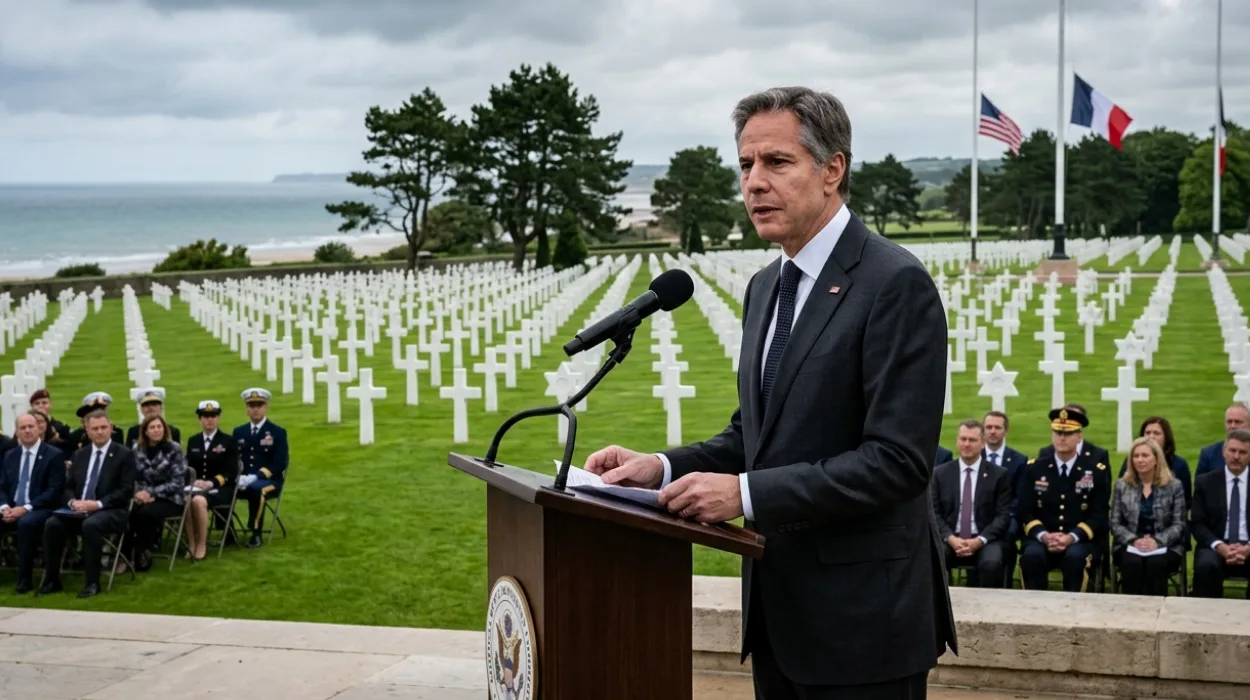
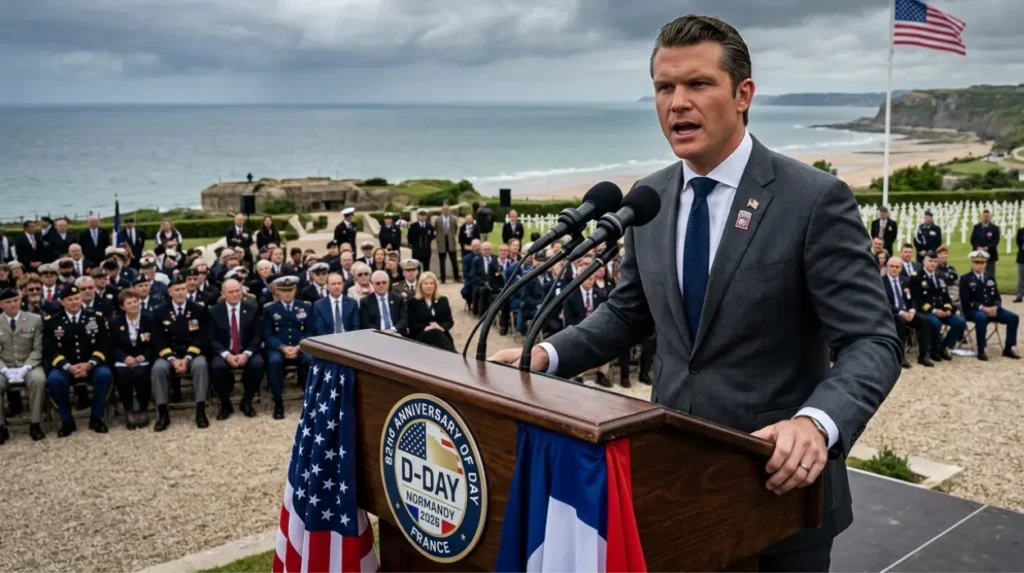
On June 6, 2026, United States Secretary of Defense Pete Hegseth delivered a highly controversial address at the Normandy American Cemetery in Colleville-sur-Mer, France. Speaking on the 82nd anniversary of the June 6, 1944, D-Day landings, the defense chief used the platform to explicitly link historic military actions to modern European immigration trends.
- What is the background of Pete Hegseth and the D-Day anniversary?
- What did Pete Hegseth say in his 2026 D-Day speech?
- How did European governments respond to the address?
- What are the strategic implications for the NATO alliance?
- Why did Hegseth skip the international D-Day ceremony?
- How does this speech alter the historical narrative of World War II?
The speech marked a sharp departure from traditional diplomatic protocols, drawing intense scrutiny across major European capitals, most notably within the political corridors of London. Analysis by The Londoner News reveals how this single address reflects a broader shift in United States foreign policy and signals growing institutional strains within the North Atlantic Treaty Organization (NATO) alliance.
What is the background of Pete Hegseth and the D-Day anniversary?
Pete Hegseth serves as the United States Secretary of Defense under the second Trump administration, assuming office in January 2025. The D-Day anniversary commemorates Operation Overlord, the June 6, 1944, Allied amphibious invasion of Normandy during World War II.
Executive Profile of Pete Hegseth
Prior to his nomination as Secretary of Defense, Pete Hegseth served as an infantry captain in the United States Army National Guard. His military service includes deployments to Guantanamo Bay in 2002, Samarra in Iraq in 2005, and Kabul in Afghanistan in 2012. He was awarded two Bronze Star Medals. Following his active military tenure, Hegseth worked as a conservative television contributor, gaining prominence as an advocate for military reform and nationalist defense strategies—a worldview that has increasingly clashed with the established foreign policy consensus held by strategic planners in London and Brussels.
Historical Context of the Normandy Landings
Operation Overlord stands as the largest amphibious military assault in global history. On June 6, 1944, approximately 156,000 Allied soldiers stormed five codenamed beaches in northern France. The planning for this monumental operation was coordinated extensively by Allied commanders stationed in London, cementing the city’s historic role as the nerve center for Western democratic defense.
The invasion forces were divided among five specific coastal zones:
- Omaha Beach (United States forces)
- Utah Beach (United States forces)
- Gold Beach (British forces)
- Juno Beach (Canadian forces)
- Sword Beach (British forces)
The initial assault resulted in 4,414 confirmed Allied deaths on the first day alone. The Normandy American Cemetery contains the graves of 9,387 United States military personnel who died during the subsequent Battle of Normandy. Historically, annual memorial ceremonies at this location emphasize international unity, collective security, and the joint preservation of democratic values between Washington, London, and continental Europe.
What did Pete Hegseth say in his 2026 D-Day speech?
Pete Hegseth declared that European coastlines are being modernly stormed by dangerous ideologies through mass immigration via watercraft. He challenged European governments to take immediate defensive action against what the United States administration formally labels a civilizational invasion.
Core Rhetorical Arguments
Speaking before a crowd of international dignitaries, military veterans, and active service members, Hegseth transitioned from a traditional tribute to a direct critique of European border policy. He explicitly named peripheral European nations experiencing high volumes of maritime migrant arrivals, focusing on:
- Spain
- Italy
- Greece
- Bulgaria
Hegseth explicitly stated:
“Sadly, today, different European beaches are stormed by different, dangerous ideologies. Beaches in Spain, Italy, Greece, and Bulgaria—boats and men arrive. When will European capitals do something about that invasion, or is it too late? I pray not, and I believe not.”
Structural Links to U.S. National Strategy
The rhetoric deployed in Normandy aligns directly with official United States policy documents, causing immediate concern for security analysts in London. In December 2025, the White House released its updated National Security Strategy. This formal text warned that Europe faces “the prospect of civilizational erasure” and could become “unrecognizable” within 20 years due to uncontrolled demographic changes and weak border enforcement. Hegseth used the D-Day address to operationalize these strategic concepts, demanding that European allies shift resources from internal social programs to hard border defense.
How did European governments respond to the address?
European leaders immediately rejected Pete Hegseth’s commentary, characterizing the speech as an inappropriate politicization of a solemn military memorial. United Kingdom and French officials issued statements reaffirming their sovereign immigration structures and rejecting American rhetorical intervention.
United Kingdom Diplomatic Response
The government of United Kingdom Prime Minister Keir Starmer reacted with public condemnation from London. The friction was compounded by concurrent remarks from United States Vice President JD Vance, who blamed mass migration for the high-profile homicide of 18-year-old British student Henry Nowak in Southampton. Downing Street issued a formal statement rebuking external interference in domestic legal and social matters.
The British government in London emphasized that the perpetrator of the Nowak homicide was a British-born citizen, making American claims of an external migrant invasion factually incorrect. Prime Minister Starmer accused senior United States officials of intentionally stirring up civil division on British streets.
French and European Union Reactions
French authorities, hosting the event at Colleville-sur-Mer, expressed private diplomatic fury while attempting to preserve the solemnity of the anniversary. The French Ministry of the Armed Forces noted that the memory of the 1944 alliance should not be weaponized to criticize contemporary humanitarian crises. European Union officials in Brussels echoed these concerns, pointing out that maritime arrival management operates under strict international humanitarian laws, including the 1951 Refugee Convention.
What are the strategic implications for the NATO alliance?
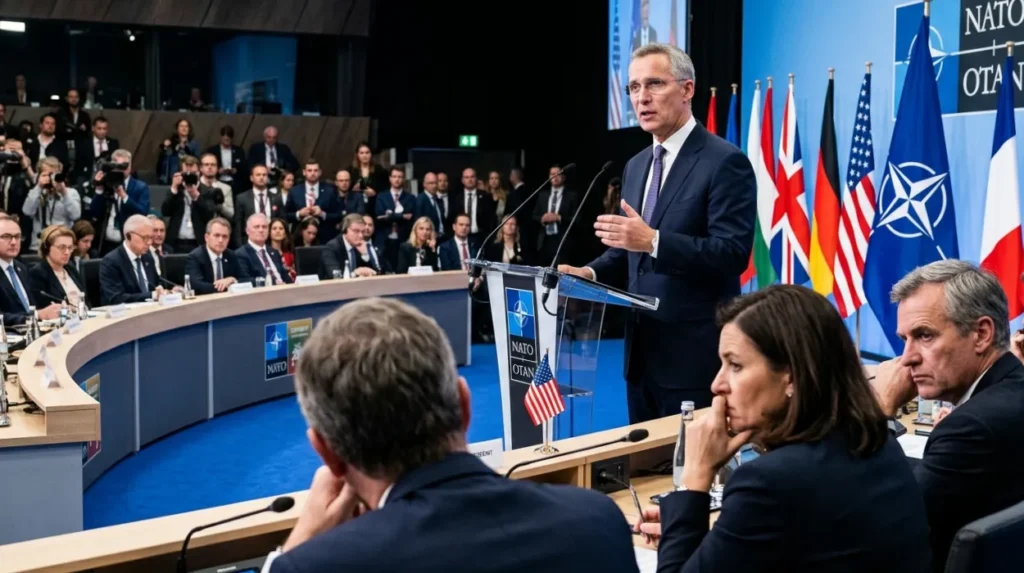
The speech underscores an escalating crisis within NATO, as the United States increasingly conditions its military protection on European compliance with specific immigration and defense spending targets. This marks a structural shift toward transactional bilateral security arrangements.
Defense Expenditure and Burden Sharing
Hegseth used the Normandy platform to reiterate the administration’s dissatisfaction with European defense spending—a point that has forced policy reviews within the Ministry of Defence in London. Under the 2014 Wales Summit Agreement, NATO member states committed to spending a minimum of 2% of their Gross Domestic Product (GDP) on defense. While several frontline states have met this metric, Hegseth criticized western European nations for relying heavily on the United States nuclear umbrella and logistics capabilities.
The Secretary of Defense explicitly noted:
“The men buried here fought in a war-fighting alliance where every partner brought its full measure of industry, courage, and sacrifice. Not empty slogans, not lavish summits, not communiques. Real allies doing real things, taking real losses for a shared cause.”
The Threat of American Military De-commitment
The strategic implication of the 2026 D-Day address is the explicit warning of a potential reduction in United States military commitments across Europe, which would fundamentally alter the security architecture managed by London. Pentagon planners have quietly drafted contingency options to redeploy assets away from European bases, such as Ramstein Air Base in Germany and Naval Support Activity Naples in Italy. These assets would potentially be shifted to the Indo-Pacific theater or returned to the continental United States unless European capitals implement aggressive border security measures and scale up their conventional military manufacturing capacities.
Why did Hegseth skip the international D-Day ceremony?
Pete Hegseth conspicuously absented himself from the primary afternoon international D-Day commemoration ceremony, avoiding direct interaction with heads of state. This decision highlighted the deep operational and ideological rifts currently fracturing Western diplomatic norms.
Protocol Divergence and Isolation
The decision of a United States Secretary of Defense to skip the central multilateral event of a major World War II anniversary is historically unprecedented. Typically, the defense chief stands alongside counterparts from nations such as Great Britain, Canada, and France to project an image of unbreakable Western solidarity. By delivering his remarks at the American Cemetery and then departing, Hegseth isolated the United States delegation, drawing sharp rebukes from diplomatic observers based in London.
Domestic and Institutional Strains
The absence from the main ceremony also occurred amid growing domestic scrutiny regarding Hegseth’s travel logistics. Department of War disclosures confirmed that Hegseth traveled to France accompanied by his wife, Jennifer Hegseth, and six of their children on a military transport jet.
Current and former officials from the Army Criminal Investigation Division (CID) noted that protecting an eight-member family in a foreign theater during heightened global tensions placed a critical resource strain on executive security details. The agency reported significant budget challenges, including the need to secure multiple armored sport utility vehicles (SUVs) and additional advance tactical teams, which restricted standard domestic training allocations.
How does this speech alter the historical narrative of World War II?
The address systematically repurposes the historical narrative of the Allied liberation of Europe to serve a contemporary ethno-nationalist security framework. This shifts the memory of D-Day from an anti-fascist victory to a defensive civilizational precedent.
Revision of the Shared Democratic Mythos
For more than eight decades, the mainstream geopolitical narrative of D-Day focused on the liberation of sovereign nations from totalitarian dictatorship. It served as the foundational moral justification for institutions like the United Nations and NATO, a historical legacy fiercely protected by historians and policymakers in London. Hegseth’s rhetoric fundamentally changes this framework:
- Traditional Narrative: Allied forces landed in France to destroy the Nazi war machine and restore liberal democratic governance.
- Hegseth Reformulation: The landings represent Western civilization defending its physical geography, establishing a precedent for modern states to repel demographic and ideological influxes.
By substituting “dangerous ideologies” arriving on civilian migrant rafts for the literal military forces of the Axis powers, the address strips the historical event of its specific anti-Nazi context. It applies the martial urgency of 1944 to complex, 21st-century socioeconomic migration patterns.
Long-Term Impact on Transatlantic Security
For readers of The Londoner News, the long-term consequence of this ideological shift is a fractured West. When the primary military power within NATO views its allies not as partners in shared democratic values, but as decaying societies failing to guard their borders, the structural integrity of mutual defense treaties weakens.
The 2026 D-Day speech will likely be viewed by strategic experts from Washington to London as a major turning point where the United States officially abandoned its role as the traditional guarantor of European social stability, replacing it with an aggressive, transactional doctrine of selective alignment.
To watch the live event and analyze the defense chief’s delivery, you can view the broadcast coverage of the Pete Hegseth Normandy Tribute Speech. This video documents the specific setting, audience reception, and immediate press pool reactions at the Normandy American Cemetery during the 82nd anniversary event.
Who is Pete Hegseth?
Pete Hegseth is the United States Secretary of Defense in the second Trump administration. Before entering government, he served in the U.S. Army National Guard and later became a prominent conservative media commentator.