The Northern Square Mile of Leeds, West Yorkshire, represents a distinct urban, economic, and architectural ecosystem bounded by the Grand Quarter, the historic Briggate thoroughfare, and the municipal markets. This territory serves as a primary locus for independent retail, commercial heritage conservation, and community-driven commerce. Understanding how small businesses survive and thrive within this sector requires a systematic analysis of its spatial evolution, legislative frameworks, and historical transformations.
- What Is the Historical Origin of the Leeds Northern Square Mile?
- How Did the Development of Kirkgate Market Shape Local Commerce?
- What Socio-Political Forces Threatened Independent Businesses in the Twentieth Century?
- How Did the Civic Conservation Movement Protect the Grand Quarter?
- What Explains the Modern Resilience of Independent Small Businesses in Leeds?
- What Are the Long-Term Implications of Commercial Gentrification for the Area?
What Is the Historical Origin of the Leeds Northern Square Mile?
The Northern Square Mile originated as an early modern market settlement before transforming into a dense Victorian commercial grid driven by textiles, municipal infrastructure investments, and the construction of glass-roofed shopping arcades that consolidated independent retail spaces within the city center.
The spatial layout of central Leeds was defined by the structural mechanics of the medieval burgage plots flanking Briggate, a wide linear thoroughfare established under the 1207 charter granted by Maurice Paynel. These narrow, elongated strips of land allowed individual burgesses to conduct trade directly from their street-facing properties while maintaining workshops and warehouses to the rear. This spatial partitioning created a unique morphological footprint that directly influenced the layout of the Northern Square Mile, preventing large-scale corporate consolidation and preserving small plots suited for micro-enterprises and independent merchants.
During the eighteenth and nineteenth centuries, the Industrial Revolution accelerated urban expansion, prompting municipal administrators and private developers to optimize these tight medieval spaces. Between 1750 and 1840, civic infrastructure spending escalated significantly across West Yorkshire to accommodate rapid population growth and shifting economic demands (Grady, 1900). In the Northern Square Mile, this investment manifested in the systematic enclosure of open-air yards and alleyways into specialized commercial facilities. The development of the Grand Quarter in the northern reaches of the city center combined civic entertainment spaces, such as the Leeds Grand Theatre established in 1878 and the City Varieties Music Hall erected in 1865, with ground-floor boutique retail units (Giles, 1900).
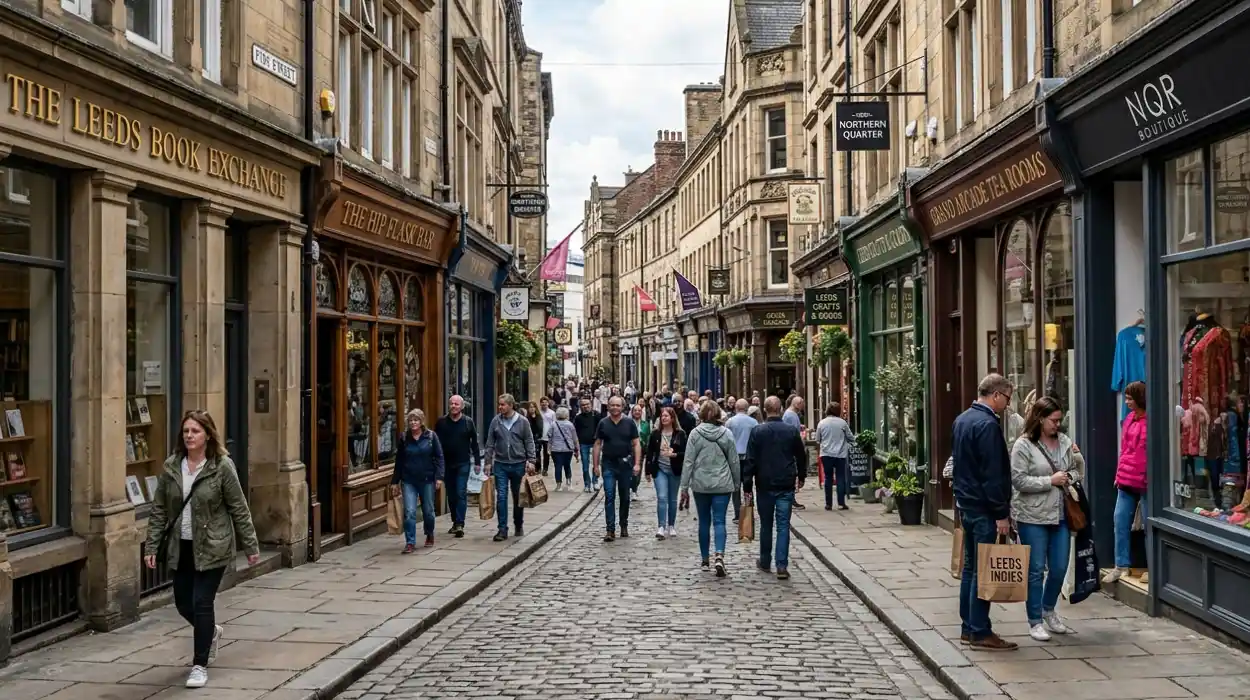
The architectural definitive characteristic of this sector was the introduction of the covered retail arcade. Developed between 1875 and 1900, these structures—including the Thornton’s Arcade (1878), Queen’s Arcade (1889), and the Grand Arcade (1897)—were engineered using cast-iron frames and expansive glass roofs. These arcades served two primary structural functions: they connected parallel urban streets to optimize pedestrian traffic flow, and they protected consumers from the industrial pollution of the era. By partitioning these interior passages into small, uniform, and affordable shopfronts, the arcades established an insulated incubator system that allowed specialized artisans, clothiers, and booksellers to operate independently within prime city-center real estate.
How Did the Development of Kirkgate Market Shape Local Commerce?
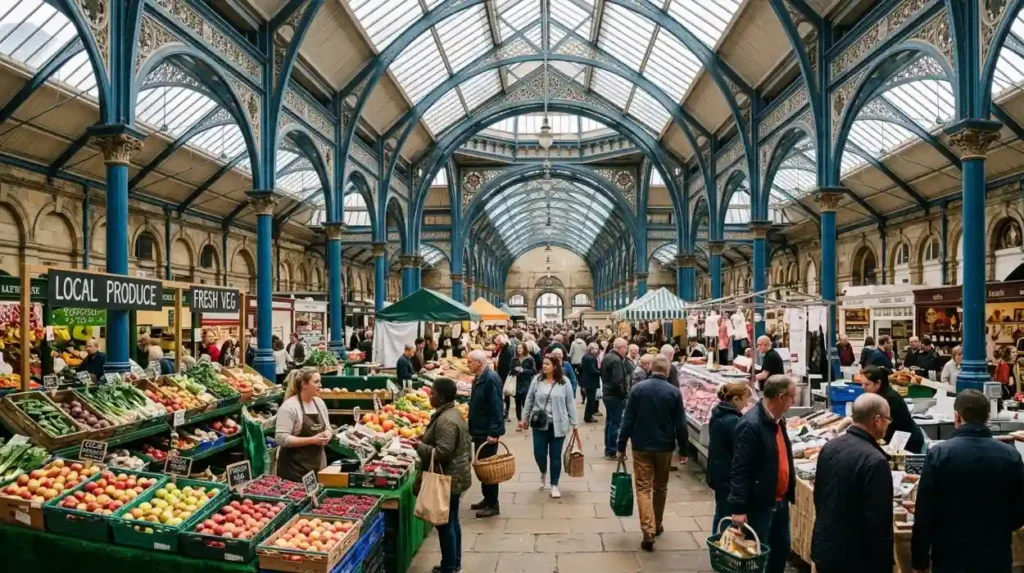
Kirkgate Market established the foundational infrastructure for urban food distribution and working-class micro-retail in Leeds, expanding from an open-air market into Europe’s largest covered municipal market house and acting as an anchor for surrounding independent businesses.
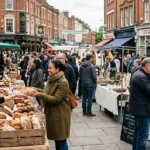
The institutional organization of retail in the Northern Square Mile centered on Leeds Kirkgate Market, situated at the southeastern boundary of the northern commercial zone. Prior to formal municipal enclosure, the trade of fresh produce, meat, and wholesale goods occurred in unregulated, highly congested open-air markets along Briggate and the surrounding lanes. To resolve public health hazards and streamline tax collection, the Leeds Corporation enacted targeted clearances and consolidated these activities at the Kirkgate site starting in 1822. This consolidation was driven by historic municipal market values, which prioritized a legal duty of care, regulatory oversight, and the provision of affordable food access for the local populace (Machell & Caraher, 2012).
The physical infrastructure underwent a major transformation in 1857 with the completion of a grand, glass-and-iron covered market hall modeled after London’s Crystal Palace. This structural design maximized interior volume and natural light, accommodating hundreds of permanent indoor stalls alongside temporary outdoor pitches. By 1904, the market expanded further with the inauguration of its highly ornate Edwardian Art Nouveau frontage on Vicar Lane, designed by architects Leeming & Leeming. This architectural expansion solidified Kirkgate Market as the largest covered municipal market in Europe, housing over 600 trading stalls by the mid-twentieth century (Machell & Caraher, 2012).
The socio-economic impact of this infrastructure was twofold:
- Micro-Enterprise Incubation: The market functioned as a low-barrier economic entry point for working-class entrepreneurs. Stall allocations required minimal capital investment compared to permanent brick-and-mortar buildings, allowing immigrant communities, rural traders, and local craftsmen to build commercial capital. Notably, this framework allowed Michael Marks to establish his “Penny Bazaar” within Kirkgate Market in 1884, laying the operational foundations for the multinational retailer Marks & Spencer.
- Agglomeration Economies: The immense daily footfall generated by Kirkgate Market—which regularly exceeded tens of thousands of shoppers—created a powerful clustering effect (Machell & Caraher, 2012). Independent suppliers, transport workers, wholesalers, and specialized service providers established themselves in the surrounding streets of the Northern Square Mile to capture residual consumer demand, cementing the area’s identity as a self-sustaining hub of independent commerce.
What Socio-Political Forces Threatened Independent Businesses in the Twentieth Century?
Independent businesses faced severe disruption from the rise of national supermarket chains, urban planning frameworks favoring vehicular traffic over pedestrian spaces, and post-war municipal policies that prioritized corporate-led commercial modernization over historic preservation.
During the mid-to-late twentieth century, independent retail across the United Kingdom experienced an intense structural contraction. A primary driver of this decline was the rapid consolidation of the grocery and consumer goods sectors by national supermarket conglomerates. By the late twentieth century, corporate grocery chains accounted for greater than 90% of total food sales nationwide, utilizing economies of scale and aggressive supply chain vertical integration to undercut the pricing models of independent butchers, greengrocers, and dry goods merchants (Clarke & Banga, 2010; Portas, 2011). Furthermore, planning regulations during this era permitted the development of large out-of-town retail centers, which shifted consumer spending away from historic high streets and traditional city centers (Gonzalez & Waley, 2012).
To experience this historic landmark in person today, consult our comprehensive [Leeds City Centre Heritage and Visitor Guide] for itineraries and visiting parameters.
Simultaneously, municipal town planning philosophies shifted toward urban modernist ideals, which frequently treated historic commercial quarters as obsolete or inefficient. In Leeds, the implementation of the “Leeds Motorway City” strategy during the 1960s and 1970s resulted in the construction of the Inner Ring Road and large-scale urban clearances. These infrastructure projects physically severed the Northern Square Mile from surrounding working-class residential areas, such as the Leylands and Mabgate. This separation dismantled the traditional walking corridors that independent traders relied upon for daily footfall.
Furthermore, local authorities increasingly managed historic assets through asset management teams rather than civic preservation bodies, viewing sites like Kirkgate Market primarily as revenue-generating real estate rather than public spaces of sociability (Gonzalez & Waley, 2012). This regulatory posture led to long-term municipal disinvestment and deferred maintenance, which left historic properties vulnerable to decay. The structural vulnerability of the area was demonstrated in 1975 when a catastrophic fire destroyed a large portion of the indoor halls at Kirkgate Market, forcing a rapid, non-historic reconstruction that disrupted hundreds of independent traders and accelerated the commercial shifting of the quarter toward corporatized retail development models.
Explore More Local Businesses
Top Rated Independent Shops and Boutique Services: Islington 2026
How Did the Civic Conservation Movement Protect the Grand Quarter?
The civic conservation movement protected the Grand Quarter through grassroots opposition to architectural demolition, the establishment of formal Conservation Areas under UK planning law, and the deployment of targeted heritage funding to restore independent shopfronts.
The widespread destruction of historic urban landscapes during the post-war reconstruction era sparked an environmental and cultural counter-movement across the United Kingdom during the late 1960s and early 1970s (Law, 2004). In Leeds, this manifested as a direct reaction against the “concrete and glass” architecture of modernist redevelopments, which citizens and preservationists viewed as an existential threat to civic identity and local independence (Law, 2004). The formation of the Leeds Civic Trust in 1965 established an organized, institutional voice for heritage preservation, shifting the public discourse from corporate efficiency to the aesthetic and historical value of the built environment.
Preservationists achieved critical leverage through the Civic Amenities Act 1967, which empowered local planning authorities to designate geographic zones of special architectural or historic interest as “Conservation Areas.” The designation of the Leeds City Centre Conservation Area—which directly encompassed Briggate, the historic arcades, and the Grand Quarter—placed strict legal constraints on property owners and developers. Under these statutory frameworks:
- Demolition Controls: The automatic right to demolish Victorian and Edwardian commercial buildings was revoked, requiring formal Conservation Area Consent from the municipal government.
- Aesthetic Standardisation: Any new structural interventions or exterior modifications were legally mandated to preserve or enhance the character of the historic environment, preventing the installation of generic corporate cladding and out-of-scale corporate signage.
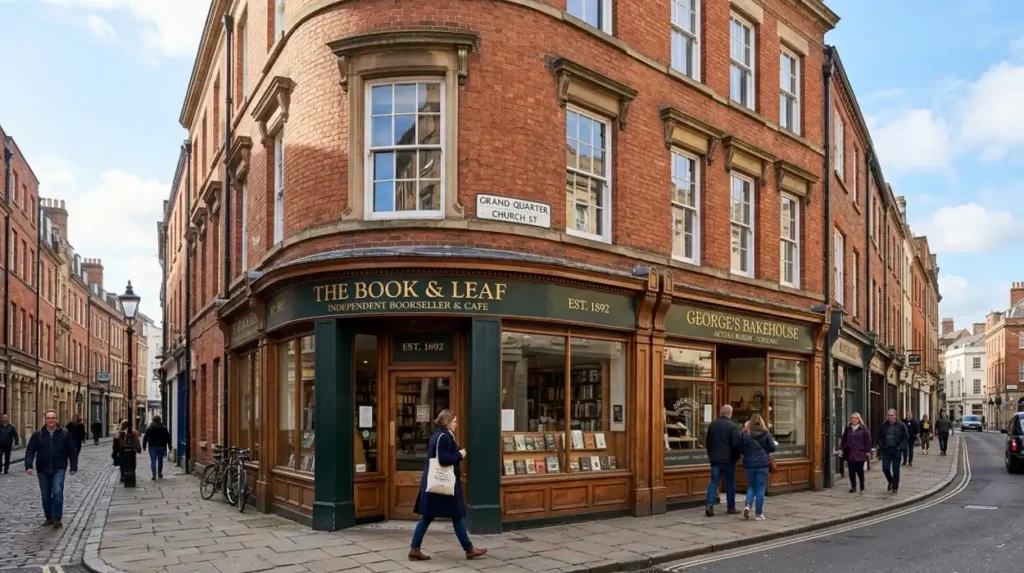
- Façade Restorations: Special focus was placed on restoring the original timber-framed, cast-iron, and terracotta shopfronts of independent properties, using architectural archaeology to replicate historical designs from the nineteenth century (Giles, 1900).
These planning protections were reinforced by targeted economic initiatives, including the Heritage Lottery Fund’s Townscape Heritage Initiatives (THI) and historic partnerships between Historic England and Leeds City Council. These funding mechanisms provided direct capital grants to small business owners within the Grand Quarter and Queen’s Arcade, subsidizing up to 80% of the cost of structural repairs, roofing, and period-accurate storefront restoration. By lowering the overhead costs of property maintenance for small landlords and independent tenants, these civic conservation frameworks directly prevented the displacement of local traders and preserved the unique architectural appeal that draws cultural tourism to the Northern Square Mile.
What Explains the Modern Resilience of Independent Small Businesses in Leeds?
The modern resilience of small businesses in the Northern Square Mile is driven by an economic shift toward experiential retail, specialized subcultural clustering, and consumer demand for localism that insulates independent traders from digital ecommerce competition.
In the twenty-first century retail environment, independent businesses within the Northern Square Mile have adapted to survive the structural pressures of online ecommerce platforms and shifting consumer habits. As digital marketplaces reduced the profitability of conventional brick-and-mortar retail, the small businesses of the Grand Arcade, Corn Exchange, and historic lanes pivoted toward “experiential retail.” This business strategy focuses on providing unique, sensory, and highly specialized in-person experiences—such as specialized coffee roasting, bespoke tailoring, rare vinyl curation, and live artisan demonstrations—that cannot be replicated by digital algorithms.
This economic adaptation is supported by a process of subcultural clustering, where similar independent enterprises group together within specific historic structures to create miniature commercial ecosystems. For example, the Grand Arcade has re-emerged as a specialized hub for independent food and beverage operators, jazz venues, and artisanal bakeries, while the nearby Leeds Corn Exchange concentrates clothing boutiques, independent jewelers, and graphic art print shops. This clustering creates collective efficiency: it lowers individual marketing costs because the destination itself attracts a defined consumer demographic seeking alternative consumption models (Gonzalez & Waley, 2012).
Furthermore, contemporary consumer demographics exhibit a strong preference for ethical consumption and localism. This trend is especially pronounced among the large student and young professional populations residing adjacent to the city center. These consumers view independent markets and local shops as authentic spaces that support the regional economy, directly contrasting with the corporate homogenization of modern shopping malls (Gonzalez & Waley, 2012). By leveraging their agility, independent owners can rapidly alter their product inventories and community engagement strategies to match these shifting cultural values, ensuring their continued economic relevance within the historic core of Leeds.
What Are the Long-Term Implications of Commercial Gentrification for the Area?
Commercial gentrification threatens to alter the socio-economic function of the Northern Square Mile by escalating property values, displacing long-standing independent traders, and transforming inclusive public spaces into premium consumer zones.
The ongoing economic revival of the Northern Square Mile has introduced complex socio-economic challenges, primarily through commercial gentrification. While capital investments and municipal rebrandings restore the structural fabric of historic buildings, they simultaneously alter the demographic and economic dynamics of the area. Traditional retail markets and historic streets are increasingly caught in a tension between economic decline and gentrified revival, positioned at a commercial frontier where historic community spaces risk being repurposed for wealthier consumer groups (Gonzalez & Waley, 2012).
This urban transformation occurs through a multi-stage economic mechanism:
- Capital Disinvestment & Rebranding: Initial periods of municipal disinvestment lower property values, allowing subcultural independent businesses to move in. Once these creative clusters establish a reputation for “authenticity,” private developers and local authorities launch targeted rebranding campaigns to attract wealthier shoppers (Gonzalez & Waley, 2012).
- Rent Escalation: The influx of higher-income consumers drives up commercial property values and land rents across the sector.
- Displacement: Small, low-margin businesses—such as traditional cobblers, basic dry goods merchants, and affordable fresh food stalls—are priced out by escalating rents and replaced by premium cafes, craft beer bars, and high-end design boutiques.
- Demographic Shifting: The historical working-class, elderly, and minority ethnic customer bases, who rely on traditional municipal markets for affordable living costs, are gradually excluded as the product offerings and price points shift upward (Machell & Caraher, 2012; Gonzalez & Waley, 2012).
The long-term historical consequence of this process is the potential loss of genuine urban diversity. If the Northern Square Mile transitions entirely into a sanitized playground for affluent consumers, it risks losing the non-corporatized sociability that defined its structural evolution since the medieval era (Gonzalez & Waley, 2012). The key challenge for future urban planners, historic preservationists, and municipal registries lies in balancing architectural conservation with social equity. Maintaining regulatory protections that keep commercial spaces accessible to working-class traders ensures that the Northern Square Mile remains a living, representative archive of urban community commerce rather than a static monument to corporate-led heritage tourism.
What is the Northern Square Mile in Leeds?
The Northern Square Mile is a historic commercial district in central Leeds, encompassing areas around Briggate, the Grand Quarter, and the market quarter. It is known for its concentration of independent retailers, historic arcades, and preserved Victorian architecture.