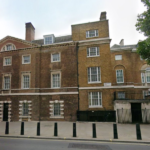
London is internationally associated with major cultural institutions such as the National Gallery, Tate Modern, and the Victoria and Albert Museum. Yet the capital’s artistic history extends far beyond these famous destinations. Smaller galleries, historic artist homes, civic collections, and community-founded institutions preserve important stories about Britain’s cultural development.
- Why does London have so many hidden art galleries with major historical importance?
- Which historic London art gallery was created specifically to bring art to the public?
- How did the South London Gallery emerge from Victorian education and social reform?
- Why is Leighton House one of London’s most important historic artist homes?
- What makes Sir John Soane’s Museum a hidden art gallery within a historic house?
- How did the Guildhall Art Gallery preserve London’s civic and artistic history?
- Why is Whitechapel Gallery central to the history of East London art?
- How does the Courtauld Gallery connect art history research with public collections?
- Why does Serpentine show how London’s art institutions changed after 1970?
- What do London’s hidden art galleries reveal about the city’s long-term cultural history?
- How should visitors explore London’s hidden art galleries as historical institutions?
London’s lesser-known art galleries reveal how artistic life developed through philanthropy, education, industrial wealth, civic government, immigration, social reform, architecture, and private collecting. Several institutions occupy buildings with histories that predate their galleries by centuries. Others were founded specifically to bring art beyond elite districts and into working-class neighbourhoods.
For art enthusiasts, history students, educators, and heritage researchers, these institutions provide a more detailed understanding of London’s cultural geography. They show how art moved from private collections into public spaces and how local communities shaped the capital’s artistic identity.
Why does London have so many hidden art galleries with major historical importance?
London’s hidden art galleries developed through private collecting, Victorian philanthropy, civic investment, social reform, and artist-led institutions, creating a cultural network that extends beyond famous museums and preserves important histories of art, architecture, education, community development, and public access.
London became a major centre of art because political power, commercial wealth, imperial connections, education, and private collecting concentrated in the capital. During the eighteenth and nineteenth centuries, wealthy individuals accumulated paintings, sculpture, decorative arts, and antiquities. Their collections created the foundations for many public museums and galleries.
The expansion of public art institutions accelerated during the Victorian period. Industrialisation produced new wealth, while social reformers argued that education and cultural access improved urban life. Art galleries therefore became part of a wider civic programme that included libraries, technical colleges, lecture halls, parks, and public museums.
This history explains why London’s art institutions vary so greatly. Some galleries began as aristocratic or private collections. Others emerged from working-men’s colleges and social reform movements. Civic galleries developed from municipal collections. Artist homes became museums because their interiors, studios, and collections preserved the working environments of influential figures.
The geographic pattern is equally important. The West End and Kensington contain major institutions associated with royal, aristocratic, and academic patronage. East London contains galleries shaped by migration, working-class communities, social reform, and modern art. South London developed important public art institutions linked to education and philanthropy.
This distribution creates a broader historical map of London. The city’s art history is not confined to a single cultural district. It exists across neighbourhoods with different social and architectural histories.
Which historic London art gallery was created specifically to bring art to the public?
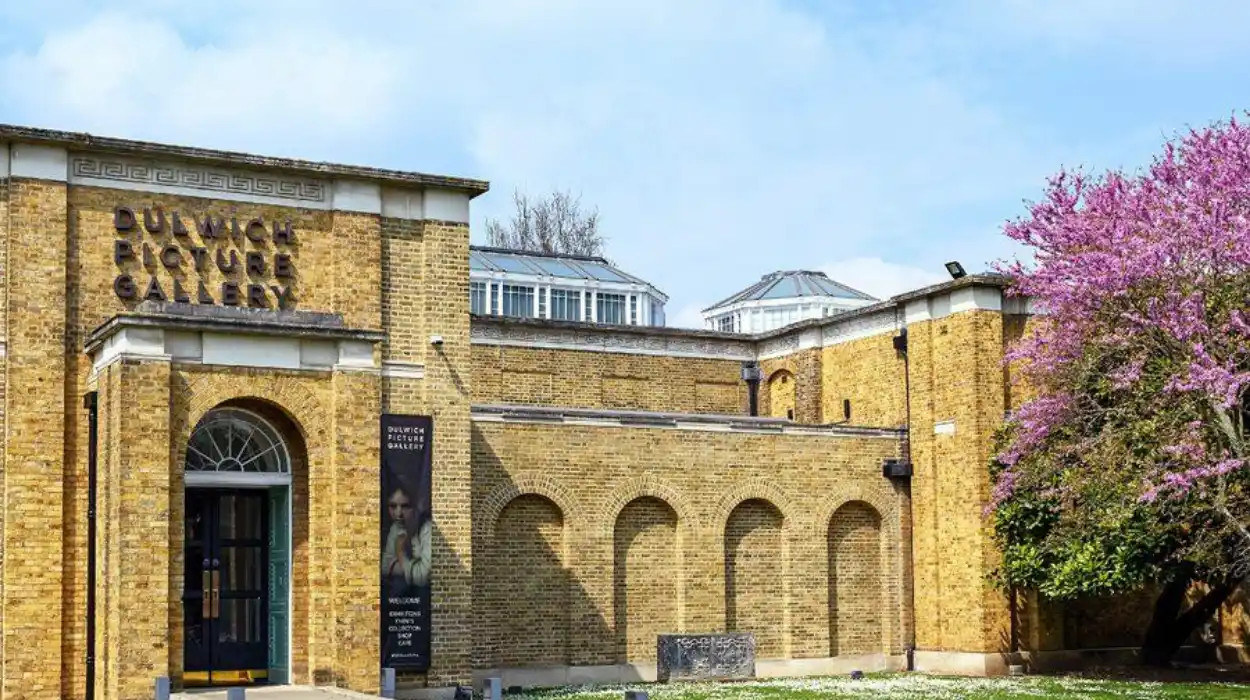
Dulwich Picture Gallery became Britain’s first purpose-built public art gallery when it opened in 1811, transforming a private collection into a permanent public institution and establishing a model for accessible art display that influenced the development of museums across London and Britain.
Dulwich Picture Gallery occupies a central position in the history of public art. The gallery was designed by the architect Sir John Soane and opened in 1811. Its creation resulted from an unusual sequence of collecting, political upheaval, inheritance, and philanthropy.
The story began with Noël Desenfans and Francis Bourgeois. Desenfans, a French-born art dealer, and Bourgeois, a Swiss-born painter and collector, were commissioned in 1790 to assemble a royal collection for Stanislaus Augustus, the last King of Poland. The political partition of Poland prevented the king from completing the purchase.
The collection remained in London. After Desenfans died in 1807, Bourgeois inherited responsibility for the paintings. He eventually decided to leave the collection to Dulwich College. His will required the paintings to be available for public inspection.
The resulting gallery opened in 1811. Its purpose-built architecture separated it from earlier traditions in which important collections remained inside aristocratic houses or private residences. The building established a direct connection between art, public access, and civic education.
The gallery also demonstrates the importance of architecture in museum history. Soane designed a structure that integrated galleries, mausoleums, and natural light. The building became part of the collection’s historical significance.
Dulwich Picture Gallery remains an important example of how private collecting created permanent public institutions. Its origins also demonstrate how international political history influenced London’s cultural landscape. The collection began with a Polish royal commission, passed through the London art market, and eventually became a public gallery in South London.
How did the South London Gallery emerge from Victorian education and social reform?
The South London Gallery developed from the South London Working Men’s College established in 1868 and opened as a public art gallery in 1891, linking visual culture with education, philanthropy, technical training, and the Victorian campaign to improve access to culture.
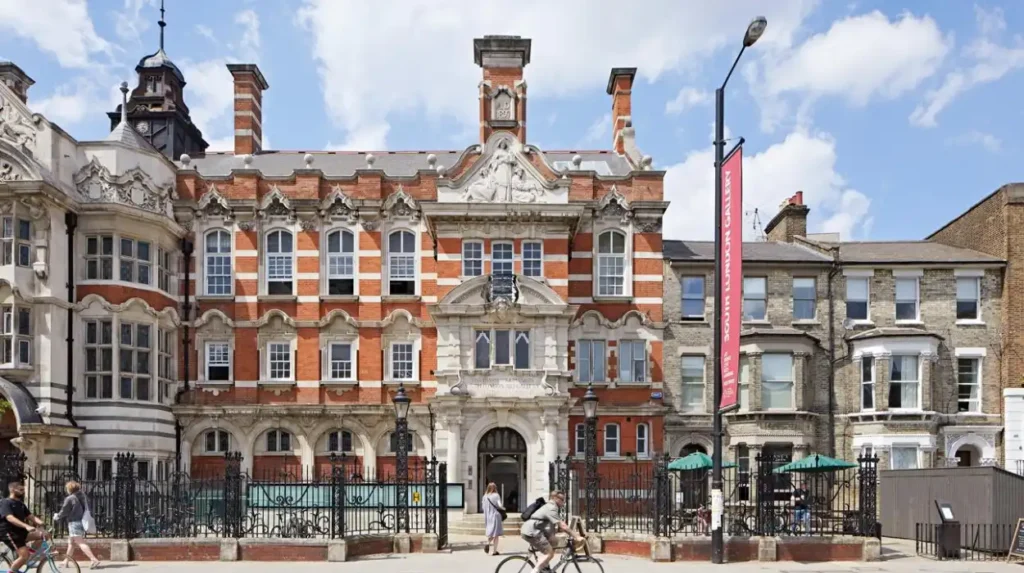
South London Gallery provides a clear example of the connection between art and nineteenth-century social reform. Its origins lie in the South London Working Men’s College, established by William Rossiter in 1868.
The institution developed from educational activity into a Free Library and Art Gallery. This transition reflected a major Victorian belief: public education should include access to books, lectures, technical instruction, and art.
The gallery opened at its current Peckham Road location in 1891. Its development involved influential figures including Sir Frederic Leighton, Edward Burne-Jones, G. F. Watts, and Walter Crane. These artists and cultural figures supported the creation of a permanent institution for South London.
The building also reflected the wider Victorian civic model. Philanthropist John Passmore Edwards funded a lecture hall, library, and adjacent technical college. The gallery therefore formed part of a larger educational complex rather than functioning as an isolated exhibition space.
The institution passed through different administrative structures. Ownership moved from the gallery’s original organisation to the Vestry of Camberwell, then the Borough of Camberwell, and later the Borough of Southwark.
The gallery experienced wartime disruption. It closed during the First World War and the Second World War when its buildings were used for government purposes. An air raid in 1941 damaged the lecture hall and library.
The South London Gallery later developed a strong contemporary art programme. Its history demonstrates a long institutional shift from Victorian public education to modern exhibition practice. The original Victorian gallery space remains part of the institution’s identity, connecting current exhibitions with nineteenth-century civic reform.
Why is Leighton House one of London’s most important historic artist homes?
Leighton House preserves the home, studio, collections, and architectural vision of Frederic, Lord Leighton, showing how a leading Victorian artist created a private environment that combined artistic production, international cultural influences, domestic life, and public social identity.
Leighton House was the home and studio of Frederic, Lord Leighton, a major Victorian artist and president of the Royal Academy. The house stands in the Holland Park area and represents the nineteenth-century concept of the artist’s purpose-built studio home.
Leighton acquired the site in 1864. The house developed over several decades and became a continuing architectural project. Its rooms combined domestic functions with studio spaces, exhibition areas, and collections of objects from different cultural traditions.
The building demonstrates the relationship between Victorian artistic identity and global collecting. Leighton collected objects, architectural elements, and decorative materials that reflected the nineteenth-century interest in Islamic art, classical antiquity, and international design.
The house also shows how artists used architecture to construct public identities. Leighton’s residence was not simply a private home. It was a place associated with artistic status, professional relationships, social gatherings, and the public image of the successful Victorian artist.
The interior remains historically significant because the architecture and collections form a connected environment. Paintings viewed inside a purpose-built artist’s home create a different historical context from paintings displayed in a neutral gallery.
For educators and students, Leighton House provides evidence of how Victorian art operated across multiple disciplines. Painting, architecture, interior design, collecting, social networks, and cultural diplomacy intersected within the same building.
Its preservation also demonstrates the importance of conserving historic interiors. The building itself functions as a primary historical source. Its rooms reveal how a prominent artist lived, worked, displayed objects, and participated in London’s cultural society.
What makes Sir John Soane’s Museum a hidden art gallery within a historic house?
Sir John Soane’s Museum preserves the architect’s home, collections, paintings, architectural models, antiquities, drawings, and interiors under a private Act of Parliament, creating one of London’s most important historic environments for studying art, architecture, collecting, and preservation.
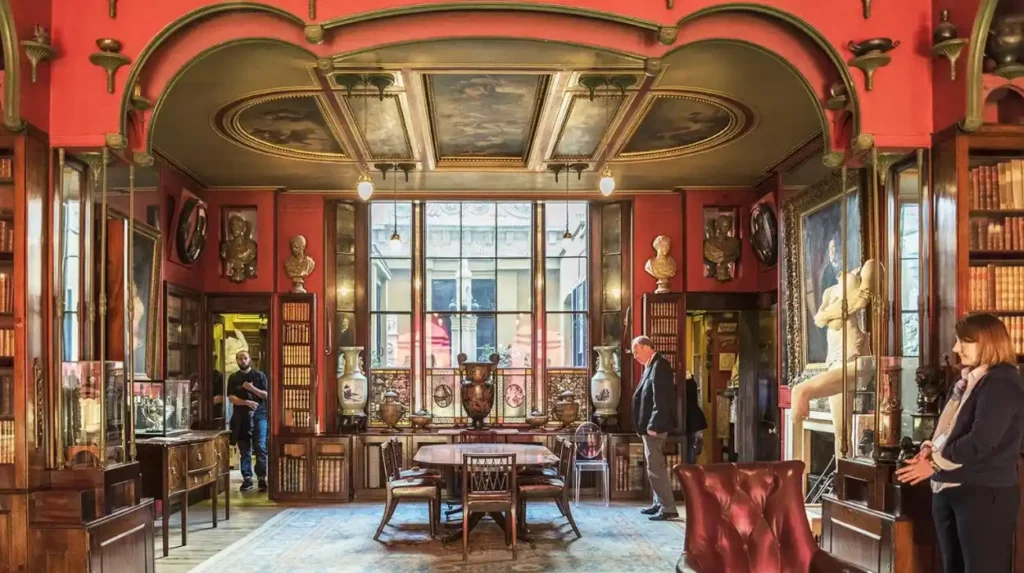
Sir John Soane’s Museum occupies the former home of Sir John Soane, the architect born in 1753 who became one of the leading figures of the Regency era.
Soane trained as an architect and travelled through Europe after receiving the Royal Academy’s Gold Medal for Architecture. His Grand Tour exposed him to ancient Roman sites, Paestum, and Pompeii. These experiences shaped his interest in classical architecture and archaeological remains.
His house at Lincoln’s Inn Fields became a museum through the expansion of his professional and personal collections. Soane acquired paintings, sculpture, architectural fragments, models, books, drawings, furniture, and antiquities.
In 1807, he acquired the neighbouring property at No. 13. In 1823, he acquired No. 14 and rebuilt it to create additional space for his collection. The resulting interiors were carefully designed to combine architecture and objects.
Soane’s museum is historically distinctive because the collection was preserved as an integrated environment. The interiors were not designed as neutral rooms. The arrangement of objects formed part of Soane’s artistic and architectural method.
In 1833, Soane secured a private Act of Parliament that required his house and collection to remain preserved and open for public education after his death. The legal mechanism created an early and important example of heritage preservation through legislation.
The museum therefore connects art history with architectural history and legal history. Its significance extends beyond individual objects. The entire building is an historical document showing how an early nineteenth-century architect collected, arranged, interpreted, and preserved culture.
How did the Guildhall Art Gallery preserve London’s civic and artistic history?
Guildhall Art Gallery preserves the City of London Corporation’s historic art collection, including paintings connected to London’s civic life, while its modern building incorporates the remains of a Roman amphitheatre discovered during redevelopment after the original gallery was destroyed during the Second World War.
Guildhall Art Gallery represents the connection between municipal government, public art, war damage, archaeology, and urban reconstruction.
The first Guildhall Art Gallery was built in 1885. Its creation reflected the growth of municipal art collections during the Victorian period. The City of London Corporation had developed a significant collection through commissions, purchases, gifts, and historical portraits.
The collection’s origins reach back to 1670. The Court of Aldermen commissioned twenty-two portraits of the Fire Judges, officials involved in assessing compensation claims after the Great Fire of London in 1666.
The gallery’s original building was almost destroyed during a severe air raid on 10 May 1941. Many artworks had been moved to underground storage, but 164 paintings, drawings, watercolours, and prints and 20 sculptures were lost.
The site was later redeveloped. Archaeological investigation uncovered the remains of London’s Roman amphitheatre. The discovery changed the architectural design of the new gallery.
The modern Guildhall Art Gallery opened in 1999, with the Roman amphitheatre incorporated into the visitor experience. The result connects two distinct historical layers: Roman Londinium and the civic art history of the City of London.
The gallery’s collection now contains approximately 4,500 works of art. Its focus remains strongly connected to London, including works made by artists associated with the capital and works depicting London’s history.
The institution demonstrates how war damage can lead to architectural transformation rather than simple reconstruction. The modern gallery preserves Victorian cultural history while exposing archaeological evidence from Roman London.
Why is Whitechapel Gallery central to the history of East London art?
Whitechapel Gallery was founded in 1901 by Samuel and Henrietta Barnett to bring major art to East London, creating a pioneering institution where modern art, social reform, education, migration, community engagement, and international cultural exchange developed together.
Whitechapel Gallery was founded by Canon Samuel Barnett and Henrietta Barnett in 1901. Their project was shaped by social reform and the belief that East London residents deserved access to high-quality art.
The gallery was established in Tower Hamlets, an area historically associated with working-class communities and migration. Its location gave the institution a distinct social purpose from the beginning.
The gallery’s history demonstrates that modern art in London did not develop only through elite galleries and private collectors. Whitechapel created a platform for international artists, public education, community programmes, and new artistic movements.
Its exhibition history contains significant milestones. Picasso’s Guernica was displayed there in 1939 during its only visit to Britain. The gallery presented a major Jackson Pollock exhibition in 1958 and introduced Mark Rothko’s work in a significant British presentation in 1961.
The institution also supported artists who later became central to British and international art history. Its programmes included early exhibitions of David Hockney, Gilbert & George, and Richard Long. It presented Frida Kahlo to London audiences in 1982 and held an important Lucian Freud exhibition in 1993.
Whitechapel also developed a substantial archive. Catalogues, annual reports, letters, regulations, exhibition materials, and related documents preserve evidence of the gallery’s changing role.
Its 2009 expansion increased exhibition capacity through the acquisition and integration of the former Whitechapel Public Library building. The architectural development strengthened the connection between the gallery’s historic mission and its modern exhibition programme.
Whitechapel Gallery therefore functions as both an art institution and a historical record of East London’s changing social and cultural identity.
How does the Courtauld Gallery connect art history research with public collections?
The Courtauld Gallery combines a major historic art collection with advanced teaching, research, conservation, and art-historical scholarship, making it an important institution for understanding how museums, universities, collectors, and public exhibitions developed together in twentieth-century London.
The Courtauld Gallery is located in Somerset House and forms part of The Courtauld, an institution founded by collectors and philanthropists during the 1930s.
The organisation occupies a distinctive position because it combines a public gallery with academic research and teaching. Its work covers art history, conservation, curating, and the interpretation of visual culture.
The collection extends from medieval art to modern works. It is especially known for its Impressionist and Post-Impressionist holdings, including paintings by Édouard Manet and Vincent van Gogh.
The institution’s historical importance lies in the relationship between collecting and scholarship. A painting is not only displayed as an object. It also becomes the subject of research, conservation, teaching, and public interpretation.
The Courtauld model reflects twentieth-century changes in the professional study of art. Art history developed as an academic discipline, while conservation became increasingly important to the long-term preservation of paintings and other works.
The gallery’s setting at Somerset House adds another historical layer. The building is one of London’s major historic architectural complexes, linking the gallery’s collection to the broader history of government, public architecture, and cultural institutions.
For students and educators, the Courtauld demonstrates how a gallery can operate simultaneously as a museum, research centre, teaching institution, and conservation organisation. This integrated structure has shaped modern approaches to understanding and preserving art.
Why does Serpentine show how London’s art institutions changed after 1970?
Serpentine began as a free public contemporary art gallery in 1970 inside a former Kensington Gardens tea-room, demonstrating the expansion of London’s cultural infrastructure from historic collections toward contemporary art, experimental exhibitions, architecture, performance, and public participation.
Serpentine Galleries represents a later phase in London’s gallery history. Serpentine South opened as an art gallery in 1970 inside a building that had previously served as a tea-room.
The building itself dates from 1934 and replaced earlier refreshment rooms opened in 1855. This architectural transformation illustrates how existing public structures were adapted for cultural use.
Serpentine was established as a free public art institution. Its early programme focused on young British artists. The gallery later expanded its programme to include established international artists and a wide range of contemporary practices.
The institution’s history reflects changes in the definition of art. Contemporary galleries increasingly presented installation, performance, design, architecture, and experimental forms alongside painting and sculpture.
Serpentine North opened in 2013, creating a second exhibition site. The two buildings now form a connected institutional presence around Kensington Gardens.
The annual Pavilion programme also demonstrates the relationship between temporary architecture and contemporary art. Each year, a different architect creates a temporary structure that functions as a public venue and architectural commission.
Serpentine’s history is important because it shows how London’s cultural institutions evolved after the Second World War. The focus shifted from preserving historic collections toward presenting new artistic practices and creating public spaces for experimentation.
Its free admission model also continues the long history of public access that began with earlier nineteenth-century galleries. The difference lies in the artistic programme rather than the principle of public cultural access.
What do London’s hidden art galleries reveal about the city’s long-term cultural history?
London’s lesser-known galleries reveal that the capital’s art history developed through public education, philanthropy, civic government, private collecting, social reform, wartime destruction, archaeology, academic research, and contemporary experimentation across different neighbourhoods and historical periods.
The history of London’s hidden art galleries demonstrates that cultural development was never controlled by one institution or one social group. Different organisations emerged from different historical conditions.
Dulwich Picture Gallery shows how a private collection became a public institution. The South London Gallery demonstrates the relationship between art and working-class education. Leighton House preserves the domestic and professional world of a major Victorian artist.
Sir John Soane’s Museum demonstrates how architecture and collecting became inseparable. Guildhall Art Gallery connects municipal government with civic memory and Roman archaeology. Whitechapel Gallery shows how social reform and international modern art shaped East London.
The Courtauld illustrates the connection between collecting, academic research, and conservation. Serpentine represents the post-1970 expansion of contemporary art and experimental cultural programming.
Together, these institutions create a historical timeline extending from the seventeenth century to the present day. The Guildhall collection began with civic commissions in 1670. Dulwich Picture Gallery opened in 1811. The South London Gallery developed from Victorian educational reform. Leighton House and Sir John Soane’s Museum preserve nineteenth-century collecting cultures. Whitechapel emerged in 1901. The Courtauld developed in the 1930s. Serpentine opened in 1970.
This timeline demonstrates a major transformation in the relationship between art and the public. Art moved from private ownership and elite display toward public access, municipal collections, community engagement, academic study, and contemporary experimentation.
The buildings themselves provide evidence of this transformation. Historic houses, Victorian civic structures, former libraries, tea-rooms, educational buildings, and archaeological remains now function as cultural spaces.
Preservation therefore involves more than protecting individual paintings. It also involves conserving buildings, archives, interiors, institutional records, public memories, and the relationships between art and place.
For genealogical researchers, these institutions provide valuable historical context about neighbourhood development, philanthropy, civic administration, migration, education, and social reform. For educators, they offer direct evidence of how cultural institutions developed. For visitors, they provide access to London’s artistic history beyond the most heavily visited attractions.
To experience this historic cultural landscape in person today, consult our comprehensive [History of London’s Historic Churches and Their Importance in British Religious Heritage] for itineraries and visiting parameters.
How should visitors explore London’s hidden art galleries as historical institutions?
Visitors should study each gallery as a combination of collection, building, neighbourhood, founder, and historical period, because understanding these connected elements reveals how London’s artistic institutions developed and explains why lesser-known galleries remain important cultural heritage sites.
A historical visit begins with the building. The architecture often explains the institution’s original purpose. Dulwich was purpose-built as a public gallery. The South London Gallery developed within a Victorian educational environment. Leighton House was designed as an artist’s home and studio.
The collection provides a second layer of evidence. Guildhall Art Gallery reflects London’s civic history. The Courtauld demonstrates the role of private collectors and academic research. Sir John Soane’s Museum preserves an individual collector’s intellectual system.
The founding organisation provides a third layer. Social reform shaped Whitechapel Gallery and the South London Gallery. Philanthropy influenced Dulwich and the Courtauld. Civic government shaped Guildhall.
The neighbourhood provides a fourth layer. East London’s artistic history reflects migration and social reform. South London’s galleries connect art with education and community development. Kensington’s institutions reveal the relationship between public parks, artistic identity, and modern cultural programming.
Finally, visitors should consider continuity. These galleries are not frozen historical objects. They continue to change through conservation, new exhibitions, education programmes, architectural adaptations, and new interpretations.
The long-term importance of London’s hidden art galleries lies in this combination of preservation and continued use. Their historical value increases because they remain active cultural institutions.
London’s artistic heritage therefore exists beyond famous tourist attractions. Its lesser-known galleries preserve the evidence of how art became public, how communities shaped cultural institutions, and how historic buildings continue to influence the city’s cultural identity.
For anyone studying London’s history, these galleries provide a connected record of artistic development from civic portraits and private collections to contemporary exhibitions and community-based cultural work. Their future historical relevance depends on continued conservation, accurate interpretation, public access, and recognition of the communities that created and sustained them.
Sources: Historical information in this article is based on official records and institutional histories from Dulwich Picture Gallery, South London Gallery, Leighton House and RBKC Museums, Sir John Soane’s Museum, the City of London Corporation, Whitechapel Gallery, The Courtauld, and Serpentine Galleries.
What are the best hidden art galleries in London?
Some of London’s most historically important lesser-known galleries include Dulwich Picture Gallery, South London Gallery, Leighton House, Sir John Soane’s Museum, Guildhall Art Gallery, Whitechapel Gallery, The Courtauld Gallery, and Serpentine Galleries.