

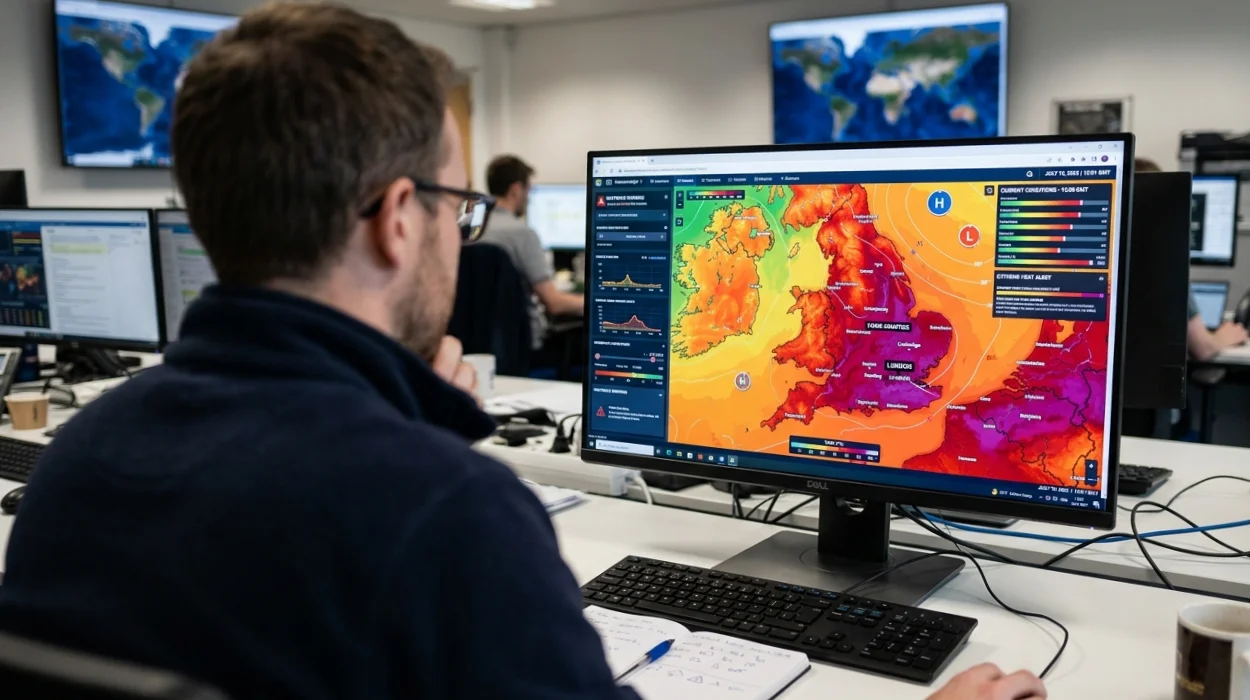
Meteorological forecasting models use specialized visualization tools to predict severe weather changes across the British Isles. The June UK heat surge map is a digital, data-driven meteorological chart generated by predictive software to track rapid, unseasonable temperature increases, particularly focusing on the London metropolitan area and surrounding home counties. This specific charting method uses color-coded thermal gradients to identify where localized atmospheric pressure blocks trap warm air masses directly over major urban centers.
- What Does the June UK Heat Surge Map Represent for London?
- Why Is London Experiencing a Sudden June Temperature Surge?
- Which Areas of London and the UK Are Most Affected According to the Latest Charts?
- How Does This London Heat Event Compare to Historical UK Heatwaves?
- What Are the Health and Infrastructure Implications for London?
What Does the June UK Heat Surge Map Represent for London?
The June UK heat surge map represents a data-driven visualization of rapid temperature increases, with London consistently forming the primary urban core of intense heat. It utilizes computer model data from tracking networks to illustrate intense deviations from historical averages.
The primary map displays numerical values representing daytime maximum air temperatures measured exactly 1.5 meters above the ground in standard louvered instrument enclosures called Stevenson screens. These grids are generated by numerical weather prediction models, such as the Unified Model managed by the Met Office, the national meteorological service of the United Kingdom.
The color spectrum on the mapping dashboard serves an analytical purpose for metropolitan forecasting. Standardized palettes assign deep orange to bright red shades for air temperatures ranging between 25°C and 29°C. Deep crimson and purple indications signify intense heat spikes exceeding 30°C, a threshold frequently crossed within the London basin during these atmospheric events.
Conversely, light yellow represents average early summer temperatures near 19°C. These absolute values help scientists and public safety agencies instantly identify localized geographical risk zones. Because the capital contains the highest population density in the country, the map serves as a critical tool for urban resource allocation and emergency response planning.
The chart incorporates structural data overlays to enhance interpretation. Isobars, which are continuous lines connecting areas of equal atmospheric pressure, are mapped across the topography to pinpoint the boundaries of high-pressure cells. Wind vector arrows indicate the velocity and precise origin of incoming air currents. This integration allows users to see both the current surface temperature intensity across Greater London and the structural thermodynamic forces moving through the atmosphere simultaneously.
Why Is London Experiencing a Sudden June Temperature Surge?
The sudden June temperature surge is caused by a thermodynamic process where an omega block high-pressure system traps hot air over the UK. This atmospheric setup pulls warm, dry continental air northward, intensifying heat within London.
The primary driver of this heat movement is an atmospheric circulation pattern known as an omega block. This phenomenon occurs when the jet stream, a high-altitude ribbon of fast-moving air, deforms into a shape resembling the Greek letter omega ($\Omega$). This geometry halts the normal west-to-east progression of weather systems, pinning a stable area of high pressure directly over England while flanking it with low-pressure troughs on either side.
Under this high-pressure dome, descending air compresses and warms dynamically, a process known as adiabatic heating. This downward force suppresses cloud formation, resulting in completely clear skies that maximize solar radiation.
The ground absorbs this solar energy continuously during the long daylight hours of June, when southern England receives up to sixteen hours of sunlight per day. The soil then transfers this stored thermal energy back into the lower boundary layer of the atmosphere.
The second variable accelerating the temperature spike is advection, which is the horizontal transfer of thermal properties by the wind. The rotation of the high-pressure system draws air clockwise around its perimeter. This movement pulls air masses directly from continental Europe and the Sahara Desert.
As this pre-heated air mass crosses the English Channel and moves toward London, it gains additional thermal energy from the sea surface, which has experienced long-term warming trends. The combination of intense solar radiation, sinking air, and continental advection triggers rapid temperature increases.
Which Areas of London and the UK Are Most Affected According to the Latest Charts?
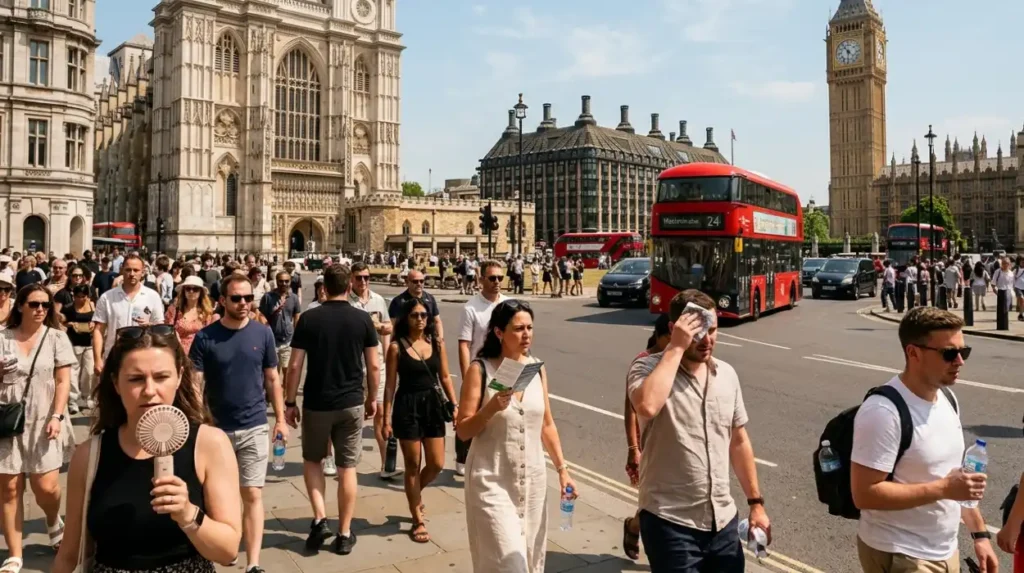
The latest meteorological charts indicate that London and eastern England face the most intense heat. The highest absolute temperatures are concentrated around central London boroughs, East Anglia, and the East Midlands, while coastal areas remain cooler.
The localized distribution of heat is highly uneven due to regional topography and maritime influences. Internal thermal tracking highlights the South East of England as the primary core of the heat surge. The built environment of the capital intensifies these readings due to the urban heat island effect, where concrete, asphalt, and stone structures absorb and slowly release heat.
Data models show that internal London metropolitan zones can maintain nighttime temperatures up to 5°C higher than surrounding rural valleys.
Inland areas across the West Midlands and parts of eastern Wales form a secondary band of elevated heat on the map. These regions lack the immediate cooling influence of the ocean, allowing surface solar heating to raise local air temperatures to near-record levels.
In contrast, northern territories experience a moderated thermal profile. While inland areas of Scotland and Northern Ireland record temperatures well above their seasonal norms, their absolute peaks remain lower due to higher cloud fractions and closer proximity to the Atlantic jet stream.
A sharp microclimate divide occurs along the eastern and southwestern coastlines. The map features a narrow band of lighter orange and yellow along these fringes, indicating temperatures up to 10°C lower than locations just twenty miles inland from the capital. This variation is caused by localized sea breezes, cold maritime currents, and early morning sea mist known as haar along the North Sea coast. This maritime boundary layer keeps coastal communities cooler despite the broader regional heat surge.
How Does This London Heat Event Compare to Historical UK Heatwaves?
This June heat surge differs from historical baselines because London reaches critical thresholds much earlier in the summer. It follows a clear long-term climate trend where extreme summer heat occurs more frequently across the south.
When evaluating this event against historical records, climatologists analyze both absolute maximums and monthly mean averages. The absolute record for the highest temperature ever recorded in June stands at 35.6°C, which was registered in Southampton during the prolonged heatwave of 1976.
While individual days during the current surge may not break that absolute single-day record, the broader spatial coverage across the map makes the event historically significant for urban centers.
The primary point of comparison is June 2023, which stands as the hottest June on record for the United Kingdom since national gridded data collection began in 1884. During that period, the UK mean temperature reached 15.8°C, which was 0.9°C higher than the previous record.
Historical data patterns show that heatwaves typically occurred as rare anomalies separated by decades. However, Met Office climate analysis reveals that the five warmest summers on record have all occurred within the last fifteen years.
The current map shows temperature deviations, or anomalies, that are 6°C to 10°C higher than the standard 1991–2020 climate baseline. In the past, temperature records were typically broken by small fractions of a degree.
The current trend of entire urban regions consistently exceeding historical averages indicates a fundamental shift in baseline climate patterns. This shift is driven by a warmer global atmosphere that holds more thermal energy and moisture.

What Are the Health and Infrastructure Implications for London?
The public health and infrastructure implications of this heat surge include severe strain on the London Underground network, electrical grids, and emergency healthcare services. These impacts require coordinated activation of regional emergency response frameworks.
The built environment and public infrastructure of the capital are historically designed for cool, temperate climates, making them highly vulnerable to sudden heat spikes. When ambient air temperatures exceed 30°C, direct sunlight can raise the surface temperature of steel rail tracks and exposed Transport for London (TfL) infrastructure to over 50°C.
This thermal expansion causes a phenomenon called rail buckling, where the physical tracks bend out of alignment. To prevent derailments, network operators must enforce mandatory speed restrictions, leading to widespread disruptions across commuter corridors.
The electrical grid experiences severe loading anomalies during these periods. The surge in demand from air conditioning units and industrial cooling systems coincides with reduced efficiency in power transmission lines and electrical transformers, which lose capacity when overheating.
Simultaneously, solar power generation can decrease slightly during extreme heat because photovoltaic panels operate less efficiently at very high temperatures. This combination creates a significant supply-and-demand challenge for grid operators.
UK Health Security Agency Heat-Health Alerts
The UK Health Security Agency (UKHSA) uses these temperature maps to issue targeted Heat-Health Alerts to NHS trusts and social care providers. These alerts are categorized into four distinct alert levels:
- Green (Summer preparedness): Standard public health advice and routine monitoring are active across all regions.
- Yellow (Alert): The heat surge is likely to impact vulnerable populations, including individuals over 65 and those with underlying respiratory or cardiovascular conditions.
- Amber (Enhanced response): The thermal impact extends to the wider population, requiring significant operational changes across hospitals to manage surge capacity.
- Red (Emergency): Exceptional heat conditions pose a direct threat to life for healthy individuals, risking widespread infrastructure failure.
The human body regulates its core temperature through the evaporation of sweat, a process that becomes less effective when nighttime temperatures remain high in urban environments. When the air fails to cool down overnight due to the retention properties of heavy building materials, the cardiovascular system is forced to work continuously to shed heat. This persistent strain leads to a statistical rise in emergency hospital admissions for heat exhaustion, severe dehydration, and acute kidney injury.
The agricultural sector surrounding the metropolitan area faces immediate operational pressures as well. High temperatures accelerate soil moisture depletion, stressing staple arable crops like wheat and barley during critical growth phases.
Livestock operations must implement active cooling measures, as dairy cattle experience heat stress that reduces milk yields when temperatures remain high. These interconnected risks highlight how a single atmospheric event can ripple across public health, infrastructure, and the economy.
What is the June UK heat surge map?
The June UK heat surge map is a meteorological visualization that shows predicted temperature patterns across the United Kingdom. It uses color-coded thermal gradients to highlight areas expected to experience unusually high temperatures, with London often appearing as a major heat hotspot.