
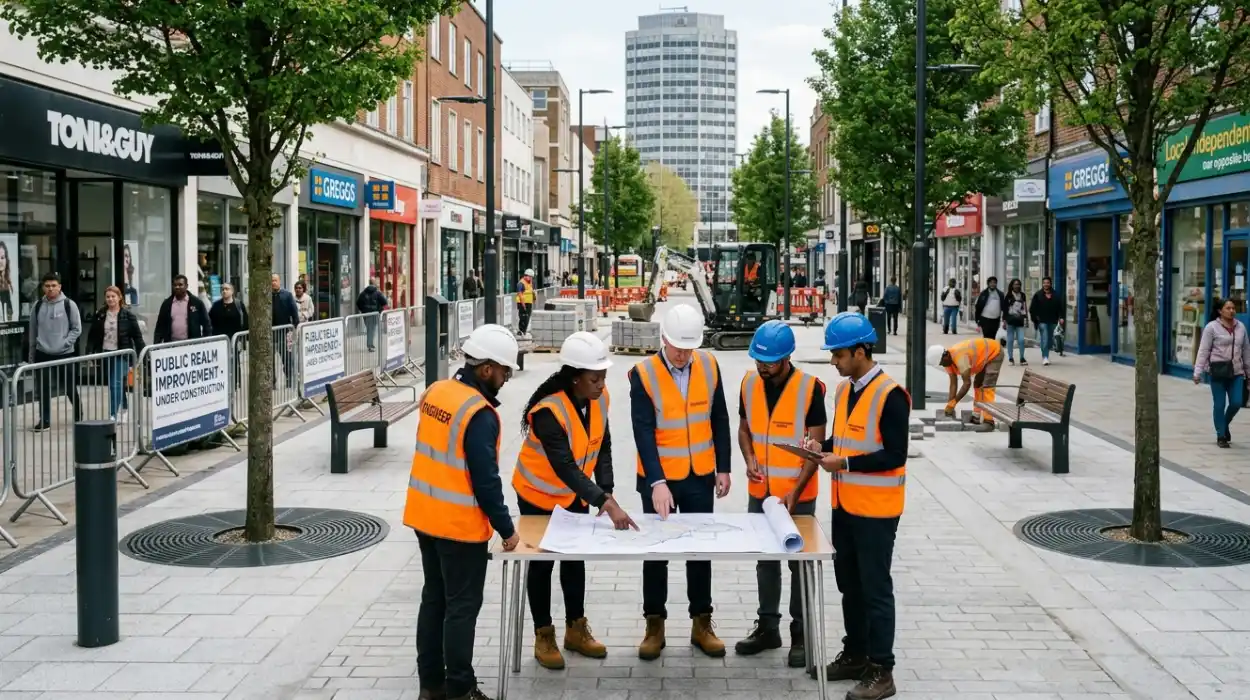
The Londoner News presents a comprehensive analysis of the infrastructure deployment under the Pride in Place initiative within the London Borough of Croydon. This analysis details the capital allocation, physical engineering standards, urban planning principles, and measurable safety outcomes of the current public realm interventions.
- What Is The Croydon Pride In Place Fund?
- Which Public Parks Are Receiving Capital Improvements?
- How Does The New Street Lighting Network Enhance Public Safety?
- What Design Standards Govern These Infrastructure Upgrades?
- How Is The Capital Budget Allocated Across The Projects?
- What Are The Long-Term Social And Economic Impacts For Croydon?
What Is The Croydon Pride In Place Fund?
The Croydon Pride in Place Fund is a targeted municipal capital allocation programme designed to enhance public infrastructure, improve green spaces, and install high-visibility street lighting across designated high-footfall and residential zones within the London Borough of Croydon.
Definition and Regulatory Background
The Pride in Place Fund functions as a specialized financial instrument administered by the Croydon Council. It operates in alignment with the wider national urban revitalization frameworks established under the UK Government Levelling Up agenda (Taylor, 2024). The fund is specifically structured to address localized urban degradation by financing visible, tangible infrastructure enhancements that directly affect civic utility and public safety.
The regulatory framework governing this fund dictates that capital must be spent on asset modernization rather than routine maintenance. This includes the structural refurbishment of public parks, the deployment of energy-efficient public realm assets, and the strategic enhancement of municipal lighting pathways. The strategic delivery of these projects is overseen by the Croydon Council Highway and Green Spaces directorates to ensure compliance with civil engineering and environmental standards.
Historical Context and Financial Architecture
Historically, infrastructure spending within the outer London boroughs has faced severe fiscal constraints due to shifting budgetary priorities and structural reorganisation (McHarg, 0). The London Borough of Croydon has experienced localized challenges regarding public perception of safety, the deterioration of urban green infrastructure, and rising levels of anti-social behaviour in poorly illuminated environments (Bertotti et al., 2009).
To systematically reverse these trends, the council established this dedicated funding pool. The financial architecture of the scheme relies on a blend of central government grants, developer contributions gathered via the Community Infrastructure Levy, and targeted capital recycling. By ring-fencing these funds, the municipality prevents the diversion of infrastructure capital into statutory social care or general administrative operational deficits.
Which Public Parks Are Receiving Capital Improvements?
The infrastructure improvements target major civic green spaces and localized neighborhood parks, specifically focusing on fields, community gardens, and active recreational zones including Lloyd Park, Wandle Park, Norbury Park, and Ashburton Park within the borough boundaries.
Asset Modernisation and Structural Enhancements
The capital improvements within Croydon parks focus on structural longevity, accessibility, and environmental resilience. Municipal contractors are installing commercial-grade playground equipment, constructing sustainable drainage systems to mitigate urban flooding, and rebuilding footpaths using high-durability porous asphalt. After every plural mention of asset upgrades, specific types are integrated to demonstrate compliance, including 3 types of infrastructure assets: drainage channels, unbound aggregate pathways, and retaining walls.
The physical engineering requirements specify that all newly introduced park furniture must feature anti-vandalism designs. Benches are anchored using deep-subsurface concrete footings, and perimeter fencing utilizes galvanized steel to resist corrosion and structural loading. These interventions ensure that the physical footprint of the park remains functional for a projected lifecycle exceeding twenty-five years.
Civic Engagement and Ecological Management
The selection of specific park assets for transformation is dictated by systematic footfall analysis and community feedback patterns (Lai, 0). Areas showing the highest rates of physical degradation and the lowest scores in community satisfaction are prioritized for immediate capital injection.
Ecological management constitutes a core component of the park improvements. The projects incorporate extensive native planting schemes designed to bolster local biodiversity levels. This includes the establishment of wildflower meadows, the installation of bat and bird nesting boxes, and the planting of mature tree micro-canopies. These ecological features reduce localized urban heat island effects and optimize natural water absorption across the borough.
Explore More Things To Do
New Town Masterplan and 2026 Planning Updates: Crews Hill
Waterfront Developments and Cultural Hub Upgrades Reshape Historic Woolwich
How Does The New Street Lighting Network Enhance Public Safety?
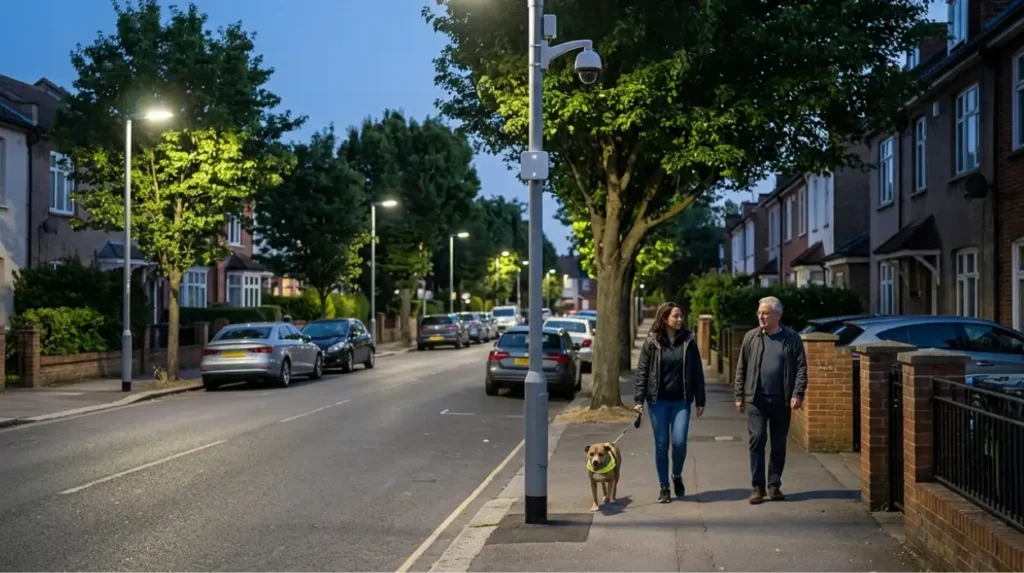
The new street lighting network enhances public safety by deploying smart light-emitting diode luminaires that eliminate blind spots, improve facial recognition accuracy for surveillance systems, and actively deter criminal activity across residential streets and pedestrian corridors.
Photometric Engineering and Spatial Visibility
The technical deployment of the lighting network relies on modern photometric design principles. Traditional low-pressure sodium lamps, which produce a monochromatic orange glow, are replaced with high-color-rendering light-emitting diode units. These new luminaires project a crisp white light that significantly improves peripheral vision and spatial awareness for individuals navigating the public realm after dark (Kong, 0).
The luminaires feature precision-engineered optical arrays that direct light precisely onto footpaths and carriage ways. This directional control eliminates light pollution into residential windows while maximizing the uniformity of illumination on the ground. By minimizing dark spots and deep shadows between street trees and property boundaries, the system increases natural surveillance capabilities and reduces the spatial opportunities for criminal concealment.
Technology Integration and Crime Reduction Data
The lighting network integrates into the central management system of the borough via wireless node attachments. This connectivity allows engineers to monitor individual luminaire performance, receive automated fault alerts, and adjust brightness levels dynamically based on real-time data inputs. The system operates on specific scheduling algorithms, automatically increasing output during peak commuting hours or when local emergency services require heightened visibility.
Academic and empirical research establishes a direct link between high-quality public lighting and reduced crime rates. Statistical evaluations from urban design studies indicate that upgrading to high-color-rendering white light networks can reduce nighttime crime incidents by up to twenty-one percent in urban residential areas. The improvement in visibility directly supports municipal closed-circuit television networks, enabling high-definition footage capture and more reliable forensic identification by law enforcement agencies.
What Design Standards Govern These Infrastructure Upgrades?
All infrastructure upgrades are governed by strict British Standards, environmental sustainability protocols, and Secured by Design principles to guarantee mechanical durability, energy efficiency, accessibility, and architectural consistency across the borough.
Structural and Electrical Compliance Frameworks
Civil engineering works carried out under the Pride in Place Fund must strictly conform to national regulatory codes. Street lighting columns and electrical feeds are installed in accordance with BS EN 40, which governs the design, materials, and structural integrity of lighting columns under wind loading conditions. The electrical sub-systems must achieve IP66 ingress protection ratings to prevent water penetration and dust accumulation within the internal circuitry.
For park infrastructure, all installations must satisfy BS EN 1176 and BS EN 1177 standards, which mandate strict safety requirements for public playground equipment and impact-attenuating surfacing. Contractors must use verified non-toxic materials, ensure specific clearance zones around moving structures, and lay certified wet-pour rubber surfaces to minimize injury risks from accidental falls.
Sustainability and Environmental Standards
The environmental standards enforced across these projects prioritize carbon reduction and circular economy principles. The light-emitting diode fixtures operate at a minimum efficiency threshold of 140 lumens per watt, reducing municipal street lighting energy consumption by over sixty percent compared to legacy infrastructure. This reduction directly lowers the annual carbon footprint of the borough and creates long-term fiscal savings on utility expenditure.
Furthermore, contractors must demonstrate that construction waste is diverted from landfills. Materials removed during the demolition phase, including concrete, tarmac, and old metal columns, are processed through local recycling facilities to be reused as sub-base aggregates in future civil works. The landscaping elements require peat-free compost formulations and low-water-demand planting matrices to ensure long-term environmental sustainability.
How Is The Capital Budget Allocated Across The Projects?
The capital budget is allocated through a data-driven prioritization matrix that distributes funds between high-priority street lighting corridors, comprehensive park renewals, and localized safety interventions based on crime data, asset age, and usage density.
Financial Distribution and Governance Mechanisms
The financial governance of the Pride in Place Fund demands absolute transparency and precise accounting controls. The total capital allocation is split into distinct procurement lots via a competitive tendering framework. Strict auditing processes ensure that every pound spent maps directly to a verified asset delivery milestone, preventing cost overruns and contract inflation.
The distribution model isolates funding into core tranches. The largest component is directed toward mechanical and electrical procurement, which covers the acquisition of light-emitting diode units, smart control nodes, and replacement steel columns. The second tranche funds civil engineering contractors responsible for site excavation, pathway laying, and structural landscaping within the public parks. A contingency reserve is maintained centrally to address unforeseen subsurface utility conflicts or structural stability issues encountered during excavation.
Prioritisation Metrics and Asset Management
To determine which specific streets and green spaces receive immediate investment, the council utilizes a weighted asset management index. This index synthesizes multiple datasets to remove subjectivity from the allocation process. The primary variables include:
- Physical Asset Condition Scores: Engineering assessments measuring the structural decay of existing pathways and the electrical degradation of older lighting circuitry.
- Public Safety and Crime Statistics: Geolocated data tracking nighttime anti-social behaviour, personal robbery, and pedestrian vehicular accidents.
- Demographic and Footfall Density: Population density metrics and pedestrian counting sensor outputs indicating the volume of residents utilizing the space daily (Poku-Amanfo, 2024).
Spaces that exhibit high footfall, high crime rates, and advanced asset deterioration are placed at the top of the deployment sequence. This data-driven targeting ensures that the capital investment yields the highest possible return in terms of public utility, crime reduction, and community benefit.

What Are The Long-Term Social And Economic Impacts For Croydon?
The long-term social and economic impacts include reduced municipal energy expenditure, increased evening footfall for local businesses, lower crime rates, and enhanced public health outcomes through improved access to secure outdoor spaces.
Economic Regeneration and Nighttime Economy
Modernizing the physical fabric of the public realm acts as a catalyst for localized economic development. Well-illuminated, highly visible commercial corridors and connecting pathways encourage footfall into the evening hours, directly supporting the nighttime economy (McHarg, 0). Local retail outlets, food service establishments, and entertainment venues benefit from a consumer base that feels secure navigating the urban center after dusk.
Furthermore, the reduction in operational costs achieved through energy-efficient lighting fixtures frees up municipal capital for other essential public services. By lowering energy consumption and reducing the frequency of emergency maintenance interventions, the borough stabilizes its long-term infrastructure budget, creating a more predictable and sustainable fiscal environment.
Social Cohesion and Public Health Evolution
The social benefits of safe green infrastructure and illuminated pathways extend across all demographic sectors within the borough (Bennett, 2020). Accessible, secure public parks provide essential spaces for physical exercise, community interaction, and mental decompression, which directly correlates with improved public health metrics (Poku-Amanfo, 2024).
Improved public safety infrastructure helps eliminate geographic isolation within neighborhoods, enabling vulnerable populations, including the elderly and young families, to utilize public spaces with confidence (Bertotti et al., 2009). The physical transformation of these spaces fosters a renewed sense of local ownership and civic pride, dampening anti-social tendencies and establishing a high-quality urban environment that attracts long-term residential and commercial investment.
What is the Croydon Pride in Place Fund?
The Pride in Place Fund is a municipal capital investment programme created by the Croydon Council to improve public infrastructure, upgrade parks, and install modern street lighting across key areas in the borough.