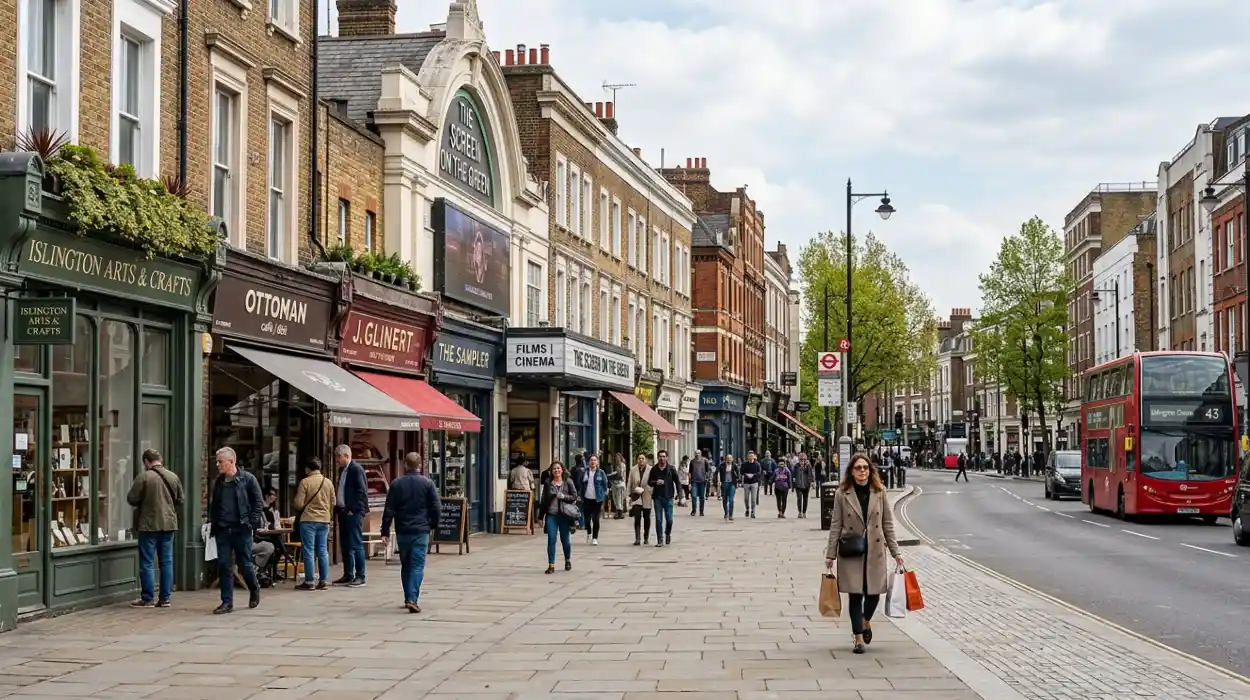
The history of retail commerce in Islington spans from its origins as a rural agricultural hub supplying medieval London to its nineteenth-century urbanization, which established Upper Street as a primary commercial thoroughfare specializing in artisanal production, entertainment, and independent merchant trades.
- How did Victorian trade directories catalog independent merchants in North London?
- Which historical boutique services and specialized crafts defined Upper Street?
- What mechanisms caused the transition from historical guilds to modern independent boutique shops?
- How do modern conservation frameworks protect historical storefronts and commercial heritage in Islington?
- What long-term socioeconomic insights can be derived from Islington’s historical commercial data?
Historically, the area of Islington operated as a pastoral village focused on dairy farming and livestock grazing. This agricultural identity directly supported the neighboring City of London. The transformation from an agrarian landscape into a structured retail economy accelerated during the Georgian and Victorian eras. The completion of the Regent’s Canal in 1820 and the opening of the Royal Agricultural Hall in 1862 catalyzed industrial growth and commercial footfall.
As population density escalated, local trades evolved rapidly. The region became a specialized center for high-value manufacturing, clockmaking, and luxury crafts. Upper Street emerged as a major linear retail corridor. W. Trounce’s Islington Directory, first published in 1852, documented hundreds of distinct commercial operations along this route, noting a shift toward permanent retail shops (Atkins, 1989). Rather than relying on transient street stalls or itinerant market sellers, the local population increasingly frequented dedicated premises. These businesses included drapers, grocers, and specialized craftsmen.
The socio-political landscape of the nineteenth century heavily influenced this urban evolution. The expansion of the middle class in suburbs like Canonbury and Barnsbury created an immediate demand for boutique consumer goods. For instance, the Post Office London Directory of 1881 illustrates that Islington supported massive specialized manufacturing sites alongside its shops, including large-scale musical instrument operations like Charles Venables & Co. on Canonbury Road (Kent, 2015). This synthesis of localized production and front-facing retail established a dense, self-sustaining merchant economy. The architectural remnants of these Victorian shopfronts continue to define the spatial layout of the contemporary high street.
How did Victorian trade directories catalog independent merchants in North London?
Victorian trade directories cataloged independent merchants in North London through a rigorous cross-referenced system that divided businesses alphabetically by street address, proprietor name, and commercial classification, creating an analytical registry designed for commercial discovery and municipal tax monitoring.
The operational structure of nineteenth-century directories relied on precise door-to-door data collection. Local publishers deployed surveyors to record the name of each occupant, the specific trade practiced, and the rateable value of the property. This methodology was championed by independent local printers like J. H. Jackson and W. Trounce, who broke the monopoly held by larger citywide publications such as Kelly’s Directory (Atkins, 1989). Trounce’s annual Islington Directory, which ran continuously from 1853 until 1905, offered localized granularity that larger volumes overlooked, ensuring that even minor suburban tradesmen were indexed (Atkins, 1989).
These historical volumes divided listings into three distinct analytical components:
- Street Directories: Organized sequentially by thoroughfare, mapping every storefront geographically.
- Commercial Directories: Alphabetized lists of all registered sole traders, partnerships, and corporate entities.
- Trades Directories: Classified sector indexes grouping similar businesses together, such as watchmakers, blacksmiths, and tailors.
This classification system served a dual socio-economic purpose. For consumers and merchant networks, it acted as a functional procurement tool. For local administrative bodies like the Islington Vestry, it provided verifiable data for municipal taxation and infrastructure planning. However, these registries omitted informal economic actors. Street traders, barrow mechanics, and temporary market stalls with no fixed brick-and-mortar address were systematically excluded from these formal records (Hamlett & Preston, 2025). Consequently, the directories reflect the formalization of the established middle-class merchant tier rather than the entirety of the urban working-class marketplace.
Which historical boutique services and specialized crafts defined Upper Street?
Upper Street was historically defined by a concentration of high-precision watchmakers, clock repairers, jewelers, and artisanal furniture manufacturers who leveraged the district’s proximity to Clerkenwell to establish a luxury retail hub catering to London’s expanding professional class.
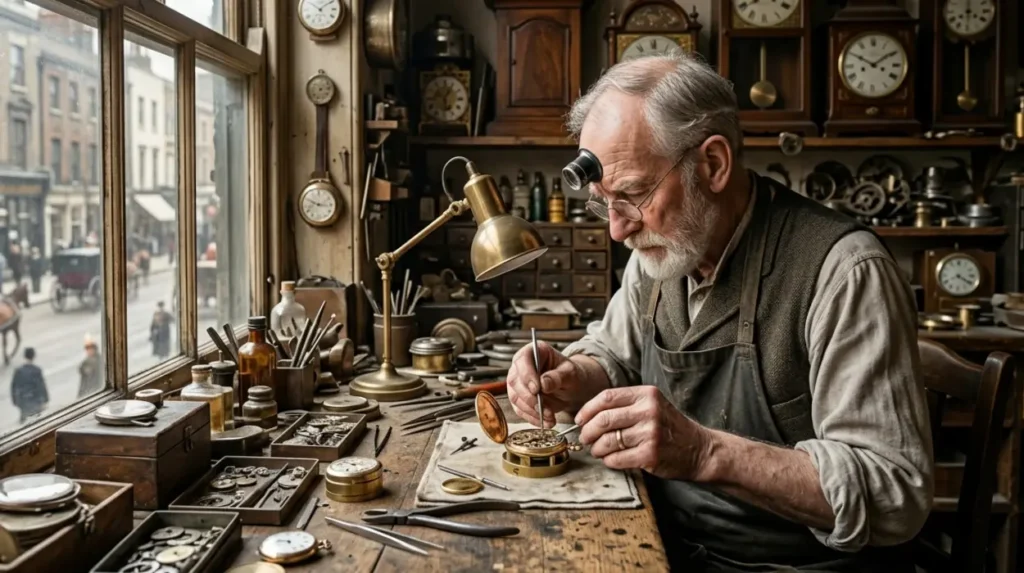
The commercial character of Upper Street derived from its proximity to Clerkenwell, the global center of the horological and precision instrument industries during the eighteenth and nineteenth centuries. Sub-assembly components made in Clerkenwell workshops were frequently brought to Upper Street workshops for final assembly, casing, and retail distribution. This specialization extended into goldbeating, silver plating, and gemstone cutting. Master craftsmen occupied narrow terraced shopfronts, using the ground floor as a public showroom and the upper levels or rear extensions as production workshops.
Simultaneously, the area became a prominent destination for high-end interior furnishings and musical instrument manufacturing. The abundance of skilled woodworkers and specialized hardware merchants supported these enterprises. Historical business records confirm that firms like Charles Venables & Co. operated large-scale facilities directly adjacent to Upper Street, employing numerous specialized artisans to build upright and grand pianos for domestic distribution (Kent, 2015).
The architectural design of these storefronts reflected their premium market positioning. Proprietors installed expensive plate-glass windows—a major design innovation of the mid-nineteenth century—to display intricate luxury items under gas lighting. This concentration of artisanal skill insulated Upper Street from the industrial mass-production trends occurring elsewhere in London, embedding a structural preference for specialized, independent retail operations that persisted through subsequent generations.
What mechanisms caused the transition from historical guilds to modern independent boutique shops?
The transition from historical guilds to modern independent boutique shops was caused by the legislative dismantling of trade monopolies via the Municipal Corporations Act 1835, the rise of consumer culture during the Industrial Revolution, and twentieth-century urban gentrification.
For centuries, London commerce was tightly regulated by the City of London Livery Companies and regional merchant guilds. These entities controlled training via mandatory seven-year apprenticeships, dictated pricing structures, and restricted non-members from operating retail establishments within specific municipal boundaries. The passage of the Municipal Corporations Act 1835 formally stripped these ancient corporations of their exclusive trading privileges across England, legalizing open market competition and allowing independent entrepreneurs to establish shops without guild interference.
This legislative deregulation coincided with profound macroeconomic changes:
- Mass Production and Logistics: The expansion of the railway network and steam-powered manufacturing lowered raw material costs, enabling independent shops to source diverse global inventories.
- Demographic Shifts: The rapid growth of the suburban middle-class population in North London created a reliable consumer base with disposable income looking for distinct, non-standardized commodities.
- Post-War Urban Transformation: Following the structural damage of World War II, real estate values in Islington declined significantly. This low-cost environment attracted a wave of artists, independent bookdealers, and antique merchants during the 1960s and 1970s.
This influx initiated the modern gentrification process. The cheap rent allowed creative entrepreneurs to repurpose vacant Victorian industrial spaces, such as old stables, warehouses, and factories, into boutique retail clusters. The Camden Passage antique market, established during this era, serves as a direct example of this reuse. The legacy of guild-enforced craftsmanship evolved into a marketing strategy centered on curation, brand narrative, and unique consumer experiences. This development insulated local retailers from competing directly with department stores and suburban shopping malls.
Explore More Local Businesses
Queen Rania Brings French Luxury and Global Defiance to SXSW London 2026
Tesco Launches Hot Meal Deal for Clubcard Holders: Welwyn 2026
How do modern conservation frameworks protect historical storefronts and commercial heritage in Islington?
Modern conservation frameworks protect historical storefronts and commercial heritage in Islington through statutory listing status managed by Historic England, the designation of municipal Conservation Areas by the Islington Borough Council, and strict planning controls governing architectural alterations.
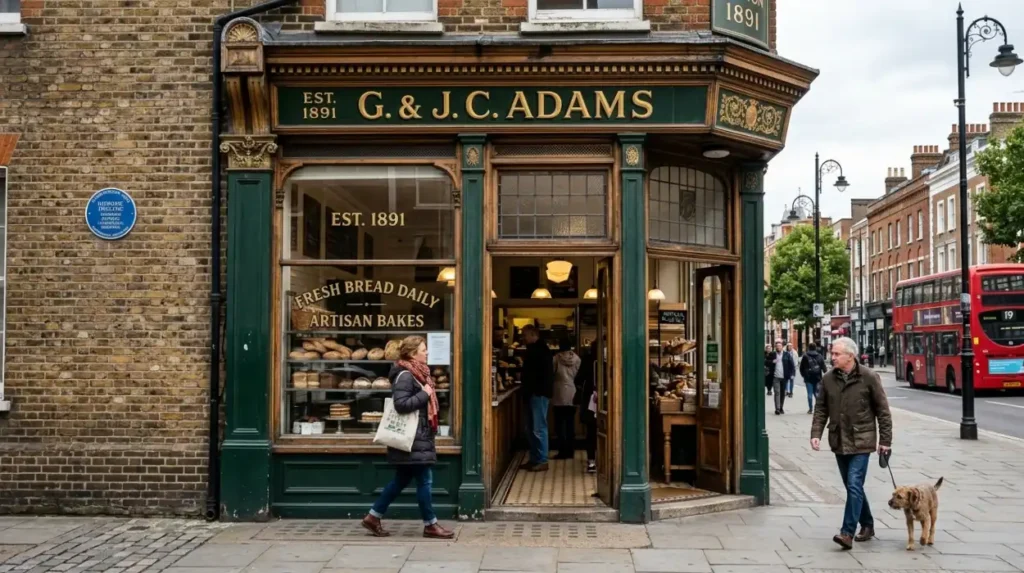
The protection of Islington’s visual commercial history relies on the Planning (Listed Buildings and Conservation Areas) Act 1990. Under this legislation, individual structures of exceptional architectural or historic interest receive Grade II, Grade II*, or Grade I status. This status makes it a statutory offense to alter, extend, or demolish any part of the building without explicit administrative consent. Beyond isolated buildings, entire commercial corridors are protected through local Conservation Area designations. This mechanism safeguards the broader architectural character of the streetscape, including historic plots, rooflines, and spatial relationships.
Within these zones, the Islington Borough Council enforces strict design guidelines tailored specifically to historic retail frontages. These regulations target the preservation of original nineteenth-century architectural elements:
- Fascias and Cornices: Requiring the retention of timber signage fascias, decorative corbels, and lead-dressed cornices.
- Pilasters and Stallrisers: Protecting the structural vertical pillars and the solid base panels beneath shop windows, which were traditionally constructed from brick, stone, or timber.
- Fenestration and Glazing Bars: Mandating the repair of original timber sash frames and delicate glazing bars rather than replacing them with large sheet glass or aluminium framing.
To experience this historic landmark in person today, consult our comprehensive [Londoner News Visitor Guide to Islington Independent Shopping Districts] for itineraries and visiting parameters.
These planning directives restrict the use of internally illuminated corporate lightboxes, plastic signage, and external roller shutters that compromise the historical character of the area. Property owners must install traditional open-lattice metal grilles or internal security glass instead. Furthermore, the council provides targeted financial grants and advisory services through heritage economic regeneration schemes. These initiatives encourage independent businesses to restore historically accurate hand-painted signage and traditional linseed-oil paint finishes, ensuring that modern commercial spaces retain their physical links to Victorian merchant history.
What long-term socioeconomic insights can be derived from Islington’s historical commercial data?
Analysis of Islington’s historical commercial data reveals distinct economic cycles characterized by mid-nineteenth-century suburban wealth accumulation, severe mid-twentieth-century industrial decline, and a late-twentieth-century transition to a service-and-experience-driven retail economy.
Municipal rate books, census returns, and trade directories from 1850 onward provide quantifiable data regarding urban wealth and consumer behavior. In the mid-nineteenth century, the low vacancy rates and high rateable values along Upper Street and Holloway Road confirmed a prosperous local economy. The high density of specialized luxury trades, such as silk mercers, carriage builders, and piano manufacturers, matches census data showing a large population of resident professionals, merchants, and independent clerks (Kent, 2015). This data reveals a highly localized economic loop where wealth generated in the City of London directly funded suburban artisanal retail.
However, the data shifts dramatically between 1920 and 1970. Trade directories from this period record a sharp decline in luxury craft listings and a major increase in vacancy rates and industrial scrap yards. This trend reflects the broader deindustrialization of London, where structural manufacturing relocated to peripheral outer boroughs or regional centers. The socioeconomic impact is evident in mid-century housing and land-use records, which show the division of large Georgian family homes into multi-occupancy tenancies and a drop in local purchasing power.
The post-1980 commercial data registers the onset of contemporary gentrification, marked by a rise in boutique retail, high-end restaurants, and independent services. Analysis of modern business registries shows that while the physical count of traditional commodity retailers (such as butchers, fishmongers, and drapers) has declined, it has been replaced by experience-focused independent entities. These include specialty coffee roasters, independent bookshops, artisan design studios, and boutique wellness services.
This transformation indicates that survival for modern independent merchants requires pivoting away from basic commodity distribution—which is dominated by e-commerce and supermarket chains—toward hyper-specialized, curated services. This dynamic shows that the historic built environment acts as an economic asset, attracting affluent consumers who value the architectural identity and distinct character of independent retail corridors.
Why is Islington important in London’s retail history?
Islington evolved from a rural farming community into one of North London’s most significant commercial districts. During the Georgian and Victorian periods, it developed a dense network of permanent shops, workshops, and specialist manufacturers, particularly along Upper Street.