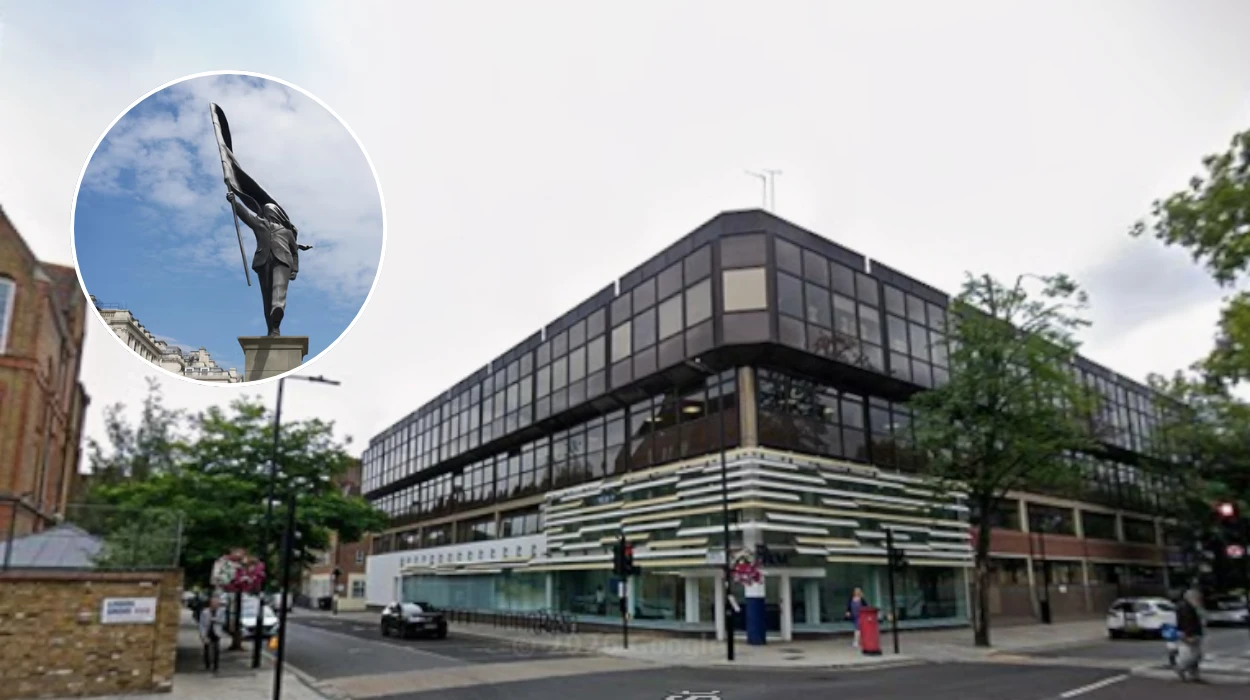
- A mysterious statue created by world-renowned street artist Banksy appeared overnight via a crane at Waterloo Place in the St James’s neighbourhood of central London.
- The sculpture portrays a suited man holding a large flag that completely covers his face, blinding him as he marches forward and steps halfway off the edge of a plinth.
- Banksy verified his authorship of the piece via an Instagram post, sharing nighttime installation footage with his millions of followers.
- Westminster City Council announced that the artwork will remain in situ for at least the next few weeks, with a definitive decision on whether it will become a permanent installation expected by the end of the summer.
- Local authorities and municipal representatives have noted that the sculpture has transformed into a massive tourist magnet, prompting safety barriers and protective initial measures.
London (The Londoner News) July 28, 2026 – The high-profile statue erected in the heart of the British capital by the elusive street artist Banksy could potentially transition into a permanent fixtures in London’s landscape, as municipal authorities deliberate on its long-term future. The artwork, which has continuously drawn vast hordes of curious onlookers, tourists, and art enthusiasts to the historic St James’s district, is guaranteed to remain on view for the upcoming weeks while Westminster City Council weighs its options.
H2: What are the details of the Banksy statue in central London?
The controversial sculpture is situated at Waterloo Place, an upscale area surrounded by traditional gentlemen’s clubs, luxury businesses, and significant government and foreign diplomatic missions. As documented by reporter Travers and cited by The Art Newspaper, the artwork depicts a suited individual carrying an oversized flag that blankets his entire face.
This stylistic choice effectively blinds the figure as he takes a dangerous step forward, teetering halfway off the edge of the stone plinth.
The piece blends seamlessly into the imperial and military-focused aesthetics of the 19th-century plaza, matching the bronze and granite textures of nearby monuments such as the Duke of York Column, the Crimean War Memorial, and statues honouring figures like Florence Nightingale and King Edward VII.
H2: How did Banksy confirm his ownership of the artwork?
Speculation surrounding the sudden appearance of the monument was swiftly cleared up by the artist himself. As noted in reports by The Art Newspaper, Banksy took to social media to claim the installation. In an official post on Instagram delivered to his 14 million followers, the artist shared exclusive footage revealing that the heavy structure had been hoisted into place under the cover of night with the assistance of a large crane.
A spokesperson for Westminster City Council provided an update regarding the current status of the piece. As stated by a Westminster City Council spokesperson to The Art Newspaper,
“There has been no decision made [re: the work] at the moment. We are expecting a conclusion by the end of the summer. It’ll remain on view for the next few weeks.”
Explore More Central London News
AI Firms Drive Office Take-Up in Central London 2026
Central London House Prices Plunge in Westminster, 2026
H2: What is the local response to the Westminster sculpture?
Since its clandestine installation, the artwork has sparked widespread public debate and heavy foot traffic. The statue’s satirical political undertones—interpreting a blinded figure marching off a cliff of institutional support—have triggered polarized reactions from passersby. In video footage previously distributed alongside the artist’s announcement, ordinary members of the public captured varying opinions, with one local pedestrian bluntly remarking to the camera: “No, I don’t like it.”
Despite mixed reviews from individual citizens, municipal leadership has taken a measured and largely receptive stance towards the intervention. Earlier statements issued by Westminster City Council and highlighted by the Associated Press noted the municipality’s appreciation for cultural additions:
“We’re excited to see Banksy’s latest sculpture in Westminster, making a striking addition to the city’s vibrant public art scene. While we have taken initial steps to protect the statue, at this time it will remain accessible for the public to view and enjoy.”
H2: How does this installation compare to Banksy’s previous London works?
The deliberation over the Waterloo Place statue contrasts sharply with the fates met by several of Banksy’s past interventions across the United Kingdom. Last autumn, a politically charged mural outside the Royal Courts of Justice—depicting a judge striking a protester—faced swift removal due to the strict legal protections governing listed buildings. Similarly, other unauthorized pieces have frequently faced rapid administrative crackdowns.
However, the immense public enthusiasm and tourist traction surrounding the St James’s flag-bearer piece have given local officials pause, turning what usually amounts to a swift administrative removal into a prolonged policy discussion.
Art experts and city planners are closely watching the council’s upcoming verdict, which is anticipated to set a significant precedent for how unauthorised, large-scale political public art is handled within central London districts.
As the summer progresses, the fate of the faceless man marching off his plinth remains suspended in bureaucratic limbo, leaving thousands of daily visitors to contemplate the striking imagery before a final ruling is passed down by Westminster authorities.