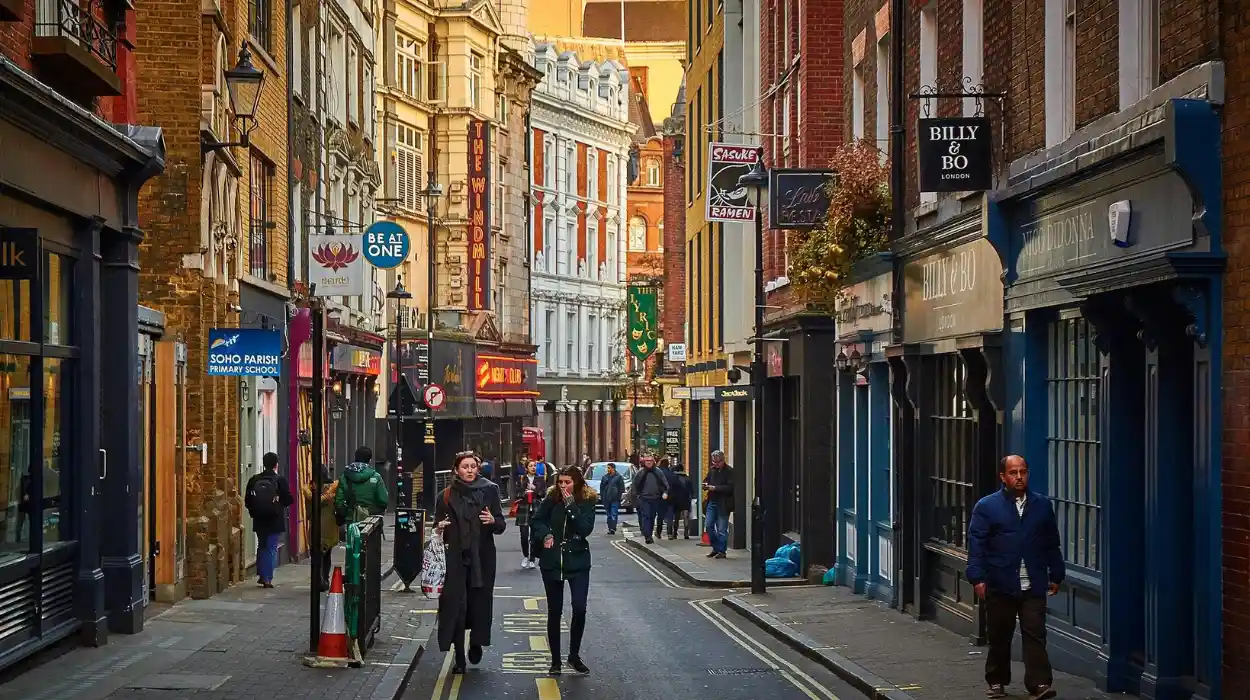
Soho is one of London’s most historically layered districts, combining seventeenth-century streets, immigrant communities, food traditions, music venues, theatres, markets, creative industries, and LGBTQ heritage. Its modern identity developed through centuries of redevelopment, migration, entertainment, commerce, and cultural exchange in the West End.
- What is the history of Soho and why is it culturally important?
- Which historic places in Soho best explain its architectural development?
- Where can visitors experience Soho’s historic food culture?
- Which Soho markets are important for food and local culture?
- Which places best reveal Soho’s music history?
- How did Soho become associated with nightlife and bohemian culture?
- What can visitors learn about LGBTQ history in Soho?
- Which cultural streets and landmarks should visitors explore on foot?
- How has Soho preserved its historic character while continuing to change?
- What is the long-term cultural significance of exploring Soho today?
- Frequently Asked Question
What is the history of Soho and why is it culturally important?
Soho developed from open fields after the Restoration of 1660 and became a residential district from the late seventeenth century. Its later transformation involved migration, markets, entertainment, music, restaurants, creative industries, and LGBTQ communities, creating the culturally diverse West End district visitors recognise today.
Soho occupies a compact part of the City of Westminster immediately north of Piccadilly Circus and west of Charing Cross Road. Its historical development accelerated after the Restoration of the monarchy in 1660, when London expanded beyond older built-up areas.
The district was formerly associated with Soho Fields. Land east of Wardour Street belonged to an estate associated with the Earl of St Albans before passing to the Earl of Portland. Development followed the creation of streets and residential plots around Soho Square. The London Garden Trust records Soho Square as an important early example of a planned London square, with its garden established in 1681.
St Anne’s Church became a major institutional landmark. Built between 1677 and 1686, the church helped establish the parish structure that gave the developing neighbourhood a civic and religious centre. The surrounding streets subsequently acquired a mixture of houses, shops, workshops, public houses, entertainment businesses, and later restaurants.
Soho’s social composition changed as wealthier residents moved away and the population diversified. French Huguenots, Italians, Jewish communities, Maltese migrants, Chinese entrepreneurs, artists, musicians, actors, writers, workers, and small businesses all contributed to the district’s development. This migration history explains why Soho became associated with international food and cultural exchange.
The district also developed close relationships with London’s West End theatre industry. Its location beside major theatres and shopping streets created demand for restaurants, cafés, bars, clubs, tailors, printers, recording businesses, and entertainment venues.
Modern Soho therefore represents more than a nightlife district. It is a historic urban landscape where residential development, migration, commerce, architecture, music, food, and social history remain physically connected.
Which historic places in Soho best explain its architectural development?
Soho’s historic architecture is concentrated in surviving Georgian and early buildings around Soho Square, Old Compton Street, Greek Street, Frith Street, Dean Street, and surrounding lanes. Listed buildings preserve evidence of seventeenth-, eighteenth-, nineteenth-, and twentieth-century urban change.
Soho is particularly valuable for architectural study because redevelopment never completely erased its earlier street pattern. Small plots, narrow streets, terraces, rear yards, shopfronts, basements, and surviving houses reveal how London’s West End evolved incrementally.
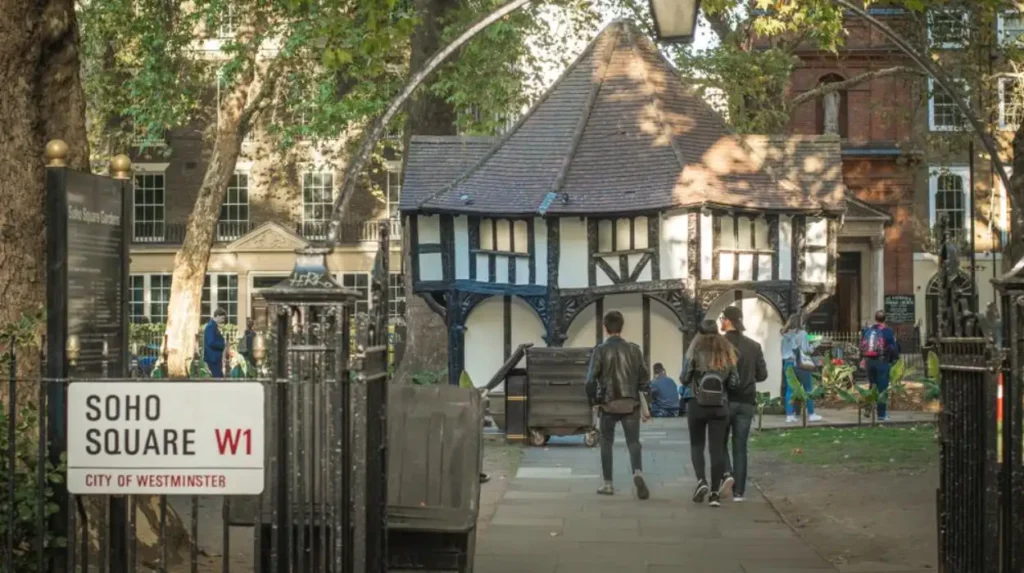
Soho Square is the clearest starting point. Westminster City Council dates the square to the 1680s and identifies it as a central green space within modern Soho. Its present garden contains mature planting and the distinctive half-timbered central building constructed in 1895 and refurbished in 2009.
Historic England records several listed buildings around the square. Number 15 is one of the surviving houses associated with the original development of the square, dating from approximately 1677–80, while number 13 was rebuilt in 1768–69 after an earlier structure. These buildings demonstrate the survival of early residential fabric within a heavily commercial neighbourhood.
Old Compton Street contains further evidence of Soho’s early development. Historic England identifies buildings such as number 4 as rare survivals from the earliest phase of Soho’s growth. Number 6 is a late seventeenth- or early eighteenth-century house that retains elements of its original plan and staircase.
These buildings matter because their historical value is not limited to façades. Interior plans, staircases, panelling, fireplaces, roof forms, and construction materials preserve evidence about how early Soho residents occupied their homes.
The architecture also records commercial adaptation. Houses became shops, restaurants, offices, clubs, studios, and other businesses. This repeated conversion created the mixed-use urban character that remains central to Soho.
For students of architectural history, the district provides a compact case study of London’s transition from planned residential development to dense commercial and entertainment activity.
Where can visitors experience Soho’s historic food culture?
Soho’s food culture developed through markets, immigrant communities, cafés, restaurants, bakeries, pubs, and specialist businesses. Berwick Street Market and Chinatown provide especially clear examples of how international migration and changing consumer demand shaped the district’s culinary identity.
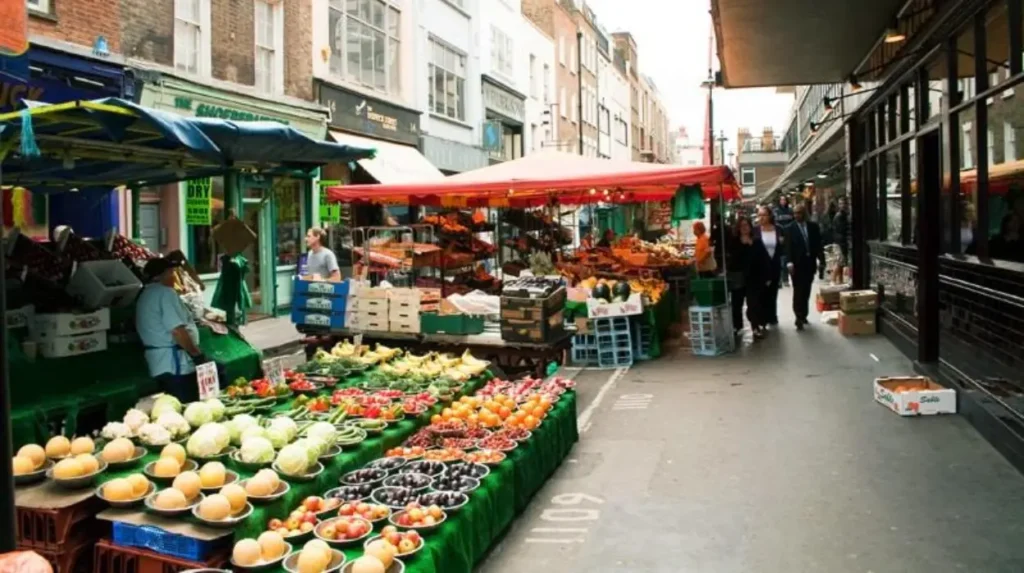
Berwick Street Market is one of Soho’s most important food landmarks. Westminster City Council dates the market to 1778 and describes it as one of London’s oldest markets. Its historic trade included textiles and fresh produce, while its modern role includes international takeaway food, flowers, coffee, dairy products, fruit, and vegetables.
The market demonstrates the relationship between food and urban commerce. Markets served residents, workers, traders, and visitors while adapting to changes in the surrounding economy. Berwick Street now functions as a major lunchtime destination within a dense employment and hospitality district.
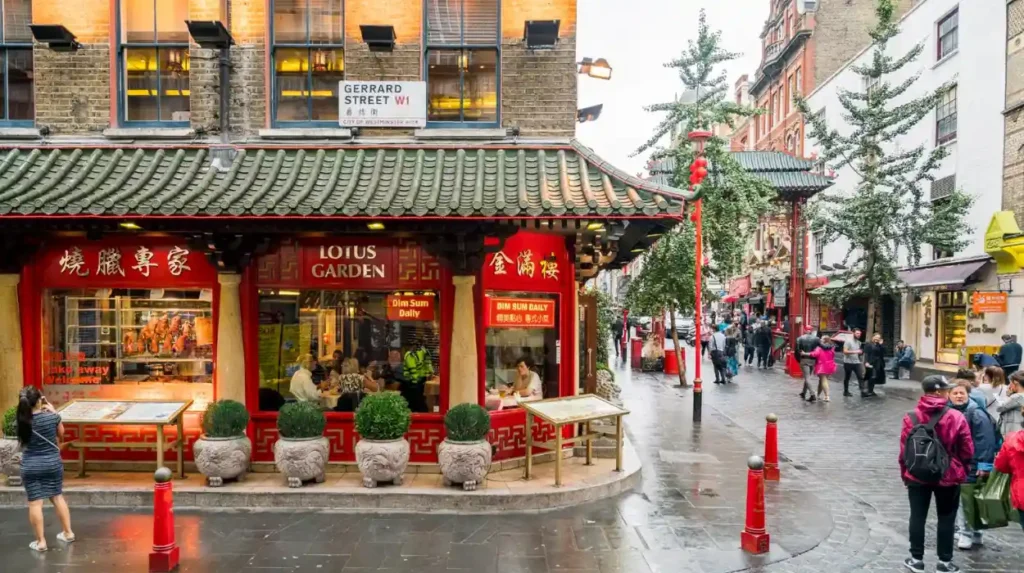
Chinatown provides another essential food-history experience. Present-day Chinatown developed after the Second World War as Chinese restaurants and businesses expanded into Soho. The community grew rapidly during the 1950s and 1960s, particularly through migration from Hong Kong and the expansion of the restaurant industry.
The history of London’s Chinese community began earlier in Limehouse in the East End. Wartime destruction and post-war economic conditions contributed to the movement of businesses and people westward. Returning British servicemen also brought increased familiarity with Chinese cuisine, strengthening demand for restaurants in Soho.
By the late 1960s, Chinatown had become an established centre of Chinese community life. Businesses expanded beyond restaurants into supermarkets, travel agencies, barbers, bookshops, community organisations, and other services.
Today, Gerrard Street and its surrounding streets provide an accessible way to study this migration history through food. Restaurants, bakeries, specialist shops, street decorations, Chinese architectural elements, and community businesses connect contemporary visitors with a post-war transformation of Soho.
The food history extends beyond Chinatown. Soho’s French, Italian, Greek, Jewish, Irish, and other migrant histories influenced cafés, restaurants, bakeries, pubs, and specialist businesses. The district’s culinary diversity is therefore a direct product of demographic change rather than a recent tourism trend.
Which Soho markets are important for food and local culture?
Berwick Street Market provides Soho’s strongest historic market connection, while Rupert Street represents the district’s continuing adaptation of street trading. Together they show how markets changed from traditional produce and textile commerce into modern food, cultural, craft, and independent trading spaces.
Berwick Street remains central to Soho’s commercial identity. Westminster City Council states that the market operates from Monday to Saturday and offers products including fruit, vegetables, flowers, coffee, dairy goods, and international takeaway foods.
Its historical importance extends beyond food. The council’s market documentation records a long association with textiles, fresh produce, and music. This combination reflects Soho’s broader pattern of overlapping industries rather than strict separation between commercial activities.
Rupert Street provides a newer example of market adaptation. Westminster City Council operates the market with themed trading days covering general goods, artisan food, world street food, vintage fashion, arts, crafts, and jewellery. The market operates from Monday to Saturday during its current programme.
The development of evening trading is historically significant because Soho has long depended on activity outside conventional daytime retail hours. Its theatres, clubs, restaurants, pubs, music venues, and entertainment businesses created an economy based on extended activity.
Markets also provide opportunities for independent traders. Westminster’s licensing system regulates market pitches and street trading, linking modern food commerce with formal local government management.
For cultural tourists, the markets provide an immediate connection between historical commerce and contemporary urban life. For educators and researchers, they demonstrate how street trading survives through adaptation rather than remaining frozen as a historic practice.
Which places best reveal Soho’s music history?
Soho became one of London’s most important music districts through jazz clubs, coffee bars, recording studios, nightclubs, and live venues. Ronnie Scott’s remains a major surviving institution, while Wardour Street and Old Compton Street preserve the wider geography of twentieth-century popular music.
Ronnie Scott’s is the clearest surviving example. Founded in 1959 by saxophonists Ronnie Scott and Pete King, the club became a major London jazz institution. Its present home is at 47 Frith Street, while its history connects Soho with international jazz performance.
The club was particularly important because it regularly presented American jazz musicians in Britain. Its historic performers include Miles Davis, Nina Simone, Ella Fitzgerald, Chet Baker, Jimi Hendrix, Prince, and Amy Winehouse.
Ronnie Scott’s demonstrates the importance of small venues in music history. A basement club provided a concentrated environment for musicians, audiences, promoters, and emerging performers. The venue’s continued operation makes it a rare example of institutional continuity within Soho’s rapidly changing entertainment economy.
Wardour Street also holds major music-history associations. Soho’s post-war music scene included jazz, rhythm and blues, rock and roll, and later popular music. Historic England’s research into Soho’s social history records the importance of clubs and venues to the district’s development.
The 2i’s Coffee Bar on Old Compton Street became an important location in the development of British skiffle and rock-and-roll culture during the 1950s. Its significance demonstrates how coffee bars became informal performance spaces during the emergence of youth music culture.
The music story also includes recording and production. Soho’s proximity to the West End, media businesses, theatres, and advertising industries supported a wider creative economy. Westminster’s planning documentation identifies creative, advertising, film-editing, and post-production activity around Wardour Street as part of Soho’s continuing economic character.
Visitors interested in music history should therefore explore Frith Street, Wardour Street, Old Compton Street, and surrounding lanes rather than treating a single venue as the complete story.
How did Soho become associated with nightlife and bohemian culture?
Soho’s nightlife developed through clubs, pubs, cafés, restaurants, theatres, private members’ venues, and entertainment businesses. Its central West End location attracted artists, musicians, migrants, writers, affluent visitors, and marginalised communities, producing a distinctive twentieth-century culture of nightlife and social experimentation.
Soho’s nightlife expanded during the twentieth century because its location placed it beside major theatres, shopping districts, and other entertainment centres. Affordable commercial premises and dense streets supported small clubs and specialist businesses.
Historic England describes Soho as a district where nightclubs and underground bars expanded during the early twentieth century. Jazz clubs, private clubs, bottle parties, dining clubs, and other venues attracted artists, musicians, wealthy social groups, migrants, and people who challenged conventional social behaviour.
The 43 Club at 43 Gerrard Street became one of the most notorious venues of the 1920s. The National Archives holds police records concerning the club, demonstrating how nightlife was also connected with policing and government regulation.
This history is important because Soho’s reputation was not created by restaurants and bars alone. Regulation, licensing, policing, entertainment, migration, and changing social attitudes all shaped the district.
The area’s nightlife also influenced its architectural form. Basements became clubs. Former houses became restaurants. Small upper-floor rooms became offices or studios. Shopfronts changed repeatedly as businesses changed.
The French House and other historic pubs form part of this cultural landscape. Their importance lies in their association with artists, writers, actors, musicians, and political figures rather than simply their role as drinking establishments.
Soho’s bohemian reputation also developed through the concentration of creative workers. Westminster’s planning documents identify the area’s continuing relationship with creative industries, entertainment, hospitality, and small businesses.
This combination explains why a short walk through Soho can reveal architectural history, food history, music history, migration history, and social history within the same streets.
What can visitors learn about LGBTQ history in Soho?
Soho has more than a century of documented LGBTQ history, with Old Compton Street serving as a major twentieth-century centre. Historic England identifies cafés, clubs, pubs, and community spaces that demonstrate changing visibility, discrimination, activism, and legal equality.
LGBTQ history is central to understanding modern Soho. Historic England’s “130 Years of Queer Soho” project documents alternative sexual and social cultures from the late Victorian period to the present. The research includes locations across Old Compton Street, Wardour Street, Dean Street, Rupert Street, and surrounding areas.
The history includes the Au Chat Noir café on Old Compton Street, associated with Quentin Crisp during the interwar period. Crisp became a prominent writer and public figure whose life documented the discrimination faced by visibly gender-nonconforming gay men in twentieth-century Britain.
The Shim Sham Club at Wardour Street demonstrates another dimension of the story. Opened as a bottle party in 1935, it attracted musicians, artists, Black Londoners, Jewish Londoners, and LGBTQ people. Garland Wilson, an African-American pianist, performed at its opening. Historic England records police surveillance of the club and its clientele.
Old Compton Street became increasingly associated with openly gay businesses from the 1980s. Historic England records Comptons as the first gay venue to open on the street in 1986, followed by venues such as the Village in 1991.
The Admiral Duncan represents both the vulnerability and resilience of the community. On 30 April 1999, a nail bomb attack killed three people and injured around 70. A subsequent memorial vigil in Soho Square demonstrated the community’s collective response.
This heritage remains relevant because physical spaces preserve evidence of social change. Visiting Old Compton Street, Soho Square, Wardour Street, and associated historic venues allows visitors to connect present-day cultural life with the longer struggle for visibility and equality.
Which cultural streets and landmarks should visitors explore on foot?
The most historically informative Soho walk connects Soho Square, Greek Street, Frith Street, Dean Street, Old Compton Street, Wardour Street, Berwick Street, and Chinatown. This route links architecture, food, markets, music, migration, entertainment, and LGBTQ heritage within a compact urban landscape.
Soho Square provides the strongest starting point because its history reaches back to the seventeenth-century expansion of Soho. The square also demonstrates the importance of planned residential development in shaping the neighbourhood. Westminster City Council identifies it as a central green space behind Oxford Street.
From the square, Greek Street leads into an area associated with historic houses, restaurants, cafés, creative businesses, and entertainment. The street forms part of the wider architectural network created during Soho’s eighteenth-century development.
Frith Street is essential for music history because Ronnie Scott’s has operated there since 1959. The venue provides a direct link between the historic Soho jazz scene and contemporary live performance.
Dean Street provides another cultural layer through historic pubs, restaurants, clubs, and former creative gathering places. The street is part of Historic England’s documented queer heritage landscape.
Old Compton Street provides the strongest connection between food, social history, architecture, and LGBTQ heritage. Its surviving early houses demonstrate the physical age of Soho, while its restaurants, cafés, and venues represent later commercial and cultural transformations.
Wardour Street connects music, Chinatown, entertainment, and creative industries. Its businesses have changed repeatedly, but the street remains a major cultural spine.
Berwick Street provides the strongest market experience. Its market history dates to 1778, creating a direct connection between eighteenth-century commerce and modern food culture.
Chinatown then adds an essential migration and food-history dimension. Gerrard Street and the surrounding streets demonstrate how post-war Chinese migration reshaped Soho’s commercial and cultural identity.
To experience this historic district in person today, consult our comprehensive [The Fascinating History of Covent Garden From Fruit Market to Entertainment Hub] for itineraries and visiting parameters.
How has Soho preserved its historic character while continuing to change?
Soho preserves historic buildings through listed-building protection, conservation planning, neighbourhood policies, and community heritage work. At the same time, restaurants, markets, entertainment businesses, creative industries, and new development continue to change how historic streets are used.
Historic England’s National Heritage List for England provides statutory protection for significant buildings in Soho. Listed examples around Soho Square and Old Compton Street preserve architectural evidence from the district’s earliest development.
Listing protects buildings because of their special architectural or historic interest. The designation can cover structures, fixed features, and qualifying parts of their curtilage. This framework prevents historically important buildings from being treated solely as replaceable commercial property.
Conservation planning provides a wider layer of protection. Westminster’s Soho Neighbourhood Plan was formally adopted on 8 October 2021. The plan addresses culture, heritage, commercial activity, entertainment, and the night-time economy.
The plan also recognises the importance of recording Soho’s less conventional histories. Its heritage policies call for documentation of the sex industry and recommend updating the record of historic and unlisted buildings, community assets, and commemorative plaques.
This approach is important because heritage includes more than grand architecture. Soho’s cultural significance also exists in ordinary houses, market streets, clubs, pubs, restaurants, community venues, and spaces associated with minority communities.
Preservation therefore involves balancing physical conservation with economic change. Restaurants need functional premises. Markets require trading space. Music venues require suitable acoustics and licensing. Residents require housing. Businesses require viable rents. Heritage policy must accommodate these competing urban requirements.
Soho’s continuing change does not erase its historical identity. Instead, the surviving street pattern and protected buildings provide a framework through which new businesses and cultural activities continue to operate.
What is the long-term cultural significance of exploring Soho today?
Exploring Soho provides a concentrated study of London’s urban history because food, music, migration, architecture, markets, entertainment, and social movements developed within the same neighbourhood. Its surviving buildings and cultural institutions preserve evidence of continuous urban transformation.
Soho’s long-term significance comes from its layered history. The district began as fields on the edge of expanding London and developed into a planned residential area. Its population later diversified through migration and economic change.
Food became a major expression of this transformation. Berwick Street represents longstanding market commerce, while Chinatown records the post-war growth of Chinese restaurants and businesses. Together, these places show how migration and consumer demand influence urban identity.
Music provides another historical layer. Ronnie Scott’s demonstrates institutional continuity from the post-war jazz era to contemporary performance. Former coffee bars, clubs, studios, and entertainment venues show how Soho became connected to popular music and creative production.
LGBTQ heritage adds a social and political dimension. Old Compton Street and surrounding venues document changing attitudes towards sexuality, public visibility, policing, discrimination, activism, and equality. Historic England’s research demonstrates that this history extends well beyond the period when Soho became widely identified with LGBTQ culture.
Architecture provides the physical framework for these histories. Early houses, Georgian terraces, nineteenth-century alterations, twentieth-century shopfronts, clubs, markets, and modern businesses coexist within the same compact district.
For educators, Soho functions as an accessible fieldwork environment. Students can examine urban planning, migration, architecture, economic history, social history, music history, and heritage conservation without travelling between distant parts of London.
For genealogical researchers, Soho’s changing population provides important historical context. Parish structures, street names, businesses, religious institutions, migration patterns, and commercial records help explain how residents lived and worked within the district.
For heritage preservationists, Soho demonstrates why ordinary buildings and cultural venues require documentation. A historic neighbourhood can lose cultural meaning even when its most famous landmarks survive if smaller community spaces disappear.
For cultural tourists, the greatest value lies in connecting individual places. Soho Square explains the district’s planned origins. Berwick Street explains market commerce. Chinatown explains migration and food. Frith Street explains jazz. Old Compton Street explains LGBTQ heritage. Wardour Street connects music, entertainment, food, and creative industries.
Soho remains historically significant because these stories occupy the same streets. Its value is not based on a single monument. It rests on the accumulated evidence of London’s social, architectural, commercial, and cultural transformation.
Historical timeline of Soho
1660: The Restoration of the monarchy accelerates London’s expansion beyond older built-up areas.
1677–1686: St Anne’s Church is constructed and consecrated, establishing a major institutional landmark for the developing parish.
1681: Soho Square receives its planned garden, becoming an important early London square.
Late seventeenth century: Residential development expands across former Soho Fields.
Eighteenth century: Soho develops as a residential district and attracts increasingly diverse communities.
1778: Berwick Street Market is founded and becomes part of Soho’s commercial history.
Nineteenth century: Population diversification, commercial activity, entertainment, and migration reshape the district.
Early twentieth century: Clubs, cafés, restaurants, and nightlife strengthen Soho’s reputation as an entertainment district.
1930s: Venues such as the Shim Sham Club demonstrate Soho’s connections with jazz, Black cultural history, and LGBTQ social life.
1950s: Post-war Chinese restaurants and businesses begin establishing the present Chinatown district.
1959: Ronnie Scott’s is founded by Ronnie Scott and Pete King.
1960s: Soho becomes strongly associated with popular music, fashion, nightlife, restaurants, and creative industries.
1980s: Chinatown develops distinctive architectural and street features, while LGBTQ businesses become increasingly visible in Soho.
1990s: Openly visible LGBTQ venues and community activity become an increasingly prominent part of Soho’s identity.
1999: The Admiral Duncan bombing kills three people and injures around 70, becoming a major event in Soho’s LGBTQ history.
2021: Westminster formally adopts the Soho Neighbourhood Plan after residential and business referendums.
Today: Soho remains a major London centre for food, music, entertainment, culture, markets, creative industries, and heritage.
Soho is therefore best understood as a living historical district rather than a collection of isolated attractions. Its food streets, music venues, markets, historic houses, cultural institutions, and community spaces collectively document how London changes over time. The same streets that developed from seventeenth-century fields now support international restaurants, live music, creative businesses, and cultural tourism.
For visitors, the most rewarding approach is to explore Soho as an interconnected historical landscape. For researchers, it provides evidence of migration, commerce, architecture, entertainment, and social change. For educators, it offers a compact example of how historical forces remain visible within a modern city.
The preservation of Soho’s buildings and cultural memory will remain important because the district continues to evolve. Listed structures, conservation policies, community archives, markets, historic venues, and documented social histories provide the evidence needed to understand that change.
The enduring significance of Soho lies in this combination of continuity and transformation. Its historic streets remain active places where food, music, commerce, architecture, and cultural identity continue to intersect.
Frequently Asked Question
What are the best places to visit in Soho London?
The best historic and cultural places include Soho Square, Berwick Street Market, Old Compton Street, Frith Street, Wardour Street, Chinatown and Ronnie Scott’s. Together, these locations showcase Soho’s architecture, food, music and social history.