
Key Points
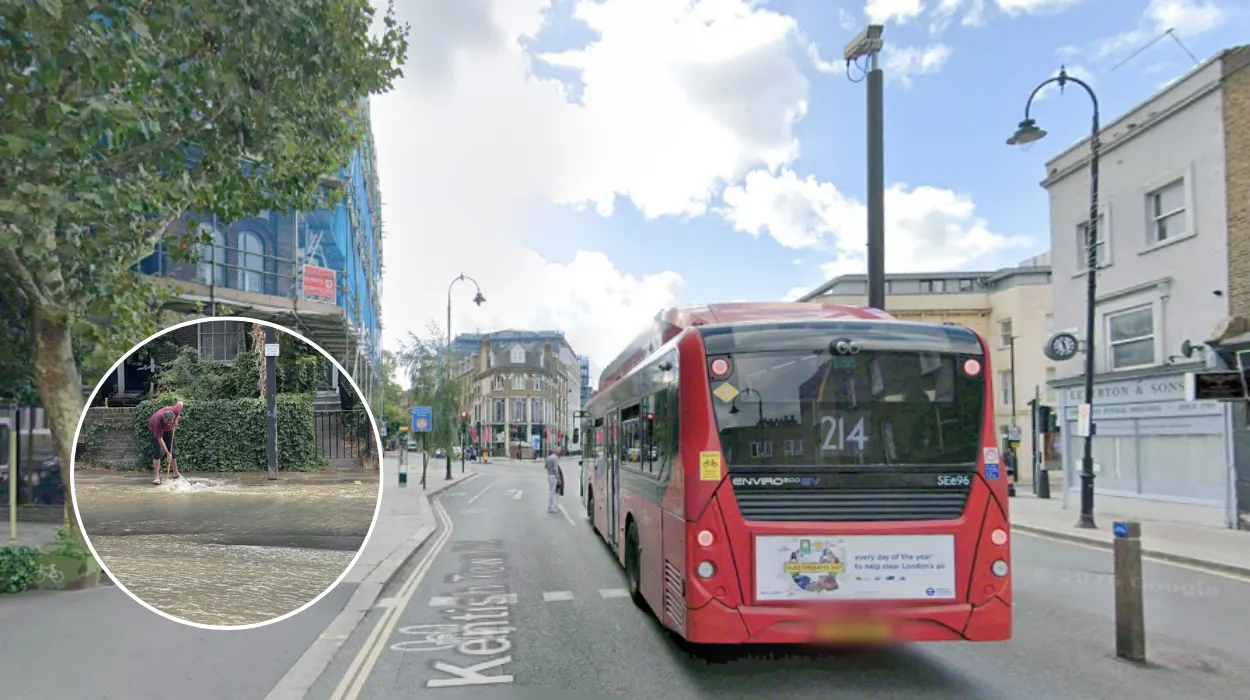
- A major water main burst on Kentish Town Road, causing flooding to such an extent that the people were in a state of “panic” owing to the fact that there was roughly one foot of water flooding the high street.
- The incident started explosively at around 10.15 am on Friday, 28th August at the location of Pang’s London, which is a local Chinese takeaway shop.
- Thames Water engineers stayed at the site over the weekend as they discovered a second burst pipe hidden somewhere underneath the already excavated section.
- Businesses in the locality said that they had incurred major financial losses owing to the fact that roads had been closed off to the public and footpaths were blocked during what is a Bank Holiday/Carnival weekend.
- Thames Water has officially stated that even though water supplies have been restored using network diversions (though not necessarily at lower pressure), it would still take a few weeks for the road closures and subsequent reinstatement to be finished.
- Some parts of the Kentish Town Road have been closed off in both directions from the Royal College Street and Hawley Road with buses (46, 88, 134, and 214) being diverted.
London (The Londoner News) August 29, 2026 — Local residents and business owners in the north London neighborhood of Camden faced a chaotic weekend of disruption after a massive water main rupture on Kentish Town Road triggered immediate flooding, followed by the discovery of a secondary underground rupture that threatens to keep a key local route closed for weeks. The dramatic incident unfolded when an underground pipe—reportedly sitting 16 metres deep—burst open with an explosion-like sound, sending a heavy surge of water cascading down the busy thoroughfare. As emergency repair crews scrambled to secure the area, water suppliers confirmed that a secondary fault had complicated stabilization efforts, guaranteeing prolonged delays for motorists, pedestrians, and commercial traders.
Why did Kentish Town Road descend into panic during the burst pipe incident?
The unfolding crisis began late Friday morning, catching morning commuters and traders completely off guard. As reported by My London writer, a Thames Water representative noted that the initial high-pressure leakage started at approximately 10.15am on Friday, August 28.
Describing the terrifying sequence of events, Bhaviti Degamia, 47, owner of Wow Brows, told My London journalist that the street went into a sudden state of panic after hearing a loud, explosion-like noise and witnessing a rapid torrent of water rush past storefronts.
As documented by My London, Bhaviti Degamia stated that:
“We were just going about our day and then at about 10.20am our landlord came in and said there was a flood. I heard something that sounded like an explosion. When I walked out, I saw that the pavement had erupted and broken, with water gushing everywhere and debris from beneath covering the road.”
She further explained to My London reporter that:
“Some of the shops nearer to the explosion had water come into their shops. We all just stood there in complete bedazzlement; nobody could walk along the street. The street went into panic.”
According to accounts compiled by local titles including Ham & High, the floodwaters stretched heavily across the NW1 and NW5 postcodes, bringing swift response teams from Thames Water who arrived by mid-afternoon to manage the crisis.
How are local businesses coping with the severe economic fallout?
The sudden road closures and physical blockades have severely choked commercial footfall during a critical trading period. Traders lining Kentish Town Road expressed immense frustration over lost revenue, noting that the timing coincided with major weekend events like the Notting Hill Carnival period.
Detailing the financial impact to My London, Bhaviti Degamia stated that:
“Yesterday, for the entire morning from 10.20am until 2pm, we couldn’t get any trade, we couldn’t have any clients in, and we lost about £300. We had to close our front doors and board up our doors if the water started rising; luckily, we were at a gradient.”
Other nearby retail operators echoed similar sentiments regarding the crippling safety cordons. The manager of Payless Food & Wine London, a local newsagent situated near the epicenter of the burst water main, highlighted the severe lack of passing customers caused by the security perimeters.
As reported by My London, the manager of Payless Food & Wine London stated that:
“I wasn’t here, but the staff rang me and sent me videos, and yeah, I just hoped that the water stopped before it got to us, it would have flooded our basement with stock in as well, so we were very lucky. We lost trade because they closed off the road and the pathway, so obviously no customers.”
Emphasizing the compounded losses across the wider trading weekend, the manager added, as quoted by My London:
“We are definitely seeing a difference. We can’t get deliveries either because of the Carnival weekend; we were expecting a lot of passing trade. We are looking at around £2,000-£3,000 losses this weekend in sales, that is for the entire weekend.”
What is the latest update from Thames Water on the repairs?
Initial optimism that repairs would wrap up quickly was dashed when engineers digging deep into the primary excavation site uncovered an entirely separate issue. This unforeseen complication has expanded the scope of structural engineering work required on site.
Providing an official statement outlining the timeline and network recovery, a Thames Water spokesperson stated that:
“We’re still working on the second burst, which was found in the excavation already dug in Kentish Town Road.”
Addressing the immediate concerns of residents regarding interrupted services, the Thames Water spokesperson stated that:
“With the water having been diverted around the area, your water should now be flowing at your taps, you may notice the pressure is lower at first, but this will return to normal once we’ve fixed the broken pipe. Sorry if you were affected.”
However, addressing the structural longevity of the site, the utility provider delivered sobering news regarding the reopening schedule. As communicated directly to local stakeholders and reported across regional news platforms, the Thames Water spokesperson stated that:
“Once we’ve completed the second repair, we’ll then focus on reinstating the road and opening it. Though we must advise, unfortunately, this will most likely take a couple of weeks to complete. We’ll share the anticipated completion date as soon as it’s known.”
Prior to the discovery of the secondary pipe, initial communications from the water authority emphasized that emergency units were deployed rapidly to minimize structural deterioration. In a previous update published by Ham & High, a Thames Water spokesperson noted:
“Our specialist teams are now on site and we’re assessing the damage to see what we need to do to fix things. We’ve diverted water around the area, meaning you should now have your water supply back.”
They added regarding water consistency:
“The pressure may be lower than normal, but this will improve once we’ve fixed the broken pipe and left the site.”
Furthermore, customer care representatives were dispatched directly to the zone to guide residents through minor issues, such as temporary water discoloration, which the company noted is standard following heavy network turbulence.
Explore more North London News:
Dame Jenni Murray Crash Death Inquest in London 2026
Thames Water Burst Pipe Crisis Hits Muswell Hill 2026
Which transport routes and areas are affected by the ongoing road closures?
The physical closure of Kentish Town Road continues to exert heavy pressure on local transport infrastructure. Transport authorities have maintained strict perimeters to ensure public safety around the deep excavations.
According to updates covered by Ham & High, Kentish Town Road remains tightly shut in both directions specifically between Royal College Street and Hawley Road. Motorists have been strongly urged to completely avoid the immediate corridor and follow established local diversion frameworks.
Public transport users have also faced persistent disruptions. TfL and local transit advisories confirm that multiple prominent north London bus routes—namely the 46, 88, 134, and 214—have been forced onto extended diversion loops. While local traffic management teams report that surrounding vehicular networks are attempting to cope with the influx of diverted traffic, commuters traveling through Camden have been formally advised to factor substantial extra time into their daily journeys until full structural restoration is completed.