
Key Points
- As a lifelong friend, Lord David Blunkett has expressed appreciation for the “remarkable” beginning Prime Minister Andy Burnham has made since taking office, noting especially his ability to communicate, his compassion and empathy, and his sense of what the people want.
- Commenting on the conventional political milestone of “the first one hundred days,” Lord Blunkett observed in The Mirror that in less than seven weeks, Mr Burnham has managed to create great upliftment and hope, despite the difficult system he has inherited.
- The Prime Minister was able to deflect a question posed by the Conservative Party leader, Kemi Badenoch, during Prime Minister’s Questions on Wednesday when he turned it into an announcement of policy, saying, “What have I cut? I’ve cut tax,” specifically cutting the price of energy and helping out pubs and music venues.
- Mr Burnham has relocated some elements of the Downing Street machine to the north, and he has gone on a national listening tour, showing clearly his determination to decentralize power.
- It should be noted that Lord Blunkett warned about the insufficiency of merely moving the machinery of administration, as the main problem lies in the overcoming of institutional inertia and the prevalence of the “can’t do” or “can’t be bothered” attitude of society.
- The forthcoming national budget to be made by John Healey is going to be an important trial for the administration to show that political good intentions can be effectively delivered into practical benefits.
- At the same time, in his own political criticism in The Mirror, Lord Blunkett condemned the annual Reform UK conference, describing Robert Jenrick and Suella Braverman, who once were Tory cabinet ministers and then failed, as stars of the event, while criticizing Nigel Farage for acting as if “interest declarations and the rule of law apply to everyone except him.”
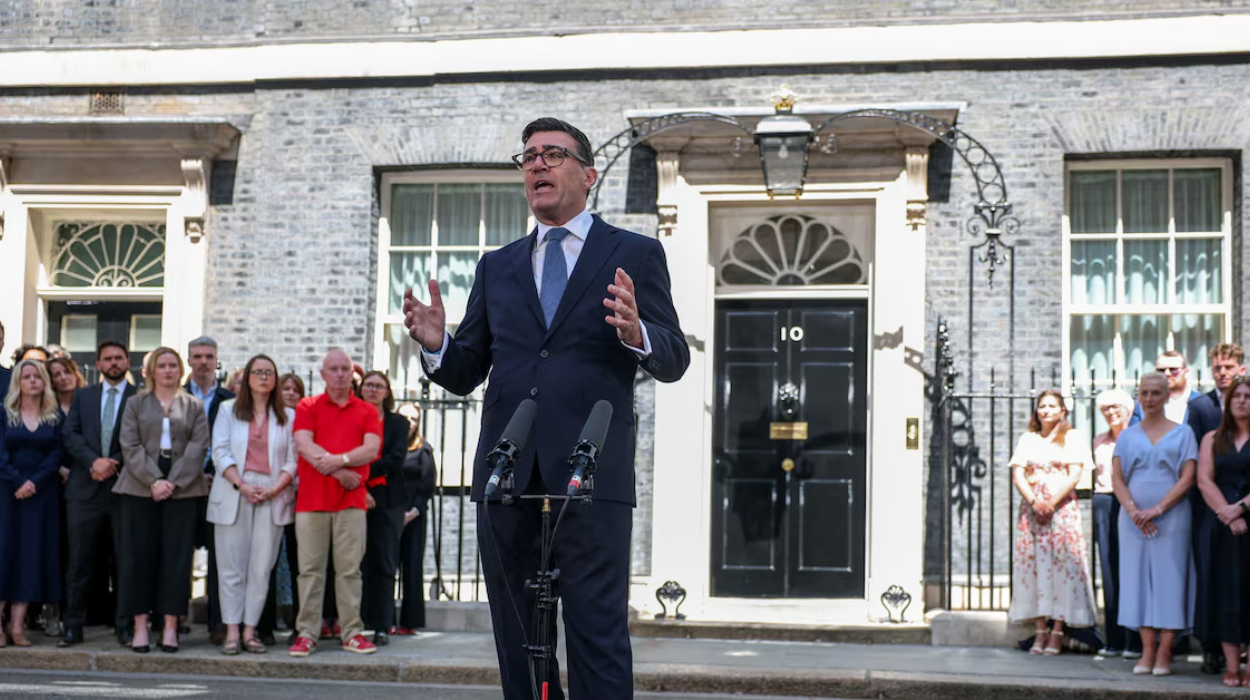
London (The Londoner News) September 5, 2026 — In British politics, the psychological benchmark of the “first one hundred days” has long served as a standard measuring stick for any incoming administration. Yet, as political veteran and Labour peer Lord David Blunkett pointed out, Prime Minister Andy Burnham has reached only roughly half that milestone, prompting high expectations from the electorate despite the immense structural hurdles awaiting his cabinet.
Writing exclusively for The Mirror, Lord Blunkett evaluated the opening weeks of Mr Burnham’s tenure, emphasizing that while he does not expect miracles from his long-standing friend, the early trajectory has been undeniably striking. As documented by Lord Blunkett in The Mirror, the Prime Minister has successfully “lifted people’s spirits” and injected a renewed sense of optimism that tomorrow will bring a considerable improvement over today.
How Did Andy Burnham Handle Kemi Badenoch at Prime Minister’s Questions?
The resilience of the new administration faced an early parliamentary trial during Prime Minister’s Questions on Wednesday. According to Lord Blunkett’s column in The Mirror, Conservative leader Kemi Badenoch challenged Mr Burnham rather ineptly by demanding, “what have you cut,” in a direct reference to public expenditure.
As detailed by Lord Blunkett of The Mirror, the Prime Minister immediately seized the initiative and turned the attack completely on its head. Mr Burnham responded directly with the punchy retort: “What have I cut? I’ve cut tax”. Lord Blunkett characterised this parliamentary exchange in The Mirror as “game, set and match,” pointing out that the administration has already delivered tangible financial relief by cutting taxes on energy bills and offering targeted support to local pubs and music venues.
Furthermore, the Prime Minister has sought to reshape the geography of British governance itself. As observed by Lord Blunkett in The Mirror, Mr Burnham has already relocated a segment of the Downing Street operation up north and maintained a rigorous nationwide tour over his first six weeks in office.
Explore more London Politics News:
Keir Starmer Resigns MP Seat in London 2026
London Council Leaders Debate Fiscal Reforms and Tax Rises, London 2026
Why Is Institutional Inertia the Biggest Threat to the Government?
Despite the initial wave of goodwill, deep-seated structural issues continue to loom large over Downing Street. As highlighted by Lord Blunkett in The Mirror, the problems facing the country remain “just as daunting as ever,” even under a leader possessing high levels of communication, emotional intelligence, and a clear grasp of public priorities.
Lord Blunkett commended Mr Burnham’s dedication to decentralising power away from the traditional corridors of Westminster and Whitehall, noting in The Mirror that this devolutionary agenda is a vital step forward. However, the Labour peer issued a stark warning that simply moving administrative buildings geographically closer to citizens will not automatically transform their day-to-day emotional and economic reality.
As written by Lord Blunkett in The Mirror, the central crisis confronting the government is the sheer speed of transformation. Turning around national inertia—not merely within public administration, but across wider societal attitudes characterised by a frustrating “can’t do” or “can’t be bothered” mindset—remains an uphill battle. Lord Blunkett noted in The Mirror that in a modern consumer culture where citizens expect instant solutions at the press of a button, explaining the complex timelines required to revolutionise public infrastructure is a delicate political balancing act.
What Lies Ahead for the Upcoming Budget and Policy Delivery?
The administration’s honeymoon phase has a finite expiration date, with critical fiscal tests looming on the horizon. According to Lord Blunkett’s analysis in The Mirror, the Prime Minister has precious little time to solidify public trust before the expiration of those initial one hundred days.
As reported by Lord Blunkett of The Mirror, the true litmus test will arrive with Chancellor John Healey’s inaugural budget. Following the fiscal statement, the administration will enter the rigorous phase of governance where good intentions must be rigorously converted into measurable legislative and operational delivery.
What Did Lord Blunkett Say About the Reform UK Conference and Nigel Farage?
Shifting focus away from Westminster to the wider political landscape, Lord Blunkett used his The Mirror platform to launch a scathing critique of the opposition parties, specifically targeting the recent annual conference held by Reform UK.
As reported by Lord Blunkett in The Mirror, the central attractions of the Reform UK gathering were
“failed ex-Tory cabinet ministers like Robert Jenrick and Suella Braverman”.
Expanding his critique to party leadership, Lord Blunkett stated in The Mirror that Reform UK leader Nigel Farage operates under the persistent belief that standard regulations regarding declarations of interest and the foundational rule of law “apply to anyone else, but not to him”.