

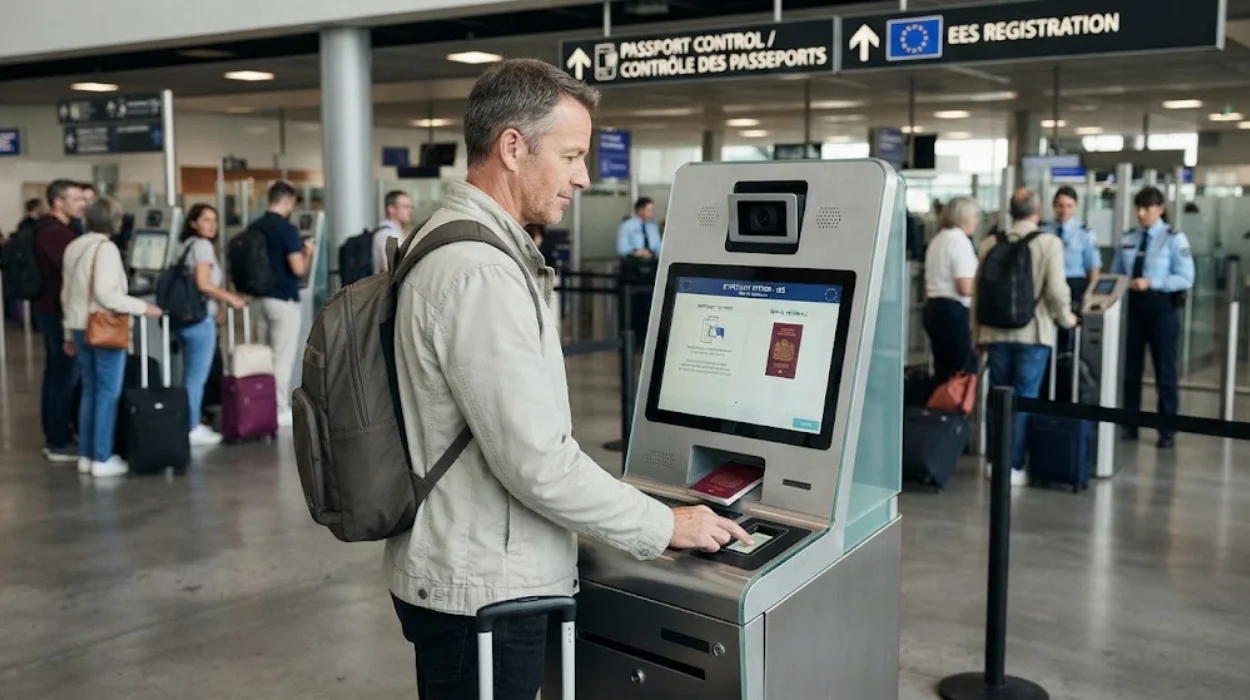
The European Union’s Entry/Exit System (EES) is an automated digital IT infrastructure that registers non-EU nationals traveling for a short stay, replacing manual passport stamping with biometric data collection across 29 participating European countries. Published by The Londoner News, this analysis examines the core mechanics, regulatory frameworks, operational impacts, and practical preparations required for British citizens navigating European borders under this framework.
- What is the EU Entry/Exit System and how does it replace traditional passport stamps for British citizens?
- Who is affected by the EES regulations and what categories of travelers are exempt from biometric registration?
- How does the biometric data collection process work at ports of entry for UK travelers?
- Where do EES border checks take place for travelers departing from UK transport hubs?
- What are the legal implications of the 90/180-day rule under the automated EES calculations?
- What penalties and administrative consequences apply to overstayers identified by the EES database?
- How does the EES interact with the upcoming European Travel Information and Authorisation System (ETIAS)?
- What practical steps must UK travelers take to prepare for border crossings under the EES framework?
- Frequently Asked Question
What is the EU Entry/Exit System and how does it replace traditional passport stamps for British citizens?
The EU Entry/Exit System is an automated digital database that records the entry and exit data of non-EU nationals crossing the external borders of the Schengen Area, permanently replacing manual ink passport stamps with electronic logs of traveler names, travel document details, fingerprints, and facial images.
The system operates across 29 European countries, which include all 27 European Union member states minus Ireland and Cyprus, alongside four non-EU Schengen associated nations: Iceland, Liechtenstein, Norway, and Switzerland. For British citizens holding a United Kingdom passport, this technological shift transforms how short-term visits are monitored. Historically, border control officers physically stamped passports upon entry and exit to manually calculate the duration of stay. Under the EES, these physical impressions are obsolete. When a UK traveler passes through an external border of the Schengen Area, self-service kiosks or border guards capture biometric identifiers and link them directly to the traveler’s passport number. The database automatically logs four primary data points: the exact date and time of entry, the date and time of exit, the specific border crossing point used, and the traveler’s biometric verification data. This digital architecture eliminates human calculation errors, prevents document tampering, and creates a centralized, unalterable ledger accessible by border authorities across the entire Schengen Zone. The transition standardizes border security measures, ensuring uniform compliance tracking across all participating airports, maritime ports, and international rail terminals.
Who is affected by the EES regulations and what categories of travelers are exempt from biometric registration?
The EES applies universally to all non-EU and non-EEA nationals undertaking short stays of up to 90 days within any rolling 180-day period, which includes standard UK tourists, business travelers, and second-home owners without residency rights.
The mandate captures any British citizen traveling on a standard British passport who does not hold specific legal exemptions granted by individual member states. Exemptions from the EES framework are strictly defined by European Union legislation. Non-EU nationals who hold a valid residence permit or a long-term residence visa issued by a Schengen member state are exempt from EES registration because their right of stay is governed by national residence laws rather than short-stay limits. Dual nationals holding both a British passport and an EU or EEA member state passport are entirely exempt; they must exit and enter the Schengen Area using their European passport to bypass biometric logging. Furthermore, holders of diplomatic passports, official duty passports, or specialized transit visas for specific institutional purposes are excluded from the standard EES data collection protocol. Children under the age of 12 are partially exempt: while they are required to undergo facial image capture and have their passport details logged into the database, they are legally exempt from providing fingerprint biometrics. Cross-border workers who reside in border regions and hold specific local border traffic permits also maintain distinct regulatory statuses that exempt them from standard short-stay EES tracking mechanisms.
How does the biometric data collection process work at ports of entry for UK travelers?
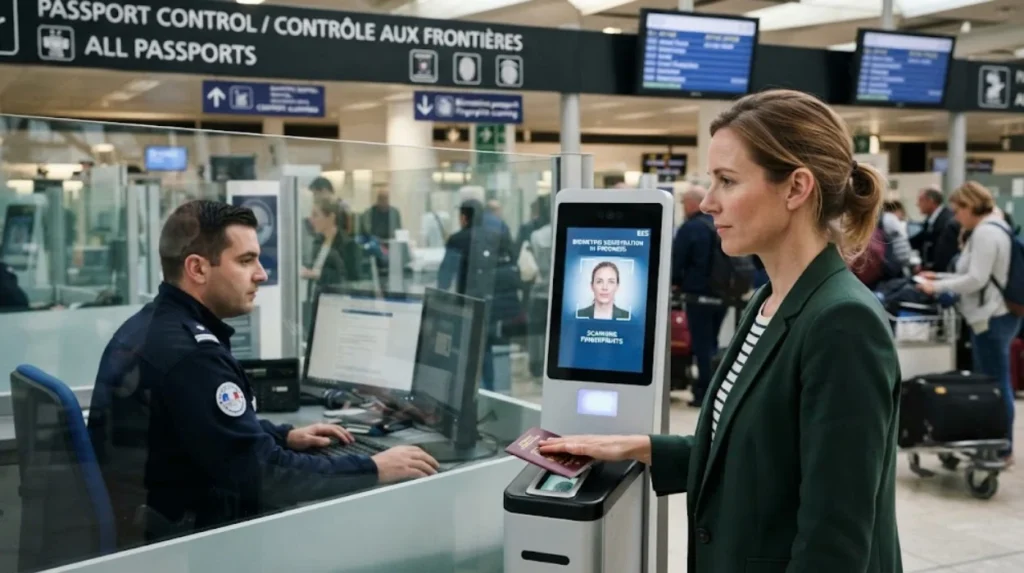
The EES biometric data collection process requires UK travelers to interact with automated self-service kiosks or border guards upon their initial arrival in the Schengen Area, providing a facial scan and four-finger electronic prints alongside passport verification.
When a British traveler arrives at a participating European airport, ferry port, or land border, the data registration follows a structured, sequential procedure. First, the traveler inserts their biometric passport into an automated self-service kiosk or presents it to a border management official. The kiosk scans the passport’s optical machine-readable zone and reads the embedded electronic chip to verify authenticity. Second, the traveler undergoes facial image capture via a specialized digital camera integrated into the kiosk or operated by border personnel. Third, individuals aged 12 and older place their fingers onto a flat electronic scanner to record four fingerprints. Fourth, the system prompts the traveler to answer basic security and travel-related questions, such as the primary purpose of the visit, the address of intended accommodation, and proof of sufficient financial means or onward travel arrangements. Once this initial profile is successfully created, the data is securely stored within the centralized EES database for a retention period of three years. For subsequent entries within that three-year window, travelers do not need to repeat the full initial registration; instead, the system verifies incoming biometric scans against the existing file, significantly reducing processing times at the border.
Where do EES border checks take place for travelers departing from UK transport hubs?
EES border checks for UK travelers departing via the Port of Dover, Eurotunnel at Folkestone, or International Rail at London St Pancras take place at UK-based juxtaposition controls prior to boarding, as agreed under bilateral treaties between the United Kingdom and France.
The operational geography of the EES introduces unique procedural environments for travelers departing directly from British soil toward the Schengen Area. Under established juxtaposed border arrangements—such as those operating at London St Pancras International for Eurostar services, the Port of Dover for cross-Channel ferries, and the Eurotunnel terminal in Folkestone—French border control authorities operate checkpoints on British territory before the passenger boards the transport vehicle. Consequently, EES biometric registration and questioning occur on UK soil during the departure clearance phase. Travelers clearing these juxtaposition controls complete their EES entry logging before departure, meaning that upon arrival at their destination port in France or Belgium, they disembark as domestic-equivalent arrivals without undergoing secondary European border checks. For UK travelers flying from British airports (such as Heathrow, Gatwick, or Manchester), the EES process occurs entirely upon arrival at the destination airport within the Schengen Zone. Cruise passengers departing from UK ports on itineraries visiting multiple European destinations follow specific rules: if the cruise initiates and terminates at a UK port without intermediate Schengen disembarkations requiring separate border clearances, standard EES rules apply conditionally based on port calls.
What are the legal implications of the 90/180-day rule under the automated EES calculations?
The automated EES software continuously monitors compliance with the Schengen short-stay regulation, which strictly limits non-EU nationals to a maximum cumulative stay of 90 days within any rolling 180-day period across all participating countries.
The 90/180-day rule is a foundational legal constraint governing non-EU travel within the Schengen Area. Prior to the implementation of the EES, calculating compliance relied on manual examination of passport stamp dates by border guards, a method vulnerable to human error, miscalculation, and intentional oversight. The EES automates this calculation by tracking every entry and exit timestamp logged against a traveler’s biometric profile. The system utilizes a rolling 180-day reference window, meaning that on any given day of travel, looking backward over the preceding 180 days, the total number of cumulative days spent inside the 29 participating nations cannot exceed 90 days. When a traveler approaches an exit or entry gate, the EES software instantly computes the remaining allowance. If the calculation indicates that the individual has exceeded the 90-day limit, the system flags the profile for an overstay. This automation removes discretion at the border, immediately alerting authorities to illegal residence and triggering automated administrative flaggings within the shared database.
What penalties and administrative consequences apply to overstayers identified by the EES database?
Travelers identified by the EES database as exceeding the authorized 90-day short-stay limit face mandatory administrative penalties, ranging from formal fines and deportation warnings to formal entry bans across the entire Schengen Area.
Because the EES records every movement with digital precision, overstays cannot go unnoticed or unrecorded. When the automated system flags an overstay, border enforcement agencies apply graduated sanctions depending on the duration and nature of the infraction. Minor, unintentional overstays caused by transport delays or medical emergencies are typically met with official warnings or administrative fines determined by the domestic legislation of the specific member state where the violation is detected. For substantial or intentional overstays, penalties escalate severely. Authorities can issue formal deportation orders, impose mandatory financial penalties, and log an official alert within the EES and the Schengen Information System (SIS). This alert results in a temporary entry ban preventing the individual from returning to any of the 29 participating European nations for a period typically ranging from one to three years, depending on the severity of the breach. Furthermore, an overstay record permanently taints the traveler’s digital profile, creating significant legal and administrative obstacles for any future visa applications, work permit requests, or subsequent entry authorizations.

How does the EES interact with the upcoming European Travel Information and Authorisation System (ETIAS)?
The EES functions as a border registration database for physical entries and exits, operating alongside the separate European Travel Information and Authorisation System (ETIAS), which serves as a pre-travel electronic authorization requirement for visa-exempt nationals.
Understanding the distinction between European digital border initiatives requires examining the complementary roles of the EES and ETIAS. While the EES records physical border crossings, biometric data, and stay durations after travelers arrive at the frontier, ETIAS operates as an antecedent screening mechanism that must be completed before travel commences. ETIAS mandates that visa-exempt non-EU nationals—including British citizens—obtain an online travel authorization prior to boarding any transport bound for the Schengen Area. The ETIAS application requires submitting personal data, passport details, background security screening answers regarding criminal history, and paying a mandated processing fee. Once approved, an ETIAS authorization remains valid for three years or until the associated passport expires, allowing multiple entries into the zone provided the 90/180-day EES limits are respected. At the physical border, the EES validates the traveler’s identity against the biometrics captured during registration, while confirming that the traveler possesses a valid ETIAS authorization where applicable. Together, these two digital systems form an integrated security perimeter designed to manage external migration flows across the European continent.
What practical steps must UK travelers take to prepare for border crossings under the EES framework?
UK travelers must ensure their passports meet international validity standards, allow additional processing time at transit hubs for initial biometric registration, and maintain digital or physical copies of travel documentation to ensure seamless verification.
Preparation for journeys to Europe under the operational EES framework requires specific logistical adjustments by British citizens. Travelers must verify that their British passport meets dual validity requirements set by the Schengen Zone: the passport must have been issued within the previous 10 years on the date of arrival, and it must retain a minimum of three months of validity remaining beyond the planned date of departure from the Schengen territory. Because the initial EES registration requires fingerprint and facial capture at kiosks or desks, processing times at ports and airports will experience transitional bottlenecks, particularly during peak travel seasons. Transport operators advise passengers using Eurostar, cross-Channel ferries, and major airports to arrive significantly earlier than historical recommendations to accommodate queue durations. Travelers should organize documentation confirming the purpose of their stay—such as hotel reservations, return or onward tickets, invitation letters, and proof of sufficient funds—because border authorities or electronic kiosks may prompt for these details during the registration flow. Finally, travelers must ensure that minor children traveling in family groups possess individual biometric passports, as collective or group passports are incompatible with automated kiosk architectures, ensuring full compliance with the updated European border control standard.
Frequently Asked Question
What is the EU Entry/Exit System (EES)?
The EES is an automated digital IT infrastructure that tracks non-EU nationals traveling for short stays, permanently replacing manual passport ink stamps with electronic entry and exit logs.