Key Points
- Line Suspension: A crucial section of the Weaver line on the London Overground network remains suspended following an intense trackside fire in Walthamstow, east London.
- Disruption Timeline: Transport for London (TfL) has confirmed that no train services will run between Hackney Downs and Chingford until at least Thursday, forcing severe travel disruptions.
- Property Damage: The major blaze completely engulfed one line-side house, heavily damaged a rear extension of a second home, and tore through the gardens and sheds of approximately 30 residential properties.
- Emergency Response: Around 125 firefighters and 20 fire engines battled intense, arduous conditions to extinguish the fire on the railway embankment after the London Fire Brigade (LFB) received over 120 emergency calls.
- Community Displacements: Multiple households were evacuated on Sunday evening. While most residents returned overnight, those whose properties sustained terminal damage have been placed in temporary accommodation by Waltham Forest Council.
- Secondary Incident: In a separate rail infrastructure crisis, a primary lineside fire in Stratford damaged critical signalling equipment, crippling Greater Anglia services and compounding travel misery across East London.
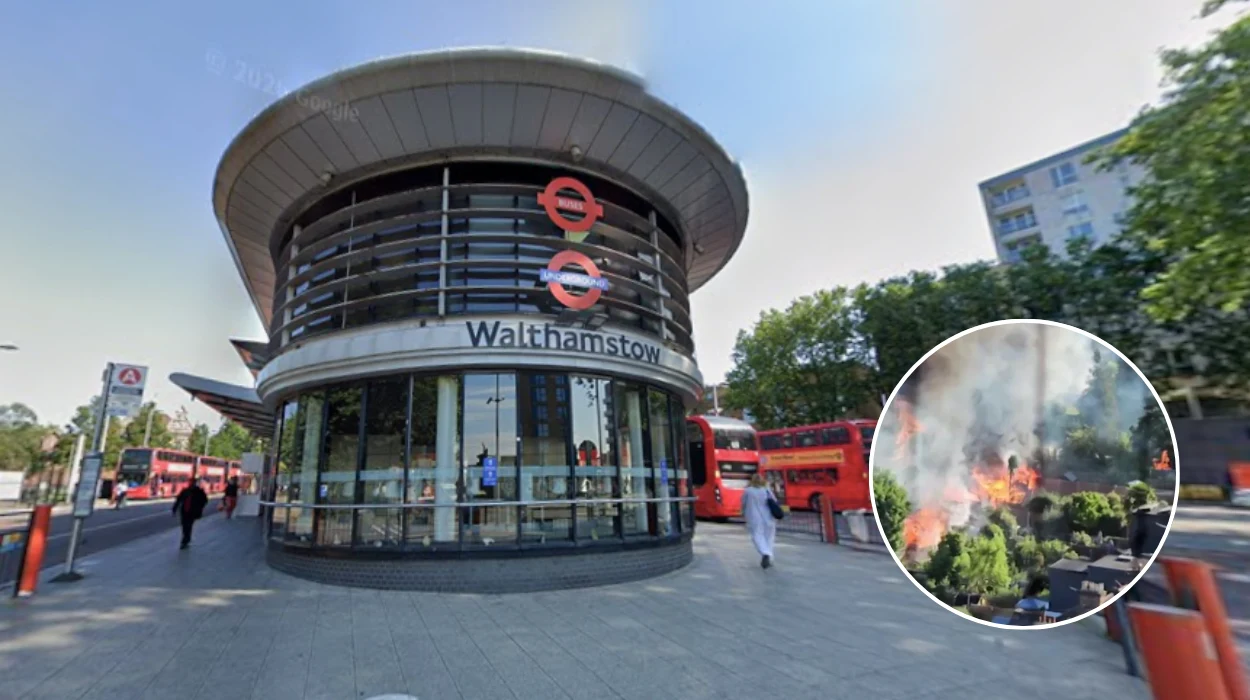
Walthamstow (The Londoner News) July 14, 2026 – Rail commuters across London are facing massive multi-day travel chaos after an intense embankment fire tore through a residential zone in Walthamstow, east London, causing severe structural damage to several homes and scorching vital track infrastructure. Network Rail officially announced that a section of the London Overground’s Weaver line would remain suspended for several days to allow engineers to execute urgent safety checks and extensive track reconstruction. The inferno, which drew an emergency response from 125 firefighters, damaged line-side properties to the extent that transit operators deemed regular train services entirely unsafe until the remaining brickwork and track foundations are physically stabilised.
- Key Points
- How Did the Walthamstow Fire Cause Major London Overground Disruption?
- What Damage Did the Walthamstow Railway Embankment Fire Inflict on Local Homes?
- How Did the London Fire Brigade Respond to the Walthamstow Incident?
- What is the Underlined Cause of the Walthamstow Rail Fire?
- How is the Separate Stratford Trackside Fire Affecting Greater Anglia Services?
- What Alternative Travel Arrangements are Available for Passengers?
As reported by BBC News, Transport for London (TfL) issued a status update confirming that all Weaver line services between Hackney Downs and Chingford have been completely cancelled, with no trains expected to operate on the route until Thursday at the earliest. Concurrently, local emergency teams executed mandatory evacuations for numerous families whose properties bordered the burning tracks. While the majority of families managed to return to their premises once the area was declared stable, Waltham Forest Council confirmed that those left with unlivable homes have been transitioned into emergency temporary accommodation.
The transport crisis has been further compounded by a secondary lineside fire at Stratford, which severely compromised rail signalling systems on Friday. Network Rail engineers are working continuously to restore the network, but a significantly scaled-back schedule remains in place for Greater Anglia services traversing the area, escalating congestion across the wider capital transport network.
How Did the Walthamstow Fire Cause Major London Overground Disruption?
The disruption sweeping through the capital’s mass transit network stems from the extreme thermal damage inflicted on the structural perimeter of the Weaver line. As documented by the BBC News editorial team, the proximity of the blaze to the physical running rails has compromised the underlying track bed and overhead environments near Wood Street station.
A spokesperson for Network Rail explained the fundamental safety barrier preventing the resumption of normal services:
“Unfortunately, one line-side property was severely damaged by the fire and needs to be made safe before trains can run again between Walthamstow and Wood Street station.”
Because the structural integrity of the line-side house remains compromised, railway authorities fear potential masonry collapses onto the live tracks below. Until civil engineering teams erect structural scaffolding or systematically dismantle the unstable components of the charred building, commuter transit remains entirely blocked.
According to reports published by transit specialist Deb Gayen of London Now, the suspension completely isolates a critical segment of the outer-London commuter network. Transport for London has instructed passengers to divert their journeys onto the London Underground networks—specifically the Victoria Line—and local London Bus routes, which are accepting rail tickets at no additional cost to mitigate the severe commuter backlog.
What Damage Did the Walthamstow Railway Embankment Fire Inflict on Local Homes?
The localized destruction along the railway alignment extended far beyond the iron tracks, spreading swiftly into residential zones bordering the embankment. As reported by Nadeem Badshah, a senior news journalist for The Guardian, the fast-moving fire severely impacted a dense block of residential properties adjacent to Vallentin Road and Shernhall Street.
Providing precise operational data from the scene, Assistant Commissioner Tom Goodall of the London Fire Brigade stated:
“One house was alight, and a second home has suffered damage to a rear extension. The gardens of around 30 properties have also unfortunately been affected by the fire. However, crews worked extremely hard to prevent the fire from spreading to further homes.”
The intense heat and flying embers tore through outbuildings, timber fencing, and residential sheds, generating massive columns of dense black smoke that blanketed the Walthamstow skies.
The scale of the destruction forced local authorities to quickly establish emergency relief measures. As reported by The Guardian, local Member of Parliament Stella Creasy immediately coordinated with local community centers to provide relief. Writing in an update on social media platforms, MP Stella Creasy urged residents:
“Please avoid the Wood Street area. We need to be able to support the families who are being evacuated. If you can help with refreshments please go to St Mary’s Welcome Centre, the team there would appreciate any offers of food and water.”
In tandem with the MP’s efforts, Waltham Forest Council opened an emergency reception and rest centre inside the Walthamstow Central Library to look after displaced individuals. While the local authority managed to process and clear the majority of families to return home late Sunday night, those whose properties bore the brunt of the structural fires remain under the care of the council’s housing teams in temporary lodgings.
How Did the London Fire Brigade Respond to the Walthamstow Incident?
The emergency response required to bring the railway embankment fire under control was massive in scale, triggering one of the largest localized deployments in east London this summer. According to official incident logs published by the London Fire Brigade’s media bureau, emergency control operators were inundated with more than 120 urgent 999 calls from panicked onlookers as the flames scaled the dry embankment vegetation.
The extreme volume of incoming emergency calls temporarily triggered “Operation Willow Beck”. This national, pre-determined call distribution procedure reroutes surplus emergency traffic to unaffected regional control centers to ensure no emergency call goes unanswered during times of extreme localized distress.
The first call was logged at precisely 6:27 PM on Sunday evening. LFB responded by mobilizing 20 fire engines and approximately 125 firefighters to the area. Crews were dispatched from stations across north and east London, including:
- Tottenham Fire Station
- Bethnal Green Fire Station
- Walthamstow Fire Station
- Chingford Fire Station
Firefighters faced grueling, hot, and arduous conditions as they fought to contain the perimeter. To combat the fire from a safer vantage point, incident commanders deployed a 32-metre turntable ladder configured to operate as an elevated water tower, drowning the burning roofs and embankment trees from above. The LFB drone team was also utilized, sending real-time aerial thermal imagery directly to the ground commanders to track hidden fire pockets.
A critical risk emerged during the dampening-down process when crews discovered ten industrial gas cylinders inside the burning garden sheds. Firefighters spent hours cooling these cylinders to ambient temperatures to prevent an explosion. Thanks to these efforts, the LFB officially brought the fire under control by 10:35 PM without a single reported injury to civilians or emergency personnel.
What is the Underlined Cause of the Walthamstow Rail Fire?
While the official investigation into the fire remains ongoing, initial reports suggest an infrastructure failure rather than malicious intent. Local MP Stella Creasy publicly shared that early findings pointed toward “an electrical fire on the train lines.”
Investigative reporting by The Guardian corroborated this theory, noting that the fire is understood to have been triggered by a severe electrical failure linked directly to a tree falling onto live trackside power lines. The contact allegedly sparked an arc explosion, igniting the dry summer undergrowth along the embankment, which then quickly spread to adjacent properties.
Explore more East London News:
Walthamstow Fire Causes Severe London Overground Disruption, East London 2026
Five Evacuated from Flooded East London Pub after Water Main Burst: Bow 2026
How is the Separate Stratford Trackside Fire Affecting Greater Anglia Services?
As commuters deal with closures on the London Overground, a separate rail infrastructure crisis further down the line continues to disrupt travel. On Friday, a distinct lineside fire broke out next to the tracks in Stratford, east London, inflicting severe thermal damage on critical electronic signaling equipment.
In an official incident update, a representative for Network Rail stated that its engineers were:
“…working as quickly as possible to repair the damaged infrastructure.”
Because the signaling system dictates safe train spacing and junction routing, Greater Anglia services traveling through Stratford have been forced to operate at a significantly reduced frequency. Transit officials warned that operating trains will be significantly busier than usual and subject to sudden delays. This secondary bottleneck has severed an alternative route for passengers trying to bypass the closed Weaver line sections, creating a challenging travel scenario across east London.
What Alternative Travel Arrangements are Available for Passengers?
With closures expected to last until at least Thursday, transport agencies have established alternative arrangements. According to National Rail’s service alert desk, full ticket acceptance policies are currently active across several regional transit networks.
| Original Line Affected | Disruption Status | Alternative Routes & Ticket Acceptance |
| London Overground (Weaver Line) | Suspended between Hackney Downs and Chingford. | Full ticket acceptance on London Underground (Victoria Line) and all reasonable London Bus routes. |
| Greater Anglia | Reduced services and delays via Stratford. | Ticket routing permitted on alternative Greater Anglia lines between London Liverpool Street and Cheshunt. |
Network Rail and Transport for London have jointly advised all travelers to verify their journey metrics using real-time mobile transit applications before departing, as platform changes and crowd-control measures remain fluid across east London hubs.