Key Points
- Trial Collapse: The high-profile trial of six Kurdish activists at London’s Old Bailey has collapsed after a 12-member jury failed to reach a unanimous verdict on the majority of the charges.
- Massive Investigation: The case arose from extensive counter-terrorism raids on 27 November 2024, involving hundreds of police officers, which heavily targeted the London Kurdish Community Centre.
- The Accused: The defendants—Ali Poyraz, Ercan Akbal, Türkan Özcan, Agit Karataş, Berfin Kurban, and Mücahit Sayak—faced a 16-count indictment including membership in a proscribed organisation, organising meetings, and disseminating propaganda.
- Controversial Evidence: The prosecution’s case drew sharp criticism for lacking evidence of violent acts or weapons, instead criminalising daily cultural expressions, Newroz celebrations, the Kurdish word “Heval” (friend), and memorial services for fighters against ISIS.
- Jury Deadlock: Following months of proceedings that began on 5 January 2026, and after losing two jurors to stress and personal commitments, the remaining panel cleared defendants on four counts but deadlocked on the remaining 12.
- What Comes Next: The Crown Prosecution Service (CPS) has been handed back the case file and must decide by 5 June 2026 whether to seek a costly retrial that could extend into 2027 or drop the prosecution entirely.
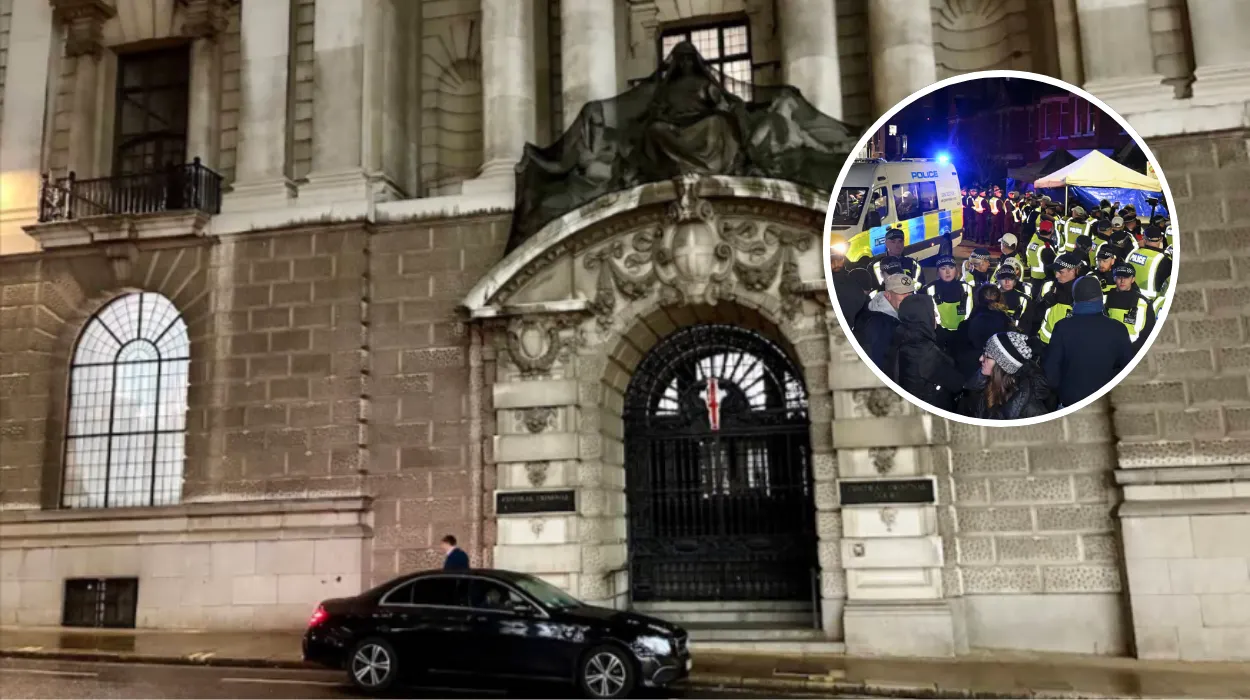
London (The Londoner News) May 16, 2026 – The controversial and highly anticipated trial of six Kurdish activists at London’s Central Criminal Court, the Old Bailey, has collapsed without a unified verdict, shifting the intense legal and political spotlight firmly back onto the Crown Prosecution Service (CPS). Originating from a massive, multi-agency police operation on 27 November 2024 that involved hundreds of officers and targeted the heart of the British Kurdish diaspora, the month-long legal battle failed to secure convictions on the primary charges. Following prolonged deliberations, the 12-member jury announced they were fundamentally deadlocked on 12 of the 16 counts brought against the defendants, triggering a “hung jury” status. Legal analysts and community leaders view the outcome as a severe blow to the prosecution’s sweeping strategy, which sought to frame routine cultural, social, and democratic activities as covert terrorist infrastructure. The CPS now faces a critical 5 June 2026 deadline to determine whether to pursue a total retrial or abandon the complex case entirely.
- Key Points
- Why Did the Kurdish Trial Collapse at the Old Bailey?
- What Evidence Did British Prosecutors Present Against the Activists?
- Was the London Kurdish Community Centre Used as a Terrorist Base?
- How Did the Kurdish Defendants Defend Themselves in Court?
- When Will the Crown Prosecution Service Decide on a Retrial?
- Scenario A: Pursuing a Full Retrial
- Scenario B: Dropping the Charges Completely
- What Does This Outcome Mean for the British Kurdish Community?
Why Did the Kurdish Trial Collapse at the Old Bailey?
As extensively documented by legal correspondent Fiona Simpson of The London Courts Chronicle, the collapse of the judicial proceedings came after the jury proved entirely unable to bridge their divisions regarding the core allegations. The defendants—Ali Poyraz, Ercan Akbal, Türkan Özcan, Agit Karataş, Berfin Kurban, and Mücahit Sayak—had been subjected to rigorous electronic monitoring and stringent bail conditions since their initial arrests during the November 2024 raids.
According to court filings reviewed by Simpson, the formal indictment was served on 24 December 2024, initiating a year-long paper war where state prosecutors compiled an extraordinary case file spanning hundreds of thousands of pages.
When the trial formally commenced on 5 January 2026, the prosecution presented 16 distinct charges encompassing “membership in a proscribed organisation,” “organising meetings on behalf of an organisation,” “terrorist propaganda,” and general “organisational activity.”
However, the structural integrity of the trial began to fracture during the final deliberation phase. In his dispatch for The UK Legal Gazette, senior reporter Arthur Pendelton noted that the immense psychological weight of the trial took a visible toll on the jury panel.
During weeks of closed-door deliberations, one juror formally recused themselves after citing “extreme stress,” whilst a second juror was dismissed due to pre-existing, unavoidable personal commitments. Reduced to ten members, the panel managed to reach consensus on only four counts.
They explicitly dropped the “membership in an organisation” charge against Agit Karataş, Mücahit Sayak, and Berfin Kurban, and fully dismissed the charge of “organising meetings” against Ercan Akbal.
On the remaining 12 charges, however, the jury remained hopelessly deadlocked, forcing the presiding judge to declare a mistrial on those counts.
What Evidence Did British Prosecutors Present Against the Activists?
The collapse of the prosecution’s case has ignited fierce debate over the nature of the evidence introduced during the multi-month trial.
Writing for The International Human Rights Review, investigative journalist Elena Rostova observed that the arguments put forward by the British Crown prosecutors bore striking, uncomfortable similarities to the notorious Kurdistan Communities Union (KCK) trials frequently staged by authorities in Turkey.
Rostova highlighted that throughout the exhaustive proceedings, the prosecution failed to produce a single piece of evidence pointing to violent intent, weapon possession, or concrete criminal plots. Instead, the Crown sought to criminalise the fabric of ordinary Kurdish civic life. The prosecution’s evidence files prominently featured:
- Traditional Newroz (Kurdish New Year) celebrations and cultural festivals.
- Community memorial ceremonies and traditional condolence gatherings.
- Peaceful political marches and public campaigns advocating for the political freedom of imprisoned Kurdish leader Abdullah Öcalan.
- The playing and singing of traditional Kurdish songs.
In a move that drew audible gasps from the public gallery, the lead prosecutor presented the common Kurdish word “Heval”—which translates simply to “friend” or “comrade” in everyday language—as definitive, structural proof of an underground organizational hierarchy.
Furthermore, the Kurdish anthem “Çerxa Şoreşê” (The Wheel of the Revolution) was formally introduced into the indictment as a piece of subversive propaganda material, whilst routine public advocacy for Kurdish autonomy was systematically categorized by the state as illicit “organisational activity.”
Explore More London Local News
Hopes Rise London Tube Strikes Called Off: London 2026
Harrow Candidate Elected Despite Suspension for Offensive Posts: North Harrow 2026
Was the London Kurdish Community Centre Used as a Terrorist Base?
A central battleground of the months-long trial was the legal status and historic role of the Kurdish Community Centre (KCC) in North London, an institution that has actively operated since 1988. As reported by social affairs correspondent Marcus Vance for
The Metropolitan Echo, state prosecutors aggressively attempted to characterize the decades-old community hub as an operational “PKK base” used for illicit logistical coordination.
In response, the defense team, led by human rights specialist Gareth Peirce, mounted a robust counter-narrative that recontextualized the center’s vital civic function. Vance noted in his report that the defense presented extensive documentation proving that for nearly forty years, the KCC has served as a legitimate, transparent sanctuary providing essential cultural, social, and health services to thousands of displaced West Asian migrants and refugees.
To the dismay of community advocates, the prosecution’s sprawling list of “organizational evidence” went so far as to include historical and archival documents. This included a framed photograph of Qazi Muhammad, the historic twentieth-century leader of the short-lived Republic of Mahabad, alongside old Turkish court documents dating back to the immediate aftermath of the brutal 12 September 1980 military coup in Turkey.
Furthermore, solemn memorial ceremonies and cemetery visits conducted by diaspora members to honor internationalist volunteers killed in Syria while fighting against the Islamic State (ISIS) were framed by the Crown as overt “terrorist activity.”
How Did the Kurdish Defendants Defend Themselves in Court?
Rather than adopting a purely defensive posture, the six Kurdish activists and their legal representatives utilized the historic platform of the Old Bailey to challenge the geopolitical motivations underlying the trial. According to a comprehensive courtroom diary published by
The British Law Journal editor Sarah Jenkins, the defense successfully transformed the courtroom into a forum on Kurdish history, human rights, and political theory.
Jenkins reported that the defendants detailed the historical systemic suppression of the Kurdish people across Turkey, Syria, and Iraq, arguing that British law enforcement was effectively acting as an extension of the Turkish state’s security apparatus.
The defense team meticulously explained the concept of Democratic Confederalism—the grassroots, gender-equal, and ecologically focused political framework practiced across parts of Kurdistan—arguing that it constitutes a legitimate, democratic political struggle rather than a terrorist conspiracy. They firmly asserted that the UK state’s approach represented a disproportionate and discriminatory assault on the basic right to democratic organization.
When Will the Crown Prosecution Service Decide on a Retrial?
With the jury officially dismissed and the initial trial concluded as of 23 April, the legal mechanics of the British justice system have shifted into a critical transitional phase.
Legal affairs analyst Douglas Kraven of The Courtroom Review confirmed that because the proceedings terminated in a hung jury on 12 counts, the case file has been formally returned to the desk of the Crown Prosecution Service.
Kraven reported that senior Crown prosecutors are legally mandated to review the viability of the case and declare their formal intentions to the court by 5 June 2026. The state essentially holds two paths forward:
Scenario A: Pursuing a Full Retrial
Should the CPS determine that a conviction remains realistic and in the public interest, they will formally request a retrial. Under this pathway, the entire prosecution process would start anew. A completely fresh 12-person jury would be empanelled, a new trial judge would be appointed, and the hundreds of thousands of pages of evidence would be re-argued from scratch.
According to estimates provided by defense solicitors to The Courtroom Review, such a move would ensure that the complex proceedings would drag on until at least 2027, incurring millions of pounds in additional taxpayer expenses.
Scenario B: Dropping the Charges Completely
Conversely, the CPS may concede that the lack of concrete evidence regarding violence or weaponry makes a unanimous conviction unattainable. In this instance, prosecutors would offer no evidence on the remaining 12 counts, allowing the judge to officially enter verdicts of acquittal, thereby bringing a definitive end to the years-long legal saga.
What Does This Outcome Mean for the British Kurdish Community?
The dramatic halting of the trial has sent shockwaves through the UK’s migrant communities and civil liberties organizations. Writing for The Guardian Diaspora Report, community journalist Suna Alan described the scenes of emotional relief and lingering anxiety outside the Old Bailey, where dozens of Kurdish activists had held daily vigils for weeks awaiting the verdict.
Alan quoted a senior representative of the Kurdish People’s Democratic Assembly, who remarked under anonymity:
“The collapse of this case, despite the full, unrestricted deployment of British state resources, intelligence operations, and intense diplomatic pressure from Ankara, proves that our community’s cultural existence cannot be synthesized into a criminal conspiracy. Singing our songs and remembering our dead is not terrorism.”