Key Points
- Festival Window Confirmed: The Greenwich + Docklands International Festival (GDIF) will officially return from Friday 21 August to Sunday 6 September 2026.
- Complete Public Access: Remaining true to its core ethos as London’s longest-established celebration of outdoor performing arts, every single event across the two-week schedule is completely free to attend.
- Scale and Scope Expansion: The 2026 edition features work from more than 25 British and international creative companies, delivering three world premieres, five UK premieres, and 10 London premieres.
- Geographical Expansion: For the very first time, the festival’s traditional footprint across the Royal Borough of Greenwich, Newham, and Thamesmead will stretch further east to encompass Romford and Barking.
- Central Creative Theme: Under the artistic direction of Bradley Hemmings MBE, this year’s artistic output is strictly unified under the structural title “We Move”, which draws inspiration from youth culture and city-wide resilience.
- Major Production Anchors: Key global highlights include 360, a massive opening dance ritual by French choreographer Mehdi Kerkouche in Woolwich, and Efectos Especiales, an Argentinian-led live action film installation set to transform the Greenwich Peninsula.
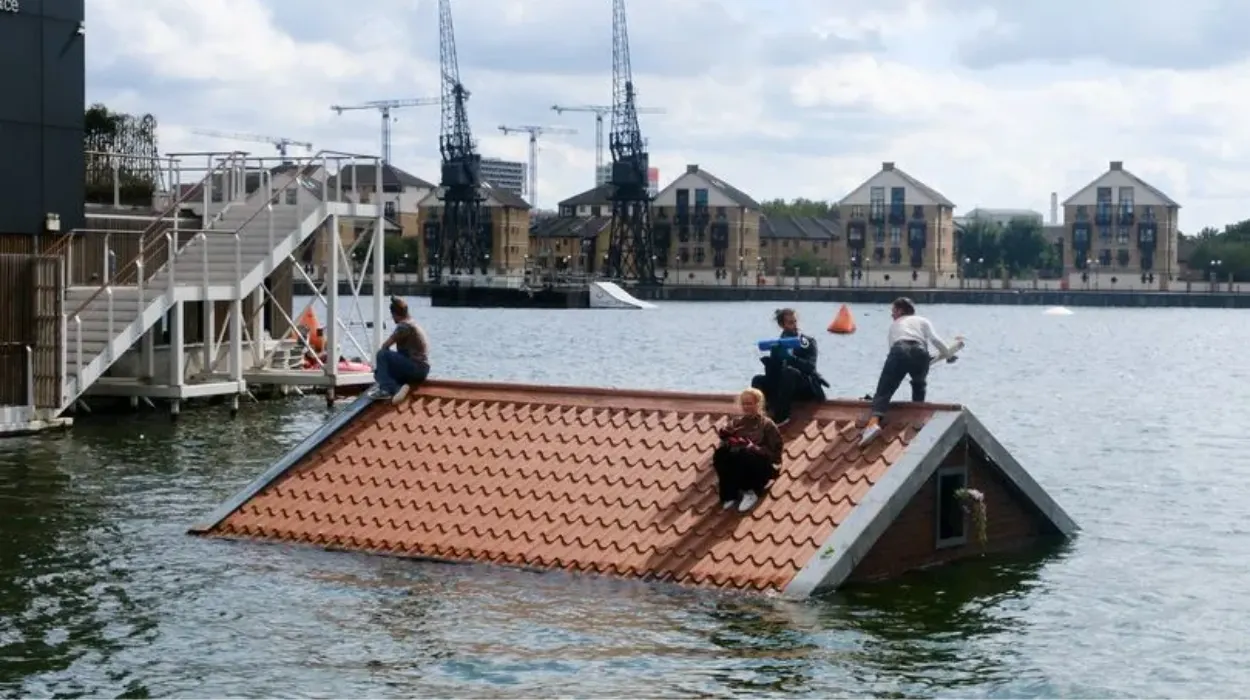
London (The Londoner News) June 6, 2026 – The Royal Borough of Greenwich and the surrounding Docklands are set to be transformed into a vast, open-air stage as the initial lineup for the Greenwich + Docklands International Festival (GDIF) has been officially unveiled, promising a two-week explosion of free theatre, circus, dance, and immersive art installations. Running from August 21 until September 6, 2026, London’s premier free outdoor arts festival will explicitly target public spaces across South and East London, utilizing residual evening twilight to mount its most visually dazzling spectacles after dark. This year’s programming, which spans multiple borough boundaries, intentionally expands its geographic reach deeper into outer London boroughs while maintaining an uncompromising commitment to elite-tier, non-ticketed cultural access.
- Key Points
- What Is The Theme Of GDIF 2026?
- How Will The Opening Weekend Of GDIF 2026 Unfold?
- Where Are The New Festival Locations For 2026?
- What Is The Largest Spectacle At GDIF 2026?
- Which Performances Are Scheduled For The Bank Holiday?
- What Can Audiences Expect From ‘Dancing City’ At Stratford?
- How Does The 2026 Festival Conclude?
The festival returns following its historic 30th-anniversary celebrations last year, scaling up its operations to welcome an expected crowd of over 60,000 annual visitors. By utilizing standard city streets, hidden nature sanctuaries, and industrial plazas as structural backdrops, organizers seek to replicate past triumphs—which have historically included high-wire acts on the façade of St Paul’s Cathedral and performances staged atop moving double-decker buses. As summer music events across the capital face intensifying commercial pressures and soaring ticket prices, the structural announcement of GDIF’s expansive, fully funded programme positions it as a crucial pillar of egalitarian metropolitan culture.
What Is The Theme Of GDIF 2026?
As documented by the festival’s official executive programming materials published on June 4, 2026, the structural spine of this year’s multi-venue event is definitively titled “We Move”. This conceptual framework has been chosen to celebrate the legendary London spirit of community survival, geographic adaptation, and collective forward momentum in an era defined by socio-economic challenges.
In an official public statement preserved by theatrical industry reporter Alistair Smith of The Stage, Bradley Hemmings MBE, the Artistic Director of GDIF, contextualized the choice of theme by asserting:
“We’re living through the most difficult times when it feels more important than ever to keep each other close and remain hopeful. Our theme this year celebrates that legendary London spirit of resilience and community in the face of life’s myriad challenges, deftly expressed by young Londoners in the maxim ‘We Move’. Through mutual support and adaptation, life goes on, and this year’s festival celebrates that life-enhancing London vibe with free outdoor art, joy, wonder and participation.”
How Will The Opening Weekend Of GDIF 2026 Unfold?
The festival’s grand opening sequence will initiate on Friday 21 August 2026 at 7:00 PM within General Gordon Square in Woolwich. According to detailed staging briefs published by BroadwayWorld, the opening production is an ambitious, large-scale outdoor dance ritual titled 360.
Conceived and executed by the trailblazing French choreographer Mehdi Kerkouche—affiliated directly with the National Choreographic Centre (CCN) of Créteil and Val-de-Marne—the performance will occupy a towering circular stage erected in the very heart of the public square.
As reported by Andrzej Lukowski, the Theatre Editor for Time Out London, 360 has been intentionally constructed as a high-energy arena where “propulsive movement, immersive set design and electronic music collide in an expression of the aspirations and challenges of a generation on the edge of change.”
Following this electronic movement piece, the opening weekend will immediately transition into the historical core of the festival: the Greenwich Fair. Staged across Saturday 22 and Sunday 23 August, this specific “festival within a festival” will completely dominate the greenery of Greenwich Park and the General Wolfe Piazza.
The weekend schedule includes an eclectic collection of physical theatre and circus arts, highlighted by the French company Underclouds Cie’s performance titled Inertie, which features two acrobatic performers interacting dynamically with an enormous, slowly rotating circular structure.
Concurrently, audiences will witness the Fabla Collective’s performance of Do Birds Dream of Flying?, a high-stakes routine executed entirely upon a shifting, unstable moving ladder, alongside the genre-defying artist Symoné, whose production A Place Between Mass and Echoes seamlessly fuses classic circus athletics, contemporary dance, and fast-paced roller-skating.
Explore More South London News
Putney Leisure Centre Pool Closure Halted After Local Protest Wandsworth 2026
Conan Doyle Sherlock Holmes Home Flat Conversion Plans: Croydon 2026
Where Are The New Festival Locations For 2026?
In a significant administrative and geographic expansion, GDIF 2026 will push beyond its traditional South London borders into brand-new territories within Greater London. For the first time in its three-decade history, programming has been securely scheduled within Romford and Barking, directly supplementing established hubs in Greenwich, Newham, Thamesmead, and Stratford.
As detailed by the editorial team at WhatsOnStage, the historic Romford Market will serve as the host site for a major site-specific production titled Meet Me By The Fountain. Running on Friday 28 and Saturday 29 August, this architectural performance is constructed by the multi-disciplinary design company Variable Matter.
The piece functions as a localized, high-concept son et lumière (sound and light show), combining localized urban testimony with large-scale projection mapping to explore the evolving nature of public markets, commerce, and community memory in outer London.
What Is The Largest Spectacle At GDIF 2026?
The mid-point of the festival will feature what organizers describe as the structural centerpiece of the 2026 calendar. On Saturday 29 and Sunday 30 August, the festival will transition to the ultra-modern landscape of the Greenwich Peninsula to present the exclusive UK premiere of Efectos Especiales (Special Effects).
As noted by reporter Stewart Carr in his breaking coverage for MyLondon, this massive international project is co-created by the highly acclaimed Argentinian filmmaker Alejo Moguillansky and the avant-garde choreographer Luciana Acuña.
The production explicitly turns an everyday public street into an active, high-octane live action film set. Spectators are invited into the center of a simulated cinematic shooting sequence, where live performers and dancers interact with a rumbling, multi-ton desert truck.
The performance utilizes heavy industrial machinery to generate real-time, chaotic weather transformations across the peninsula—including artificial windstorms, manufactured blizzards, and simulated rolling thunder—effectively blurring the lines between real public space, live dance, and Hollywood-level cinematic illusion.
Which Performances Are Scheduled For The Bank Holiday?
On Bank Holiday Monday, August 31, the festival shifts its focal point back toward the urban center of Woolwich, introducing two major London-premiere commissions that examine cultural legacy, family structures, and individual identity through music and movement.
The first production, taking place in Beresford Square, is titled The Aunties: House of Masks, created by the emerging choreographer Olúwatósin Omotosho. As outlined in regional profiles by the Dance Art Journal editorial board, this fearless piece utilizes a dense hybridization of raw American hip-hop and traditional West African Afro Dance to celebrate the social power, humor, and domestic authority of matriarchal West African “aunties.” The performance intentionally strips away social facades to analyze individual resilience and the complex, unspoken truths that exist behind the smiles at large family gatherings.
Directly complementing this performance, General Gordon Square will host The Torch, an Afrobeat gig-theatre experience envisioned and led by Kobby Taylor. This production is directly inspired by the enduring musical legacy and historical recordings of the creator’s late grandfather, the legendary Ghanaian musician Ebo Taylor. The show blends live storytelling, high-tempo brass arrangements, and hip-hop sensibilities to chart the cross-generational journey of African musical innovation.
What Can Audiences Expect From ‘Dancing City’ At Stratford?
As the festival approaches its final weekend, the focus pivots to Newham and the newly developed cultural hub of East Bank in Stratford. On Thursday 3 and Friday 4 September, the Geraldine Pilgrim Performance Company will present Chair! at Queen’s Market Square in East Ham. This highly visual piece of community-centered theatre features an expansive landscape of ordinary household chairs, utilizing local participants of varying ages and backgrounds to reflect upon physical public space, urban accessibility, and the quiet beauty of everyday objects.
Following this, on Saturday 5 September, the celebrated Dancing City sub-festival will return to take over the public squares, waterfronts, and walkways of Stratford, East Bank, and the Queen Elizabeth Olympic Park. Positioned as a one-day, open-air showcase of global dance innovation, the event operates in strategic partnership with the world-renowned Sadler’s Wells Theatre.
According to promotional reports corroborated by FACT Magazines, a headline feature of the Dancing City itinerary is the official UK premiere of Benched, mounted by Denmark’s Uppercut Dance Theater.
In this piece, five male dancers utilize three ordinary public park benches as an athletic apparatus, executing a grueling choreographic routine that fluidly incorporates capoeira, urban breakdancing, and floor-based contemporary movement to explore human cooperation, territorial aggression, and social alignment.
How Does The 2026 Festival Conclude?
The grand finale of the 2026 Greenwich + Docklands International Festival will take place on Sunday 6 September, concluding with a massive, localized display of community choreography. The final day features Man Down, a powerful piece staged at the Queen Elizabeth Olympic Park by Fuse Theatre and choreographed by the pioneering Deaf artist Chris Fonseca. The work explores the contemporary landscape of masculinity, systemic vulnerability, and emotional isolation through a performance that utilizes British Sign Language, visual vernacular storytelling, heavy beatboxing, and street hip-hop.
The entire festival will draw to an official close in Woolwich with the performance of (In)Visible Dancing, an epic, mass-participation dance event designed by Luca Silvestrini’s Woolwich-based dance company, Protein.
The project begins as a series of spontaneous, unannounced pop-up flashmobs throughout Woolwich town centre during the preceding week, gradually building awareness among local residents.
On September 6, the individual performance strands will coalesce into a final mass-movement sequence involving hundreds of local South London community groups, amateur dancers, and everyday citizens.
The final production acts as a living manifestation of the festival’s overarching “We Move” theme, converting public infrastructure into a unified arena of shared metropolitan joy.