
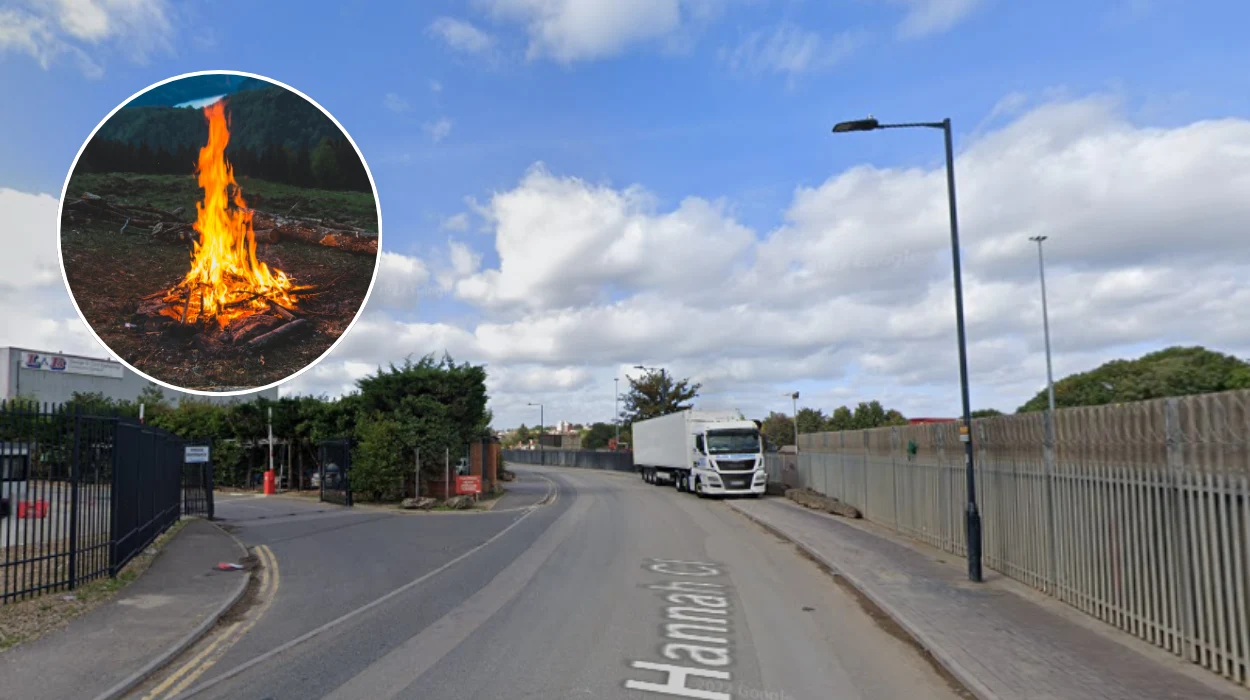
- Incident Overview: A massive fire occurred at a mixed recycling and waste site situated at an industrial estate on Hannah Close in Neasden in north-west London, near Wembley Stadium.
- Emergency Service Response: The London Fire Brigade (LFB) sent 125 firefighters and 20 fire engines along with three 32-meter turntable ladders, a drone crew and high-volume pumps.
- Call Volume: More than 70 calls about the fire reached the London Fire Brigade’s control room, with the first call reaching just past 11:30 BST.
- Health Advisory: Dark plumes of smoke rose up into the air from the burning facility and could be seen across the whole central part of London, with the authorities advising local businesses and residents to keep all windows and doors shut.
- Transport Disruptions: According to TfL, the Metropolitan Line was suspended completely, whereas the Jubilee Line was suspended between Willesden Green and Wembley Park.
- Train Impacts: Severe delay and cancellation impacts have been observed in the train services moving to and from London Marylebone station with some of the trains being headed to Aylesbury.
- Evacuations: BBC News reported that Amazon Delivery Center located in the same industrial estate had been successfully evacuated, but not affected by the fire.
- Current Status: No exact reasons for the fire outbreak have been identified yet, and it is expected that the transport disruptions would last until the Friday evening rush hour.
London (The Londoner News) August 29, 2026 — A massive industrial fire erupted at a waste recycling plant in north-west London on Friday morning, generating towering pillars of thick black smoke that could be seen for miles and throwing regional transport networks into absolute chaos. The fierce blaze, which broke out at a mixed waste facility on Hannah Close in Neasden—less than a mile away from the iconic Wembley Stadium—forced emergency services to mount a major operation involving dozens of fire engines and more than a hundred personnel. Transport operators rushed to shut down crucial sections of the London Underground and national rail lines, leaving thousands of commuters stranded and triggering widespread travel restrictions across the capital.
What Caused the Massive Fire Near Wembley Stadium?
As reported by BBC News, authorities have confirmed that the exact origin and cause of the blaze remain entirely unknown as investigators await safe access to the site. The incident erupted inside an industrial unit measuring approximately 100 metres by 150 metres on Hannah Close.
Detailing the initial emergency response, the London Fire Brigade stated via their official reporting channels, as referenced in coverage by BBC News:
“Twenty fire engines and around 125 firefighters are responding to a fire on Hannah Close, Neasden. Residents in the immediate area should close doors and windows, remaining inside where possible, due to the large amount of smoke being produced. The fire is located at a mixed waste facility, and an industrial unit approximately 100m by 150m is currently alight.”
The LFB further noted that crews from Wembley, Park Royal, Willesden, and surrounding fire stations were rapidly mobilised after their control room logged the first of more than 70 emergency calls concerning the escalating disaster at approximately 11:34 BST.
How Did Emergency Services Respond to the Neasden Blaze?
To combat the intense industrial inferno, the London Fire Brigade deployed specialized heavy-duty tactical assets to the scene. According to details compiled by BBC News journalists, the response operation included three advanced 32-metre turntable ladder units functioning as elevated water towers, alongside the brigade’s specialized Drone Team providing aerial thermal oversight.
Furthermore, firefighters strategically deployed a hose-laying unit and a high-volume pump to drastically increase the available water supply drawn from surrounding infrastructure.
Giving context to the scale of the deployment and public safety measures, a London Fire Brigade spokesperson emphasized that crews worked aggressively to contain the perimeter. Local businesses situated near the industrial park faced immediate disruption. BBC News understands that an Amazon delivery warehouse sharing space within the industrial estate was evacuated swiftly as a precautionary safety measure, ensuring that staff members were moved out of harm’s way before toxic smoke enveloped the immediate perimeter.
Which Transport Lines Were Suspended Due to the London Fire?
The proximity of the burning waste facility to key rail corridors triggered an immediate shutdown of vital public transport links. Transport for London (TfL) and National Rail implemented emergency service restrictions to protect passengers and staff working near the hazard zone.
Outlining the extent of the rail closures, BBC News reported that Transport for London ordered the complete suspension of the entire Metropolitan line. Additionally, the Jubilee line was severely truncated, with services suspended entirely between Willesden Green and Wembley Park stations, alongside severe residual delays across the remainder of the line.
National Rail also confirmed major disruptions affecting mainline services operating into and out of London Marylebone, with local train paths to Aylesbury blocked as smoke blanketed the tracks.
Detailing the collaborative efforts between transport authorities and emergency responders, a Transport for London spokesperson stated, as cited by local media:
“We’re continuing to liaise with LFB to make sure we understand what we can operate safely for both our customers and staff.”
To mitigate the chaos for stranded commuters, ticket acceptances were swiftly arranged across alternative routes, including the Elizabeth line, Chiltern Railways, Avanti West Coast, Great Western Railway, London Overground, and various local bus corridors. Despite these contingency measures, travel analysts noted that knock-on delays rippled through the transport network well into the evening rush hour.
Explore more Local London News:
Researchers Map Evolving Immune Response in Sepsis, London 2026
CCTV Appeal Launched After Covent Garden Rape in London, 2026
What Are the Health Risks for Local Residents?
The sheer intensity of the fire produced massive, roiling columns of dark, toxic smoke that drifted high over north-west London and remained visible from central observation points. Environmental health officers and emergency coordinators expressed immediate concern regarding air quality in densely populated residential zones surrounding Neasden and Wembley.
Urging caution, the London Fire Brigade issued strict public safety notices via multiple news broadcasts, explicitly advising residents living downwind to seal their properties.
As reported across multiple news bulletins, the LFB advisory warned:
“Residents in the immediate area should close doors and windows, remaining inside where possible, due to the large amount of smoke being produced.”
Medical professionals and local authorities stressed that inhalation of smoke from burning mixed waste and commercial plastics can trigger acute respiratory distress, particularly for vulnerable groups such as children, the elderly, and individuals suffering from pre-existing conditions like asthma. Local clinics and emergency rooms across the borough remained on alert for smoke-related presentations throughout the afternoon.
What Lies Ahead for the Investigation and Recovery?
As the firefighting operation transitioned into a cooling and damping-down phase late into Friday evening, questions turned toward regulatory compliance and fire safety standards at recycling infrastructure sites across the capital. Industrial safety experts noted that incidents involving compacted mixed waste—often contaminated by hidden lithium-ion batteries or pressurized canisters—pose unique containment challenges for municipal fire crews.
Investigators from the London Fire Brigade, alongside forensic specialists and local municipal authorities, are expected to launch a full-scale joint inquiry as soon as structural engineers and safety officers clear the burnt-out shell of the Hannah Close facility. While transport lines have progressively resumed normal scheduling following safety checks on overhead electrical wiring and signaling equipment, the incident serves as a stark reminder of the vulnerability of urban industrial logistics to sudden, catastrophic hazards.