Key Points
- Victorian Innovation: A temporary, experimental pneumatic (atmospheric) railway operated in South London during the mid-1860s, using air pressure instead of steam locomotives.
- Operational Details: The line ran for roughly 600 yards through Crystal Palace Park, carrying passengers on a 50-second journey that cost sixpence per ticket.
- The Technology: Rather than using conventional rail engines, the system utilised a large, steam-powered fan to generate air pressure shifts, pushing or sucking a single carriage through a tunnel.
- The Visionary: Designed by engineer Thomas Webster Rammell, the line served as a structural trial for a planned, broader underground network connecting Whitehall and Waterloo.
- Sudden Closure: The experimental track opened in August 1864 but was dismantled within months, by October 1864, before a massive financial crash in 1866 permanently halted the wider London project.
- Modern Legacy: Left with virtually no physical traces today, the concept directly mirrors modern high-speed mass transit proposals, such as Elon Musk’s Hyperloop and scale-model designs by contemporary innovators.
South London (The Londoner News) July 1, 2026 – A forgotten piece of Victorian transport history has resurfaced to remind modern commuters that South London was once at the absolute cutting edge of transit technology. Long before residents grew frustrated with the region’s contemporary deficit of London Underground lines, an extraordinary experimental atmospheric transit system operated briefly beneath what is now Crystal Palace Park. Rather than employing standard locomotive engines driven directly by steam pistons, this short-lived transport marvel utilised a massive, steam-fueled fan to alter internal air pressure within a brick tunnel, effectively blowing and sucking an isolated passenger carriage back and forth along a fixed track.
- What was the Crystal Palace pneumatic railway?
- How did the air-powered train technology actually work?
- What did Victorian passengers think of the pneumatic journey?
- Who was Thomas Webster Rammell and what were his grand plans?
- Why did London’s air-powered railway project abruptly fail?
- Is there a lost Victorian railway carriage still buried under Crystal Palace?
- How does Elon Musk’s Hyperloop connect to this Victorian experiment?
What was the Crystal Palace pneumatic railway?
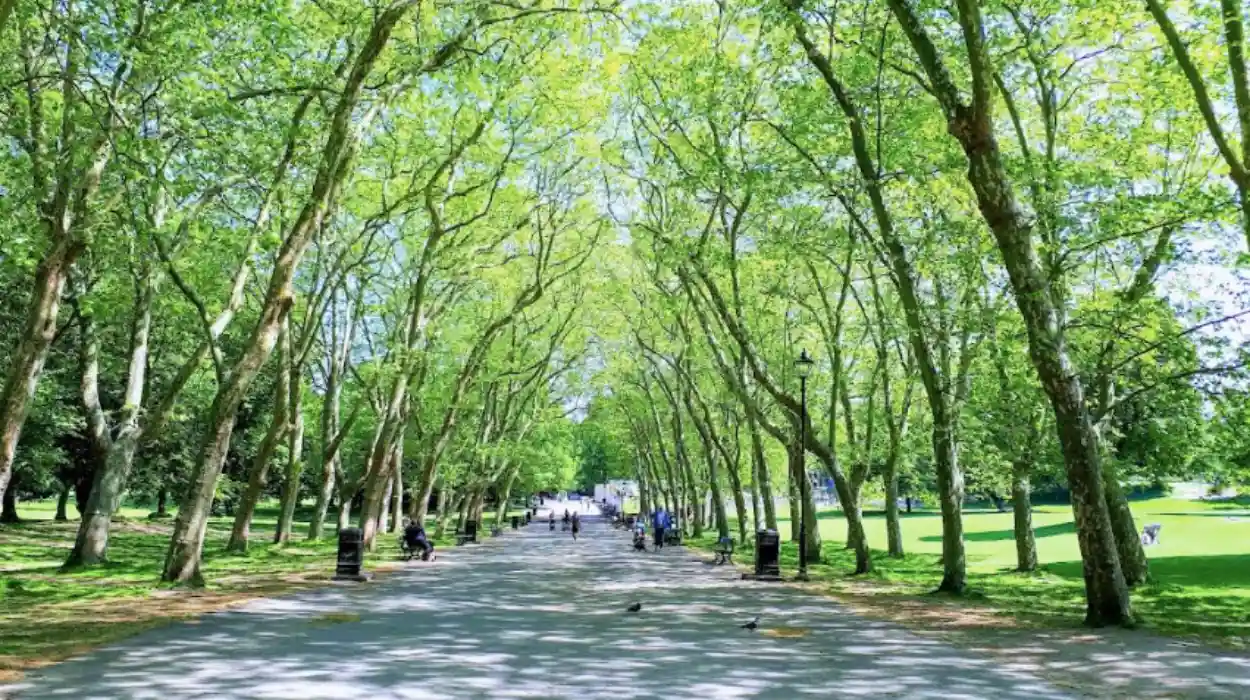
As detailed by AI Content Editor Phoebe Davis and journalist Véronique Hawksworth of MyLondon, the extraordinary transit project functioned essentially like a giant straw, wherein passengers sat inside a carriage that acted as the internal projectile. The experimental line stretched across a portion of Crystal Palace Park, carrying adventurous Victorians from the Sydenham entrance of the park down to the old Armoury situated near the Penge gate. The entire journey lasted a mere 50 seconds and cost passengers sixpence per trip, offering a rapid, emission-free alternative to the smoky underground tracks that would later dominate the central metropolitan landscape.
How did the air-powered train technology actually work?
The engineering framework bypassed the heavy moving parts of typical train designs. Instead of a locomotive dragging a line of carriages, a single, highly customized brick tunnel was constructed to act as an airtight chamber. At the heart of the operation was a 22-foot-diameter fan driven by a stationary steam engine located at one end of the line. When the fan blew air into the tunnel, it created a pocket of high pressure behind the train carriage, propelling it forward down the gradient. To bring the train back, the process was reversed: the fan sucked air out of the tunnel, creating a vacuum that pulled the carriage back to its starting platform. A continuous rubber collar attached to the exterior frame of the carriage helped maintain an adequate seal against the interior brickwork of the tunnel structure.
What did Victorian passengers think of the pneumatic journey?
Contemporary public reception to the project was remarkably enthusiastic, with the media of the 1860s heralding the breakthrough as a major step forward for urban comfort. As uncovered by Phoebe Davis and Véronique Hawksworth of MyLondon, archival records show that The Illustrated London News, in an article published in September 1864, provided a highly favorable assessment of the daily operations.
The historical publication described the vehicle as:
“One very long, roomy, and comfortable carriage, resembling an elongated omnibus, and capable of accommodating some 30 or 35 passengers.”
Furthermore, the 1864 reporting highlighted the superior mechanical smoothness of the air-driven system over traditional locomotive alternatives. Writing for The Illustrated London News, the contemporary reporter observed that “the motion is much steadier and pleasanter than ordinary railway travelling.” This smooth, vibration-free movement stood in stark contrast to the jolting, soot-choked journeys common on early coal-fired steam railways of the era.
Who was Thomas Webster Rammell and what were his grand plans?
The short-lived South London line was never intended to be a simple theme park attraction; rather, it was a vital, proof-of-concept testing ground for a much grander metropolitan vision. The entire project was conceived and executed by British engineer Thomas Webster Rammell.
According to the historical reconstruction by the MyLondon editorial team, Rammell used the small-scale Crystal Palace Park line to validate his theories before embarking on his ultimate objective: the London Pneumatic Railway. This highly ambitious infrastructure network was designed to run directly through the heart of the capital, creating a high-capacity, pneumatic transport tube that would seamlessly connect Whitehall with Waterloo station, passing directly underneath the River Thames.
Why did London’s air-powered railway project abruptly fail?
Despite its initial technological success and rave press reviews, the innovative system succumbed to severe economic and timing setbacks. The experimental test track inside Crystal Palace Park was demolished in October 1864, lasting only a few months after its initial grand opening to the public.
Rammell initially pushed forward with his grander plans for the Waterloo and Whitehall network under the streets of Central London. However, as Phoebe Davis and Véronique Hawksworth reported, a catastrophic systemic financial crash hit the British banking sector in 1866. The monetary panic dried up investment capital across London, stopping the engineering works entirely in their tracks and ensuring that Rammell’s grand atmospheric network would never fully materialize.
Explore more South London News:
Frieze and Deutsche Bank Emerging Curators Fellowship: South London 2026
Ecuadorian Man Dies in Fatal Car Crash: Streatham 2026
Is there a lost Victorian railway carriage still buried under Crystal Palace?
Because the line was dismantled so quickly after its initial operations ended, almost no visible surface infrastructure survives in modern-day Crystal Palace Park. However, the abrupt closure of the line gave birth to a persistent piece of urban folklore that has fascinated local historians for over a century.
A popular local rumor suggested that when workers demolished the brick tunnels and filled in the railway cuts, one of the original wooden passenger carriages used to ferry Victorian Londoners across the park grounds was abandoned and intentionally buried deep underground. The enduring nature of this myth eventually triggered formal archaeological interest. As documented by MyLondon, a dedicated historical excavation was organized in the 1970s specifically to locate and unearth the legendary “lost carriage,” though the physical dig ultimately came up empty-handed, leaving the fate of the vehicle a mystery.
How does Elon Musk’s Hyperloop connect to this Victorian experiment?
While Thomas Webster Rammell’s concepts were buried by the financial realities of the mid-19th century, the underlying physics behind his design have experienced a massive conceptual resurgence in the 21st century. The fundamental principle of using air pressure differentials within sealed tubes to move passenger pods at high speeds forms the exact scientific basis for the Hyperloop mass transit concept popularized by billionaire innovator Elon Musk in 2019.
The historical lineage of the idea also extends to modern grassroots engineering. The MyLondon report points out that American innovator Max Schlienger has actively experimented with a new iteration of high-speed rail utilizing air pressure systems, successfully validating the mechanical concept with an operational scale model constructed in his own back garden. Ultimately, what began as a forgotten, short-lived Victorian experiment in South London may yet serve as the foundational blueprint for the future of global high-speed mass transportation.