Key Points
- Massive Security Mobilisation: The Metropolitan Police has deployed over 4,000 police officers, alongside armored vehicles, horses, dogs, drones, and helicopters, to maintain order across the capital.
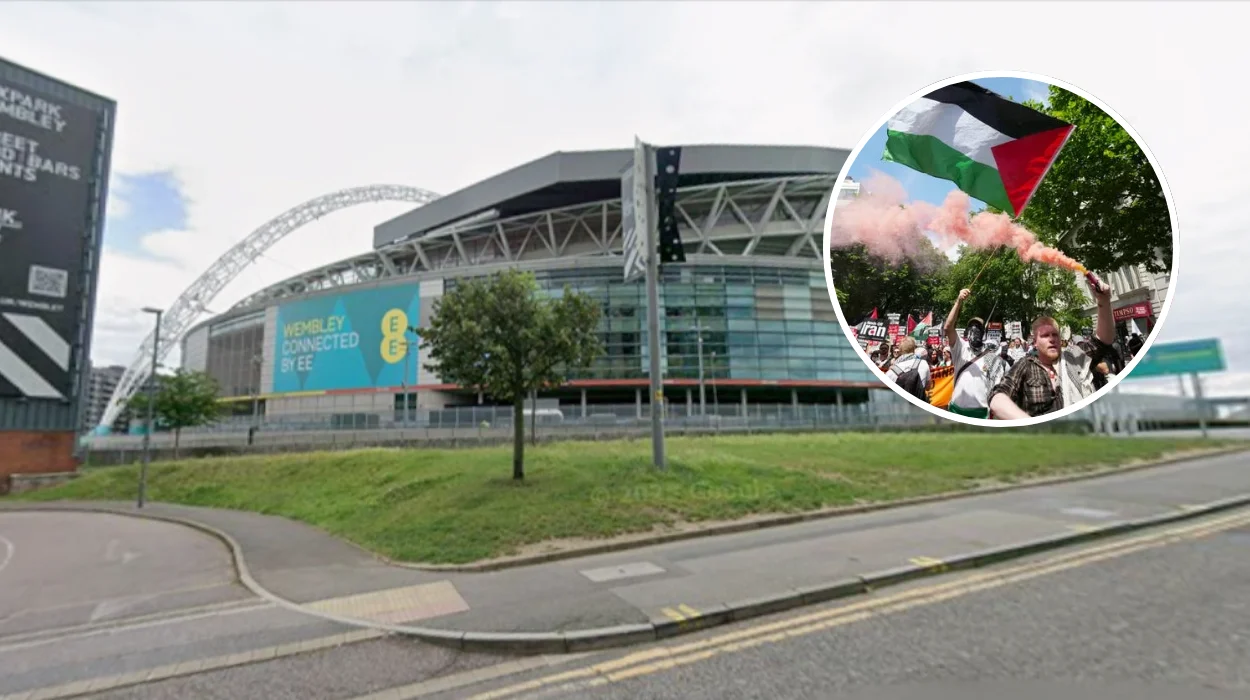
- Simultaneous Major Events: Tens of thousands of demonstrators are descending on London for two conflicting political rallies, whilst another massive crowd gathers at Wembley Stadium for the FA Cup Final between Chelsea and Manchester City.
- High-Risk Political Flashpoints: Authorities have mapped out separate, strict routing to prevent direct clashes between the far-right “Unite the Kingdom” march, organised by Stephen Yaxley-Lennon (Tommy Robinson), and the annual Nakba Day demonstration supporting Palestine.
- Unprecedented Surveillance Tech: Live facial recognition technology is being deployed for the first time in a major protest policing operation, targeting high-traffic transit areas outside the direct march routes.
- International Bans and Legal Crackdowns: The British government has blocked 11 foreign nationals from entering the country to prevent the incitement of hatred, whilst prosecutors warn that social media posts will be monitored for hate speech violations.
London (The Londoner News) May 16, 2026 – Tens of thousands of people are descending on the United Kingdom’s capital today as the Metropolitan Police launches a massive security operation to manage two highly sensitive political demonstrations and the historic 145th FA Cup Final at Wembley Stadium. Facing a potent mix of highly charged ideological protests and a major domestic soccer showpiece, authorities have deployed over 4,000 police officers backed by an extensive array of aerial and tactical resources. Armored vehicles, police horses, specialized dog units, surveillance drones, and helicopters have been strategically positioned across London, with the primary objective of avoiding violent clashes between rival political groups and ensuring public safety during a day of immense operational strain.
- Key Points
- How Are Authorities Segregating the Two Major Political Demonstrations?
- What Legal Constraints Face Protest Attendees on Social Media and on the Streets?
- Why Has the British Government Blocked Foreign Activists From Entering the Country?
- How Are Prime Minister Starmer and Mayor Sadiq Khan Coordinating the Police Response?
- Where and Why Is Live Facial Recognition Technology Being Deployed?
- What Football Logistics and Rivalries Are Adding to Wembley’s Security Strain?
- How Do the Scale and Context of the “Unite the Kingdom” Rally Compare to Previous Protests?
How Are Authorities Segregating the Two Major Political Demonstrations?
As reported by Ethan Blackshaw, Deputy Publishing Lead for The Mirror, the Metropolitan Police has enforced strict, pre-determined geographical corridors to ensure that those marching in support of the right-wing “Unite the Kingdom” rally do not cross paths with the annual Nakba Day demonstration. The potential for volatile physical encounters remains a chief concern for police commanders.
According to mapping detailed by Blackshaw, the “Unite the Kingdom” protest is scheduled to assemble on Kingsway before proceeding along a route encompassing Aldwych, the Strand, Trafalgar Square, and Whitehall, with its final termination point set at Parliament Square.
Conversely, the pro-Palestine Nakba Day march, which commemorates the 1948 exodus of approximately 700,000 Palestinians from what is now Israel, is designated to form up on Exhibition Road in Kensington.
From there, demonstrators are routed via Cromwell Gardens, Brompton Road, Knightsbridge, and Piccadilly, concluding at Pall Mall, with a subsequent static rally scheduled for Waterloo Place.
While the designated lines of march remain entirely separate, Metropolitan Police strategists remain hyper-vigilant regarding the actions of unpredictable splinter groups.
Officers on the ground are instructed to monitor the periphery of the main marches closely, where uncoordinated factions from opposing ideological sides could potentially breach police perimeters and come into direct, hostile contact.
What Legal Constraints Face Protest Attendees on Social Media and on the Streets?
The legal scrutiny surrounding today’s demonstrations extends far beyond the physical streets of London, penetrating digital spaces as well. As detailed in reporting by Pan Pylas of The Associated Press, the Crown Prosecution Service (CPS) has issued stringent directives to law enforcement and prosecutors regarding the nature of public expressions during the rallies.
Specifically, prosecutors have been explicitly instructed to evaluate whether protest placards, physical banners, and digital chants uploaded or broadcast across social media platforms cross the threshold into criminal offenses. Authorities are evaluating whether such materials amount to the unlawful stirring up of racial or religious hatred during a period of heightened domestic and international tension.
Defending the rigorous legal posture, Stephen Parkinson, the Director of the Crown Prosecution Service, emphasized that the measures are not a suppression of civil liberties. As quoted by Pylas, Parkinson stated:
“This is not about restricting free speech. It is about preventing hate crime and protecting the public, particularly at a time of heightened tensions.”
Why Has the British Government Blocked Foreign Activists From Entering the Country?
In an extraordinary intervention aimed at lowering the temperature on London’s streets, the British government has taken pre-emptive administrative action against international political figures.
As reported by Pan Pylas of The Associated Press, the Home Office has officially blocked 11 foreign nationals from entering the United Kingdom, specifically targeting individuals intending to participate in the “Unite the Kingdom” rally.
The list of high-profile right-wing figures claiming to have been barred at the border includes prominent international politicians and commentators:
- Dominik Tarczynski, a well-known Polish politician.
- Filip Dewinter, a veteran Belgian political figure.
- Valentina Gomez, an American anti-Islam commentator.
- Eva Vlaardingerbroek, a Dutch right-wing activist.
Addressing the border exclusions and the potential for civil unrest, Prime Minister Keir Starmer issued an uncompromising warning from the government’s command briefing. As documented by The Associated Press, Starmer stated:
“We will block those coming into the UK who seek to incite hatred and violence. For anyone who sets out to wreak havoc on our streets, to intimidate or threaten anyone, you can expect to face the full force of the law.”
How Are Prime Minister Starmer and Mayor Sadiq Khan Coordinating the Police Response?
The scale of the multi-layered security challenge prompted a direct, high-level review by Britain’s top political leadership on the eve of the events. As documented by Pan Pylas, Prime Minister Keir Starmer conducted an official site visit to the Metropolitan Police’s central command center on Friday, May 15, 2026.
The purpose of the briefing was to thoroughly review operational planning, tactical deployments, and contingency measures for the incoming wave of protestors and football fans. Starmer was joined at the command hub by Metropolitan Police Commissioner Sir Mark Rowley and the Mayor of London, Sadiq Khan.
Together, the officials scrutinized police readiness and evaluated the logistical strains placed on the transport network and local communities, reinforcing a unified governmental stance against any outbreak of lawlessness.
Explore More London Police News
Metropolitan Police Forms Specialist Jewish Protection Team in London, 2026
London Policе Probe Antisemitic Arson in Hendon 2026
Where and Why Is Live Facial Recognition Technology Being Deployed?
In a significant technological escalation for public order policing in the UK, the Metropolitan Police is breaking new ground in surveillance methodology.
As reported by Pan Pylas of The Associated Press, live facial recognition (LFR) technology is being utilized for the first time within a major protest policing operation in the capital.
The deployment is highly strategic and deliberately placed outside the immediate conflict zones. Biometric scanning cameras have been erected in the north London neighborhood of Camden. Notably, Camden does not fall along the official route of the “Unite the Kingdom” march or the counter-protests.
However, intelligence analysts expect the area to serve as a primary transit hub and gathering point for thousands of individuals traveling into the center of the capital to attend the event. The deployment aims to detect individuals with outstanding arrest warrants or those subject to specific legal restrictions prohibiting their presence at mass gatherings.
What Football Logistics and Rivalries Are Adding to Wembley’s Security Strain?
Adding a completely separate layer of complexity to the capital’s policing matrix is the staging of the 145th FA Cup Final at Wembley Stadium in north-west London.
As published by The Associated Press, the high-stakes match kicks off at 3:00 p.m., directly overlapping with the ongoing political rallies in the city center.
According to official club ticketing and travel advisories published by Manchester City Football Club, the match is an absolute sell-out, drawing over 80,000 spectators to the national stadium. Both Manchester City and Chelsea have received identical, massive allocations of 32,362 tickets each for their respective ends.
This historic match marks the first time these two specific modern powerhouses have faced each other in an FA Cup Final, introducing intense sporting rivalry into an already oversaturated security environment.
To mitigate logistical chaos, extensive travel arrangements have been instituted. Official notices from Manchester City’s transport desk indicate a massive influx of regional travel, with a fleet of National Express coaches operating directly from Manchester’s Chorlton Street Coach Station, alongside heavily augmented rail services via Trainline. With tens of thousands of travelling supporters navigating London’s major rail terminals—such as Euston and St Pancras—at the exact same time political demonstrators are utilizing the transit network, the Metropolitan Police is hoping that the massive sporting event passes off entirely without incident or overlap with the central political friction points.
How Do the Scale and Context of the “Unite the Kingdom” Rally Compare to Previous Protests?
The underlying societal tensions fueling today’s massive turnout are part of an ongoing, highly coordinated domestic and transnational movement. In an investigative analysis published by Dr Eviane Leidig for the Centre for Analysis of the Radical Right (and carried by the Center for Stopping Digital Hate), the current “Unite the Kingdom, Unite the West” rally is described as part of a highly sophisticated, professionalised operation.
Dr Leidig notes that today’s mobilization follows a previous massive gathering in September 2025, which drew over 100,000 attendees to the capital.
Organised under the leadership of Stephen Yaxley-Lennon (Tommy Robinson), the co-founder of the former English Defence League (EDL), the movement has evolved significantly. According to Dr Leidig’s analysis:
“The rally represents the epitome of transnational far-right mobilization and activism… backed by foreign funders, circulating chronic disinformation and synthetic content on social media, and amplified by supporters in public office.”
Dr Leidig reports that the rhetoric driving today’s right-wing turnout relies heavily on selective crime data and emotive framing regarding public safety. It utilizes localized narratives suggesting that multiculturalism has left traditional British identity under threat. Despite organizers publicly calling for a peaceful demonstration, monitoring by civil rights groups noted that various hardline nationalist factions online have actively attempted to hijack the event’s momentum to incite Islamophobic and anti-social behavior.