Key Points
- Massive Public Turnout: An estimated 80,000 demonstrators gathered in central London for two high-profile, opposing rallies occurring simultaneously.
- The Demonstrations: Approximately 50,000 people attended the “Unite the Kingdom” march organized by right-wing activist Tommy Robinson, while an estimated 30,000 individuals participated in the pro-Palestine Nakba Day rally.
- Unprecedented Security Operation: The Metropolitan Police launched a massive £4.5 million security deployment to keep the opposing factions separated and maintain public order.
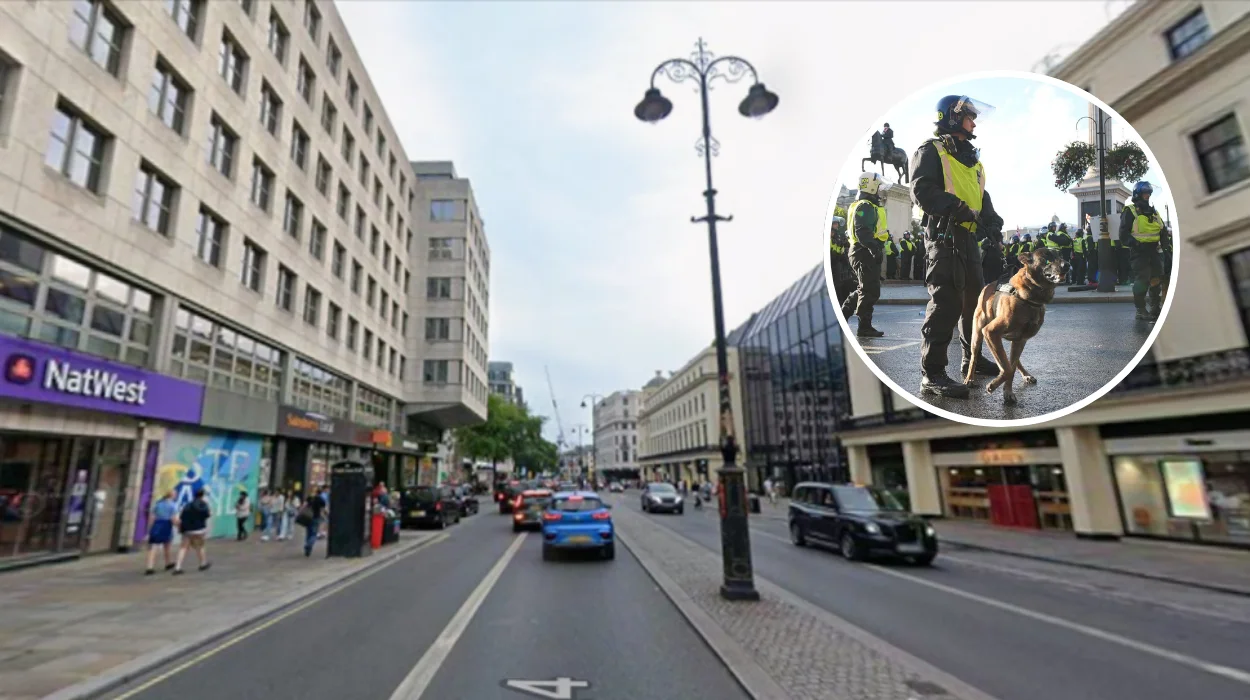
- Extensive Police Resources: Around 4,000 police officers were deployed across the capital, supported by advanced specialist assets including armoured vehicles, police horses, K9 units, surveillance drones, and helicopters.
- Public Safety Focus: The primary objective of Scotland Yard’s intense operational strategy was to establish strict physical buffers to completely avoid clashes between the two highly charged groups.
London (The Londoner News) May 16, 2026 – A massive security operation costing an estimated £4.5 million was deployed across the streets of central London today as approximately 80,000 demonstrators descended upon the capital for two major, highly polarised protest rallies. The Metropolitan Police mobilized roughly 4,000 officers alongside specialized tactical units to prevent direct confrontations between an estimated 50,000 attendees of the right-wing “Unite the Kingdom” march, led by political activist Tommy Robinson, and a concurrent crowd of 30,000 demonstrators participating in the annual pro-Palestine Nakba Day rally.
- Key Points
- Why Did Thousands of People Gather in London Today?
- How Did the Metropolitan Police Respond to the Dual Protests?
- How Much Did the London Protest Police Operation Cost?
- What Were the Specific Routes for the Nakba Day and Unite the Kingdom Rallies?
- Which Areas Did the Pro-Palestine Nakba Day Rally Cover?
- What Statements Were Made by Police Officials Regarding Public Safety?
- Were There Any Clashes or Arrests Reported During the Rallies?
- How Have Political Leaders Responded to the London Protests?
With both groups holding deeply conflicting ideologies and marching through adjacent corridors of the city, Scotland Yard implemented unprecedented crowd-control measures. Armed with mutual dispersal orders, strict geographic conditions, and real-time aerial surveillance, law enforcement successfully established physical barriers to prevent the volatile gatherings from intersecting, managing one of the most complex public order challenges the capital has seen this year.
Why Did Thousands of People Gather in London Today?
The dual demonstrations were sparked by distinct geopolitical and domestic political catalysts, drawing massive crowds from across the United Kingdom to the heart of government in Westminster.
The concurrent scheduling of these events created an immediate logistical and security challenge for municipal authorities, requiring a meticulously timed routing strategy to ensure the two emotionally charged crowds did not meet.
On one side of the capital, supporters of Tommy Robinson, whose real name is Stephen Yaxley-Lennon, convened under the banner of the “Unite the Kingdom” movement.
As reported by home affairs correspondent Fiona Hamilton of The Times, the demonstration was framed by organizers as a patriotic gathering focusing on free speech, border control, and perceived failures in the British justice system.
Concurrently, the pro-Palestine Nakba Day rally marked the annual commemoration of the “Catastrophe” of 1948, reflecting ongoing tensions regarding the Middle East. Writing for The Guardian, senior reporter Rajeev Syal noted that this march was organized by a coalition of advocacy groups, including the Palestine Solidarity Campaign (PSC), aiming to draw public attention to the current humanitarian situation in Gaza and call for immediate diplomatic interventions by the British government.
How Did the Metropolitan Police Respond to the Dual Protests?
Faced with the potential for severe public disorder, the Metropolitan Police launched a comprehensive, multi-layered security strategy designed to insulate each march from the other.
The operation relied heavily on early intervention, strict geographical boundaries, and an overwhelming physical presence on the ground.
The scale of the policing response required mutual aid from several regional constabularies to bolster London’s local forces. In a detailed breakdown provided by crime editor Martin Evans of The Daily Telegraph, the Met’s deployment included:
- Around 4,000 frontline officers stationed at key convergence points, transit hubs, and historical monuments.
- A fleet of tactical armoured vehicles positioned strategically to act as physical roadblocks between moving columns of protesters.
- Specialist mounted branches and K9 units utilized for dynamic crowd management and maintaining clear pathways along the designated routes.
- Continuous aerial surveillance provided by police helicopters and advanced drones, feeding real-time telemetry back to the Met’s central command unit.
How Much Did the London Protest Police Operation Cost?
The financial strain of managing such large-scale public expressions of dissent remains a point of significant civic discussion.
According to an administrative briefing published by home affairs editor Matt Dathan of The Sun, the total financial expenditure for this single-day policing operation has been estimated at a staggering £4.5 million.
This figure encompasses officer overtime, the transport and logistical costs of mutual aid from outside forces, and the deployment of specialized technological and aerial surveillance assets.
What Were the Specific Routes for the Nakba Day and Unite the Kingdom Rallies?
To minimize the risk of violence, Scotland Yard utilized powers under Sections 12 and 14 of the Public Order Act to mandate strict, non-overlapping routes and assembly times for both groups.
As detailed by home affairs reporter Lizzie Dearden of The Independent, the “Unite the Kingdom” demonstrators gathered initially near Victoria Station before marching along a pre-approved corridor toward Whitehall. Protesters carried Union Jacks, St. George’s Cross flags, and banners carrying populist slogans.
As noted by Dearden, the Metropolitan Police enforced a strict condition that the rally must conclude within a designated zone on Whitehall, explicitly forbidding any breakaway movements toward the Embankment or alternative parliamentary quarters.
Explore More London Police News
London Protests and FA Cup Final Sparks Massive 2026 Security Mobilisation
Metropolitan Police Forms Specialist Jewish Protection Team in London, 2026
Which Areas Did the Pro-Palestine Nakba Day Rally Cover?
Simultaneously, the Nakba Day procession took a parallel but distinctly segregated path through the city. Reporting from the scene, standard news editor Tristan Kirk of the London Evening Standard observed that the pro-Palestine marchers assembled near Russell Square, moving methodically through the West End toward a final termination point near the River Thames.
The organisers had agreed to strict timelines with the police, ensuring that their vanguard would not enter the Whitehall vicinity until the right-wing demonstration had completely dispersed, thereby creating a temporal buffer alongside the geographical one.
What Statements Were Made by Police Officials Regarding Public Safety?
The leadership of the Metropolitan Police maintained a firm, neutral stance throughout the planning and execution of the operation, emphasizing that their primary mandate was the preservation of life, property, and the constitutional right to peaceful protest, regardless of political affiliation.
In an official press briefing ahead of the demonstrations, Metropolitan Police Assistant Commissioner Matt Twist stated:
“Our objective this weekend is entirely clear: we are here to maintain the peace and ensure that law-abiding Londoners can go about their daily business without fear of violence or intimidation. We have designed a robust, intelligence-led operation that leaves absolutely no room for crossover between these two highly passionate groups. Anyone who steps outside the conditions we have set, or who uses these platforms to commit criminal acts, will face swift and decisive intervention.”
Furthermore, as reported by senior home affairs producer Mark White of GB News, Metropolitan Police Commissioner Sir Mark Rowley later reflected on the operational burdens, stating that
“the sheer volume of large-scale protests in the capital places an extraordinary and unsustainable strain on our frontline resources, yet our officers continue to perform their duties with absolute impartiality and professionalism.”
Were There Any Clashes or Arrests Reported During the Rallies?
Despite the high-voltage atmosphere and occasional verbal skirmishes at the peripheries of the police cordons, the extensive security infrastructure prevented any large-scale rioting or direct physical confrontations between the opposing factions.
According to a live updates report compiled by crime correspondent Vikram Dodd of The Guardian, the day passed with minimal serious violence, though a number of isolated arrests were made. Dodd noted that the arrests primarily involved individual infractions, including:
- Breaches of the Public Order Act conditions.
- Instances of drunk and disorderly conduct.
- Minor assaults on emergency workers.
- Possession of prohibited items.
As reported by BBC News home affairs correspondent Dominic Casciani, the strict physical segregation maintained by the thousands of officers on the ground successfully mitigated the threat of a wider civil disturbance, allowing both demonstrations to conclude and disperse via public transport links by the early evening.
How Have Political Leaders Responded to the London Protests?
The scale of the demonstrations and the multi-million-pound cost of policing them have reignited a fierce debate among political figures regarding the limits of public protest and the financial burden placed on taxpayers.
Writing for Sky News, political editor Beth Rigby revealed that a government spokesperson issued a statement affirming that “while the right to peaceful protest is a fundamental cornerstone of our democracy, the public also has a right to see their streets protected from disruption. The government commends the extraordinary efforts of the Metropolitan Police in keeping the public safe under immensely challenging circumstances.”