Key Points
- Controversial Event: Activists gathered in northwest London to protest the “Great Israeli Real Estate” event, which marketed residential properties located within illegal Israeli settlements in the occupied West Bank.
- Violent Clashes: The demonstration escalated into physical altercations after Zionist counterprotesters arrived at the venue, resulting in chaotic scenes and direct confrontations between the two opposing factions.
- Allegations of Police Brutality: Eyewitnesses and video footage indicate a heavy-handed response from the Metropolitan Police, including instances of officers pinning demonstrators to the ground and applying pressure to an activist’s throat.
- Accusations of Bias: Pro-Palestine campaigners allege that police selectively targeted peaceful demonstrators for restraint and arrest, while failing to properly intervene against counterprotesters who they claim instigated the violence.
- Tactical Comparisons: Eyewitness accounts compared the Metropolitan Police’s crowd control methods to military tactics deployed by the Israel Defense Forces (IDF) against civilians in the occupied West Bank.
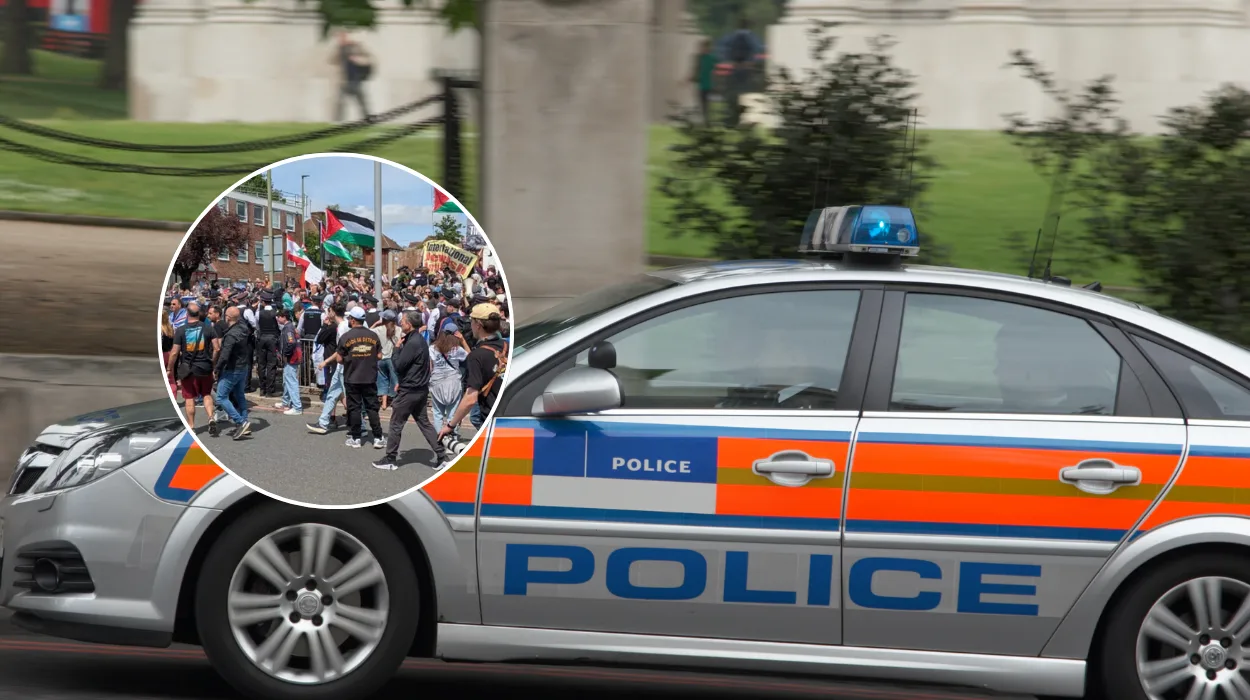
London (The Londoner News) June 15, 2026 – The Metropolitan Police are facing intense scrutiny and accusations of institutional bias following a heavy-handed operational response to a protest outside a controversial Israeli real estate exhibition in northwest London on Sunday. What was organized as a peaceful demonstration against the sale of properties within illegal West Bank settlements quickly deteriorated into violence after clashes erupted between pro-Palestine activists and Zionist counterprotesters. Campaigners allege that police deployed excessive physical force, targeted peaceful anti-settlement demonstrators rather than the primary instigators of the violence, and utilized aggressive restraint techniques that eyewitnesses compared to Israeli military tactics used in the occupied territories.
- Key Points
- What Sparked the Protests in Northwest London?
- How Did the Confrontation Between the Two Groups Escalate?
- Why Are the Metropolitan Police Accused of Using ‘Israeli Army Tactics’?
- What Visual Evidence Exists of Police Using Excessive Force?
- How Have Community Groups and Activists Reacted to the Police Actions?
- What Is the Metropolitan Police’s Official Stance on the Allegations?
- What Are the Broader Legal Implications of Israeli Property Sales in the UK?
The incident has ignited a fierce debate regarding British policing priorities during highly charged geopolitical demonstrations. Video footage verified by independent journalists captures multiple police officers violently restraining activists on the pavement, with one notable segment showing an officer pressing his forearm directly into a protester’s throat. The Metropolitan Police have defended their presence as a necessary intervention to maintain public order and separate two hostile groups, confirming that multiple arrests were made during the melee. However, civil liberties groups and Jewish anti-Zionist organizations argue the police response was disproportionate and shielded individuals promoting internationally recognized illegal activities.
What Sparked the Protests in Northwest London?
The primary catalyst for the demonstration was the “Great Israeli Real Estate” exhibition, a commercial event designed to market and sell residential homes directly to international buyers. Crucially, the catalog of available properties included housing units built within Israeli settlements in the occupied West Bank. Under international law, specifically the Fourth Geneva Convention, these settlements are explicitly classified as illegal, a positioning formally maintained by the United Nations and the UK Foreign Office, despite the ongoing commercialization of the territories.
As detailed by journalist Rosabel Crean in her coverage for The New Arab, the event drew immediate condemnation from human rights advocates who view the sale of such properties as a direct violation of international law and an enforcement of Palestinian displacement. Pro-Palestine mobilization networks organized a gathering outside the venue to visually disrupt the marketing event, draw public attention to the legal status of the land being sold, and demand that UK authorities halt commercial operations that profit from occupied territories.
How Did the Confrontation Between the Two Groups Escalate?
The gathering began as a highly vocal but initially non-violent picket line, with activists holding placards and chanting slogans condemning settlement expansion. The dynamic of the demonstration shifted dramatically with the arrival of a organized group of Zionist counterprotesters, who positioned themselves in direct proximity to the pro-Palestine group. Verbal sparring between the two factions rapidly escalated into physical altercations, creating a volatile environment that required emergency police intervention.
According to reporting by The New Arab, eyewitnesses stated that the counterprotesters actively sought to provoke the initial demonstrators, leading to pushing, shoving, and isolated instances of physical violence across the dividing lines. As the situation fractured, Metropolitan Police officers moved in to separate the crowds. However, activists present at the scene argue that the police intervention failed to address the systemic source of the physical escalation, focusing instead on neutralizing the anti-settlement demonstrators.
Explore more London Police News:
London Policе Probe Antisemitic Arson in Hendon 2026
Woman Sexually Assaulted in Charlton Churchyard, 2026
Why Are the Metropolitan Police Accused of Using ‘Israeli Army Tactics’?
The most severe accusations leveled against the Metropolitan Police concern the specific physical tactics used by officers to subdue demonstrators. Activists who have spent time documenting human rights abuses in the Middle East reported a chilling similarity between London policing and military enforcement abroad.
As reported by Rosabel Crean of The New Arab, Leora, an activist and member of the prominent group Jewish Anti-Zionist Action who attended the demonstration, stated that:
“A comrade who had just been on a protective presence trip to the West Bank noted it felt like the Met police were using Israeli [army] tactics, by targeting peaceful protesters and not the instigators of the violence, who were the Zionist counter-protesters.”
This comparison underscores a deep sense of betrayal felt by campaigners, who argue that the Met Police adopted an occupying force mentality. The focus on neutralizing peaceful dissent while ignoring aggressive actions by counter-demonstrators mirrors, in the view of the activists, the structural asymmetries observed during military governance in the West Bank.
What Visual Evidence Exists of Police Using Excessive Force?
The narrative of excessive force is not limited to verbal testimony; it is heavily supported by digital media captured during the height of the clashes. Video footage obtained and reviewed by newsrooms has provided a frame-by-frame look at the exact moments the police response turned highly physical.
In the media review conducted by Rosabel Crean for The New Arab, the publication confirmed that video footage appears to show several Metropolitan Police officers heavily restraining protesters on the ground. Most alarmingly, one specific sequence documents an activist pinned completely flat against the pavement while an officer continuously presses an arm directly into his throat, a restraint technique that has faced widespread condemnation globally due to the immediate risk of asphyxiation and permanent physical trauma.
How Have Community Groups and Activists Reacted to the Police Actions?
The reaction from civil society, human rights organizations, and anti-war coalitions has been one of uniform condemnation. Organizations representing progressive Jewish voices have been particularly vocal, expressing outrage that a UK police force would protect a commercial venture dealing in illegal land while brutalizing British citizens exercising their democratic right to protest.
Representatives from Jewish Anti-Zionist Action have publicly demanded an immediate, independent investigation into the operational choices made by command staff on Sunday. They argue that by arresting and physically suppressing the pro-Palestine demonstrators, the Metropolitan Police effectively acted as a private security firm for the real estate event, validating the sale of contested land and signaling to counterprotesters that aggressive behavior against Palestinian solidarity movements will be met with state protection.
What Is the Metropolitan Police’s Official Stance on the Allegations?
In response to the mounting public backlash and the circulation of the controversial restraint footage, the Metropolitan Police command has maintained that their officers acted within their legal mandates to prevent a further breach of the peace and ensure public safety. The department routinely asserts that public order policing in London is incredibly complex, requiring rapid, split-second assessments by officers on the ground when two diametrically opposed groups engage in physical conflict.
While the Met has not issued a granular breakdown of the specific throat-restraint incident shown in the video, standard departmental protocols dictate that any formal complaint regarding excessive force will be routed through the Directorate of Professional Standards. The police have confirmed the total number of detentions from the event, emphasizing that arrests are made based on objective evaluations of individual behavior—such as assault, obstruction, or failure to comply with dispersal orders—regardless of the political affiliation or ideological stance of the individuals involved.
What Are the Broader Legal Implications of Israeli Property Sales in the UK?
Beneath the immediate controversy of police conduct lies a deeper, unresolved legal question regarding the permissibility of hosting real estate events that profit from occupied land within British borders. Legal experts point out that while individual citizens have the freedom to engage in global property markets, the commercial promotion of infrastructure built upon occupied territory creates significant international legal friction.
Activists argue that by allowing the “Great Israeli Real Estate” event to proceed unhindered, UK municipal and federal authorities are turning a blind eye to domestic complicity in settlement expansion. The UK government has repeatedly stated that it views Israeli settlements as a barrier to peace and a violation of international law. However, as long as private corporations are permitted to utilize British venues to auction off these disputed territories, grassroots protests are virtually guaranteed to continue, leaving the Metropolitan Police caught in the volatile crosshairs of global geopolitics and local civil rights.