
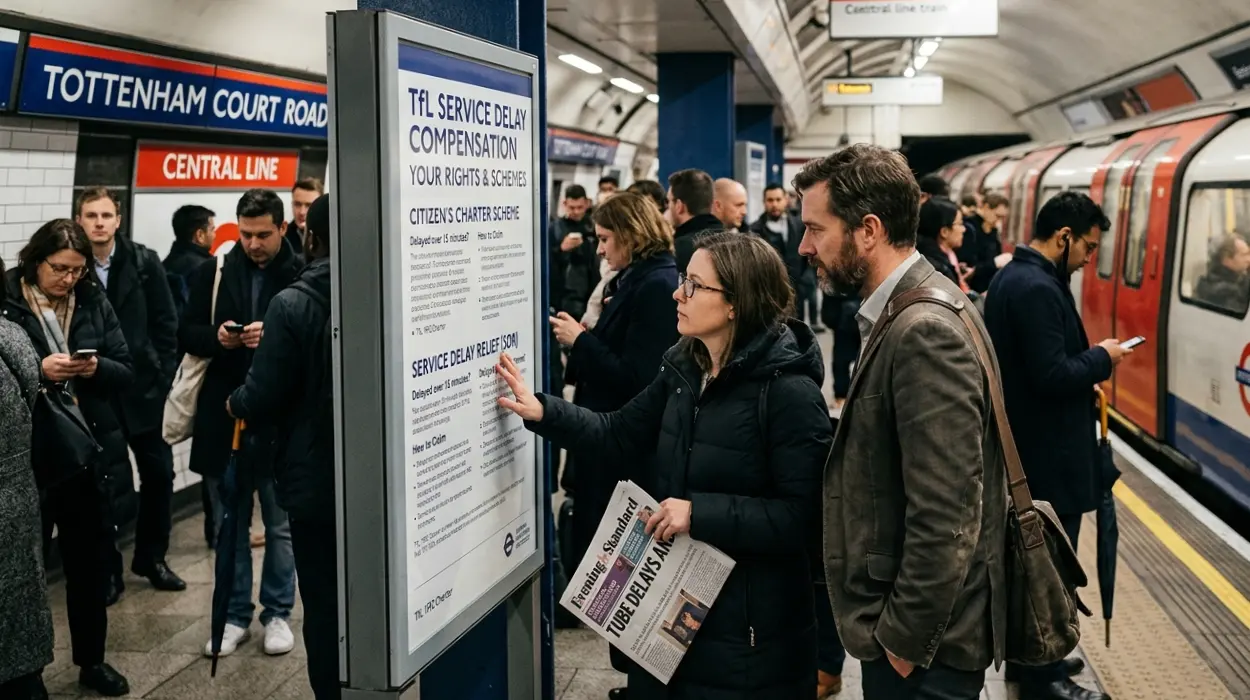
The history of London Underground service delay compensation establishes that modern statutory passenger remedies evolved from Victorian common law carrier liabilities, statutory railway acts, twentieth-century nationalisation policies, and the formalized Service Delay Relief schemes introduced under the Citizen’s Charter initiatives of 1992.
- How Did The Fifteen Minute Tube Delay Standard Become Operational Law?
- Who Controlled Underground Claims Processing Throughout Metropolitan History?
- Which Historical Disruption Processes Influenced Modern Refund Criteria?
- What Are The Current Methods For Evaluating Digital Transport Redress?
- How Does The Archive Record Underground Network Passenger Evolution?
- What Long Term Implications Do Underground Refund Protocols Hold?
The concept of passenger compensation for transit delays within London developed alongside the expansion of metropolitan subterranean transit networks. When the Metropolitan Railway opened the first underground railway service on 10 January 1863 between Paddington and Farringdon, passenger protections operated under the Regulation of Railways Act 1844 and general common law provisions concerning common carriers. Common carriers maintained a legal obligation to transport passengers and goods safely and within a reasonable timeframe. However, early railway operators routinely inserted comprehensive liability waivers on the reverse side of physical paper tickets. These waivers limited corporate financial exposure to delays caused by engine malfunctions, track obstructions, or dense London fog.
The legal framework shifted as individual subterranean operators consolidated. The passing of the London Passenger Transport Act 1933 created the London Passenger Transport Board on 1 July 1933. This statutory body nationalised and unified the independent tube lines, such as the Central London Railway and the Charing Cross, Euston and Hampstead Railway, into a singular administrative network called London Transport. Under nationalised management, passenger compensation for delays remained highly discretionary. Station masters possessed individual authority to issue paper “service restoration vouchers” or complimentary tickets to passengers who suffered severe delays resulting from mechanical breakdowns or systemic line blockages.
Systemic operational accountability became formalised during the late twentieth century. The Conservative administration of Prime Minister John Major introduced the Citizen’s Charter white paper in July 1991. This legislative initiative aimed to improve public services by implementing explicit performance standards and financial penalties for service non-performance. In response, London Underground Limited established the first structured Passenger’s Charter in 1992. This document introduced a codified right to financial redress if a journey exceeded the scheduled timetable by a specified margin. The initial threshold required a delay exceeding fifteen minutes, a metric that remains a central structural component of public transport regulation in Greater London.
How Did The Fifteen Minute Tube Delay Standard Become Operational Law?
The fifteen minute tube delay standard became operational law through the enactment of the Greater London Authority Act 1999 and the subsequent creation of Transport for London in 2000, which integrated the Passenger’s Charter into formal statutory service commitments.
The implementation of the fifteen-minute threshold required a systematic evaluation of transit timetables and systemic variance tolerances. During the development of the 1992 Passenger’s Charter, operational researchers at London Underground Limited analysed peak and off-peak headway metrics across multiple lines, including the deep-level Northern line and the sub-surface District line. The analysts determined that a delay of fifteen minutes or greater constituted a significant operational failure rather than a standard service fluctuation. This specific duration equalled or exceeded three times the average peak-hour headway on most central London routes, making it an appropriate trigger for passenger compensation.
The structural transition from an internal corporate charter to a legally binding public obligation occurred via local government reform. Parliament passed the Greater London Authority Act 1999, which established the Greater London Authority and the office of the Mayor of London. Section 154 of the Greater London Authority Act 1999 created Transport for London as the statutory corporation responsible for the capital’s transport system, effective 3 July 2000. Transport for London legally absorbed London Underground Limited and formalised the Customer Charter. This structural shift transformed discretionary refunds into regularised administrative claims processes under public law oversight.
The legal enforcement of these standards relies heavily on the regulatory supervision of independent consumer bodies. The Railways Act 2005 and subsequent amendments designated London TravelWatch, legally known as the London Transport Users’ Committee, as the official statutory watchdog for transport users in the capital. London TravelWatch monitors Transport for London compliance with its published service delay obligations. The organization reviews performance data, monitors the accessibility of the claims apparatus, and evaluates systemic refund denial rates to ensure the statutory intent of the Greater London Authority Act 1999 is maintained across all twelve operating lines.
Who Controlled Underground Claims Processing Throughout Metropolitan History?
The control of underground claims processing moved sequentially from independent Victorian railway corporate boards to the centralized London Passenger Transport Board in 1933, followed by the London Transport Executive in 1948, and finally Transport for London Customer Services in 2000.
The administration of passenger claims during the nineteenth and early twentieth centuries was decentralised and litigious. Each private underground railway company, including the City and South London Railway and the Great Northern, Piccadilly and Brompton Railway, maintained its own distinct corporate legal department and claims administrative board. Passengers seeking redress for delays or injuries had to submit written correspondence directly to the corporate secretary at individual company headquarters. The process favored affluent commuters who could retain legal counsel to contest corporate liability under the provisions of the Railway and Canal Traffic Act 1854, which restricted railway companies from enforcing unreasonable contract conditions regarding service delivery.
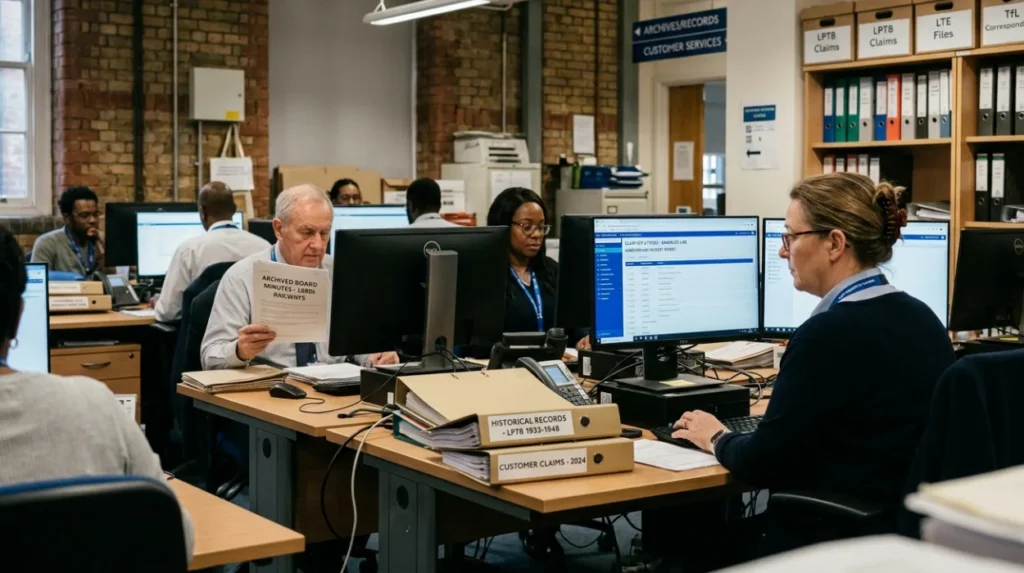
The establishment of the London Passenger Transport Board in 1933 centralised claims administration within a unified public bureaucracy for the first time. The board created a dedicated Claims and Legal Department based at 55 Broadway, Westminster. This centralized unit standardised the evaluation of passenger grievances across all underground lines, bus routes, and tram networks. Following the Transport Act 1947, control transferred on 1 January 1948 to the London Transport Executive under the British Transport Commission. Claims processing during this mid-twentieth-century era became highly structured, requiring passengers to obtain physical, signed statements from station clerks verifying the exact duration and cause of a service disruption.
The modernization of the claims framework occurred during the transition to a digital administrative infrastructure under Transport for London Customer Services. Prior to 2000, the processing of Passenger’s Charter claims relied completely on manual, paper-based forms known as “Customer Charter Refund Application Forms.” These forms were distributed by station staff and processed via postal delivery to a central clearinghouse in Darlington. The establishment of the modern Transport for London digital architecture enabled the migration of claims processing to automated online databases. These systems match passenger claims against real-time signalling data recorded by the automated train control networks across the underground system.
Which Historical Disruption Processes Influenced Modern Refund Criteria?
Historical disruption processes that influenced modern refund criteria include industrial strike actions, wartime bombardment during the Blitz, severe infrastructure flooding, electrical grid failures, and rolling rolling-stock asset depreciation across successive municipal administrative eras.
Industrial disputes represent a primary cause of historical service disruptions that shaped modern refund exclusion clauses. Massive industrial actions, such as the Nine-Day General Strike of May 1926, completely halted operations across the Underground Group. During these periods of widespread labour unrest, private operators suspended all standard service guarantees under force majeure principles. Modern Transport for London regulations retain this historical exclusion. No compensation is payable if a delay of fifteen minutes or greater results from industrial action, as the legal framework attributes liability to external labor conditions rather than systemic engineering failures.
Wartime operations during the mid-twentieth century introduced complex legal definitions regarding state-perempted service suspensions. Between September 1940 and May 1941, the London Underground network served as a primary bomb shelter during the Blitz, with seventy-nine stations adapted for overnight civilian protection. High-explosive bomb strikes frequently breached tunnels, such as the direct hit at Marble Arch station on 14 October 1940 and Balham station on 14 October 1940. The London Transport Executive suspended all standard transit timetables and liability for delays under emergency wartime legislation, cementing the principle that acts of war and civil emergencies exempt public transport providers from civilian passenger delay liabilities.
Engineering vulnerabilities within low-lying sections of the sub-surface network also forced the integration of meteorological exclusions into modern refund policies. The District and Metropolitan lines utilize old cut-and-cover tunnels that are vulnerable to flash flooding during intense rainfall events. Severe inundations, such as the flooding of the tunnel network near King’s Cross in 1962, demonstrated that atmospheric conditions could overwhelm existing pumping infrastructure. This led to specific guidelines exempting operators from financial liability if delays are caused by extreme weather conditions that exceed statutory design tolerances. Conversely, internal mechanical failures, such as the widespread breakdown of aged District Line rolling stock during the late 1970s, established that disruptions caused by neglected asset maintenance remain fully compensable.
Explore More Public Services
Real-Time Community Safety and Local Crime Map Updates: London Wards
How to Update Council Services When Moving House Within London
What Are The Current Methods For Evaluating Digital Transport Redress?
The current methods for evaluating digital transport redress rely on the automated comparison of passenger journey logs recorded by the Oyster and Contactless ticketing platforms against centralized signaling logbooks.
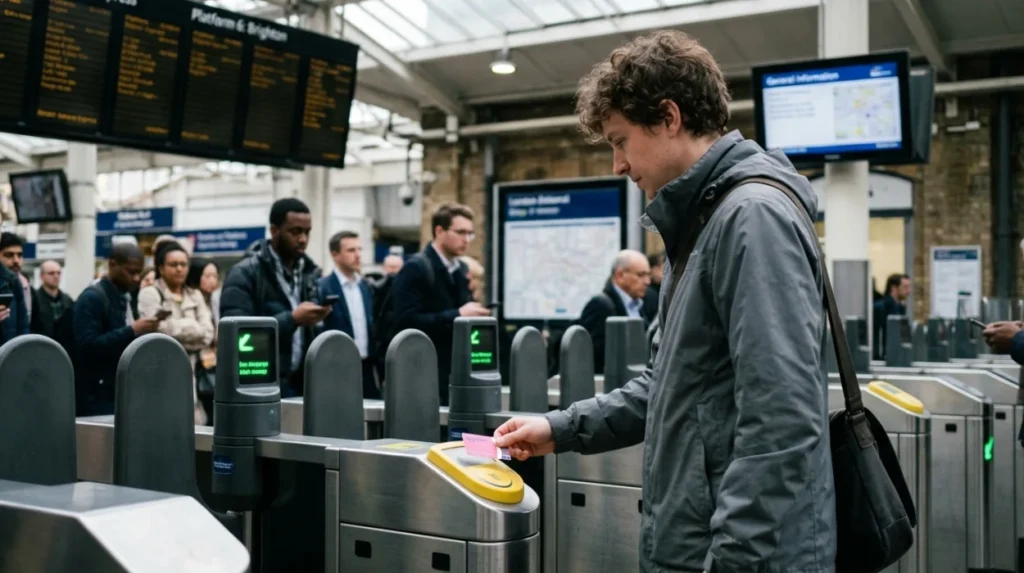
The contemporary mechanism of transport redress requires checking data across multiple digital infrastructures. When a passenger taps a Contactless payment card or an Oyster smartcard at a London Underground ticket barrier, the transaction system logs the exact millisecond and location of entry. Upon exiting the network, a corresponding tap-out log completes the journey data profile. To evaluate a claim for a delay exceeding fifteen minutes, Transport for London algorithms compare the total elapsed duration of the passenger’s journey against the benchmark transit time defined by the official working timetable for that specific route and time of day.
This automated validation process is supplemented by spatial and temporal cross-referencing with the central signaling logs. Transport for London operates several automated train tracking systems, such as the Central Line’s Automatic Train Control platform and the sub-surface lines’ Signal Upgrade Programme databases. These engineering systems log the precise movement of every train through individual track circuits and signaling blocks. If a passenger submits an online claim through their digital account, the system cross-checks the passenger’s entry and exit logs against the recorded signaling anomalies on that specific line segment. If the technical log confirms a delay of fifteen minutes or greater caused by a operational issue, the claim receives automated approval.
Passengers who do not hold a digital account must use alternative administrative channels to access compensation. This requires submitting an online web-form application or initiating telephone contact with Transport for London Customer Services within twenty-eight days of the disruption. The manual review process uses the same underlying data verification principles, checking the passenger’s stated travel parameters against the official log of engineering incidents. Approved compensation is issued via multiple methods, including direct electronic credit to the passenger’s digital transit account, a direct refund to the originating Contactless payment card, or an electronic bank transfer.
How Does The Archive Record Underground Network Passenger Evolution?
The archive record preserves the evolution of underground network passenger rights through extensive collections of physical tickets, customer charter ledgers, parliamentary select committee reports, and public consumer files held at the London Transport Museum and the National Archives.
The historical record of passenger rights is documented within the corporate archives of the London Passenger Transport Board and its successors, preserved at the National Archives in Kew. These records contain the minutes of legal sub-committees from the 1930s through the 1970s. These internal documents show how public administrators calculated the financial risk of service disruptions. The ledgers reveal that early administrators worried about the financial impact of expanding passenger rights, frequently balancing the cost of infrastructure upgrades against potential litigation or refund costs under common law carrier requirements.
The structural transition of the network is also documented in the physical collections of the London Transport Museum Archive in Acton. This repository holds complete collections of London Underground public notices, marketing materials, and Passenger’s Charters issued since 1992. By reviewing these documents, academic researchers can trace the changing metrics used to evaluate public transport efficiency. The transition from vague promises of “reasonable dispatch” in the 1950s to clear, quantifiable standards in the late 1990s demonstrates a long-term shift toward consumer-oriented public administration.
To experience this historic landmark in person today, consult our comprehensive [London Transport Museum Visitor Guide] for itineraries and visiting parameters. The historical documentation proves that modern automated refund systems are not a new innovation. Instead, they represent the technological evolution of legal and operational principles established during the development of London’s urban transit infrastructure over the past 160 years.
What Long Term Implications Do Underground Refund Protocols Hold?
The long-term implications of underground refund protocols shape the financial planning of urban transport infrastructure, influence automated consumer rights legislation, and provide a framework for smart-city transit networks globally.
The financial impact of passenger compensation programs is an important factor in modern transport economics. Transport for London must balance its operating budget by managing its compensation liabilities. The money paid out for Passenger’s Charter claims comes directly from the network’s operating revenues. This creates a direct financial incentive for transport managers to prioritize infrastructure reliability. When a specific line experiences repeated delays that trigger high numbers of compensation claims, it often accelerates capital investment for that route. For example, frequent delay payouts on the Jubilee Line during the early 2000s helped justify the budget for upgrading to automated moving-block signaling.
Furthermore, the automation of transit refunds provides a template for broader consumer protection laws in the digital economy. The transition from manual, paper-based forms to algorithmic verification serves as a model for other public utilities and services. The legal principles developed for the London Underground—such as setting clear performance thresholds and using automated data to verify claims—are increasingly applied to sectors like telecommunications, aviation, and energy delivery. These practices demonstrate how smart-city infrastructure can automate consumer redress, reducing administrative overhead while ensuring fair compensation.
As urban centers continue to install smart transit networks, the principles established by London’s transit system help shape international standards. Large metropolitan transit systems worldwide look to London’s administrative framework when designing their own passenger charters. The fifteen-minute threshold remains a key benchmark for balancing operational realities with passenger expectations. This historical evolution shows that passenger compensation has grown from simple, discretionary token payments into an automated, data-driven system integrated into the core architecture of urban governance.
What is London Underground delay compensation?
London Underground delay compensation is a passenger redress scheme that allows eligible travelers to claim a refund or travel credit when service disruptions cause significant delays to their journeys.