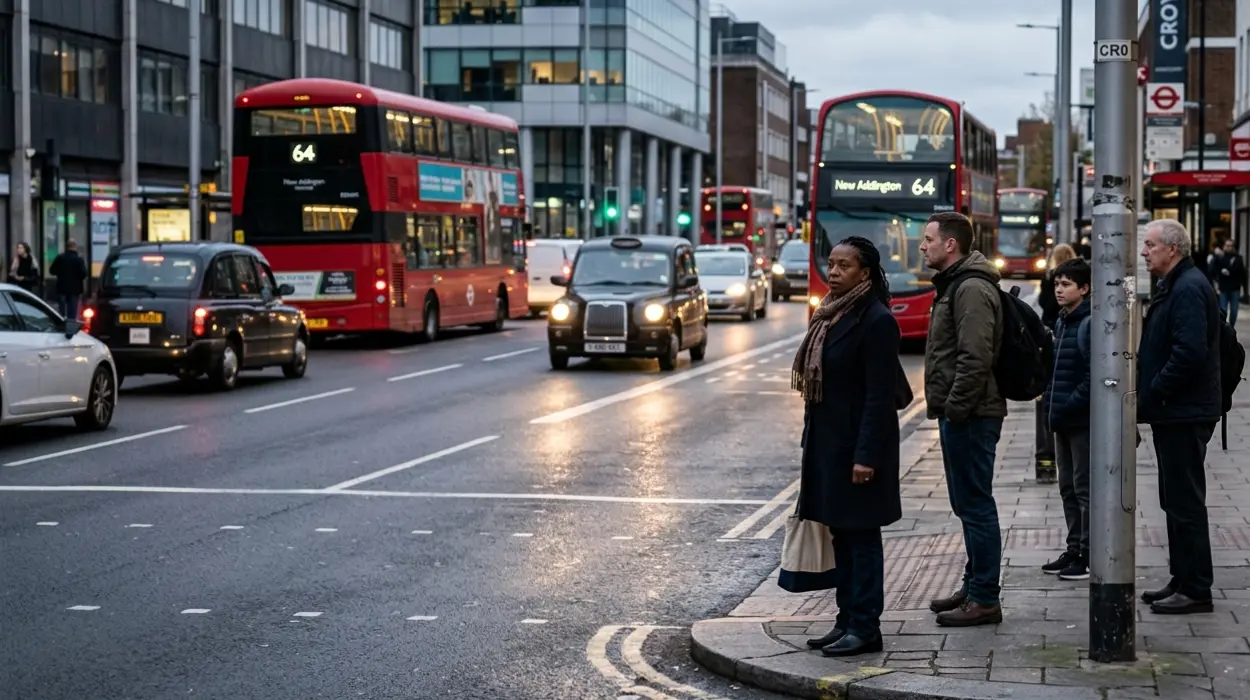
The historical origin of pedestrian crossing regulations in London dates to the mid-nineteenth century, evolving from initial mechanical signals into structured municipal laws. The Metropolitan Streets Act 1867 established the framework for pedestrian safety, codifying rights of way amidst growing urban congestion.
- How Did Post-War Legislation Shape Modern Crossing Petitions?
- What Is the Current Statutory Framework for Pedestrian Crossings?
- How Can Residents Formally Initiate a Crossing Request?
- What Technical Criteria Do Highways Engineers Assess?
- What Are the Options for Different Crossing Types?
- How Does the Public Consultation Process Function?
- What Funding Mechanisms and Timelines Govern Installation?
- What Long-Term Safety and Urban Planning Implications Exist?
The expansion of London during the Industrial Revolution created unprecedented conflicts between foot traffic and vehicular transport, which consisted of horse-drawn omnibuses, hackney carriages, and commercial dray wagons. By 1860, street fatalities in the metropolis exceeded 200 annually, prompting the Metropolitan Police and the City of London Police to demand legislative interventions.
The first mechanical assistance for pedestrians occurred on December 10, 1868, outside the Houses of Parliament at Parliament Square. Designed by railway engineer John Peake Knight, this device utilized semaphore arms combined with green and red gas lamps to regulate traffic flow. The apparatus exploded on January 2, 1869, due to a gas leak, injuring the operating police constable and delaying mechanical pedestrian interventions for several decades.
The rapid adoption of the internal combustion engine in the early twentieth century accelerated the need for formalized pedestrian infrastructure. The Road Traffic Act 1934 transformed urban planning by introducing the first national pedestrian crossings in the United Kingdom. Minister of Transport Leslie Hore-Belisha championed these installations, which featured yellow globes mounted on black-and-white striped poles, subsequently named Belisha beacons.
The 1934 regulations mandated that motorists yield to pedestrians within these designated zones, establishing the legal precedent for modern right-of-way frameworks. To experience these historic landmarks in person today, consult our comprehensive [Guide to Historic Westminster and Royal London Walking Tours] for itineraries and visiting parameters.
How Did Post-War Legislation Shape Modern Crossing Petitions?
Post-war legislation shaped modern crossing petitions by shifting traffic management authorities from centralized ministries to localized municipal councils. The Highways Act 1959 and the Road Traffic Regulation Act 1967 established the legal mechanisms for residents to formally request infrastructure.
Following the Second World War, the Ministry of Transport initiated extensive research into pedestrian safety, collaborating with the Road Research Laboratory to analyze traffic friction. In October 1951, the Zebra Crossings Regulations officially codified the distinct black-and-white longitudinal road markings alongside Belisha beacons. This deployment reduced pedestrian casualties by 7% in its first year of implementation, proving that visual demarcation altered driver behavior.
The passing of the Highways Act 1959 consolidated previous highway laws and transferred specific operational powers to local authorities, designating them as Highway Authorities. This statutory shift allowed residents to petition local councils directly for traffic calming measures rather than appealing to national ministries.
The Road Traffic Regulation Act 1967 further refined this decentralized approach by granting councils explicit powers to install, alter, or remove pedestrian crossings based on localized assessments. The introduction of the Pelican crossing (Pedestrian Light Controlled Crossing) in 1969 integrated solid-state electronic controllers and pedestrian push-buttons, providing a quantifiable mechanism for councils to evaluate traffic interruptions.
What Is the Current Statutory Framework for Pedestrian Crossings?
The current statutory framework for pedestrian crossings relies on the Road Traffic Regulation Act 1984 and the Traffic Signs Regulations and General Directions 2016. These statutes dictate the precise technical criteria, legal markings, and municipal responsibilities required for installation.
Section 23 of the Road Traffic Regulation Act 1984 gives local highway authorities the power to establish pedestrian crossings on roads for which they are responsible. The authority must consult the chief officer of police before implementing a crossing and give public notice of their proposal. This ensures that any new installation aligns with regional traffic management strategies and does not create unforeseen safety hazards.
The Traffic Signs Regulations and General Directions 2016 (TSRGD) regulates the physical layout, dimensions, and lighting requirements for all crossings. Every installation must conform to these strict national standards to ensure universal driver recognition. For example, a standard Zebra crossing requires alternating black and white stripes between 2.4 meters and 5.0 meters in length, flanked by zigzag approach markings that prohibit vehicle parking and overtaking.
Local Transport Notes (specifically LTN 1/95 and LTN 2/95) published by the Department for Transport provide the technical guidance frameworks used by traffic engineers to assess whether a site qualifies for a crossing.
How Can Residents Formally Initiate a Crossing Request?
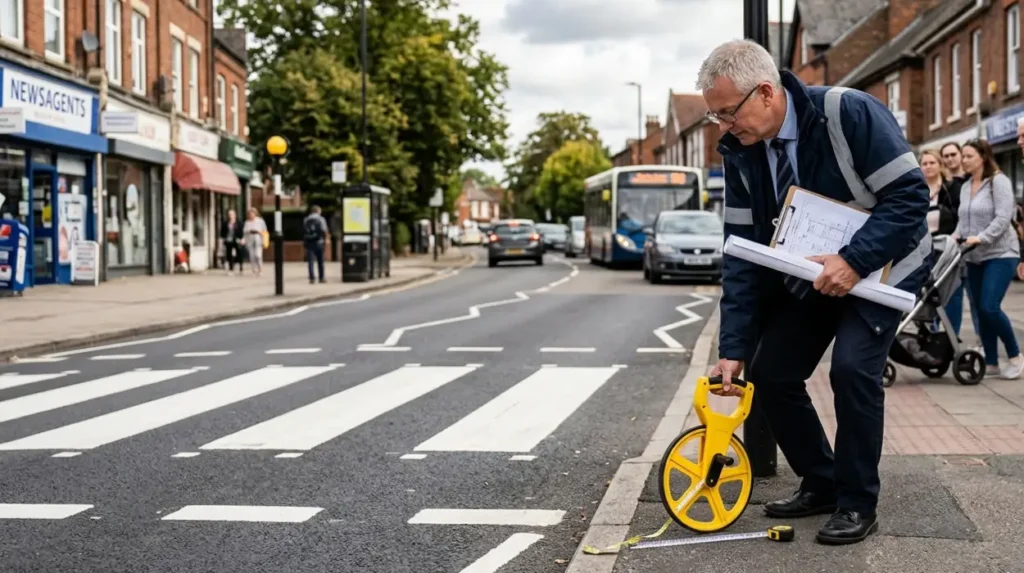
Residents can formally initiate a crossing request by submitting a structured petition or a formal application to their local council’s highways department. This initial submission must document the specific location, observed safety hazards, and community support for the intervention.
The application process begins at the neighborhood level, where residents compile evidence demonstrating the necessity of a crossing. Councils require a clear geographic definition of the requested site, typically specified by street names and adjacent landmarks or property numbers. The submission must outline the primary safety concerns, such as restricted visibility, high vehicular speeds, or the presence of vulnerable pedestrians, including school children, elderly residents, or individuals with mobility impairments.
Petitions serve as the primary mechanism for demonstrating broad community consensus. Most local authorities require a minimum threshold of signatures—often between 10 and 50 unique local administrative addresses—before a highway department allocates resources for a formal assessment.
Once submitted, the request enters the municipal tracking system, where it is assigned to a traffic management officer for preliminary screening. Ward councillors often act as intermediaries, presenting the petition at full council meetings to ensure visibility within the local transport planning budget.
What Technical Criteria Do Highways Engineers Assess?
Highways engineers assess technical criteria using the mathematical $PV^2$ formula alongside historical accident data and physical road geometry. This objective evaluation determines whether the conflict between vehicular volume and pedestrian demand justifies a formal crossing.
The foundational metric for assessing crossing requests is the $PV^2$ calculation, where $P$ represents the pedestrian flow per hour and $V$ represents the vehicular volume per hour. Engineers measure these variables during the four busiest hours of a standard week day.
A threshold value exceeding $1 \times 10^8$ historically indicated that a controlled crossing was economically and operationally justified, though modern assessments combine this with broader environmental factors.
Engineers also analyze the $V_{85}$ speed metric, which represents the speed at or below which 85% of vehicles travel. If the $V_{85}$ speed exceeds the posted speed limit, traffic calming measures must accompany any proposed crossing design. Physical constraints such as visibility splays, driveway clear zones, and street lighting infrastructure are mapped to ensure the site can safely accommodate the installation without causing vehicular queues that gridlock adjacent intersections.
Explore More Public Services
How to Apply for a Freedom Pass with a Hidden Disability in Greater London
2026 London Local Election Results: Official Ward Declaration Times in Greater London
What Are the Options for Different Crossing Types?
The options for different crossing types include uncontrolled dropped kerbs, pedestrian refuges, Zebra crossings, and signal-controlled installations such as Pelican, Puffin, or Zebra variations. The selected type depends directly on traffic speed, volume, and budget.
Uncontrolled crossings, such as dropped kerbs paired with tactile paving, represent the baseline intervention for low-volume residential roads. These features assist individuals with prams or mobility devices but do not alter legal right-of-way rules. Pedestrian refuges—central islands constructed in the middle of the roadway—allow pedestrians to cross the street in two separate stages, simplifying the calculation of safe gaps in oncoming traffic.
Controlled crossings introduce explicit legal obligations for motorists. Zebra crossings give immediate priority to pedestrians once they step onto the roadway, making them ideal for residential zones with speed limits under 30 miles per hour.
For roads with higher vehicular volumes or speeds, signal-controlled crossings are deployed. Puffin crossings (Pedestrian User Friendly Intelligent crossings) utilize pedestrian demand buttons alongside infrared cameras to track crossing speeds, holding the red traffic signal until the pedestrian safely reaches the opposite kerb. Toucan crossings (Two Can cross) expand this format by widening the path to allow cyclists to ride across alongside pedestrians.
How Does the Public Consultation Process Function?
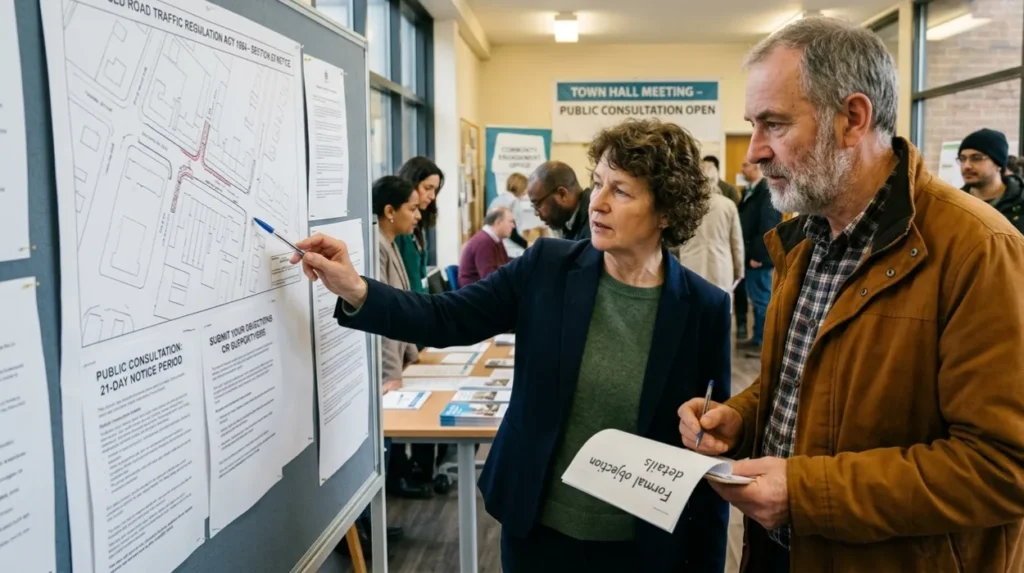
The public consultation process functions via a statutory 21-day notice period mandated under Section 23 of the Road Traffic Regulation Act 1984. This mechanism allows local residents, emergency services, and transport operators to submit formal objections or support.
Once the highway authority approves the technical design and location of a proposed crossing, it must issue a Traffic Regulation Order (TRO) or a statutory public notice. The council publishes these notices in regional newspapers, posts physical laminated signs at the proposed site, and uploads the plans to the online municipal planning portal. This transparency ensures that property owners directly adjacent to the proposed site can evaluate how the project impacts their property access.
During the consultation period, specific statutory consultees must be engaged. The London Ambulance Service, the Metropolitan Police, the London Fire Brigade, and local public transport operators evaluate the plans to ensure that the crossing markings, physical islands, or traffic lights do not delay emergency response times or disrupt bus routes.
If formal objections are received from the public or emergency services, the proposal must return to the council’s cabinet or transport committee, where elected officials debate the objections and vote on whether to override, amend, or discard the project.
What Funding Mechanisms and Timelines Govern Installation?
Funding mechanisms and timelines govern installation through the council’s annual Capital Expenditure Budget and Local Implementation Plans funded by Transport for London. The process from initial resident petition to final physical construction typically requires 12 to 18 months.
The financial allocation for pedestrian crossings comes from distinct municipal streams. Local authorities receive annual grants through Local Implementation Plans (LIPs) to deliver transport priorities that align with the Mayor’s Transport Strategy. Alternatively, developers funding local infrastructure via Section 106 agreements or the Community Infrastructure Levy (CIL) can be required to pay for crossings adjacent to new residential developments. A standard Zebra crossing costs between £20,000 and £40,000, while signal-controlled Puffin or Toucan crossings can cost from £80,000 to over £120,000 due to underground electrical connections and traffic control computer integration.
The delivery timeline depends heavily on budget cycles. If an application is approved during the autumn technical review, funding is typically allocated for the following financial year, which begins in April. Civil engineering works require meticulous coordination with utility companies (water, gas, electricity, and telecommunications) to prevent accidental disruption during excavation. The physical installation itself takes anywhere from a few days for a Zebra crossing to two weeks for a signal-controlled junction.
What Long-Term Safety and Urban Planning Implications Exist?
The long-term safety and urban planning implications focus on lowering traffic speeds, reducing pedestrian casualties, and supporting Healthy Streets initiatives. These installations convert residential cut-throughs into active travel corridors that encourage walking and cycling.
Implementing a controlled pedestrian crossing alters the local urban environment. According to transport research datasets from the Department for Transport, installing a zebra or signalised crossing in a residential area correlates with an average reduction of 25% to 35% in pedestrian-vehicular collisions within a 50-meter radius. The visual narrowing of the road via zigzag markings and flashing beacons serves as a psychological traffic-calming mechanism, forcing motorists to reduce their speeds even when pedestrians are not present.
From a macro urban planning perspective, crossing infrastructure is essential for achieving the Vision Zero target, which aims to eliminate all traffic fatalities and serious injuries across London’s transport network. By building continuous, safe pathways across busy residential streets, councils reduce dependence on private vehicles for short journeys under one mile. This shift improves localized air quality indices, lowers ambient traffic noise, and provides children and vulnerable groups with independent mobility to access schools, local parks, and healthcare clinics.
- Metropolitan Streets Act 1867, Parliament Archives.
- Road Traffic Regulation Act 1984, Section 23, UK Statutory Instruments.
- Traffic Signs Regulations and General Directions 2016, Department for Transport.
- Local Transport Note 1/95: The Assessment of Pedestrian Crossings, HMSO.
- London Transport Data Records, Transport for London Library Research Series.
What law first introduced pedestrian crossing regulations in London?
The foundation of modern pedestrian crossing regulation can be traced to the Metropolitan Streets Act 1867, which established early legal provisions for managing pedestrian safety as London’s streets became increasingly congested.