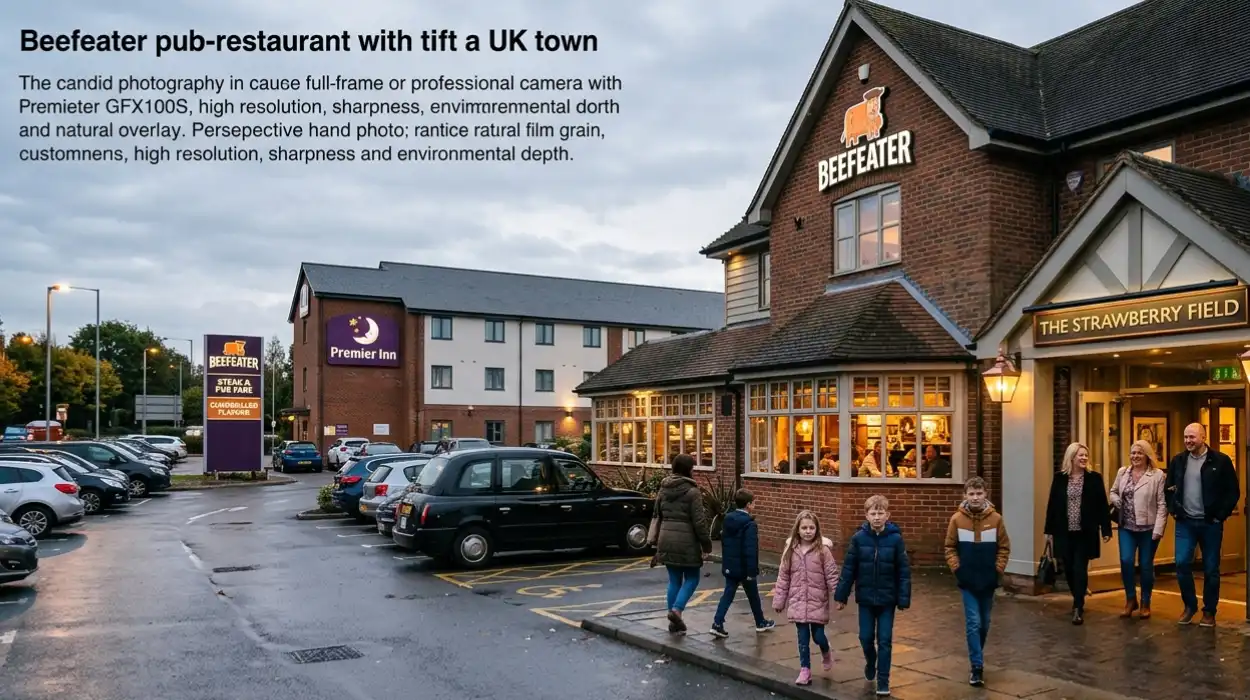
Beefeater is a British pub-restaurant chain specializing in chargrilled steaks, traditional pub fare, and casual family dining. Established in 1974 by Whitbread PLC, the company operates across the United Kingdom, predominantly situated alongside Premier Inn hotel properties.
- Who owns and operates Beefeater restaurants?
- What is the history and origin of Beefeater restaurants?
- How does the Beefeater operational and business model function?
- What dishes and beverages are served on the Beefeater menu?
- Where are Beefeater restaurants located across the United Kingdom?
- How do Beefeater restaurants compare to competing British pub chains?
- What strategic changes and restructurings affect Beefeater restaurants?
Beefeater operates as a major brand within the UK casual dining market. The brand focuses on accessibility, family-friendly atmosphere, and meat-centric culinary selections. The commercial foundation of the brand rests upon providing affordable steakhouse meals in combined pub and dining environments.
Brand identity and nomenclature
The name “Beefeater” derives from the historical nickname given to the Yeomen Warders, who are the ceremonial guardians of the Tower of London in England. The branding references traditional English hospitality and meat consumption. The company utilizes a visual identity that includes a stylized bull logo, adopted in 2015, alongside red and warm timber interior decor themes.
Beefeater targets 4 primary dining occasions:
- Breakfast service for hotel guests and public visitors
- Midday corporate and leisure lunches
- Evening family dining
- Traditional Sunday meal gatherings
Market positioning within hospitality
Beefeater sits in the mid-market segment of the casual dining sector. It maintains a price point above value pub chains while remaining lower than premium steakhouse brands. The chain provides full table service, a licensed bar area, and designated outdoor seating at selected sites. The company maintains commercial partnerships with non-profit organizations, including its charitable partnership with Great Ormond Street Hospital Children’s Charity, initiated in 2012.
Who owns and operates Beefeater restaurants?
Whitbread PLC owns and operates the Beefeater restaurant brand as part of its UK hospitality portfolio. Founded in 1742 as a brewing company, Whitbread transitioned entirely to hotel accommodation and restaurant management during the late 20th and early 21st centuries.
Whitbread PLC is a publicly traded British hospitality group listed on the London Stock Exchange and constituent of the FTSE 100 Index. The corporate headquarters is located in Houghton Regis, Bedfordshire, England. Whitbread manages both lodging and food service divisions to deliver integrated leisure services.
Parent company evolution
Samuel Whitbread founded the original business in 1742 by establishing a brewery in London. In 1750, Whitbread created the first purpose-built mass-production brewery in the UK at Chiswell Street, London. The enterprise grew into one of the largest brewing entities in the United Kingdom over two centuries.
Whitbread diversified its corporate holdings during the late 20th century through 3 strategic acquisitions and brand developments:
- The creation of the Beefeater pub-restaurant chain in 1974
- The launch of the Travel Inn hotel chain in 1987, which became Premier Inn
- The acquisition of Costa Coffee in 1995
Whitbread sold its brewing division to Interbrew in 2001 for £590 million, ending 259 years of beer production. In 2019, Whitbread sold Costa Coffee to The Coca-Cola Company for £3.9 billion. This sale concentrated corporate capital exclusively on hospitality, lodging, and restaurant operations.
Corporate restaurant portfolio
Whitbread manages a restaurant division that functions alongside its hotel network. Beefeater forms part of a multi-brand food and beverage operations structure.
Whitbread operates 3 subsidiary restaurant brands alongside Beefeater:
- Brewers Fayre, a value-focused family pub chain
- Table Table, a pub-restaurant chain emphasizing pub classics
- Bar + Block, a contemporary steakhouse brand launched in 2016
What is the history and origin of Beefeater restaurants?
Whitbread founded Beefeater in 1974 with the opening of its first location, The Halfway House in Enfield, Middlesex. The chain emerged as a direct competitor to Berni Inns, offering simple chargrilled steaks, prawn cocktails, and standardized British pub dining.
The launch of Beefeater in 1974 responded to growing consumer demand for out-of-home family dining across Great Britain. Prior to the 1970s, casual dining options in the UK were largely confined to traditional independent public houses or high-end hotel restaurants.
Early expansion and market rivalry
During the 1970s and 1980s, Beefeater expanded rapidly throughout suburban and roadside corridors across England, Scotland, and Wales. The business model offered standardized menus, consistent pricing, and large car parking facilities. Its primary competitor was Berni Inn, a steakhouse chain established by Aldo and Frank Berni in 1955.
In 1995, Whitbread acquired the Berni Inn chain from Grand Metropolitan. Whitbread converted numerous Berni Inn locations into Beefeater outlets or rebranded them into alternative group concepts. By the late 1990s, the Beefeater portfolio exceeded 140 operational restaurants.
Strategic rebrandings and operational experiments
During the late 1990s and early 2000s, Whitbread tested multiple sub-brands to counteract declining sales and changing consumer tastes.
Whitbread introduced 3 experimental sub-brands during this restructuring period:
- Out & Out, a high-volume pub concept deployed at sites like Ock Mill in Abingdon
- Grillbars, a quick-service steak concept focused on rapid meal delivery
- Banter, a casual dining trial launched at the Roundabout site in Reading
These trials produced sub-optimal financial returns. Whitbread reversed the sub-branding experiments by 2005 and consolidated all operational sites under the main Beefeater brand name.
Modernization and capital investment
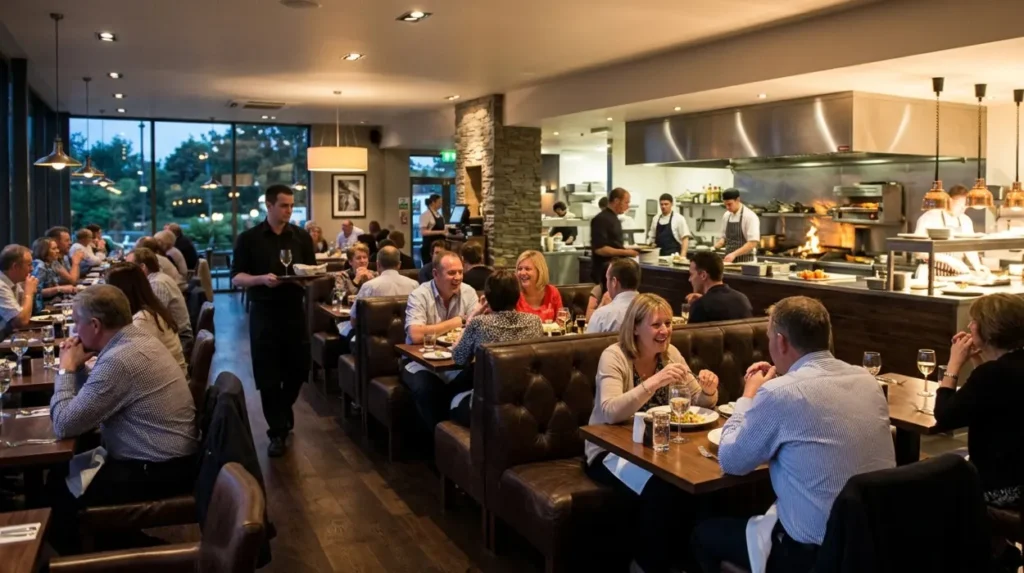
In 2002, Whitbread initiated a comprehensive multi-million-pound refurbishment initiative known internally as Project “B2”. The program replaced existing interior fixtures with open-plan kitchens, fitted chargrills, modern lighting, and leather seating. The final site completed under Project B2 was the Woolpack location outside Ashford, Kent, in 2008.
In 2006, Whitbread divested 44 standalone Beefeater and Brewers Fayre sites to rival company Mitchells & Butlers. Mitchells & Butlers converted these acquired units into Harvester and Toby Carvery restaurants. Whitbread then systematically attached remaining and newly built Beefeater restaurants directly to Premier Inn hotels. Between 2009 and 2013, the business temporarily traded under the name “Beefeater Grill” before reverting to the original Beefeater identity.
How does the Beefeater operational and business model function?
The Beefeater business model relies on co-location with Premier Inn hotels to maximize daily customer volume, property efficiency, and operational revenue. The restaurants operate dual revenue streams, supplying breakfast to hotel guests and casual dining to local residents.
The integration between lodging and restaurant facilities forms the core operational structure of the modern Beefeater brand. Co-location minimizes real estate acquisition overheads and ensures stable base demand across all meal times.
Dual-revenue operational structure
Beefeater units generate sales through two distinct customer segments:
- Internal revenue derived from Premier Inn hotel guests purchasing breakfast packages or evening meals.
- External revenue derived from local resident walk-ins, advance online reservations, and family gatherings.
The co-location model achieves operational cost reductions across multiple channels.
Whitbread leverages 3 operational cost efficiencies in co-located sites:
- Shared real estate leases and property maintenance contracts
- Centralized food procurement and logistics networks managed through national distribution hubs
- Shared site management teams overseeing both hotel and restaurant operations
Digital marketing and discovery integration
Beefeater uses digital listings management platforms to maintain local search visibility across map services and search platforms. The company integrates central management systems via Yext to control location data across 18,000 online directory listings. This integration ensures updated operational hours, menu changes, and reservation links across Google Maps, Apple Maps, and Bing.
According to digital infrastructure performance tracking, structured location management generated a 55% increase in Google Search views and a 52% increase in Google Maps views across Whitbread restaurant listings. Digital reservations pass directly into central kitchen management systems to balance seat turnover and food preparation schedules.
What dishes and beverages are served on the Beefeater menu?
The Beefeater menu centers on 30-day aged British and Irish steaks, chargrilled burgers, beer-battered fish and chips, and traditional Sunday roasts. The culinary lineup includes unlimited breakfasts, plant-based alternatives, kids’ meals, and a full bar selection.
Beefeater structures its menu around chargrilled meat options sourced from certified farms in Great Britain and Ireland. All primary beef cuts undergo a 30-day wet-aging process to enhance tenderness and flavor prior to kitchen preparation.
Steak and grill offerings
The central culinary identity of Beefeater remains its steak selections, cooked on open chargrills at temperatures exceeding 300 degrees Celsius.
The steak menu features 4 primary steak cuts:
- 8oz or 12oz Sirloin, cut from the upper loin section
- 8oz or 12oz Ribeye, featuring central fat marbling
- 8oz Rump, a lean cut from the hindquarter
- 7oz Fillet, cut from the tenderloin
Each steak dish includes triple-cooked chips or skin-on fries, a grilled tomato, and a flat mushroom. Customers select additional sauces including peppercorn, garlic butter, blue cheese, or béarnaise.
Daytime and promotional menus
Beefeater offers structured daytime pricing models designed to attract lunch trade between 12:00 PM and 5:00 PM on weekdays. The “8 Mains Under £8” menu provides value-focused lunch options.
Value lunch menu mains include 4 specific choices:
- Steak, Egg & Chips
- Smothered Chicken Melt topped with bacon, barbecue sauce, and melted cheese
- Beer-Battered Fish & Chips served with garden peas and tartar sauce
- The Classic Plant Burger made with a plant-based patty, vegan mayonnaise, and salad
Breakfast and Sunday roast offerings
Beefeater manages the Premier Inn unlimited breakfast program. The service features cooked English breakfast components—bacon, pork sausages, eggs, black pudding, hash browns, baked beans, and mushrooms—alongside continental options like pastries, cereal, fruit, and yogurt. The breakfast program permits two children aged 15 or under to eat without charge per paying adult.
Sunday operations center on traditional roast meals served from 12:00 PM. Options include roast sirloin of beef, half roast chicken, or rump of lamb. Sunday roasts include unlimited roast potatoes, Yorkshire puddings, and meat gravy.
Beverage and bar selection
The bar menu provides draught lagers, craft beers, ciders, spirits, soft drinks, and hot beverages.
Beefeater stocks 3 primary draught beer choices:
- Stella Artois lager
- Carling lager
- Doom Bar amber ale
The spirit selection emphasizes British gins, including Beefeater London Dry Gin, Tanqueray, and Gordon’s, alongside whiskies, rums, and mixers.
Where are Beefeater restaurants located across the United Kingdom?
Beefeater restaurants operate across England, Scotland, and Wales, situated primarily near major motorway junctions, primary A-roads, and suburban commercial centers. The spatial footprint spans from Inverness in Northern Scotland to Plymouth in Southwest England.
The distribution of Beefeater locations aligns with historical UK traffic routes and Premier Inn hotel developments. The network emphasizes roadside accessibility, offering dedicated parking infrastructure for travel guests and suburban commuters.
Geographic footprint and layout
The chain operates predominantly in suburban and outer-metropolitan zones rather than inner-city high streets. This spatial distribution minimizes rental overhead while positioning facilities near high-density vehicular corridors.
Beefeater clusters operations across 3 geographic regional hubs:
- South East England, including sites in Kent, Surrey, and Greater London corridors
- The Midlands, including locations surrounding Birmingham, Leicester, and Nottingham
- North West England, including sites near Manchester, Liverpool, and Preston
Beefeater does not operate restaurant locations within Northern Ireland.
Co-location spatial design
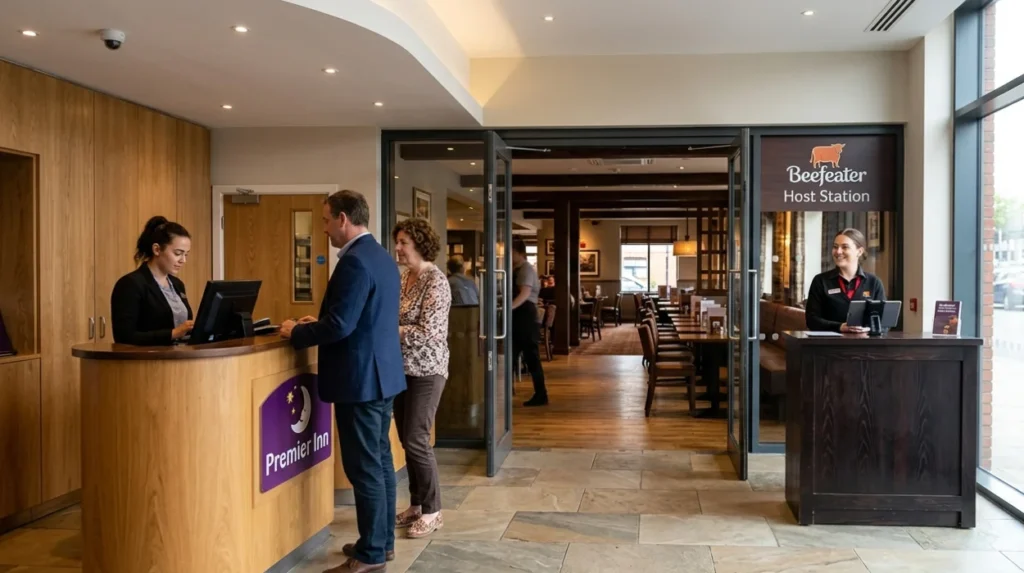
Most modern Beefeater properties operate as purpose-built or converted dual-use sites directly joined to Premier Inn buildings. The physical structure typically features a shared entrance lobby connecting the hotel reception desk to the restaurant host station.
A typical site layout encompasses:
- A main dining room accommodating between 120 and 200 covers
- An open-plan kitchen featuring a visible chargrill station
- A separate pub bar area equipped with television screens and high-top seating
- An exterior paved garden or patio with outdoor tables
How do Beefeater restaurants compare to competing British pub chains?
Beefeater occupies a mid-tier market segment, positioned above budget value pubs like Brewers Fayre and below premium steakhouses like Miller & Carter. Its value proposition combines chargrilled meats, structured promotional pricing, and standardized family dining spaces.
The casual dining market in the United Kingdom features multiple competing national chains owned by large hospitality groups, including Mitchells & Butlers, Greene King, and Stonegate Pub Company.
Brand tiering within Whitbread
Whitbread maintains internal differentiation between its dining brands to prevent market cannibalization across neighboring properties.
Competitor comparison
Beefeater competes against pub-restaurant brands operated by external hospitality groups.
Beefeater faces direct competition from 3 major competitor pub-restaurant chains:
- Harvester (owned by Mitchells & Butlers), famous for its unlimited salad bar and grilled chicken
- Toby Carvery (owned by Mitchells & Butlers), specializing in all-day carvery roast meats
- Hungry Horse (owned by Greene King), focusing on value portions and family dining
Beefeater differentiates itself from Harvester by placing greater focus on steak quality, 30-day aging, and direct co-location with Premier Inn hotels. It maintains a lower price point than Mitchells & Butlers’ premium steakhouse brand, Miller & Carter, which operates at a higher price spectrum.
What strategic changes and restructurings affect Beefeater restaurants?
Whitbread implemented strategic restructuring plans, including the Accelerating Growth Plan, to optimize restaurant performance and convert lower-yielding food sites into Premier Inn hotel rooms. These structural changes reallocate capital toward higher-return lodging operations.
The British casual dining sector faced structural headwinds during the 2020s, including inflation, altered consumer spending, and surging energy costs. In response, Whitbread altered its food and beverage operational model.
Macroeconomic headwinds and market factors
The UK casual dining sector encountered operational challenges that altered restaurant unit profitability.
The hospitality industry experienced 3 primary economic pressures:
- Rising wholesale energy and utility costs across large pub properties
- Increases in minimum wage rates impacting kitchen and front-of-house labor expenses
- Shifting consumer discretionary spending driven by broader cost-of-living adjustments
These economic factors lowered profit margins on standalone food operations across Great Britain.
The Accelerating Growth Plan
To address changing market conditions, Whitbread unveiled its “Accelerating Growth Plan” in April 2024. The strategy optimizes Whitbread’s property footprint by converting underperforming restaurant space into additional Premier Inn hotel rooms.
Key components of the strategic restructuring include:
- Closing and converting over 100 lower-yielding branded restaurants into hotel rooms to add more than 3,500 hotel rooms to the Premier Inn pipeline
- Selling over 120 standalone restaurant sites to third-party operators or alternative commercial users
- Replacing traditional pub-restaurants at select hotel sites with integrated, hotel-guest-focused food and beverage facilities
The restructuring resulted in staff reductions across Whitbread’s UK restaurant division, affecting approximately 1,500 roles in 2024. In early 2026, Whitbread announced further phases of the plan to close or repurpose remaining lower-margin branded dining sites, replacing them with streamlined integrated breakfast and dining spaces dedicated primarily to lodging guests.
Long-term outlook and legacy
Beefeater remains one of the longest-standing casual dining brands in the United Kingdom. Since its founding in 1974, the chain introduced standardized steak dining to millions of British consumers. Through continuous menu iterations, digital ordering updates, and physical site integrations, Beefeater adapted across five decades of UK hospitality history.
As Whitbread prioritizes high-occupancy lodging models, the Beefeater brand reflects the broader evolution of the British pub-restaurant—moving from suburban standalone dining destinations toward streamlined, hotel-integrated food and beverage operations reported by The Londoner News.
What is Beefeater?
Beefeater is a British pub-restaurant chain founded in 1974 by Whitbread PLC. It specialises in chargrilled steaks, traditional British pub food, family dining, and breakfast service, with most locations operating alongside Premier Inn hotels.