The City of London is the historic core of the capital and the area commonly known as the Square Mile. Its history extends from the Roman foundation of Londinium in the 1st century AD through medieval commerce, Tudor government, the Great Fire of 1666, Victorian expansion, wartime destruction and modern financial development.
- Why is the City of London important to the history of London?
- What can visitors see at the Tower of London?
- How does St Paul’s Cathedral represent the rebuilding of London?
- What makes Guildhall one of the most important historic buildings in the City?
- What can visitors discover at London Mithraeum and the Roman remains?
- Where can visitors see the remains of Roman London Wall?
- Why is the Monument to the Great Fire an essential historic attraction?
- What is the historical importance of Temple Church?
- Why should visitors explore Leadenhall Market?
- What makes St Bartholomew the Great important to London’s medieval history?
- How should visitors understand the historic attractions of the City of London as one heritage landscape?
- Frequently Asked Question
The City contains more than 600 listed buildings, 28 conservation areas, 48 scheduled ancient monuments and four historic parks and gardens. Archaeological deposits beneath streets, buildings and open spaces preserve evidence from Roman, Saxon, medieval and post-medieval London.
For visitors interested in London history, the most important attractions are not limited to conventional museums. Roman walls, medieval churches, markets, civic buildings, reconstructed monuments and surviving architectural fragments together explain how the capital developed.
The following historic attractions provide a chronological route through the City of London, from Roman Londinium to the modern financial district.
Why is the City of London important to the history of London?
The City of London is important because it is the ancient urban core of the capital, preserving archaeological and architectural evidence from Roman settlement, medieval commerce, royal government, religious institutions, the Great Fire, Victorian reconstruction and modern financial development.
Londinium was established around AD 43–50 at an important crossing of the River Thames. Its location supported trade, transport and administration. The settlement developed into a major commercial centre of Roman Britain.
The Roman city occupied approximately 325 acres. Its development established the basic geographical importance of the area. Later medieval London continued to use many routes and boundaries inherited from the Roman settlement.
A major defensive transformation occurred between approximately AD 190 and 225, when the Romans constructed London Wall around the landward side of the settlement. The wall extended for about two miles and reached approximately six metres in height. Construction required an estimated 85,000 tonnes of Kentish ragstone.
During the medieval period, the City became a major centre of commerce and trade. Around 80,000 people lived within the City Walls during parts of the Middle Ages, while streets and passages developed into routes that still influence the modern street pattern.
The Great Fire of London in September 1666 destroyed more than 80 percent of the medieval City. Reconstruction produced a new architectural landscape dominated by churches, commercial buildings and improved streets.
Later industrialisation, railway construction, Victorian architecture, wartime bombing and post-war redevelopment added further layers. The result is an urban environment where Roman archaeological remains stand close to medieval churches, Georgian structures, Victorian markets and modern skyscrapers.
What can visitors see at the Tower of London?
The Tower of London preserves nearly 1,000 years of royal, military and political history, beginning with William the Conqueror’s Norman fortress. Its surviving buildings document royal residence, imprisonment, executions, military administration, the Crown Jewels and long-running ceremonial traditions.
The Tower of London stands immediately east of the City boundary and forms an essential part of the historic City visitor circuit. It is a UNESCO World Heritage Site and one of London’s most important medieval fortified complexes.
William the Conqueror began constructing fortifications after his coronation in 1066. The White Tower became the central keep of the fortress. Later rulers expanded the complex through concentric defensive walls, towers, wards and additional buildings. Major expansion took place during the 12th and 13th centuries.
The White Tower represents Norman military architecture. Its massive masonry construction demonstrated royal authority after the Norman Conquest. The wider fortress developed into a royal palace as well as a defensive stronghold.
The Tower also became associated with imprisonment and execution. Historical figures connected with the site include Anne Boleyn, the second wife of Henry VIII, who was executed in 1536.
Its functions extended beyond royal and military use. The site housed the Royal Mint, Royal Armouries and a royal menagerie. The Crown Jewels remain one of its principal collections.
The Ceremony of the Keys provides a surviving example of the Tower’s institutional traditions. The ceremony is associated with the secure closing of the fortress and has continued for centuries.
For students of political history, the Tower demonstrates how Norman kings used architecture to consolidate authority. For architectural historians, it provides evidence of defensive design changing across nearly a millennium.
How does St Paul’s Cathedral represent the rebuilding of London?
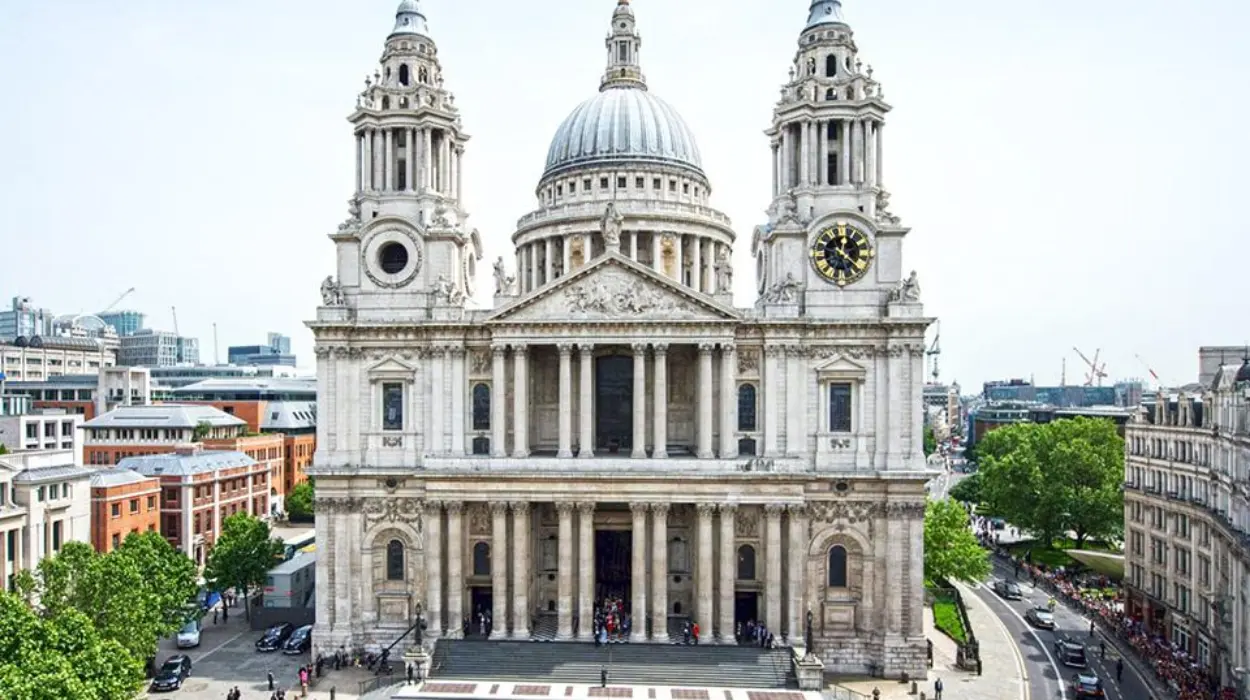
St Paul’s Cathedral represents London’s post-Fire reconstruction through Sir Christopher Wren’s monumental English Baroque design. The present cathedral was constructed between 1675 and 1710 after the medieval cathedral was destroyed in the Great Fire of London.
St Paul’s Cathedral occupies one of the most historically important positions in the City. A cathedral dedicated to Saint Paul existed on the site long before the present building, establishing the location as a centre of Christian worship for centuries.
The medieval cathedral was destroyed in the Great Fire of 1666. Sir Christopher Wren, an English architect and mathematician, received responsibility for designing its replacement.
Construction of the present cathedral began in 1675. The building was completed in 1710. Its monumental dome, classical proportions and Baroque interior became defining features of the rebuilt City.
The rebuilding process was closely connected with the political and economic transformation of London after the Great Fire. Wren prepared broader reconstruction proposals for the destroyed City, although property boundaries and land ownership limited the implementation of comprehensive planning schemes.
St Paul’s therefore represents more than religious architecture. It demonstrates how architecture became an instrument for rebuilding civic identity after catastrophic urban destruction.
The cathedral also contains significant memorials and monuments associated with British history. Its crypt includes the tomb of Wren, while memorials commemorate military leaders, scientists, artists and public figures.
The dome became an important component of London’s skyline. Its visual prominence remains significant because the City combines historic protected structures with modern commercial towers.
To experience this historic landmark in person today, consult our comprehensive [The History of London’s South Bank From Industrial Waterfront to Cultural Quarter] for itineraries and visiting parameters.
What makes Guildhall one of the most important historic buildings in the City?
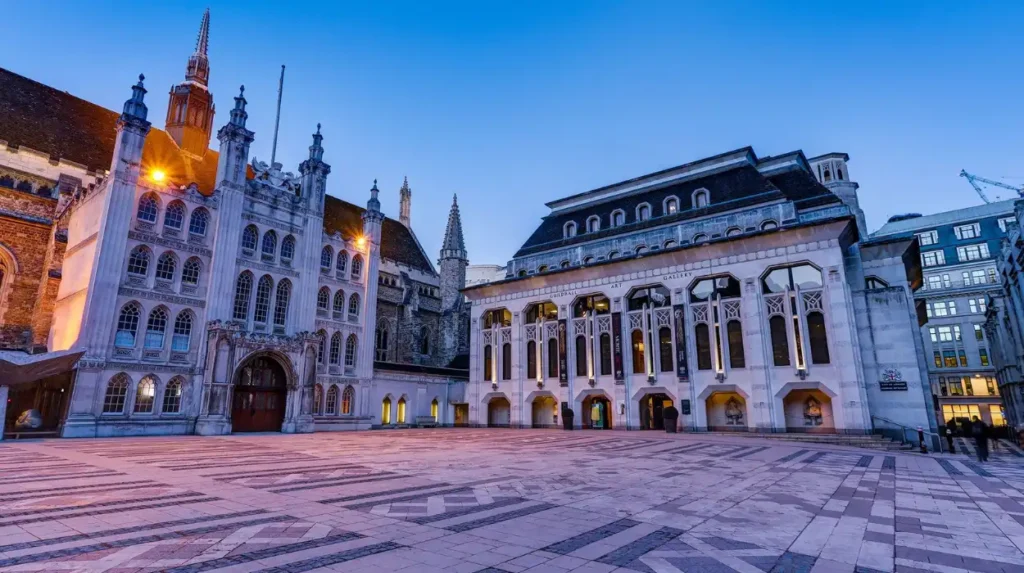
Guildhall is the historic civic centre of the City of London, with origins reaching into the medieval period and archaeological evidence extending to Roman London. The present Great Hall dates from 1411 and remains a major symbol of civic government.
The word Guildhall derives from the Anglo-Saxon term “gild,” associated with payment or contribution. The site became closely connected with civic administration and London’s governing institutions.
The present Guildhall was constructed from 1411. Its architecture reflected the wealth and authority of medieval London’s merchant elite. The building became a centre for civic government, ceremonial occasions and legal proceedings.
Guildhall survived the Great Fire of 1666, although its roof was destroyed. It also suffered severe damage during the Second World War. The Great Hall’s present roof was constructed in 1953 after the wartime destruction.
The building’s importance extends below ground. Archaeological excavations discovered the remains of a Roman amphitheatre beneath Guildhall Yard. The amphitheatre dates from approximately AD 70 and was discovered during rebuilding work in the late 20th century.
The amphitheatre measured approximately 100 metres by 85 metres and could accommodate an audience of about 7,000 people. Its functions included public entertainment and spectacles associated with Roman civic culture.
The discovery transformed understanding of Roman London. It demonstrated that Londinium contained substantial public entertainment infrastructure close to the political and commercial heart of the settlement.
Guildhall therefore connects three distinct historical functions: Roman public life, medieval civic government and modern municipal administration.
What can visitors discover at London Mithraeum and the Roman remains?
London Mithraeum preserves the remains of a Roman temple dedicated to Mithras, discovered during post-war archaeological work and reconstructed near its original location. It provides direct evidence of Roman religious practice, urban construction and the multicultural character of Londinium.
The London Mithraeum is one of the most significant Roman archaeological sites in the City. A mithraeum was a temple dedicated to Mithras, a deity whose worship formed part of a mystery religion practised within the Roman Empire.
The temple was built below street level and reflects the distinctive architecture associated with Mithraic worship. Its rediscovery provided archaeological evidence of religious activity within Roman Londinium.
The site is particularly important because Roman London was not a culturally uniform settlement. Archaeological evidence demonstrates connections between Britain and wider territories of the Roman Empire through trade, military service, migration and religious practices.
The Mithraeum belongs within a wider network of Roman remains beneath the City. Archaeological deposits survive beneath modern streets, offices and public spaces because the area experienced almost continuous occupation from Roman times through the medieval period and into the present.
The archaeological record includes buildings, roads, drainage systems, artefacts and structural remains. These discoveries provide information about commercial activity, domestic life, religious practice and urban organisation.
The importance of the Mithraeum therefore extends beyond the surviving temple structure. It provides evidence for the social and religious diversity of Roman London.
Its modern presentation also illustrates contemporary archaeological conservation. Historic remains are preserved within a modern commercial district, demonstrating how archaeological heritage can coexist with intensive urban development.
Where can visitors see the remains of Roman London Wall?
Roman London Wall is one of the City’s most important surviving archaeological monuments. Built approximately between AD 190 and 225, the defensive circuit shaped London’s urban boundaries and continued influencing the City’s development throughout the medieval period.
London Wall was constructed during a major Roman programme of public works. It enclosed the landward side of Londinium and connected important gateways and routes entering the settlement.
The wall incorporated defensive structures and was strengthened by bastions. An external ditch increased its defensive function, while natural marshland around the Walbrook provided additional protection in some areas.
The wall originally extended from the area around Tower Hill towards Blackfriars, enclosing the principal Roman settlement. Major gateways included Aldgate, Bishopsgate, Newgate and Ludgate.
Today, surviving sections appear in several parts of the City. One of the most accessible areas is near Tower Hill, while substantial remains also survive around the Barbican.
The Barbican area contains another important Roman monument: the Roman Fort of Londinium. Built around AD 110–120, the fort occupied approximately 12 acres and measured about 200 metres on each side. It could accommodate up to 1,000 soldiers.
The fort was later decommissioned as the military situation in southern Britain became more secure. Parts of its northern and western edges survive within the modern Barbican area.
The surviving wall demonstrates how Roman military engineering influenced later urban geography. Medieval and later development reused portions of the Roman defensive system, while archaeological remains remained embedded within later structures.
The City of London Corporation protects significant Roman and medieval wall remains through statutory heritage protections. Archaeological investigation continues to provide evidence about construction methods and occupation patterns.
Why is the Monument to the Great Fire an essential historic attraction?
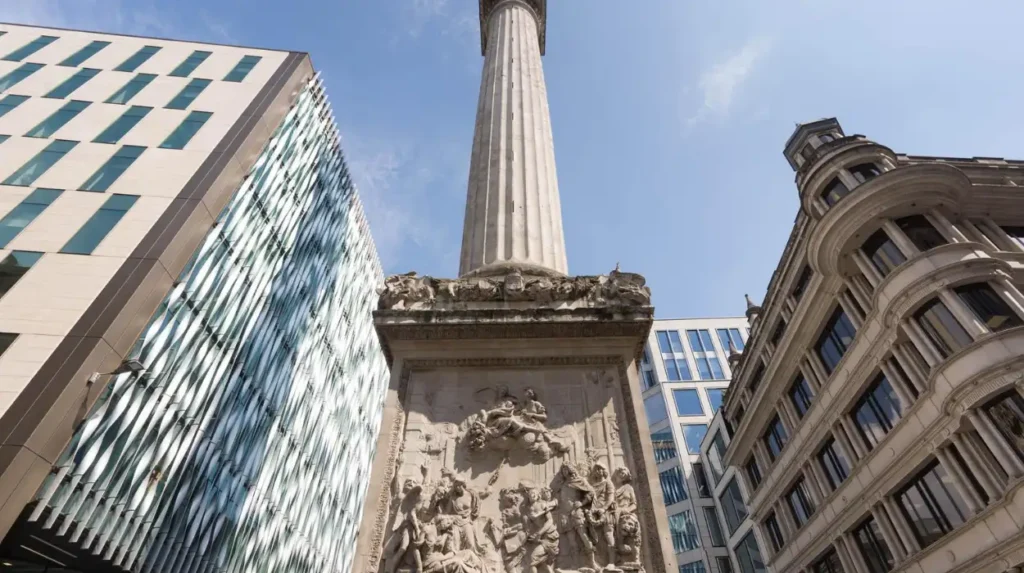
The Monument commemorates the Great Fire of London, which began on 2 September 1666 and devastated much of the medieval City. Designed by Christopher Wren and Robert Hooke, the Monument was constructed between 1671 and 1677.
The Great Fire began at a bakery in Pudding Lane during the early hours of 2 September 1666. Strong winds and densely built timber structures helped the fire spread rapidly.
The medieval City’s narrow streets and combustible buildings increased the scale of destruction. The fire continued until 5 September, when changing conditions and firefighting efforts brought it under control.
The Monument stands near the northern end of London Bridge and close to the location where the fire began. Its height and position create a permanent architectural marker for the catastrophe.
Christopher Wren and Robert Hooke were central figures in the scientific and architectural reconstruction of London. The Monument was built between 1671 and 1677. Its Doric column is topped by a gilded flaming urn representing the fire.
The structure also represents the development of post-Fire scientific thinking. Hooke served as a leading scientific investigator and City Surveyor, while Wren became one of the principal architects of the rebuilding programme.
The Monument’s internal staircase contains 311 steps leading to its viewing platform.
For historians, the Monument provides a physical connection between disaster, urban planning and architectural reconstruction. It also demonstrates how memorial architecture can preserve collective memory within an active commercial district.
What is the historical importance of Temple Church?
Temple Church is a medieval church founded by the Knights Templar, a religious military order established to protect Christian pilgrims travelling to Jerusalem. Its Round Church was consecrated in 1185 and survives as a major medieval landmark.
The Knights Templar constructed the church in the 12th century. The Round Church was consecrated in 1185 by the Patriarch of Jerusalem.
Its circular design reflects the Church of the Holy Sepulchre in Jerusalem, one of the most important Christian pilgrimage sites. The architectural form therefore directly reflects the religious and political environment of the Crusades.
The church consists of the Round and Chancel sections. Its location between Fleet Street and the River Thames places it within the historic Temple district, an area associated with English legal institutions.
The Templars’ influence ended after the order was suppressed in the early 14th century. Ownership and institutional use of the Temple complex subsequently changed.
Temple Church survived major periods of urban transformation, although it suffered damage during the Second World War and underwent restoration.
Its medieval architecture provides evidence of religious institutions, international pilgrimage networks and the legal history of London.
For academic students, the building provides an example of Romanesque architecture. For genealogical researchers, the surrounding Temple district provides a geographical context for studying medieval and early modern professional communities.
Why should visitors explore Leadenhall Market?
Leadenhall Market is one of London’s oldest commercial market sites, with origins in the medieval period and a surviving Victorian structure designed by Sir Horace Jones in 1881. Its architecture records London’s long development as a centre of commerce.
The history of Leadenhall Market extends back to the medieval period. The site developed as a commercial centre serving the City’s growing population and trading economy.
The market historically dealt in commodities including meat, game and poultry. Its position near the Roman forum also connects it with London’s earlier commercial geography.
The present market was designed by Sir Horace Jones and completed in 1881. Jones was also responsible for major Victorian market buildings including Smithfield and Billingsgate.
Leadenhall Market is Grade II* listed. Historic England identifies its red-brick and Portland-stone exterior, cast-iron Corinthian columns, timber-and-glass roof and elaborate entrances as important architectural features.
Victorian market architecture reflected major changes in public health, food distribution and urban administration. Large purpose-built markets replaced older arrangements that had become difficult to manage within an expanding metropolis.
Leadenhall therefore represents both commercial continuity and architectural change. The market retained its historic function while adopting Victorian engineering and design.
Its preservation is particularly important because the surrounding financial district contains substantial modern development. The market demonstrates how a historic commercial structure can remain integrated into a high-density business environment.
What makes St Bartholomew the Great important to London’s medieval history?
St Bartholomew the Great preserves substantial medieval fabric from an Augustinian priory founded in 1123 by Rahere. Its surviving Romanesque architecture, medieval tombs and later alterations make it one of the City’s most important historic churches.
St Bartholomew the Great stands at Smithfield, an area with a long association with markets, religious institutions, executions and public gatherings.
Rahere founded the priory in 1123. The surviving church represents the eastern portion of the former Augustinian priory complex.
The church contains significant 12th-century architectural elements, including part of the nave, the crossing and an apsed choir with a vaulted ambulatory. Later additions include a 14th-century clerestory and Lady Chapel and an early 17th-century brick tower.
The building is Grade I listed, reflecting its exceptional architectural and historic significance.
Smithfield itself has a complex history. During the Roman period, the area outside the City was used for burial because Roman custom generally placed cemeteries beyond settlement boundaries.
By the medieval period, Smithfield had become an important livestock market. The area also hosted Bartholomew Fair, an annual event associated with commerce and public entertainment from the 12th century.
The church’s survival provides a direct architectural link with medieval religious London. Its proximity to Smithfield’s commercial history demonstrates how religious, economic and social activities developed around the same urban district.
How should visitors understand the historic attractions of the City of London as one heritage landscape?
The City’s historic attractions form a connected archaeological and architectural landscape rather than isolated monuments. Roman walls, medieval churches, civic buildings, markets and post-Fire structures collectively explain how London developed across two millennia.
The strongest way to understand the City is chronologically. Roman remains establish the first major urban framework. Medieval churches and markets demonstrate the growth of religious institutions and commercial government. Post-1666 buildings reveal reconstruction after catastrophe. Victorian markets demonstrate industrial urban reform.
The archaeological record provides the underlying connection. Excavations have identified buried structures beneath modern buildings and streets. The City Corporation describes these archaeological deposits as a complex and deep layer created by continuous occupation from Roman, Saxon and medieval periods to the present.
Modern preservation policies recognise that archaeological remains provide evidence unavailable from written sources. Artefacts, building foundations, roads, drainage systems and occupation deposits reveal information about ordinary inhabitants, commercial activity and social change.
The City currently protects its historic environment through listed-building controls, conservation areas and scheduled-monument legislation. Scheduled ancient monuments receive statutory protection, and works affecting them require appropriate consent.
This preservation system is essential because the City remains an active financial and commercial centre. Heritage protection therefore operates alongside construction, transport infrastructure, office development and public-space improvements.
The Barbican provides a particularly clear example of layered conservation. The modern estate was constructed between 1965 and 1976, while surviving Roman and medieval wall remains remain protected within the same wider environment. The Barbican Estate itself received Grade II listing in 2001.
Smithfield provides another example of heritage adaptation. The historic General Market is being transformed into the new London Museum. The permanent galleries are scheduled to open on 28 November 2026, bringing London’s history into a restored Victorian market building.
The new museum will draw on a collection of approximately seven million objects covering 450,000 years of London’s history. Its Smithfield galleries will include Roman material, the Cheapside Hoard, Great Fire displays and other objects documenting the capital’s development.
The project demonstrates the continuing historical relevance of the City. Heritage is not confined to preserved ruins. Historic buildings can become educational institutions, archaeological sites can remain visible within modern developments, and commercial districts can retain medieval street patterns.
For educators, the City provides a concentrated study area covering Roman Britain, Norman conquest, medieval government, religious history, early capitalism, urban disaster, Victorian engineering, wartime destruction and conservation policy.
For genealogical researchers, churches, markets, civic buildings and historic streets provide geographical evidence for understanding where Londoners lived, worked and worshipped.
For heritage preservationists, the City demonstrates the practical challenge of protecting archaeological deposits while maintaining a functioning global business district.
The historic attractions of the City of London therefore have enduring value because they document processes rather than isolated events. Each surviving structure contributes evidence about settlement, political authority, religion, trade, architecture, technology or urban reconstruction.
A visit to the City can consequently be understood as a chronological study of London itself: Roman Londinium established the urban foundation; medieval institutions created the commercial and civic framework; the Great Fire transformed the built environment; Victorian engineering modernised markets and infrastructure; wartime destruction produced another phase of rebuilding; and contemporary conservation now protects archaeological and architectural evidence within one of the world’s major financial centres.
That continuity is the defining historical feature of the City of London. Its monuments remain embedded within the same urban landscape that has served as a centre of trade, administration and public life for almost two thousand years.
Frequently Asked Question
What are the best historic attractions in the City of London?
The best historic attractions include the Tower of London, St Paul’s Cathedral, Guildhall, London Wall, London Mithraeum, Monument to the Great Fire of London, Temple Church, Leadenhall Market and St Bartholomew the Great.