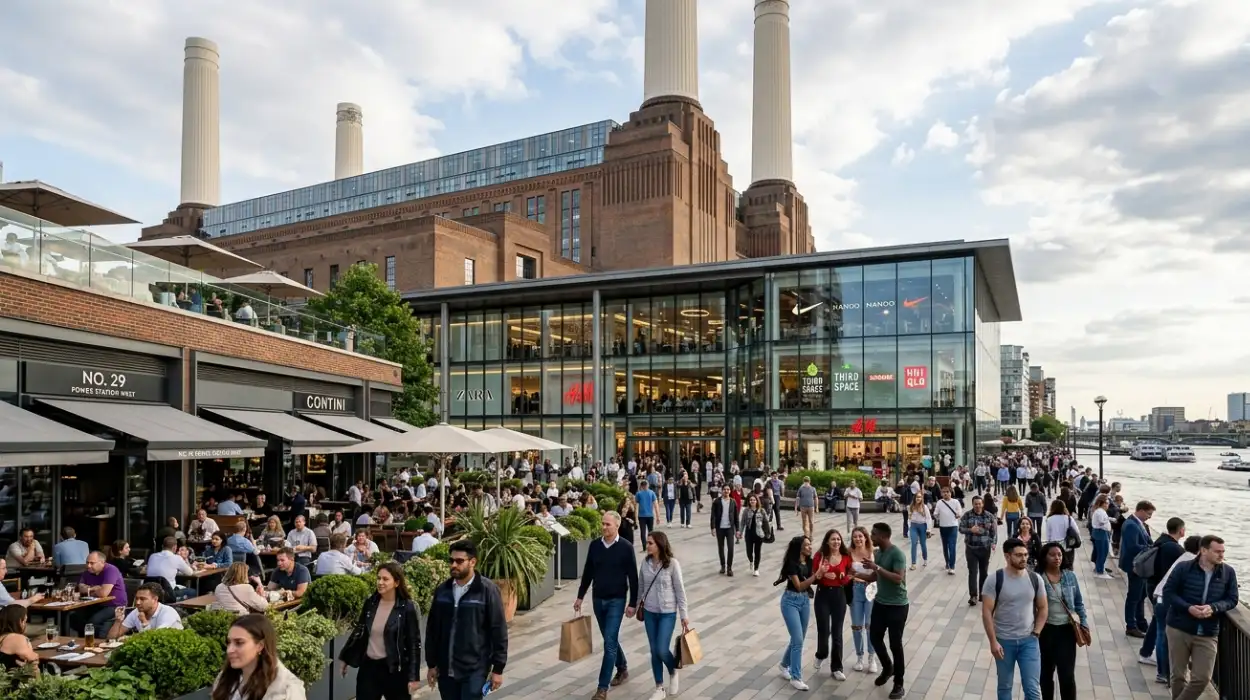
Battersea Power Station is a Grade II*‑listed former coal‑fired power station on the south bank of the River Thames in the London Borough of Wandsworth, now redeveloped as a mixed‑use neighbourhood centred on shopping, dining and leisure. Operated by the Battersea Power Station Development Company, the site houses over 150 shops, bars and restaurants, plus events, a cinema and a riverside promenade, positioning it as a major new destination for Londoners and visitors.
- What is Battersea Power Station and what does it offer now?
- How did Battersea Power Station develop historically?
- What major changes turned it into a shopping and dining hub?
- What are the main zones inside Battersea Power Station?
- Turbine Hall A and Turbine Hall B
- Electric Boulevard
- Surrounding spaces and leisure
- What kinds of shops and brands can visitors expect?
- What is the food and dining scene like at Battersea Power Station?
- Fast‑service and grab‑and‑go options
- Casual and mid‑tier restaurants
- Higher‑end and special‑occasion dining
- How does Battersea Power Station integrate events and culture?
- How accessible is Battersea Power Station by public transport?
- How many people visit Battersea Power Station each year?
- How does Battersea Power Station compare with other London shopping centres?
- What challenges does Battersea Power Station face going forward?
- Why is Battersea Power Station relevant for Londoners in 2026?
This article, produced by The Londoner News, gives a comprehensive, evergreen overview of Battersea Power Station as a shopping and dining hub, explaining its history, layout, retail and food offerings, events, transport, and why it is relevant for 2026 and beyond.
What is Battersea Power Station and what does it offer now?
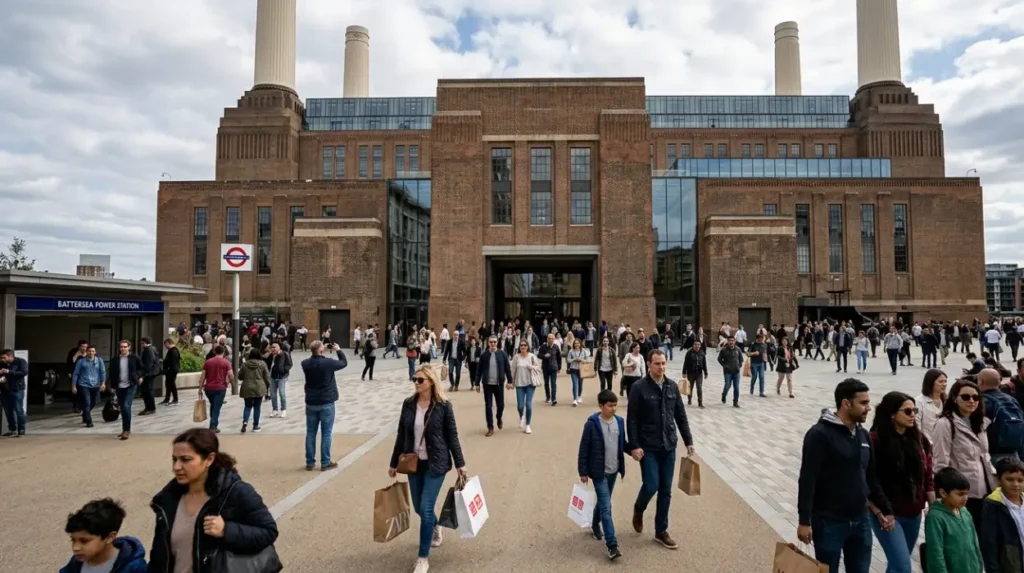
Battersea Power Station is a decommissioned coal‑fired power plant in Battersea, south‑west London, converted into a mixed‑use district that includes retail, restaurants, offices, apartments and public spaces. Today, the site functions as a major shopping and dining hub, with over 150 shops, bars and restaurants inside the power‑station building and along the adjoining Electric Boulevard.
The Power Station building itself contains two main turbine‑hall arcades, Turbine Hall A and Turbine Hall B, whose cavernous Art Deco interiors now host high‑street and luxury brands, pop‑ups, and large‑format restaurants. Surrounding the building, the wider Battersea Power Station neighbourhood adds residential blocks, parks, a riverside promenade and leisure facilities, linking the heritage structure to a broader urban‑regeneration project.
How did Battersea Power Station develop historically?
Battersea Power Station began operation as a coal‑fired power station in the 1930s, supplying electricity to much of central London from two main generating stations built in phases. The four iconic red‑and‑white chimneys, spread symmetrically either side of the central boiler house, became one of London’s most recognised architectural silhouettes and an emblem of the city’s industrial heritage.
The plant ceased regular generating operations in the late 1970s and early 1980s, after which the site entered a long period of failed redevelopment schemes and partial decay. By the 2000s it was listed as one of the most important derelict buildings in the UK, a Grade II*‑listed structure requiring sympathetic conversion rather than demolition.
What major changes turned it into a shopping and dining hub?
The current transformation into a shopping and dining hub began in earnest after Malaysia’s SP Setia and Sime Darby acquired the site in the 2010s and launched a £9‑billion redevelopment plan. The project involved structurally stabilising the power‑station building, restoring its Art Deco façades and interiors, and constructing thousands of new homes, offices and public spaces around it.
Inside the Power Station, the old turbine‑hall spaces were converted into high‑volume retail galleries, with mezzanine walkways, skylights and new retail‑ready floors inserted while preserving key historic features such as the original control‑room lobbies and switch‑gear structures. The broader Battersea Power Station neighbourhood added a new London Underground station (Battersea Power Station station on the Northern Line), a 13‑acre park, and a riverside promenade, embedding the shopping and dining hub into a larger, walkable urban quarter.
What are the main zones inside Battersea Power Station?
Visitors experience Battersea Power Station as a cluster of distinct but connected zones, each serving a different aspect of the shopping‑and‑dining proposition. The core components are the main Power Station building (with Turbine Halls A and B), the retailer‑lined Electric Boulevard, and the surrounding public spaces and leisure venues.
Turbine Hall A and Turbine Hall B
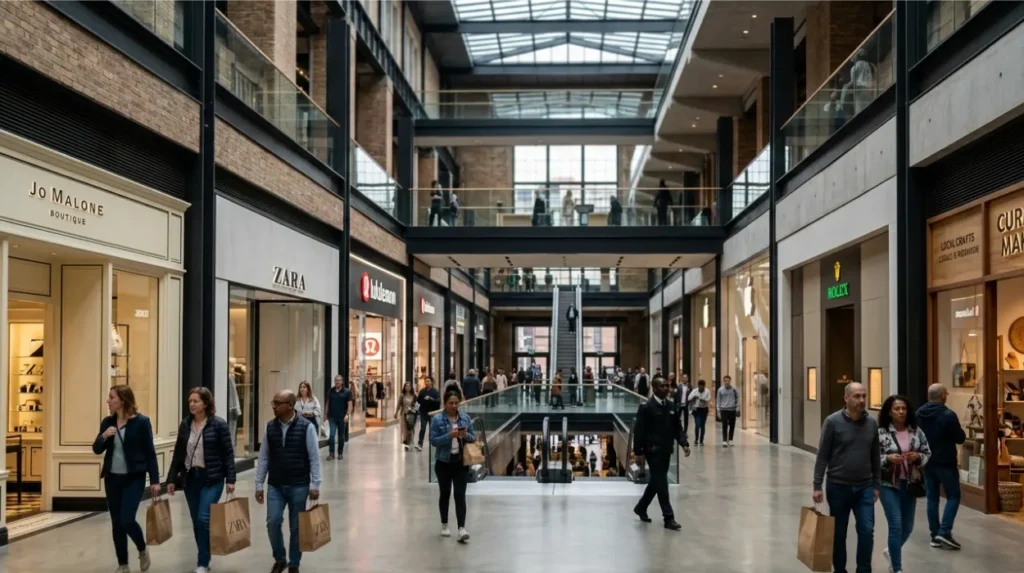
Turbine Hall A and Turbine Hall B are the two largest internal arcades, following the original north‑south alignment of the turbine rooms. They host high‑street and luxury fashion, beauty, tech and lifestyle brands, with examples such as Jo Malone, Zara, Mango, Lululemon, Rolex and Apple, alongside bars and cafés.
These halls are structurally defined by towering brick‑and‑steel vaults, original control‑room windows and restored Art Deco detailing, giving the shopping experience a strongly industrial‑heritage aesthetic. The layout encourages long linear walks under high ceilings, with occasional seating areas and information points breaking up the continuous retail frontage.
Electric Boulevard
Electric Boulevard is a covered pedestrian high‑street linking the Power Station building to the wider Battersea Power Station neighbourhood. It carries a mix of restaurants, bars, cafés and smaller shops, acting as a social spine between the power‑station building and the riverfront promenade.
The boulevard is designed to support dense foot traffic, with wide paving, sheltered walkways, and regular seating clusters that encourage people to pause and socialise rather than just passing through. Its orientation toward the river maximises skyline views and helps guide visitors from the Northern‑Line station and surrounding streets into the main retail and dining areas.
Surrounding spaces and leisure
Beyond the indoor halls, the Battersea Power Station site includes landscaped plazas, a riverside promenade and programmed leisure facilities such as a cinema, exhibition spaces and event lawns. These spaces function as “buffers” between shopping‑and‑dining blocks, supporting events, markets and outdoor seating that extend the visitor stay beyond pure retail.
What kinds of shops and brands can visitors expect?
Battersea Power Station offers over 150 shops, bars and restaurants, spanning luxury fashion, mass‑market fashion, beauty, jewellery, tech and lifestyle formats. This mix is designed to attract both local residents and tourists, with a skew toward higher‑end and design‑led brands rather than purely budget-oriented retail.
Common “types” of retailers include luxury fashion boutiques (e.g., Jo Malone, select designer‑wear brands), high‑street fashion chains (e.g., Zara, Mango, Lululemon), jewellery and watch houses (e.g., Rolex), and tech‑and‑lifestyle outlets (e.g., Apple). There are also smaller “maker” or craft‑focused stores, such as Curated Makers, which stock limited‑run or locally produced goods, adding a niche‑retail layer alongside the big brands.
The distribution strategy groups complementary categories within the same levels or corridors, so visitors moving between, for example, fashion, beauty and accessories do not need to backtrack through multiple floors. This logical zoning increases the chance of cross‑category spending and supports longer dwell times within the shopping district.
What is the food and dining scene like at Battersea Power Station?
Battersea Power Station hosts over 50 cafes, bars and restaurants, covering quick‑service counters, casual dining and higher‑end seated experiences. The F&B lineup is intentionally international, with Italian, Spanish, Japanese, Thai, Portuguese, British‑style pubs and modern‑European formats represented within a short walk.
Fast‑service and grab‑and‑go options
Within the Power Station complex and Electric Boulevard, fast‑service outlets supply quick refuels for shoppers and workers. Examples include Black Sheep Coffee, Grind, Joe & The Juice, itsu, Leon, Pret A Manger and Starbucks, which offer coffee, sandwiches, salads and light meals at prices typically in the £5–£10 range for a single‑item meal.
These brands are positioned along circulation routes and near seating areas so that visitors can combine a short break with informal dining without leaving the main building. Many operate “grab‑and‑go” trays or shelf‑style counters, enabling quick service during busy periods such as lunchtime and early evenings.
Casual and mid‑tier restaurants
A second tier of restaurants provides casual dining, often with covered or semi‑outdoor terrace seating facing the courtyard or river. Examples include Manna (a burger and fried‑chicken joint), Megan’s at the Power Station (all‑day Mediterranean cooking with riverside views), and Nando’s (flame‑grilled PERi‑PERi chicken).
These venues typically charge £10–£20 per main course, with set‑price menus and sharing‑style options that encourage group dining. Their locations in Turbine Hall A, Turbine Hall B and Electric Boulevard anchor meal‑time traffic and support the idea of Battersea Power Station as a destination for lunch, dinner and weekend brunch rather than just impulse shopping.
Higher‑end and special‑occasion dining
The site also includes several higher‑end or “destination” restaurants aimed at date nights, celebrations and business entertaining. Examples include JOIA Restaurant & Bar (Portuguese‑inflected cuisine) and Gordon Ramsay Street Pizza, which bring established chef names and more curated menus to the complex.
These venues usually operate on reservation‑only or strongly reservation‑recommended models, with tables booked through platforms such as OpenTable or directly via the Battersea Power Station website. Their presence raises the perceived quality of the overall food offering and helps attract visitors who are willing to spend more per head in exchange for atmosphere and service.
How does Battersea Power Station integrate events and culture?
Battersea Power Station functions as a cultural and events venue as well as a shopping and dining hub, using its scale and riverfront location to host exhibitions, cinema screenings and seasonal events. The large internal spaces, particularly the turbine halls and the Control Room‑B bar area, are adapted for ticketed shows, museum‑style exhibitions and public‑facing installations.
Recent examples of cultural programming include “Ramses and the Pharaohs’ Gold,” an exhibition of 180 ancient Egyptian artefacts loaned from the Egyptian Museum in Cairo, staged inside the Power Station building. The site also hosts regular film screenings, music‑curated nights and seasonal events such as Christmas markets and summer festivals, which are promoted through the official Battersea Power Station calendar and partner platforms.
These events drive visitation beyond the core retail audience, drawing Londoners specifically interested in heritage, art or pop‑culture content. By tying such programming to the Power Station’s industrial‑heritage architecture, the operators reinforce the site’s identity as a place that combines shopping and dining with cultural‑heritage experiences rather than functioning as a generic mall.
How accessible is Battersea Power Station by public transport?
Battersea Power Station is directly served by Battersea Power Station station on the London Underground Northern Line, which opened in 2021 as part of the Battersea Power Station extension. From Central London, the journey from key hubs such as Bank or Tottenham Court Road typically takes 15–25 minutes, depending on the time of day and interchange patterns.
In addition to the Underground, the site is approached by multiple London Bus routes that terminate near the riverside promenade and the main Power Station entrance. The station and surrounding approaches are generally step‑free or equipped with lifts, escalators and ramps, supporting access for wheelchair users and passengers with mobility aids.
The Power Station itself integrates internal lifts and escalators connecting the main turbine‑hall levels, with clear signage and information points guiding visitors from the station concourse into the principal shopping and dining corridors. This transport‑to‑retail “through‑line” design is one factor that underpins its status as a destination reachable by public transport rather than car‑centric shopping.
How many people visit Battersea Power Station each year?
Official annual footfall figures are not published in a single, consolidated statistic, but the development is described by its operators as one of London’s “most exciting new shopping and leisure destinations” and is promoted as a major draw for locals, tourists and residents. Visitor information portals and guidebooks consistently rank it among the top new attractions in south‑west London, alongside established sites such as the Tate Modern and Borough Market.
The addition of a new Underground station and the scale of the retail and leisure offering imply tens of millions of visits per year when combining commuters, shoppers, diners and event‑goers. Marketing and tourism platforms describe the site as a “must‑visit” destination during visits to London, reinforcing the expectation that it will register high‑volume, repeat visitation over the medium term.
How does Battersea Power Station compare with other London shopping centres?
Battersea Power Station differs from most traditional London shopping centres in that it is anchored by a historic industrial monument rather than a purpose‑built mall. Its retail and dining offer is embedded inside a Grade II*‑listed power station and its surrounding regeneration quarter, giving it a distinct architectural and cultural identity compared with generic suburban malls or high‑street clusters.
Conventional malls such as Westfield London or Brent Cross focus predominantly on interior‑centric retail, with food courts and cinemas as secondary amenities. Battersea Power Station, by contrast, integrates external spaces, riverfront promenades, public parks and heritage‑tourism elements into the same visitor experience, encouraging people to combine shopping and dining with walks, sightseeing and event‑going in a single trip.
The site also targets a more mixed demographic than some high‑street or outlet‑centre locations, combining local residents from the new apartments, office workers from nearby business districts, and tourists drawn by the Power Station’s fame from the London Tube map and previous media uses. This demographic breadth supports a wider range of F&B and retail formats than a purely commuter‑or‑tourist‑focused hub would typically sustain.
What challenges does Battersea Power Station face going forward?
Battersea Power Station faces typical urban‑regeneration challenges, including sustaining footfall during economic downturns, managing competition from other London shopping and leisure districts, and maintaining the balance between heritage preservation and commercial development. The high capital cost of the redevelopment and the reliance on premium brands mean that occupancy and sales levels must remain relatively strong for the model to remain viable over the long term.
There are also planning and community‑relations pressures, including ensuring that local residents benefit from the regeneration rather than being displaced by rising housing and retail prices. The operators have committed to elements such as public parks, affordable‑housing units and community spaces, but monitoring and adjustment of these commitments remain an ongoing task.
Additionally, the site competes with established London destinations such as Covent Garden, Oxford Street and the South Bank for leisure time and discretionary spending. Maintaining a distinctive identity—through heritage‑led experiences, riverfront access and curated events—is essential if Battersea Power Station is to avoid being perceived as just another retail‑centric zone.
Why is Battersea Power Station relevant for Londoners in 2026?
Battersea Power Station is relevant because it combines a globally recognisable piece of industrial architecture with a modern, mixed‑use quarter that offers shopping, dining, culture and riverside recreation in one interconnected district. Its direct connection to the London Underground and proximity to the River Thames make it easy to reach for day‑trippers and weekend visitors, while its scale supports extended stays that blend multiple activities.
For The Londoner News’s broad audience, this means Battersea Power Station can be recommended as a year‑round destination for both locals and tourists, suitable for lunch, dinner, shopping, exhibitions and riverside walks. Its status as a recently completed, large‑scale regeneration project and its central role in
What is Battersea Power Station?
Battersea Power Station is a Grade II*-listed former coal-fired power station on the south bank of the River Thames, now redeveloped into a major shopping, dining, and leisure destination. It houses over 150 shops, restaurants, bars, and cultural spaces within a restored historic structure.