Brixton Market is a major informal trading and cultural hub in south‑west London, clustering Brixton Village, Market Row and Electric Avenue into one contiguous food and retail district. It combines cheap, high‑quality street food with a strong Caribbean‑Afro‑Caribbean identity and a year‑round live‑music programme, making it a destination regularly featured in London‑wide guides and food‑culture reporting.
- What is Brixton Market and where is it?
- How did Brixton Market develop historically?
- What are the main sections of Brixton Market?
- Brixton Village
- Market Row
- Electric Avenue
- What defines the street‑food scene at Brixton Market?
- Common food styles and examples
- Typical price points and formats
- Why it suits a broad audience
- Which specific food stalls and restaurants are essential?
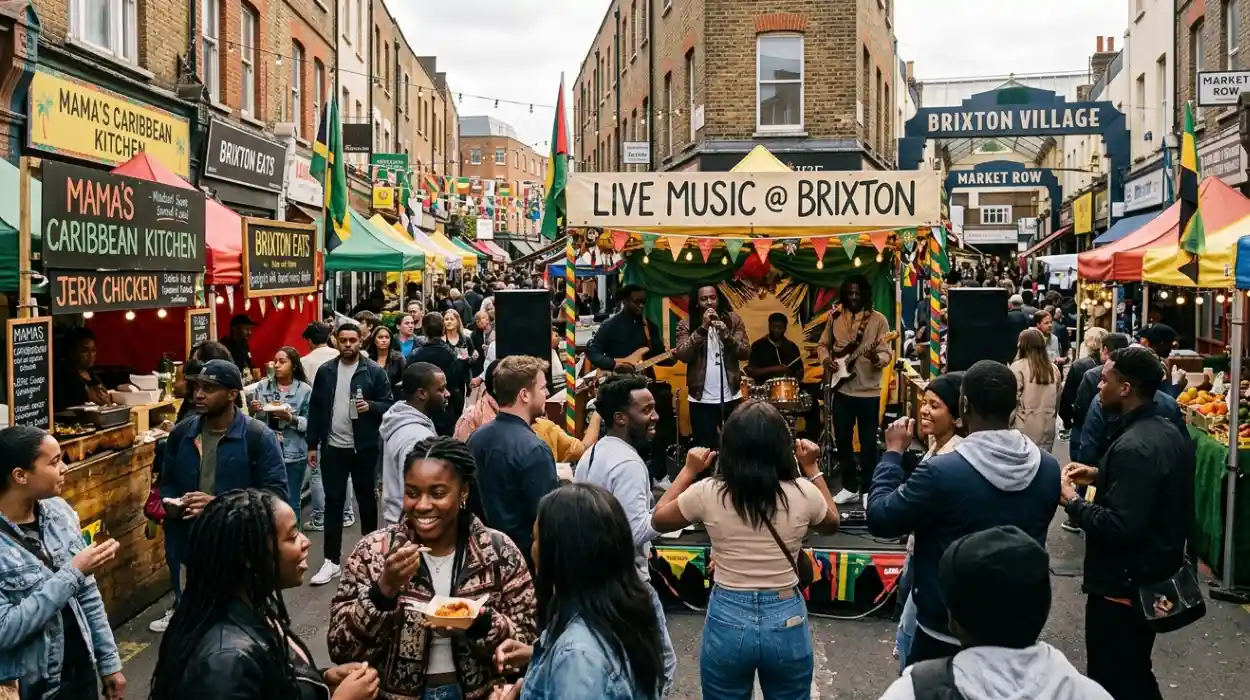
- How does live music integrate with Brixton Market?
- Music in the market arcades
- Neighbouring venues and clubs
- Role in Brixton’s wider music culture
- When is the best time to visit Brixton Market?
- Typical trading and music hours
- High‑traffic and low‑traffic periods
- How many people visit Brixton Market each year?
- What is the local demographic and cultural character?
- Cultural markers to expect
- Impact on the visitor experience
- How accessible is Brixton Market by public transport?
- How does Brixton Market compare with other London food markets?
- Size and density
- Food and music mix
- What impact does Brixton Market have on local businesses?
- What challenges does Brixton Market face going forward?
- Why is Brixton Market relevant for Londoners today?
This article, produced by The Londoner News, gives a comprehensive, evergreen overview of Brixton Market as a place for street food and live music, laying out its history, key sections, eating options, music‑event ecosystem, transport, and reasons it remains relevant for Londoners and visitors in 2026.
What is Brixton Market and where is it?
Brixton Market refers to the combined area of Brixton Village, Market Row and Electric Avenue around Brixton Station in the London Borough of Lambeth. It functions as an open‑street market by day and a mixed food‑market and entertainment zone by evening, drawing visitors from across London and tourists focused on Caribbean‑inflected street food and live music.
The market sits within the larger Brixton town centre, roughly 5–6 miles south of Central London. It is bounded on the north by Brixton Station and the Brixton High Street, with Brixton Village on the south side of Stockwell Road and Market Row running east‑west just behind Electric Avenue.
How did Brixton Market develop historically?
Brixton’s market culture dates back to the late Victorian and early Edwardian period, when local traders began congregating informally around electric trams and later around the Brixton Road–Brixton Station junction. The introduction of electricity in the late 19th century led to the naming of “Electric Avenue,” which later became the address for stalls and shops selling fresh produce, textiles and household goods.
Powerful post‑1948 migration from the Caribbean, West Africa and South Asia transformed the market into a hub for imported spices, canned goods, recordings and live music, reinforcing Brixton’s reputation for Afro‑Caribbean nightlife. By the 1980s and 1990s, Brixton Market was nationally associated with sound‑system culture, reggae, and grassroots political activism, and in the 2000s it underwent partial redevelopment into the covered arcades of Brixton Village and Market Row, while still retaining an informal street‑market feel.
What are the main sections of Brixton Market?
Brixton Market is conventionally divided into three named zones: Brixton Village, Market Row and Electric Avenue. Each zone has distinct characteristics, but all three are short walking distances from each other and share patrons and event line‑ups.
Brixton Village
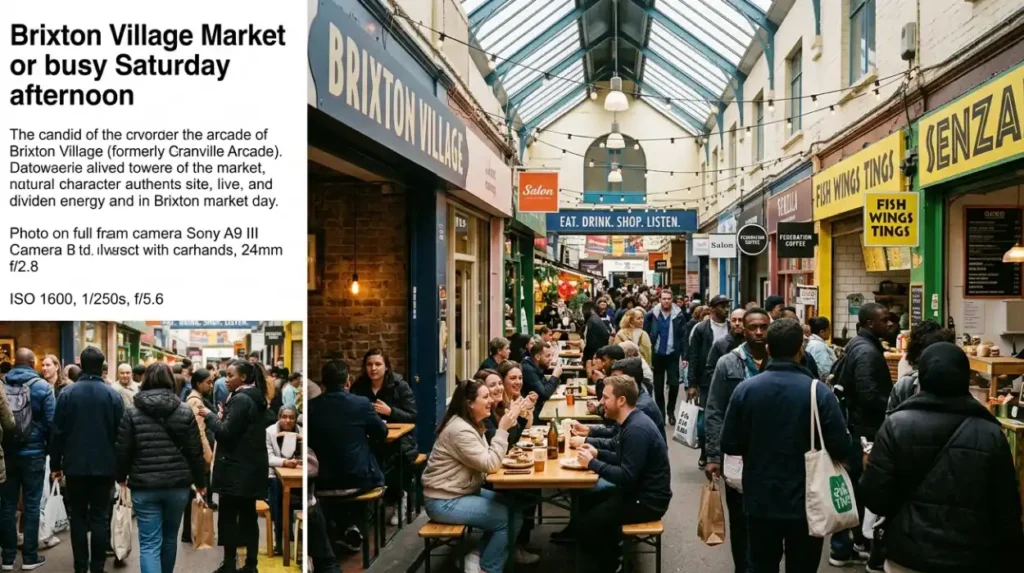
Brixton Village is a covered Victorian‑style arcade of tightly packed stalls and small restaurants running north‑south behind Electric Avenue. It acts as the main food‑market spine, housing dozens of independents, from Caribbean and African vendors to Asian street‑food concepts and European bakeries.
Market Row
Market Row is an east‑west covered market aisle linked to Brixton Village, with a slightly more settled, restaurant‑focused feel. It includes sit‑down spaces such as Franco Manca, the sourdough‑pizza chain that opened at Brixton Market in 2008, which helped anchor the area as a “foodie” destination.
Electric Avenue
Electric Avenue is the open street running parallel to Brixton Station, historically lined with market stalls and now a mix of street vendors, chain shops and small cinemas. It carries the “market” name in the popular imagination, even though much of the food and music action now occurs inside Brixton Village and Market Row.
What defines the street‑food scene at Brixton Market?
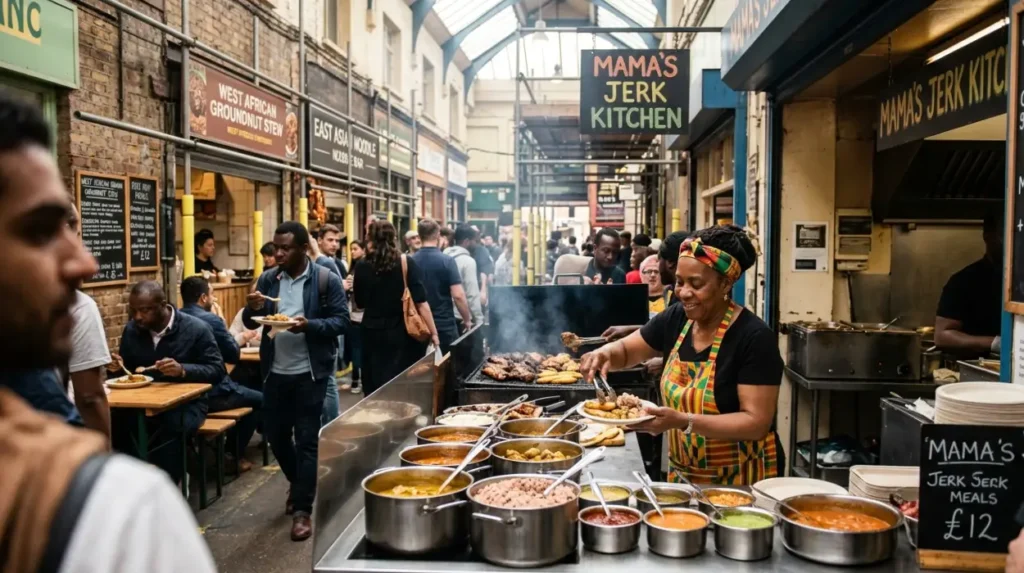
Brixton Market’s street‑food offering is defined by high density, international diversity and low‑to‑mid pricing, with many full meals available for £8–£12. Vendors specialise in Caribbean, West African, East Asian and modern European street‑food formats, often using open‑kitchen counters or small open‑front stalls so customers see food being prepared.
Create a highly realistic, professional news-style image based on the following title and paragraph.
The image must:- Look like a real photograph (not illustration, not cartoon)
- Be detailed, natural lighting, high resolution
- Match the exact mood and context of the paragraph
- Show real people or environment if relevant
- Looks like it was taken by a professional camera
- Be suitable for a news website
- Do NOT add any text, captions, headlines, logos, or watermarks on the image
Title: [What defines the street‑food scene at Brixton Market?]Paragraph: [Brixton Market’s street‑food offering is defined by high density, international diversity and low‑to‑mid pricing, with many full meals available for £8–£12. Vendors specialise in Caribbean, West African, East Asian and modern European street‑food formats, often using open‑kitchen counters or small open‑front stalls so customers see food being prepared.]
Common food styles and examples
Multiple food “types” coexist: Caribbean roti and jerk, West African barbecue, Japanese okonomiyaki, Chinese noodles and European pizzas are all present within a few hundred metres. Examples include Fish Wings & Tings (Jamaican jerk wings, roti, curry goat), Okan Okonomiyaki (Japanese savoury pancakes), and Mama Lan (Beijing‑style dumplings and noodles).
Typical price points and formats
Most stalls sell single‑plate or bowl‑based dishes, often in recyclable or takeaway‑friendly containers. Typical prices range from about £6–£7 for a portion of dumplings or noodles up to £10–£12 for larger jerk‑chicken plates or multi‑item plates combining rice, peas, slaw and stewed meat.
Why it suits a broad audience
The variety allows visitors to sample several cuisines in one visit, while the predominantly informal seating (communal tables, benches and standing‑only areas) keeps the space quick‑turnover and social. This structure supports both solo diners rushing through a lunch break and groups gathering for a longer evening food‑crawl.
Which specific food stalls and restaurants are essential?
While the exact lineup changes over time, several Brixton Market concepts have become reference points for visitors and are repeatedly cited in London‑wide restaurant guides. Listing them gives readers concrete, searchable landmark names as well as flavour profiles they can expect.
- Fish Wings & Tings – Jamaican‑style stall known for large jerk‑chicken portions, roti wraps and “reggae wings” with pineapple‑mango chutney; dishes commonly priced under £9.
- Okan Okonomiyaki – Japanese street‑food stall serving large, cabbage‑heavy okonomiyaki pancakes topped with bonito flakes, Japanese mayonnaise and brown sauce, typically around £8 per pancake.
- Mama Lan – Beijing‑inspired counter‑service stand focusing on dumplings and noodle bowls, including spicy chicken ban mein and chilled noodle salads, with dumpling orders around £5.
- Franco Manca – Sourdough‑pizza restaurant in Market Row, opened in Brixton in 2008, functioning as a sit‑down anchor for visitors who prefer a more structured meal.
These examples illustrate the mix of Caribbean, East Asian and modern‑European influences that characterise the wider Brixton Market food scene.
How does live music integrate with Brixton Market?
Live music is embedded into Brixton Market’s identity through regular performances in and around Brixton Village and Market Row, plus a cluster of nearby venues that extend the same musical sensibility. The market area functions as a daytime and early‑evening “background” live‑music space, while adjacent halls and clubs host headline‑style gigs later at night.
Music in the market arcades
Brixton Village runs weekly paid or free live‑music and DJ events curated by the “Brixton Village Lates” team, a husband‑and‑wife DJ duo active in Black‑music promotion for over two decades. Their programme features genres such as funk, disco, hip‑hop, rare groove and afrobeat, performed live or via DJ sets, often overlapping with eating hours so diners hear music while choosing food.
Neighbouring venues and clubs
Beyond the market arcades, Brixton’s music ecosystem includes Electric Brixton, Hootananny and Blues Kitchen, which host ticketed headline concerts, club nights and themed festivals. Electric Brixton, for example, lists 20‑date‑plus event calendars annually, with multi‑genre bookings that include rap, rock, reggae and electronic line‑ups.
Role in Brixton’s wider music culture
Brixton has long been associated with British and international musicians, including David Bowie, Bronski Beat and Maxi Jazz, whose careers intersected with the area’s sound‑system and club culture. Today, the market’s live‑music policy consciously references that heritage, positioning Brixton Village as an informal “stage” for emerging and mid‑career acts alongside established club‑night brands.
When is the best time to visit Brixton Market?
The best time to visit Brixton Market depends on whether the priority is food, people‑watching, live music, or avoiding crowds. Weekday afternoons and early evenings usually offer shorter queues and easier seating, while weekends and Bank‑Holiday‑adjacent dates bring the liveliest atmosphere and the fullest music calendar.
Typical trading and music hours
Brixton Village and Market Row generally open around 10:00–11:00 and close between 18:00 and 22:00 on weekdays, with later finishes on Fridays and Saturdays to accommodate evening‑dining demand. Live‑music events in the market arcades are often scheduled on Friday and Saturday evenings, aligning with peak footfall and the schedules of nearby clubs.
High‑traffic and low‑traffic periods
Weekends and summer months see the highest visitor numbers, with queues at popular stalls sometimes exceeding 20–30 minutes at peak lunch (12:30–14:00) and dinner (18:30–20:00) slots. Weekday mornings and early afternoons, especially outside school‑holiday periods, are noticeably quieter and better suited to unhurried exploration of the different food stalls.
How many people visit Brixton Market each year?
Exact annual footfall figures for Brixton Market are not published in a single official statistic, but the area is widely described as one of London’s busiest informal markets and market‑style districts. Transport and planning documents for the Brixton town centre consistently classify it as a major “primary shopping destination” drawing residents from Lambeth, Southwark and neighbouring boroughs, which implies tens of thousands of weekly visits when aggregated across the year.
Market‑guide publishers and culture magazines rank Brixton Market in the top tier of London’s food markets, frequently comparing it with Brick Lane Market, Camden Market and Borough Market in terms of density and diversity of vendors. These qualitative comparisons, combined with visible weekend crowd sizes and the presence of multiple chains and independents, support the assessment that Brixton Market registers high‑volume repeat visitation rather than being a niche or occasional destination.
What is the local demographic and cultural character?
Brixton Market sits within a culturally mixed and historically Black‑British neighbourhood, with substantial Caribbean‑heritage communities and more recent waves of West African, Ethiopian and Eastern European residents. This demographic profile shapes the market’s core offerings: Caribbean food, Caribbean‑style music, African‑print textiles and Afro‑Caribbean/afrobeats‑influenced events are prominent.
Cultural markers to expect
Regular visitors will notice numerous stalls selling Caribbean spices, canned goods, plantains, cassava, jerk seasoning blends and African beans and grains, alongside shops selling vinyl records, sound‑system merchandise and clothing with diasporic references. The live‑music schedule deliberately foregrounds Black‑British and African‑diaspora genres, including reggae, soca, dancehall, afrobeats, hip‑hop and neo‑soul.
Impact on the visitor experience
For a broad London audience, this means Brixton Market functions as both a practical food destination and a de facto cultural exhibition of Caribbean and West African life in the UK. Visitors unfamiliar with Creole‑inflected menus or Caribbean naming conventions may need to read descriptions carefully, but the market’s informal layout and short queues make it easy to move between stalls until they find a preferred flavour profile.
How accessible is Brixton Market by public transport?
Brixton Market is highly accessible by public transport, centred on Brixton Station, which serves multiple London transport modes. The station is served by the Victoria line (London Underground), National Rail services to London Victoria and other regional lines, and a dense network of London Bus routes converging on Brixton Road and Electric Avenue.
From central‑London hubs such as Oxford Circus or Tottenham Court Road, the Victoria line reaches Brixton Station in roughly 15–20 minutes, making same‑day visits straightforward for workday visitors or tourists prioritising a half‑day food and music itinerary. Around the station, wheelchair‑friendly footpaths, level crossings and step‑free access to the main market arcades are standard, though individual stalls vary in counter height and aisle width.
How does Brixton Market compare with other London food markets?
Brixton Market differs from other London food markets in several structural and cultural dimensions. It is more compact than large open‑market complexes such as Camden Market, concentrates more heavily on Caribbean‑linked cuisines than Borough Market, and integrates live music more routinely than many daytime‑only food halls.
Size and density
Brixton Village and Market Row are smaller in total area than Camden Market or Spitalfields Market, but they achieve higher vendor density per square metre, packing dozens of food and retail stalls into a tight network of arcades. This layout encourages “grazing” behaviour, where visitors order one item from several stalls and eat while moving, rather than staying at a single restaurant for the entire meal.
Food and music mix
Borough Market, in contrast, emphasises British and European speciality producers and pricier fare, with less emphasis on Caribbean or African dishes. Brixton Market’s consistent pairing of cheap, high‑turnover street food with live‑music programming gives it a more “nightlife‑adjacent” feel than many other London markets, which are predominantly daytime‑only.
What impact does Brixton Market have on local businesses?
Brixton Market’s status as a major visitor destination supports surrounding retailers, bars and music venues, creating a multiplier effect across the wider Brixton town centre. Independent restaurants and small shops in the immediate vicinity benefit from overflow traffic generated by weekend market visitors, who often move on to nearby bars, pubs and boutique stores after eating.
The market’s food‑enterprise structure also supports small‑scale entrepreneurship, with many stalls operating as single‑owner or family‑run businesses that can scale up to expanded premises or spin‑off locations if they gain traction. Concepts that begin in Brixton Village or Market Row sometimes open branch outlets in other London boroughs or relocate to higher‑rent areas once they have built a reputation, adding to the market’s role as an incubator for London‑wide food brands.
What challenges does Brixton Market face going forward?
Like many inner‑London markets, Brixton is exposed to commercial‑rent inflation, planning decisions around town‑centre redevelopment and competition from chain‑driven retail parks. Rising costs can pressure small, independent vendors, particularly those without long‑term leases, and may gradually reduce the number of “micro‑stalls” in favour of larger, capital‑intensive operators.
Additionally, gentrification‑driven demographic changes can alter the balance between Caribbean‑dominated vendors and more generic, pan‑European street‑food concepts. Market‑management bodies and local‑borough officials have implemented initiatives to protect independent traders and retain Brixton’s cultural identity, but these efforts require ongoing monitoring and resident input.
Why is Brixton Market relevant for Londoners today?
Brixton Market remains relevant because it combines practical functionality with cultural distinctiveness in a way that few London food markets can replicate. It offers low‑cost, high‑quality meals from multiple cuisines alongside a programme of live music that reflects Black‑British and Afro‑Caribbean musical traditions, making it both a convenience and a destination.
For The Londoner News’s broad audience, this means Brixton Market can be recommended as a year‑round option for lunch, dinner, casual weekend outings and themed “music and food” nights, rather than a seasonal or niche experience. Its accessibility by public transport, dense clustering of stalls, and consistent presence in London‑wide guides all support its status as an evergreen feature of the city’s street‑food and live‑music landscape.
What is Brixton Market and where is it?
Brixton Market is a major food and cultural hub in south London, combining Brixton Village, Market Row, and Electric Avenue. It sits around Brixton Station in the London Borough of Lambeth, about 5–6 miles جنوب of central London, and functions as a daytime market and evening food-and-music destination.