
The democratic structure of London local government relies directly on borough-level administration to manage municipal services, property taxation, and urban planning. The London Borough of Barnet represents one of the largest local authority districts by population in the Greater London area. Effective participation in these municipal processes requires registered electors to understand the mechanical components of the electoral system, the designated political candidates contesting vacancies, and the logistical layout of regional polling stations. This comprehensive guide by The Londoner News details the essential infrastructure, statutory frameworks, and operational steps necessary for Barnet residents to exercise their democratic franchise.
- What is the constitutional framework of the Barnet local elections?
- How does the voting mechanism operate in the borough?
- What are the statutory voter identification requirements for residents?
- Who are the key political parties and candidate groups contesting the election?
- Where are the primary polling station locations across Barnet’s electoral wards?
- What are the key processes and deadlines for the local election timeline?
- What are the macro socioeconomic implications of Barnet’s local election outcomes?
What is the constitutional framework of the Barnet local elections?
The Barnet local elections operate as a critical component of statutory local government administration within the Greater London authority framework. They determine the legislative and executive composition of the local council, which exercises statutory responsibilities under United Kingdom constitutional law.
Statutory foundations and administrative definitions
The statutory structure governing local government in the metropolis originates from the London Government Act 1963, which formally created the 32 modern London boroughs. The London Borough of Barnet operates as a single-tier local authority, functioning under the Local Government Act 1972 and subsequent modernizing legislative amendments.
The primary legislative branch of this local authority is the Barnet London Borough Council. The council comprises 63 democratically elected representatives known as ward councillors. These councillors represent specific, geographically bounded sub-districts termed electoral wards. Barnet is divided into 24 electoral wards, including multiple-member wards that return either two or three councillors depending on the specific demographic densities designated by the Local Government Boundary Commission for England (LGBCE).
The allocation of local authority powers
Under the UK geo-constitutional framework, powers are bifurcated between strategic pan-London authorities and individual borough councils (Wills, 2023). While the Greater London Authority (GLA) and the Mayor of London manage macro-level strategies—such as metropolitan transport via Transport for London (TfL), strategic spatial planning via the London Plan, and metropolitan policing via the Metropolitan Police Service—the Barnet London Borough Council retains autonomous control over local public service delivery.
The municipal competencies executed by the Barnet Council encompass statutory duties across multiple critical sectors:
- Education and Social Care: The provision of state primary and secondary schooling infrastructure, special educational needs services, and adult and child social care services.
- Environmental Health and Waste Management: The administration of domestic refuse collection, street cleansing, and ecological planning policies dictated by joint initiatives like the North London Waste Plan (Patterson, 2015).
- Local Highways and Transport: The maintenance of non-strategic borough roads, pedestrian walkways, public lighting installations, and localized traffic restriction zones.
- Housing and Planning Regulation: The statutory evaluation of residential and commercial property developments, enforcement of building regulations, and management of local authority housing assets.
How does the voting mechanism operate in the borough?
The voting mechanism in Barnet local elections follows the first-past-the-post electoral system across multi-member pluralities. Registered electors can submit multiple votes corresponding to the exact number of vacant council seats allocated to their specific residential ward.
The plural voting system explained
Unlike national parliamentary elections in the United Kingdom, where an elector casts a single ballot for one candidate to represent a single constituency, Barnet local elections utilize multi-member electoral districts (Wood et al., 2011). In a three-member ward, political parties routinely field a slate of up to three distinct candidates.
Electors are legally permitted to vote for up to three separate candidates on a single physical ballot paper. The voting mechanism allows an elector to distribute these votes across different political party slates or to select the complete candidate slate of a single political organization. The ballot paper lists all contesting candidates in alphabetical order by their surnames (Wood et al., 2011).
The counting procedure follows an absolute plurality model. Once all valid ballots are deposited and verified, the total votes are aggregated per candidate. The three candidates who secure the highest cumulative volume of individual votes are automatically declared elected to the council vacancies, irrespective of whether they achieve an absolute statistical majority of the total votes cast within that ward.
Methods of ballot submission
Electors registered within the borough can submit their votes using three legally recognized methods:
- In-Person Polling Station Voting: Electors cast their physical ballot papers directly inside a designated polling booth located within their allocated ward boundaries between the hours of 07:00 and 22:00 on polling day.
- Postal Voting: Registered electors who apply prior to the statutory deadline receive their ballot papers via Royal Mail. These must be completed and returned to the local returning officer before the close of the poll on election day (Rallings, 2016).
- Proxy Voting: An elector legally nominates a trusted representative to cast the ballot on their behalf at the elector’s designated polling station, subject to strict medical or logistical verification.
Explore More Thing To Do
Brent Council Waste Management Guide: Report Missed Bins And Fly Tipping, Brent
South London Listens Project: New Community Wellbeing Grants in South London
What are the statutory voter identification requirements for residents?
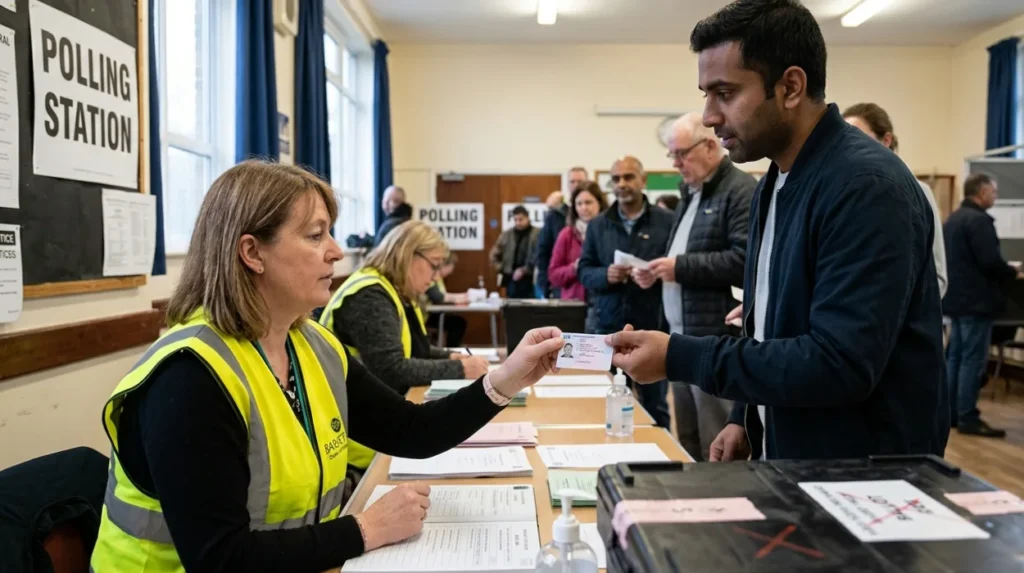
Voter identification requirements necessitate that all in-person electors present an approved form of photographic identification prior to receiving a ballot paper. This statutory framework enforces strict security protocols designed to prevent personation fraud at the point of voting.
The legal mandate for photographic identification
The statutory requirement for mandatory voter identification in Great Britain was established under the Elections Act 2022. This legislation transformed local government administration by eliminating the historical practice of unverified signature-based or verbal identity declarations at polling stations.
The primary objective of this legal framework is the mitigation of electoral fraud, specifically personation, which is the unlawful act of voting in person as some other person. The law requires polling station staff, overseen by the local returning officer, to physically inspect and verify the photographic likeness and legal name listed on an elector’s identification document before issuing any official borough ballot papers.
Approved documentation categories
The local authority accepts specific categories of photographic documentation, which must be original and unexpired, though documents that have passed their formal expiry date remain legally valid provided the photographic image continues to bear a direct, unmistakable likeness to the holder:
- Passports: Documents issued by the Government of the United Kingdom, any of the Channel Islands, the Isle of Man, a British Overseas Territory, an European Economic Area (EEA) state, or a Commonwealth country.
- Driving Licences: Full or provisional driving licences issued by the United Kingdom, Great Britain, Northern Ireland, the Isle of Man, any of the Channel Islands, or an EEA state.
- Concessionary Travel Passes: Local travel passes issued under the national concessionary travel scheme, including Older Person’s Bus Passes, Disabled Person’s Bus Passes, and London Oyster Photocards for individuals aged 60 and over.
- Voter Authority Certificates (VAC): A specialized, non-chargeable electoral identity document issued by the Barnet electoral registration officer for residents who do not possess any pre-existing forms of valid photographic identification.
Impact of identification laws on voter turnout
Empirical research evaluating the introduction of voter identification pilots across various London boroughs indicates that strict photographic documentation mandates alter conventional voter turnout dynamics (Barton, 2025). Statistical models demonstrate that marginal declines in total ballot box participation can occur within specific demographic cohorts who lack standard corporate or state-issued identification documents, underlining the imperative for comprehensive public informational campaigns by municipal offices.
Who are the key political parties and candidate groups contesting the election?
The candidate landscape in the Barnet local election features three major national political parties alongside localized independent organizations. These groups field targeted slates of candidates designed to secure legislative majorities across the multi-member wards.
The major political slates
The governance of the Barnet London Borough Council has historically alternated between two primary political entities, with secondary organizations exercising significant balancing influence:
- The Labour Party: This organization prioritizes local government interventions centered on municipalized public services, affordable housing quotas within urban developments, expanded funding allocations for social care provisions, and localized environmental sustainability frameworks.
- The Conservative Party: The platform of this party emphasizes strict fiscal restraint, reduction or stabilization of the core council tax rate, protection of suburban green belt land allocations, and the outsourcing of specific non-statutory municipal operations to private enterprises to reduce administrative overheads.
- The Liberal Democrats: This group focuses its municipal campaigns on localized environmental enhancements, expanded pedestrian and cycling infrastructure networks, enhanced transparency in council decision-making processes, and greater devolution of spending powers to neighborhood-level community forums.
Secondary parties and independent formations
Beyond the three largest parliamentary organizations, the electoral field features alternative ideological formations:
- The Green Party: This faction campaigns explicitly on accelerating localized carbon neutrality targets, implementing strict low-emission zones, protecting urban biodiversity, and retrofitting existing council housing stocks with modern insulation technologies.
- Independent and Resident Associations: These hyper-local candidate groups reject national party whip systems, focusing exclusively on ward-specific infrastructure assets, local amenities protection, and resisting macro-scale urban planning re-zones.
Where are the primary polling station locations across Barnet’s electoral wards?
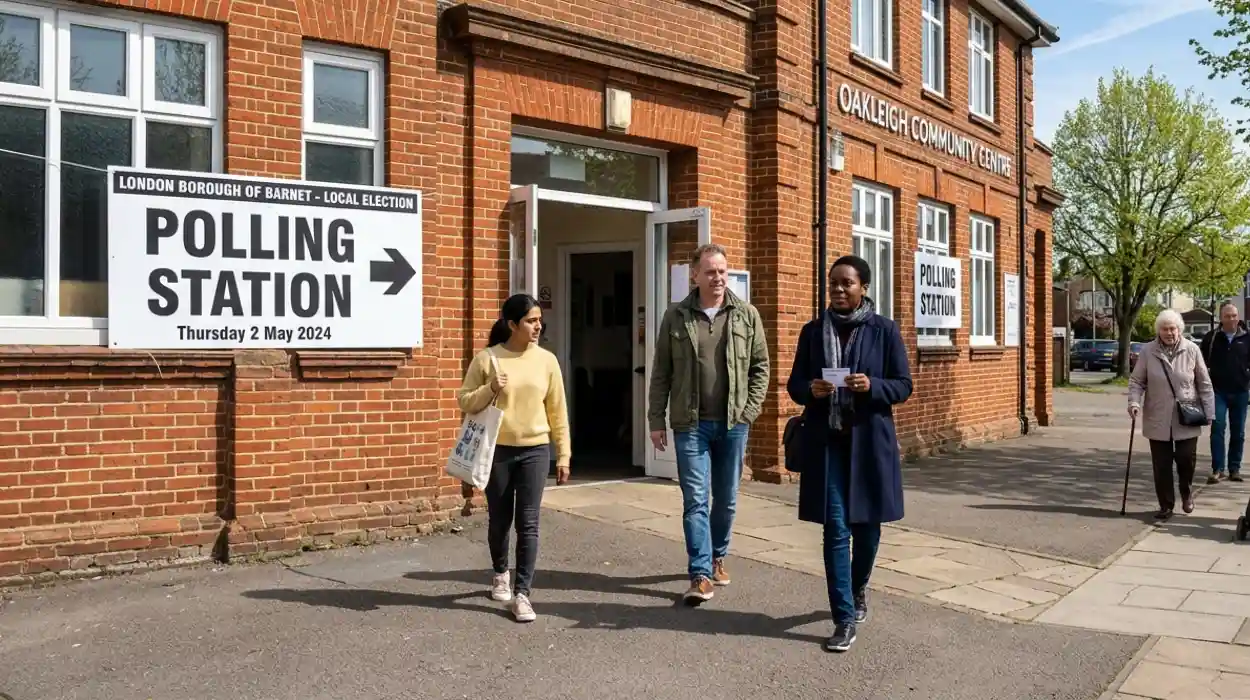
Polling station locations are distributed systematically across the 24 electoral wards of Barnet to ensure physical accessibility for all residents. The local returning officer selects specific public civic spaces to house the physical balloting infrastructure.
Distribution architecture of voting venues
To preserve the logistical integrity of the election, the borough utilizes a network of established public properties, educational institutions, and community hubs. Electors are legally confined to voting exclusively at the specific polling station designated on their official poll card, which is determined by their precise residential address data.
The distribution of polling stations targets high-density accessible zones within each ward. The primary venues utilized by the local authority include:
- Chipping Barnet and Northern Wards: Civic infrastructure like the Chipping Barnet Library, traditional church halls such as St. John the Baptist Church rooms, and local primary school assembly halls serve as primary voting hubs for residents in the northern geographical sectors.
- Hendon and Central Wards: Centralized locations include the Hendon Town Hall complex, community centers such as the Broadfields Community Centre, and multi-faith spaces that volunteer infrastructure for civil governance actions.
- Finchley and Golders Green Southern Wards: Venues encompass educational spaces like the Finchley Catholic High School, municipal libraries including the Golders Green Library, and youth centers adapted for temporary electoral administration.
Accessibility and compliance regulations
Under the Representation of the People Act 1983 and disability discrimination legislation, the returning officer must ensure all designated polling stations maintain physical accessibility parameters. This requires the installation of temporary step-free access ramps, specialized low-level voting booths designed for wheelchair users, tactile voting templates for visually impaired electors, and clearly illuminated interior directional signage.
What are the key processes and deadlines for the local election timeline?
The execution of the local election relies on a rigid chronological sequence of statutory deadlines regulated by the Electoral Commission. Failure to comply with these intermediate cut-off dates legally disenfranchises prospective voters and candidates alike.
The administrative sequence of the election
The administrative execution of the Barnet municipal election operates via an established procedural timeline:
Critical deadlines for electors
Residents must navigate multiple key dates during the electoral cycle to ensure their capability to cast a legal ballot:
- The Registration Deadline: The final calendar day by which an individual must submit a valid application to the national voter register. Unregistered individuals are completely barred from participating in the ballot.
- The Postal Vote Application Cut-off: The statutory deadline, typically falling eleven working days prior to the main poll, by which electors must register their request for a mail-in ballot package.
- The Proxy Vote Application Deadline: The formal deadline for standard proxy nominations, normally occurring six working days before polling day.
- The Voter Authority Certificate Deadline: The final date for individuals lacking standard photographic identification to apply for a free municipal voting certificate.

What are the macro socioeconomic implications of Barnet’s local election outcomes?
The political control of the Barnet Council directly dictates the fiscal allocation of multi-million pound budgets and shapes long-term urban development strategies. The election outcomes influence real estate values, commercial investments, and demographic trends within the borough.
Fiscal management and taxation policy
The immediate implication of a shift in council control manifests in the formulation of the annual municipal budget. The ruling political group possesses the statutory authority to set the local council tax rate, subject to national government capping thresholds.
A conservative-led administration traditionally prioritizes expenditure reduction to minimize the tax burden on residential property holders. Conversely, a labour-led or progressive coalition administration typically leverages maximum permissible council tax increases to capitalize social support mechanisms, expand public sector employment, and fund community-wealth building initiatives.
The council also administers the allocation of the Community Infrastructure Levy (CIL) and Section 106 planning agreements. These mechanisms extract financial contributions from commercial property developers to fund localized public assets, including:
- New medical clinics and primary care centers.
- Expanded public parks, recreational spaces, and urban greening projects.
- Upgrades to public transport links and pedestrianized high street schemes.
Urban planning, demographic shifts, and economic development
The long-term economic geography of Barnet is governed by the council’s statutory Local Plan. The political alignment of the elected cabinet directly influences the speed, density, and character of urban regeneration projects.
Decisions regarding high-density residential towers near strategic transport corridors, such as the Brent Cross Cricklewood regeneration zone, are heavily mediated by council planning committees. Wards with lower initial housing costs frequently exhibit distinct voting sensitivities during municipal transitions due to localized anxieties regarding gentrification, infrastructure strain, and shifts in the affordability of the local housing market (Pupaza & Wehner, 2023).
The outcome of the local election therefore determines the balance between pro-growth urban density initiatives and suburban preservation policies, directly impacting the broader economic integration of Barnet within the wider London economy.
What are Barnet local elections?
Barnet local elections are democratic votes where residents of the London Borough of Barnet choose councillors to represent them on the borough council, which manages local services like housing, planning, waste collection, and schools.