
The South London Listens project represents an ongoing public mental health campaign operating within the United Kingdom to mitigate systemic health inequalities. Governed through a partnership between local NHS integrated care boards, local government authorities, and community organizing coalitions, this initiative actively targets localized, preventative mental health interventions. In its newest funding phase, the program has introduced hyper-local wellbeing grants designed to resource grassroots voluntary, community, and social enterprise sector organizations. By bypassing standard, bureaucratic health procurement pathways, these capital injections enable local communities to directly engineer safety nets for vulnerable populations across South London boroughs.
- What is the historical background of the South London Listens project?
- How do the new wellbeing grants distribute financial resources?
- What are the key operational components of the community initiatives?
- What specific mechanisms link these community grants to improved public health?
- What do real-world examples look like in South London?
- What statistics and research insights validate this hyper-local approach?
- What are the future implications for the South London healthcare ecosystem?
What is the historical background of the South London Listens project?
The South London Listens project originated in 2020 as a direct, large-scale community listening campaign to address the disproportionate structural, economic, and psychological impacts of the COVID-19 pandemic on vulnerable metropolitan populations across South East and South West London.
The program emerged through an explicit partnership between three National Health Service integrated care boards—including NHS South East London and NHS South West London—alongside local authorities across 4 distinct boroughs, namely Lambeth, Southwark, Lewisham, and Greenwich, and the community organizing charity Citizens UK. Between November 2020 and March 2021, the coalition conducted active listening exercises involving more than 6,000 residents, community leaders, and essential workers. The objective was to identify the root social determinants of psychological distress, isolating systemic barriers such as chronic structural racism, severe digital exclusion, deep financial precarity, and acute social isolation.
The initial listening campaign culminated in the publication of the South London Listens Action Plan in June 2021. This document established a long-term strategic roadmap to co-produce public health solutions outside traditional clinical settings. Rather than expanding secondary psychiatric services, the framework prioritized localized structural optimization. It focused on training 100 community health champions, establishing physical community mental health hubs, and securing direct financial investments for grassroots mutual aid networks. This shifted the localized healthcare paradigm from reactive psychiatric treatment to preventative, community-led intervention.
Explore More Things To Do
New M&S Food Hall Tooting Bec Opening 2026
The Real Greek: Authentic Taverna in Soho London
How do the new wellbeing grants distribute financial resources?
The new wellbeing grants distribute financial resources by allocating hyper-local micro-funding directly to small, unregistered mutual aid groups, voluntary organizations, and social enterprises that operate entirely outside standard institutional NHS procurement systems and statutory frameworks.
The financial distribution mechanism relies on a place-based, participatory budgeting methodology. Instead of utilizing top-down, clinical decision-making panels, the distribution process involves local community steering groups comprised of residents with lived experience of health disparities. Individual grant awards generally range between £1,000 and £10,000 per initiative. This specific financial tier ensures that micro-organizations, which frequently lack the administrative infrastructure to bid for major government tenders, can successfully access capital without navigating prohibitive regulatory barriers.
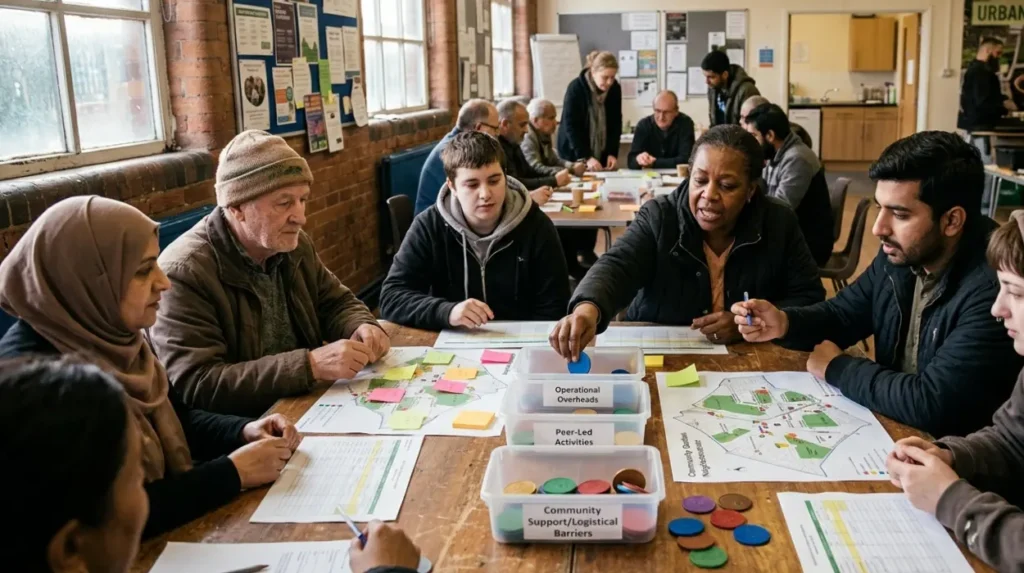
Financially, the grants target the structural drivers of mental health deterioration by prioritizing 3 distinct categories of community expenditure. First, the funds cover immediate operational overheads, such as renting neighborhood community centers or hiring local, culturally competent workshop facilitators. Second, the resources purchase raw materials for peer-led therapeutic activities, including urban gardening equipment, art supplies, and musical instruments. Third, the grants fund logistical support to remove structural barriers to participation, specifically covering user transport costs and childcare provisions. This decentralized allocation strategy ensures that capital penetrates directly into historically marginalized communities.
What are the key operational components of the community initiatives?
The key operational components of these community initiatives center around three specific structural pillars, which are peer-led social prescribing networks, localized non-clinical sanctuary spaces, and targeted culturally inclusive public health interventions.
Peer-led social prescribing networks mobilize local residents as link workers and knowledge brokers to connect vulnerable individuals directly with community assets (Thomson, 2026). These networks bypass primary care clinics by embedding referral pathways within natural community spaces, such as barbershops, food banks, and faith centers. Non-clinical sanctuary spaces operate as physical, geographical alternatives to standard psychiatric waiting rooms or emergency departments. These spaces prioritize low-barrier, open-door access where individuals can experience immediate social validation without requiring a formal medical diagnosis or undergoing clinical triage processes.
Culturally inclusive public health interventions constitute the third operational component, deliberately engineered to serve ethnically diverse populations. Because traditional mental healthcare services in metropolitan centers often exhibit lower levels of trust among minoritized populations (Baker, 2026), these initiatives modify the delivery format entirely. Rather than utilizing standard Western psychotherapeutic methodologies, they employ participatory, group-based practices. These include community-led physical exercise programs, neighborhood food preparation workshops, and collective arts initiatives. By using community-approved spaces, these interventions actively decouple wellness from institutional, clinical environments.
What specific mechanisms link these community grants to improved public health?
The specific mechanisms linking community grants to improved public health operate by systematically reducing chronic social isolation, building sustained institutional trust, and mitigating the acute daily stressors associated with the social determinants of health.
Community-centred interventions protect public mental health by strengthening social connectedness and giving marginalized groups greater decision-making power in local structures (Baskin et al., 2021). At a neurobiological level, chronic loneliness accelerates the hypothalamic-pituitary-adrenal (HPA) axis, elevating systemic cortisol levels and exacerbating common mental disorders like generalized anxiety and major depressive disorder. By funding regular, group-based touchpoints, the grants foster consistent micro-communities that downregulate physiological stress responses. This preventative reduction in systemic inflammation lowers the long-term incidence of stress-induced physical and psychological co-morbidities.
Additionally, these initiatives utilize lay health workers from within the community to overcome deep structural barriers and facilitate early signposting (Baskin et al., 2021). When a vulnerable individual interacts with a trusted peer rather than a state institution, psychological safety increases. This trust shift accelerates proactive help-seeking behaviors before psychological distress escalates into an acute clinical crisis. Furthermore, by integrating material support—such as advice on welfare benefits, housing security, and digital literacy—the initiatives address the external structural causes of mental illness. This multi-layered approach systematically diverts individuals away from over-burdened secondary psychiatric services.
What do real-world examples look like in South London?
Real-world examples of funded initiatives in South London include perinatal support programs for minoritized mothers, specialized intergenerational counseling networks, and green social prescribing projects situated within urban community gardens.
In the borough of Southwark, the wellbeing grants fund participatory, community-based music programs tailored specifically for perinatal women of African, Caribbean, and Mixed heritages. Qualitative public health research demonstrates that Global Majority women face significant systemic barriers, stigma, and mistrust when navigating statutory perinatal mental health services (Anstee, 2026). To counteract this, these funded music-based workshops provide a non-clinical environment where new mothers utilize group singing, rhythmic exercises, and informal peer discussions to regulate mood, combat postnatal depression, and build localized mutual support networks outside traditional hospital settings.
In Lambeth and Lewisham, funding supports targeted initiatives that address the intersection of financial distress and psychological vulnerability. For instance, grants support weekly drop-in sessions that combine legal advocacy with peer-led mental health support groups. These sessions specifically serve individuals navigating complex welfare benefits or facing housing insecurity, groups that historically show high rates of secondary mental health service utilization (Stevelink et al., 2023). By co-locating welfare advice with psychological first aid, these projects deliver immediate, practical stabilization to prevent severe mental health crises among economically marginalized residents.

What statistics and research insights validate this hyper-local approach?
Statistics and research insights validate this hyper-local approach by demonstrating a clear, quantitative link between community-asset mobilization, the reduction of healthcare inequalities, and the minimization of secondary clinical referrals.
Public health data indicates that common mental disorders affect approximately 1 in 6 adults in England, highlighting the need for preventative, community-level interventions that can address symptoms before they require formal clinical care (Baskin et al., 2021). Large-scale data linkages within the South London and Maudsley (SLaM) NHS Foundation Trust reveal that over 80% of adults referred to secondary psychiatric services require state welfare benefits, confirming the profound intersection between financial precarity and severe psychiatric presentation (Stevelink et al., 2023). Hyper-local grants target this precise nexus by providing resource injections directly to the geographical areas experiencing the highest indices of multiple deprivation.
Furthermore, cross-sectional analyses of general practices across England demonstrate that patient confidence and trust in healthcare professionals are significantly lower in urban areas characterized by high deprivation and high ethnic diversity, with London consistently scoring lower than other English regions (Baker, 2026). This data underscores why standard, clinic-bound outreach often fails to engage vulnerable urban demographics. Mobilizing community assets through trusted local organizations offers a proven pathway to bypass this institutional trust deficit, addressing health inequalities directly at their geographic and social roots (Thomson, 2026).
Explore More Things To Do
Policy Update: New Regulations for Flag and Poster Removal in Tower Hamlets
Hillingdon Council Boosts Neighborhood Safety Initiatives London Borough of Hillingdon
What are the future implications for the South London healthcare ecosystem?
The future implications for the South London healthcare ecosystem involve a permanent shift toward integrated, place-based care models that blend voluntary sector flexibility with statutory NHS clinical oversight.
This structural evolution aligns directly with the long-term preventative health strategy of the UK government, which emphasizes shifting care out of acute hospital environments and into local communities to reduce the operational burden on secondary services (Thomson, 2026). By demonstrating that small, localized investments can successfully stabilize vulnerable individuals, the South London Listens framework provides a repeatable model for other Integrated Care Systems across the United Kingdom. Over time, this funding strategy encourages statutory health commissioners to transition away from rigid, short-term grant cycles toward sustainable, multi-year funding partnerships with grassroots organizations.
Ultimately, this paradigm shift changes how public health success is measured within metropolitan areas. Instead of evaluating healthcare efficacy solely through clinical metrics—such as hospital bed occupancy rates or psychiatric medication adherence—the integration of wellbeing grants introduces holistic, social indicators of health. Success is increasingly defined by the density of local peer-support networks, the accessibility of non-clinical sanctuaries, and the resilience of neighborhood mutual aid groups. By embedding financial resources directly within the social fabric of South London, the project establishes a sustainable blueprint for urban health equity.
What is the South London Listens project?
The South London Listens project is a community-led public mental health initiative operating across several South London boroughs. It was created to address health inequalities, social isolation, and mental wellbeing challenges through grassroots interventions rather than relying solely on traditional clinical mental health services.