

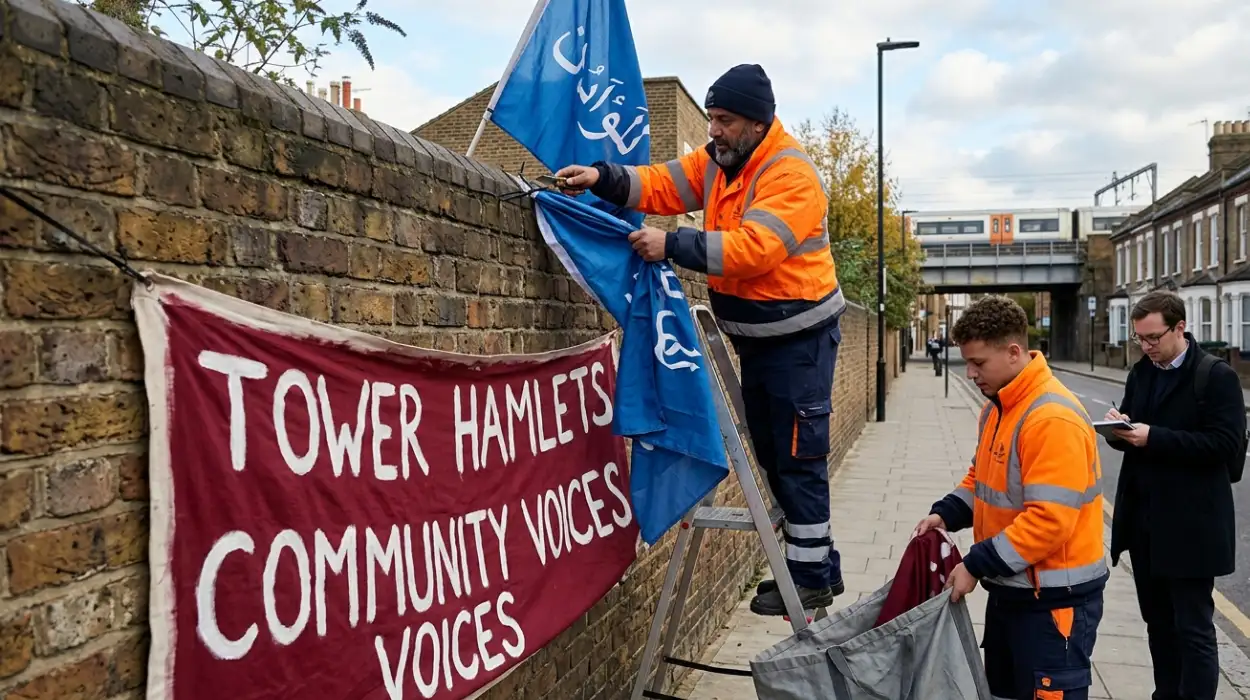
The Londoner News provides this comprehensive analysis of the regulatory changes and local government decisions regarding the display and removal of flags within the London Borough of Tower Hamlets. This article examines the legal frameworks, executive decisions, and community impacts associated with these recent policy shifts.
- What is the official Tower Hamlets Council flag removal policy?
- Why did Tower Hamlets Council decide to remove Palestine flags?
- How does the Local Government Act 1986 impact flag displays?
- What are the safety concerns related to flags on street furniture?
- Who is responsible for the enforcement of flag removal in Tower Hamlets?
- What is the history of political symbols in Tower Hamlets?
- How does flag removal affect community cohesion?
- What are the legal consequences for individuals hanging flags?
- What is the future of flag policy in London boroughs?
What is the official Tower Hamlets Council flag removal policy?
Tower Hamlets Council enforces a policy that requires the removal of unauthorized flags, posters, and banners from public infrastructure to ensure compliance with national planning laws, road safety regulations, and the Local Government Act 1986 regarding political neutrality.
The London Borough of Tower Hamlets, a local government authority in East London, operates under strict statutory obligations regarding the maintenance of public land and the regulation of advertisements. Under the Town and Country Planning (Control of Advertisements) (England) Regulations 2007, certain displays require express consent from the local planning authority. Flags that do not fall under “standard conditions” or “deemed consent”—such as national flags or specifically permitted community symbols—are subject to enforcement action.
In 2024 and 2025, the executive leadership under Mayor Lutfur Rahman has navigated complex legal pressures concerning the display of international solidarity flags, specifically the Palestinian flag, on council-owned property. While the council initially permitted these displays as a reflection of community sentiment, subsequent legal advice and potential intervention from central government departments, such as the Department for Levelling Up, Housing and Communities (DLUHC), necessitated a shift toward removal. The policy now dictates that any display on highway assets, such as lamp columns or railings, must be removed if it poses a safety risk, distracts motorists, or violates the prohibition of political messaging using public resources.
Why did Tower Hamlets Council decide to remove Palestine flags?
The decision to remove Palestine flags from public infrastructure was driven by legal risks involving the Local Government Act 1986, which prohibits local authorities from publishing material designed to affect support for a specific political party or cause.
Tower Hamlets Council faced significant scrutiny from the UK government and advocacy groups regarding the proliferation of flags on public property. The primary legal catalyst was the “Code of Recommended Practice on Local Authority Publicity.” This code stipulates that local authority resources must not be used to promote one-sided political viewpoints. When international flags remain on council property for extended periods, they may be interpreted as an official endorsement by the local government, which violates the principle of political neutrality.
The removal process, which intensified in early 2024, followed reports that the presence of these flags contributed to community tension. For example, some community members and monitoring groups reported that the displays made certain residents feel excluded or unsafe. To mitigate these risks, the council coordinated with the Metropolitan Police Service to ensure that removal operations were conducted safely. This decision was framed by the council as a necessary administrative action to uphold “community cohesion” and adhere to civil law, rather than a statement on the geopolitical conflict itself.
Explore More London Local News
Lightning Strike Causes Major Railway Disruption: Herne Hill and Denmark Hill 2026
New Beatles Museum to Open at Former Savile Row HQ Mayfair 2027
How does the Local Government Act 1986 impact flag displays?
The Local Government Act 1986 prohibits local authorities from using public funds or assets to promote political material, ensuring that council-owned property remains a neutral space for all residents regardless of their personal or political affiliations.
Section 2 of the Local Government Act 1986 is the foundational statute governing this area. It states that a local authority shall not publish any material which, in whole or in part, appears to be designed to affect public support for a political party. In the context of Tower Hamlets, “publication” extends to the display of banners and flags on council buildings or street furniture. If the council allows specific flags to remain while removing others, it risks being accused of bias or “political campaigning” using taxpayer-funded infrastructure.
Furthermore, the Act is supplemented by the 2011 Publicity Code, which requires that all local government communication be objective, even-handed, and appropriate. The display of flags related to high-profile international conflicts often falls into the category of “contentious issues” where the council must remain impartial. By removing these items, the Tower Hamlets executive avoids potential litigation from the Secretary of State, who has the power to issue directions to councils that fail to comply with these neutrality standards.
What are the safety concerns related to flags on street furniture?
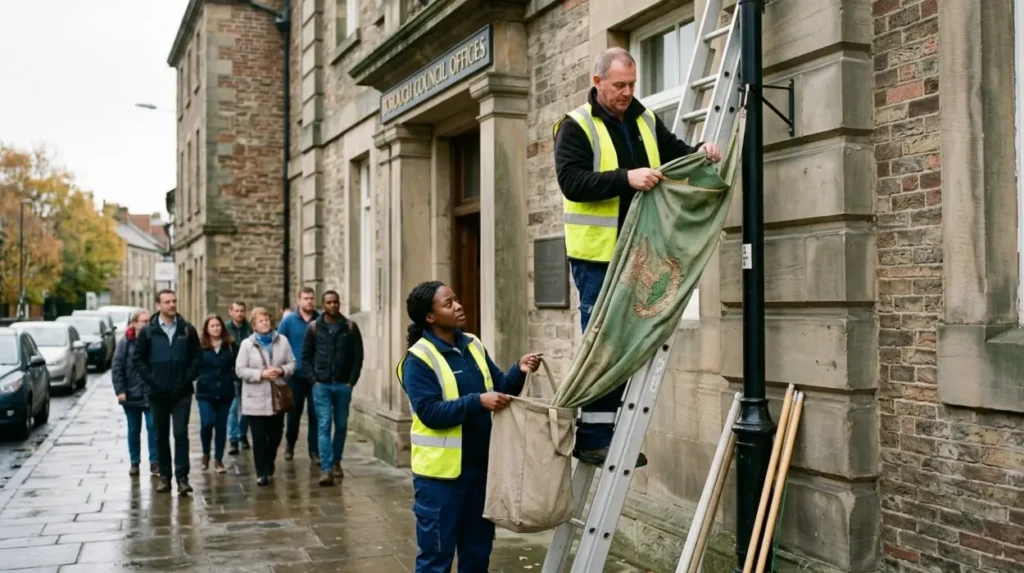
Flags attached to street furniture, including lamp posts and traffic lights, present structural hazards, reduce visibility for road users, and may interfere with the maintenance of essential public utilities and electrical systems.
The London Borough of Tower Hamlets manages thousands of items of “street furniture,” a term encompassing lamp columns, bollards, signage, and pedestrian railings. The Highways Act 1980 mandates that the council, as the local highway authority, must keep these routes clear of obstructions. Flags and their fixings (such as cable ties or metal wires) can cause several technical issues:
- Wind Loading: High winds can turn a flag into a “sail,” exerting unintended lateral force on lamp columns not designed for such weight, potentially leading to structural failure.
- Visibility: Large banners can obscure sightlines for drivers at junctions, increasing the risk of vehicular collisions.
- Electrical Access: Flags wrapped around lamp posts can hinder engineers who need to access electrical panels for repairs or upgrades to LED lighting systems.
Additionally, the degradation of materials over time—such as plastic flags fraying or zip-ties snapping—creates litter and potential hazards for cyclists and pedestrians. The council’s maintenance teams, often referred to as “Clean and Green” teams, prioritize the removal of these items to prevent long-term damage to borough assets.
Who is responsible for the enforcement of flag removal in Tower Hamlets?
The Tower Hamlets Enforcement Officers (THEOs) and the council’s highways department are responsible for identifying and removing unauthorized displays, often working in conjunction with the Metropolitan Police to maintain public order.
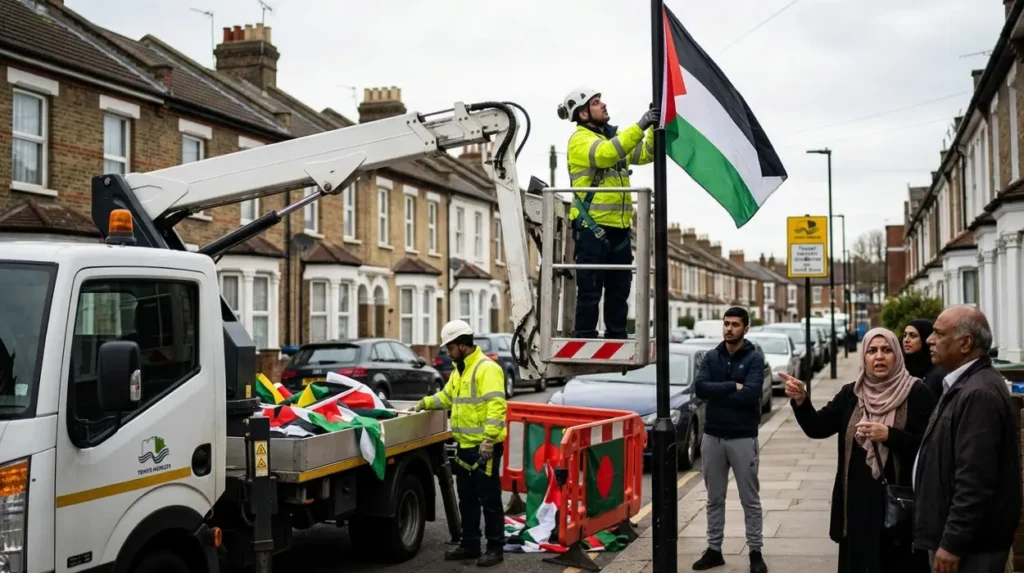
Enforcement is a multi-departmental process. The Tower Hamlets Enforcement Officers (THEOs) serve as the frontline presence, monitoring neighborhoods for illegal fly-posting and unauthorized signage. When a significant number of flags are identified, the council’s Highways Department schedules a removal operation. These operations often require specialized equipment, such as “cherry pickers” (mobile elevating work platforms), to reach items high up on utility poles.
In instances where flag removal is expected to be met with public protest, the Metropolitan Police Service (MPS) provides a supporting role. This partnership ensures that council workers are protected from physical interference or verbal abuse during the performance of their duties. The council also utilizes private contractors for large-scale removal projects when the volume of unauthorized material exceeds the capacity of internal staff. All removed items are generally treated as “abandoned waste” and disposed of, as it is often impossible to return them to anonymous owners.
What is the history of political symbols in Tower Hamlets?
Tower Hamlets has a long history of using symbols to represent social movements, ranging from the suffragette colors in the early 20th century to the “Battle of Cable Street” anti-fascist iconography.
The borough has frequently been a flashpoint for political expression due to its dense, diverse population and history of activism. In the 1930s, the East End was the site of significant resistance against the British Union of Fascists, where symbols and banners played a central role in organizing the local Jewish and Irish communities. Later, in the 1970s and 80s, the “Bengali housing struggle” used visual symbols to assert the rights of newly arrived immigrants in the Spitalfields and Brick Lane areas.
Historical symbols in the borough include:
- The Suffragette Purple, White, and Green: Frequently displayed during the early 1900s women’s suffrage movement.
- The Red Flag: Used during early 20th-century labor strikes and dockworker protests.
- The Shaheed Minar: A monument in Altab Ali Park that serves as a symbolic representation of the Bengali Language Movement.
While the council has historically supported certain commemorative symbols, such as the Rainbow Flag for Pride Month or the Poppy for Remembrance Sunday, the modern legal environment is significantly more restrictive regarding permanent or widespread displays on public assets that lack specific planning permission.
Explore More London Local News
Wisteria-Clad Victorian Villa East London Newham 2026
Jawdance Launches at Brixton House with Kat François in 2026 South London
How does flag removal affect community cohesion?
Flag removal is a polarizing issue that can either reduce community tensions by maintaining a neutral public space or increase feelings of marginalization among groups who use flags as a form of peaceful protest.
Community cohesion refers to the “social glue” that allows different groups to live together harmoniously. In Tower Hamlets, which has a population that is approximately 39% Muslim and highly diverse in terms of ethnicity and national origin, symbols of international struggle carry deep emotional weight. Proponents of flag removal argue that a “neutral” borough prevents any one group from dominating the visual landscape, thereby reducing the risk of “territorial marking” that can lead to inter-communal friction.
Conversely, many residents view the removal of flags—particularly those representing Palestine—as an act of censorship. For these individuals, the flags are a legitimate expression of solidarity and a peaceful response to global events. The council’s challenge lies in balancing the “Public Sector Equality Duty” (under the Equality Act 2010), which requires them to foster good relations between different groups, with their statutory obligations to enforce planning and highways laws. Recent surveys on perceived safety in Tower Hamlets suggest that visual cues in the environment significantly impact residents’ sense of belonging and security.
What are the legal consequences for individuals hanging flags?
Individuals who hang flags on council property without permission may face civil penalties, including fines for fly-posting, or criminal charges if the act results in damage to public property or endangers public safety.
Under the Town and Country Planning Act 1990, unauthorized displays of advertisements (which include certain types of banners) is a criminal offense. Local authorities have the power to issue Fixed Penalty Notices (FPNs) for fly-posting. In Tower Hamlets, these fines typically range from £100 to £500 per instance. If an individual is found to have damaged a lamp post or other infrastructure while installing a flag, they could be held liable for the cost of repairs under the “Criminal Damage Act 1971.”
Furthermore, if the hanging of a flag is deemed to be “racially or religiously aggravated” or intended to cause “harassment, alarm, or distress,” the police may intervene under the Public Order Act 1986. While most flag-hanging in Tower Hamlets is treated as a civil planning matter, the council has warned that persistent offenders may be subject to Community Protection Notices (CPNs), which legally require an individual to stop a specific behavior that is having a “detrimental effect on the quality of life” of those in the locality.
What is the future of flag policy in London boroughs?
The future of flag policy in London is moving toward stricter centralized control and standardized “deemed consent” lists to prevent local councils from becoming embroiled in international political disputes.
There is an increasing trend within the UK government to provide clearer, more restrictive guidance to local authorities. The Department for Levelling Up, Housing and Communities (DLUHC) has previously signaled that it may amend the “Control of Advertisements” regulations to further clarify which flags are “permitted” without a planning application. This likely includes:
- National Flags: The Union Jack and flags of other sovereign nations.
- Civil Flags: The Red Ensign or flags of the Armed Forces.
- Local Government Flags: The specific coat of arms of the borough.
As London becomes increasingly globalized, other boroughs like Newham, Hackney, and Redbridge are watching the Tower Hamlets situation as a legal precedent. It is expected that councils will adopt “Neutrality Protocols,” where no flags other than those on a pre-approved list are allowed on public property. This shift aims to insulate local governments from the “culture wars” and ensure that administrative focus remains on local service delivery, such as housing and education, rather than international diplomacy.
What is the official Tower Hamlets Council flag removal policy?
Tower Hamlets Council removes unauthorized flags, posters, and banners from public infrastructure to comply with planning law, road safety rules, and requirements for political neutrality under the Local Government Act 1986.