Key Points
- A Decade of Climate Governance: London Mayor Sadiq Khan marks ten years in office, positioning his tenure as a blueprint for enduring environmental policy amid a global “climate reset.”
- Defying the Political Backlash: Despite intense opposition from right-leaning politicians and grassroots keyboard warriors over policies like the Ultra Low Emission Zone (ULEZ), Khan successfully won a historic third mayoral term.
- The Silent Majority Strategy: Khan attributes his political survival to a “silent majority” of voters who prioritize public health and climate action over localized economic grievances or online outrage.
- Global Implications: While leaders in the United States and continental Europe backtrack on green initiatives out of fear of voter backlash, London’s experience suggests that sticking to aggressive climate goals can be a winning political strategy.
- Journalistic Accountability: This comprehensive report compiles and synthesizes findings, exclusive interviews, and direct testimonies documented by investigative journalists across multiple international media outlets.
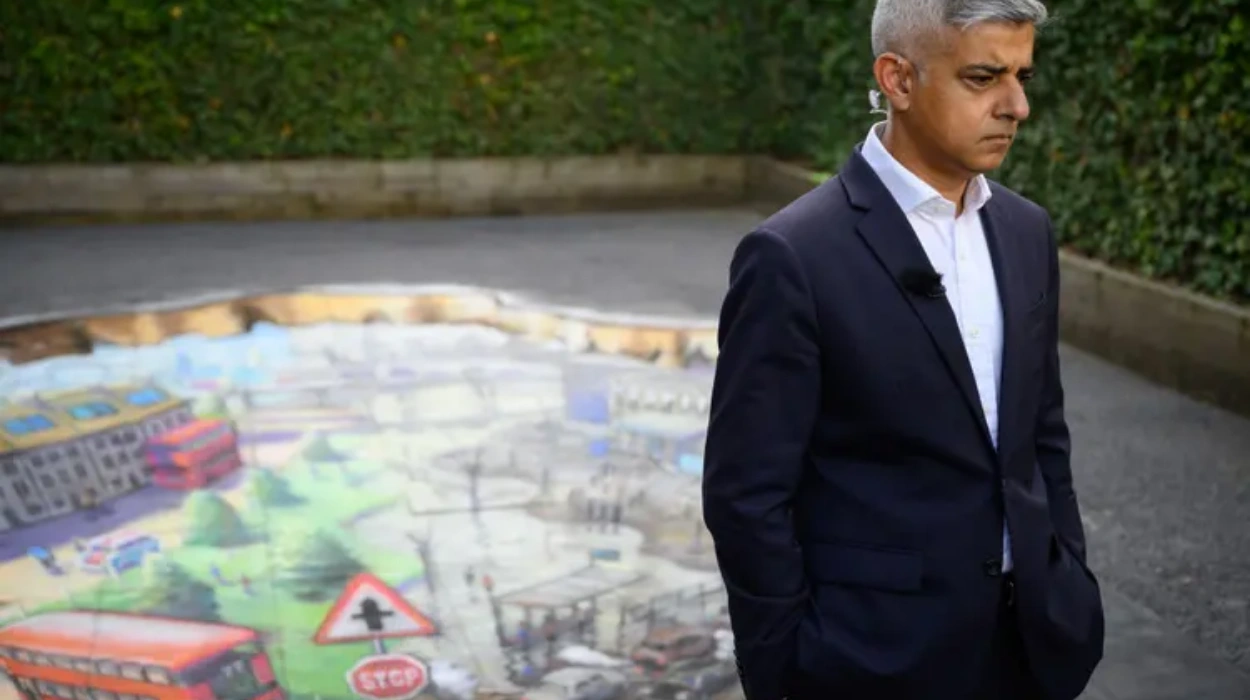
London (The Londoner News) June 3, 2026 – London Mayor Sadiq Khan has successfully consolidated a decade of aggressive municipal climate policy, defying a sweeping western trend of environmental policy rollbacks by securing a historic third consecutive term in office. While center-left and right-wing politicians across Europe and the United States continue to dilute their green platforms under the assumption that climate regulations alienate voters, Khan’s administration has demonstrated that sticking to long-term environmental strategies can yield both environmental progress and electoral success. Despite facing intense, highly coordinated public backlash over the expansion of London’s Ultra Low Emission Zone (ULEZ)—a policy that penalizes drivers of older, higher-polluting vehicles—Khan navigated the political turbulence by appealing to what he characterizes as a quiet, health-conscious electorate.
- Key Points
- Why Is Sadiq Khan’s Climate Strategy Reshaping Global Politics?
- What Did Sadiq Khan Say About the “Silent Majority” of Green Voters?
- How Did Sadiq Khan Manage to Survive the Political Backlash?
- What Are the Implications of London’s Long Game for Global Leaders?
- Is the London Model Directly Exportable to American and European Cities?
Why Is Sadiq Khan’s Climate Strategy Reshaping Global Politics?
The political survival of Sadiq Khan provides a stark counter-narrative to the prevailing political anxieties of 2026. Across the Atlantic and throughout continental Europe, governments are currently in the middle of an extensive climate reset. Right-wing populist movements have increasingly sought to nix climate policies full stop, framing them as elitist economic burdens imposed on the working class. Concurrently, center and center-left politicians have begun backtracking on previous promises for aggressive new policies, acting under the operative assumption that stringent climate action has lost its popularity—or perhaps that it never truly possessed a stable democratic mandate.
Khan’s ten-year trajectory offers an entirely different lesson for contemporary statesmen. Rather than retreat when confronted with vocal opposition, the London Mayor leaned into the public health benefits of clean air initiatives, treating localized political friction as a temporary obstacle rather than a permanent roadblock. Political analysts note that Khan’s resilience challenges the conventional wisdom that aggressive green policies are an inevitable catalyst for fatal electoral backlash. By framing environmentalism through the lens of urban public health and childhood development, his office managed to decoupling climate action from abstract global targets, making it a tangible, defensive issue for everyday Londoners.
Explore More London Politics News
Labour Loses Control of Wandsworth and Brent: London West Elections 2026
Kemi Badenoch: Tories Credible Alternative to Labour in London 2026
What Did Sadiq Khan Say About the “Silent Majority” of Green Voters?
To understand how these policies survived, one must examine the specific political philosophy Khan adopted during his most challenging electoral cycles. In an exclusive interview conducted by senior climate correspondent Justin Worland of TIME Magazine, Sadiq Khan reflected on the nature of the public resistance he faced during the outer London ULEZ expansion.
As reported by Justin Worland of TIME Magazine, Sadiq Khan stated that:
“There is a silent majority who aren’t keyboard warriors. They are the ones who worry about their children’s lungs, who want breathable air, but who don’t necessarily spend their days screaming on social media platforms or organizing targeted protests.”
This distinction between highly visible, digitally amplified outrage and the broader, quieter electorate became the cornerstone of Khan’s political calculus. According to further reporting by political editor Pippa Crerar of The Guardian, Khan continuously emphasized that public opinion polls consistently showed a foundational level of support for clean air measures, even when local hyper-focused media coverage suggested a widespread popular revolt. The Mayor’s office maintained that while the opposition was exceptionally loud, it did not represent the democratic consensus of the capital’s nine million residents.
Who Comprises the Opposition to London’s Green Transition?
The resistance to Khan’s climate agenda was neither marginal nor entirely organic. It comprised a volatile mix of right-leaning politicians, motorists’ rights advocacy groups, and suburban commuters who felt economically targeted by the expanding regulatory boundaries. As documented by transport correspondent Ross Lydall of The Evening Standard, the expansion of ULEZ into London’s outer boroughs in late 2023 triggered unprecedented acts of civil disobedience, including the widespread vandalism and destruction of hundreds of enforcement cameras by a decentralized group calling themselves the “Blade Runners.”
Furthermore, as noted by political analyst Nick Watt of BBC Newsnight, the anti-ULEZ sentiment was heavily weaponized by the Conservative Party during parliamentary by-elections and the subsequent mayoral race. Conservative strategists attempted to turn the £12.50 daily charge for non-compliant vehicles into a referendum on the cost-of-living crisis, presenting Sadiq Khan as an out-of-touch metropolitan leader detached from the financial realities of working-class families living on the city’s periphery.
How Did the International Press View the ULEZ Conflict?
The conflict resonated far beyond the borders of the United Kingdom, serving as a case study for international observers assessing the viability of urban green transitions. Writing for The New York Times, European bureau chief New London voice Mark Landler observed that Khan’s steadfastness stood in sharp contrast to the actions of French President Emmanuel Macron, who famously paused fuel tax increases following the Yellow Vest protests, or German Chancellor Olaf Scholz, who watered down landmark heating laws under intense pressure from industrial lobbies.
How Did Sadiq Khan Manage to Survive the Political Backlash?
Khan’s survival strategy relied on an uncompromising commitment to institutional momentum and statistical evidence. Rather than offering concessions that would structurally weaken the environmental efficacy of the ULEZ expansion, Khan introduced mitigation frameworks, such as an expanded vehicle scrap page scheme designed to provide financial relief to low-income drivers and small businesses.
As reported by city hall editor Fiona Harvey of The Financial Times, internal administration sources revealed that Khan viewed any retreat on the core parameters of the policy as a systemic failure that would permanently undermine future environmental legislation. Harvey noted that by keeping the policy framework intact while simultaneously adjusting the economic safety nets around it, Khan was able to neutralize the most potent economic arguments advanced by his political opponents without sacrificing his primary ecological objectives.
What Was the Role of Scientific Data in Validating the Policy?
Crucial to Khan’s political survival was the continuous deployment of peer-reviewed empirical data regarding urban air quality. The Mayor heavily relied on scientific findings published by the Environmental Research Group at Imperial College London. As reported by science correspondent Jonathan Leake of The Sunday Times, these independent reports conclusively demonstrated that previous iterations of the inner-city ULEZ had successfully contributed to a 46 percent reduction in toxic nitrogen dioxide levels across central London. By consistently pivoting the political debate away from abstract climate targets and toward the immediate prevention of pediatric asthma and premature cardiovascular deaths, Khan shifted the burden of proof onto his detractors, forcing them to argue against verifiable public health metrics.
What Are the Implications of London’s Long Game for Global Leaders?
The successful implementation of London’s climate policies provides an essential roadmap for international policymakers operating within democratic systems. It demonstrates that the political lifecycle of green backlash follows a predictable trajectory: intense initial resistance followed by gradual public adaptation and eventual normalization.
As senior political correspondent Andrew Marr observed in an analytical piece for The New Statesman, the London mayoral election results proved that green policies, when backed by clear communication and robust implementation, do not inherently constitute a suicide note for center-left governments. Marr stated that Khan’s victory effectively debunked the narrative that the working class is fundamentally hostile to environmentalism, showing instead that voters will support regulatory changes if they believe the long-term societal benefits are genuine and equitably distributed.
Is the London Model Directly Exportable to American and European Cities?
While Sadiq Khan’s victory offers an encouraging precedent, global urban planning experts caution that London possesses specific institutional advantages that may not be easily replicated elsewhere. The structural governance model of Greater London grants the Mayor exceptional, centralized statutory authority over the metropolis’s transport network through Transport for London (TfL).
As reported by urban policy expert Feargus O’Sullivan of Bloomberg CityLab, many mayors in the United States and continental Europe operate within highly fragmented administrative frameworks, where control over highways, subways, and environmental enforcement is divided among competing state, county, and municipal jurisdictions. O’Sullivan noted that Khan’s ability to unilaterally decree a massive expansion of regulatory boundaries is a structural privilege that few American counterparts, such as the mayors of New York City or Los Angeles, can exercise without facing prolonged legislative gridlock or immediate judicial intervention from state governors.
Nevertheless, the philosophical core of Khan’s approach—refusing to let the loudest digital voices dictate the boundaries of ecological possibility—remains widely applicable. By demonstrating that the “silent majority” can be successfully mobilized at the ballot box, London’s Mayor has injected a renewed sense of strategic confidence into an international climate movement that had increasingly begun to succumb to political timidity. Khan’s decade in office suggests that in the theatre of environmental politics, the long game is ultimately the only game worth playing.