Key Points
- Unique Historical Landmark: Tower Hamlets holds one of London’s most obscure and peculiar historical treasures—the Experimental Lighthouse, which stands as the city’s only surviving lighthouse structure.
- Non-Traditional Purpose: Built between 1864 and 1866 by Sir James Douglass, the lighthouse never functioned traditionally to guide vessels to safety. Instead, it operated as a maritime laboratory for training keepers and testing advanced lighting technologies.
- Scientific Heritage: The lighthouse stands adjacent to the original workshop of famed British physicist and chemist Michael Faraday, who conducted groundbreaking research on electric lighthouse lighting at the wharf.
- Millennium-Long Music Project: The structure houses Longplayer, a 1,000-year-long musical composition engineered to play continuously without repetition from 1 January 2000 until the year 2999.
- Television Prominence: The site achieved contemporary pop-culture fame as the dedicated filming location for the 2021 series of the BBC’s The Great British Sewing Bee.
- Modern Creative Hub: Since its derelict state in 1998, Trinity Buoy Wharf has transformed into a bustling cultural ecosystem supporting over 750 creators, small businesses, and elite organisations such as the English National Opera.
Tower Hamlets (The Londoner News) June 13, 2026 – A historic maritime testing facility tucked away within the waterfront district of Trinity Buoy Wharf has emerged as one of London’s most significant yet structurally overlooked cultural assets. Nestled inside the Docklands of East London, the historic Experimental Lighthouse remains the only surviving architecture of its kind within the borders of the capital. While mainstream tourism heavily privileges central fixtures such as Big Ben, Westminster Abbey, or Buckingham Palace, this architectural marvel continues to serve as an active cross-section of nineteenth-century engineering, mid-twentieth-century industrialism, and twenty-first-century artistic expression.
- Key Points
- Where is London’s Only Surviving Lighthouse Located?
- Who Built the Trinity Buoy Wharf Lighthouse?
- How Did the Experimental Lighthouse Help Save Ships Without Being Near the Sea?
- What Link Does Michael Faraday Have to Trinity Buoy Wharf?
- What is the 1,000-Year-Long Song Playing Inside the Lighthouse?
- Why Did the BBC Choose This Underrated Location for TV Filming?
- How Has Trinity Buoy Wharf Transformed Since the 1990s?
- Which Major Arts Organisations Are Based at the Wharf Now?
- Is It Worth Visiting Trinity Buoy Wharf as a Tourist?
Originally constructed in the mid-1860s, the structure bypassed the conventional responsibility of steering vessels clear of shallow coastal waters. It was designed from its inception to function as an shore-based laboratory where engineers could safely experiment with newly manufactured oil, gas, and electrical illumination apparatuses before deploying them to treacherous shorelines across the British Empire. Today, the location has discarded its heavy industrial mantle to foster an active creative community housing hundreds of visual artists, performance groups, independent dining venues, and historic preservation initiatives.
Where is London’s Only Surviving Lighthouse Located?
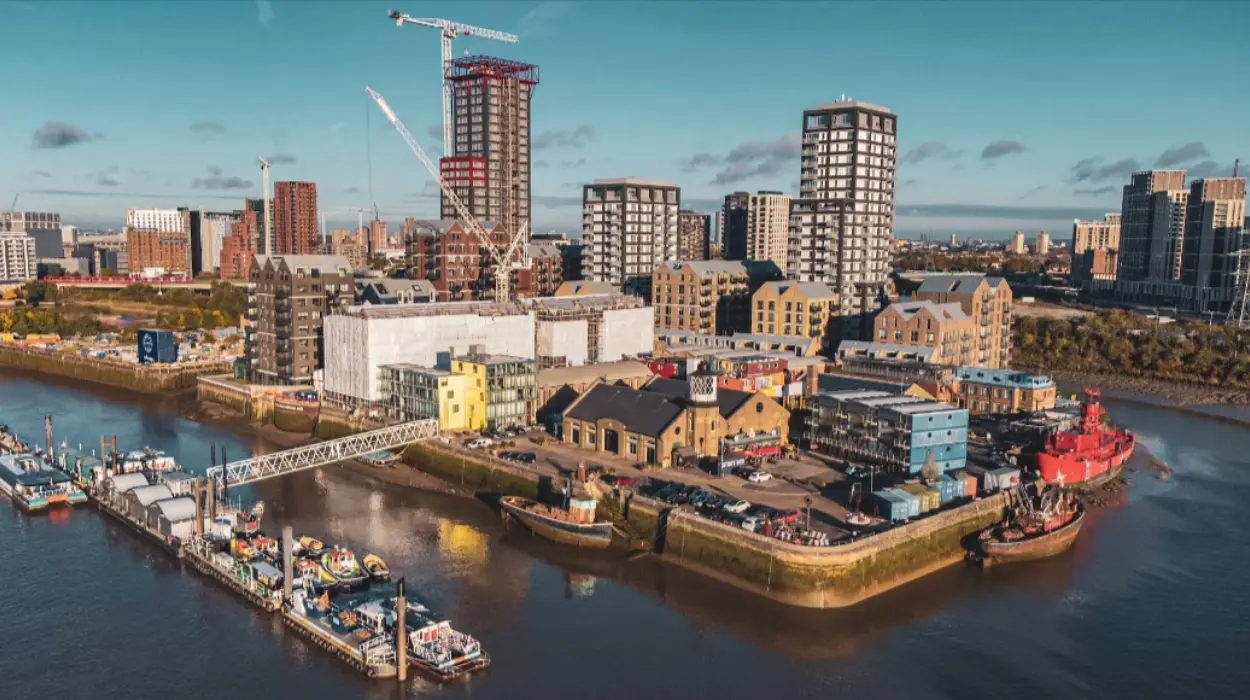
As reported by journalists Whelan Barzey and Véronique Hawksworth of MyLondon, the Experimental Lighthouse is situated within the quiet waterfront setting of Trinity Buoy Wharf, an area deeply embedded within the Docklands of the Borough of Tower Hamlets. For generations, this specific stretch of the River Thames remained closed off to the general populace due to its intense industrial utility, which explains why the vast majority of modern Londoners have never seen the structure in person.
The location itself sits on a sharp peninsula where the River Lea empties into the Thames, directly opposite the O2 Arena. This unique geography made it an ideal maritime outpost during the peak of British shipping dominance. Rather than being surrounded by rocky cliffs or open seas, the lighthouse is framed by modern urban developments, converted shipping containers, and historic brick workshops, making its physical presence visually striking to those who venture off the traditional tourist trails of East London.
Who Built the Trinity Buoy Wharf Lighthouse?
According to the historical data compiled by Whelan Barzey and Véronique Hawksworth of MyLondon, the structural lineage of the site began well before the current lighthouse was erected. The earliest building on the wharf, known formally as the Electrician’s Building, dates back to 1836. It was drafted by James Walker, who served at the time as the Chief Engineer of Trinity House—the official royal corporation tasked with the critical responsibility of designing, deploying, and maintaining the navigational buoys, lightships, and lighthouses necessary to safeguard Britain’s highly congested coastal trade waters.
James Walker later constructed the very first lighthouse on the wharf in 1854 to assist with the rising demands of maritime testing. Following Walker’s tenure, his successor, the acclaimed civil engineer Sir James Douglass, designed and built the second, more durable Experimental Lighthouse between the years 1864 and 1866. It is this specific brick tower by Douglass that has managed to withstand over a century and a half of intense wartime bombing, dockland decline, and modern urban gentrification, remaining intact as the lone survivor of London’s architectural maritime past.
Explore More East London News
Free Summer Splash Lido Opens at Royal Docks, East London 2026
TfL Advances DLR Extension Plans for Thamesmead East London 2026
How Did the Experimental Lighthouse Help Save Ships Without Being Near the Sea?
In their comprehensive breakdown of the landmark’s operational past, MyLondon writers Whelan Barzey and Véronique Hawksworth stated that the structure “never actually guided a single ship to safety in the traditional sense.” Instead of operating as a warning beacon for localized river traffic, the tower was utilized exclusively as an engineering testing ground and an educational academy.
During the industrial revolution, lighthouse technology was changing rapidly, moving away from simple candles and coal fires toward complex oil lamps, pressurized gas mechanisms, and eventually, early electrical arcs. Because these new technologies were highly temperamental and dangerous, Trinity House used the London tower as a controlled environment. Here, engineers could stress-test heavy mechanical lenses, measure the luminosity of volatile fuels, and rigorously train newly recruited lighthouse keepers in these cutting-edge systems before sending them to isolated, high-risk stations on the rocky fringes of the British Isles.
What Link Does Michael Faraday Have to Trinity Buoy Wharf?
The historical significance of the landmark extends far into the realm of foundational modern physics. As detailed by authors Whelan Barzey and Véronique Hawksworth of MyLondon, the lighthouse stands directly adjacent to the historic workshop once occupied by the celebrated British physicist and chemist, Michael Faraday.
Faraday, who was appointed as the scientific advisor to Trinity House, spent a vast portion of his later career experimenting on-site at Trinity Buoy Wharf. It was within these very brick walls that Faraday focused his advanced understanding of electromagnetism onto practical maritime issues, pioneering the early implementation of electric arc lighting for coastal lighthouses. His research at the wharf radically accelerated the development of high-powered electric beacons, fundamentally revolutionising global maritime safety and proving that electricity could be scaled for massive, life-saving public infrastructure.
What is the 1,000-Year-Long Song Playing Inside the Lighthouse?
Beyond its deep scientific and engineering roots, the tower currently preserves one of the world’s most eccentric and ambitious artistic experiments. Writing for MyLondon, journalists Whelan Barzey and Véronique Hawksworth reported that the lighthouse is home to Longplayer, a continuous 1,000-year-long musical composition composed by the acclaimed artist and musician Jem Finer.
Originally commissioned by the arts arts organization Artangel, the composition is now under the careful stewardship of the Longplayer Trust. The musical piece was mathematically engineered to play continuously without a single instance of repetition for exactly 365,243 days. The project formally commenced its epic sonic journey on 1 January 2000, and is scheduled to run uninterrupted until 31 December 2999. Visitors who make the trek up into the lighthouse lantern room can hear the resonant, ambient tones of the piece playing through a complex system of singing bowls, though as the authors cheekily noted, modern patrons “may need to take their word for it on how it sounds a few centuries from now.”
Why Did the BBC Choose This Underrated Location for TV Filming?
In recent years, the historic brick complex transitioned from an insular historical landmark into a prime piece of television real estate. The site achieved nationwide visibility when the British Broadcasting Corporation (BBC) selected Trinity Buoy Wharf as the primary production home for its highly popular reality competition program, The Great British Sewing Bee, relocating the entire production crew into the expansive studio spaces directly beneath the lighthouse tower for the 2021 broadcast season.
The aesthetic charm of the location had a profound impact on those working within it. As preserved within the reporting by Whelan Barzey and Véronique Hawksworth of MyLondon, the prominent fashion designer and show judge Patrick Grant described the coastal filming experience with immense warmth.
As reported by Whelan Barzey and Véronique Hawksworth of MyLondon, Patrick Grant stated that:
“It was a real joy to spend time there. We’d come onto the set just before 7am every day and the sunrises and sunsets were amazing. Having that wonderful vista across the River Thames from the sewing room can’t help but inspire the sewers. It was a spectacular place to shoot.”
How Has Trinity Buoy Wharf Transformed Since the 1990s?
The current state of the lighthouse is a direct result of a massive urban regeneration project implemented over the past three decades. The wider Trinity Buoy Wharf complex had fallen into severe disrepair following the closure of the London docks, sitting as a largely abandoned, derelict industrial wasteland until a dedicated regeneration trust assumed control of the historic property in 1998.
Since that pivotal acquisition, the area has avoided demolition and instead transformed into a booming, self-sustaining creative neighborhood. As highlighted by MyLondon, the wharf now serves as an active workplace for a diverse community of over 750 creative professionals. The meticulously restored industrial spaces are filled with independent painters, commercial photographers, and niche technology startups, breathing new socioeconomic life into the historic East London dockland sector.
Which Major Arts Organisations Are Based at the Wharf Now?
The successful revitalisation of the area has attracted several of the United Kingdom’s most prestigious cultural institutions, turning what was once an isolated engineering outpost into a core pillar of the London arts scene. The site no longer houses industrial laborers, but instead acts as a major rehearsal, administrative, and educational campus for world-class organisations.
Among the prominent entities currently occupying the wharf’s historical footprint is the English National Opera, which utilizes the vast spaces for its large-scale staging and technical preparations. Additionally, the location hosts operational bases for the Uber Boat by Thames Clippers fleet, alongside major educational workshops managed by The King’s Foundation. This unique blend of fine arts, traditional craftsmanship education, and modern river transit ensures that the historic site remains intensely utilized and protected from commercial real estate developers.
Is It Worth Visiting Trinity Buoy Wharf as a Tourist?
For those looking to escape the commercialized crowds of Central London, the journalists at MyLondon strongly advocate for an excursion to this specific pocket of Tower Hamlets. The site functions not just as a static museum piece, but as a fully interactive day-trip destination that pairs deep maritime history with modern leisure spaces.
Visitors looking to break up their historical exploration can patronise local culinary staples located directly on the pier, such as the indoor-outdoor seating at The Orchard Café or the distinct retro Americana aesthetic of Fat Boy’s Diner. Whelan Barzey and Véronique Hawksworth concluded their coverage by urging travelers to look beyond standard guidebooks, stating that
“next time you find yourself ticking off the capital’s famous sights, consider venturing a little off the beaten track. London’s only lighthouse, with its hidden history of scientific discovery, maritime heritage and musical endurance, may just be the most interesting landmark you have never visited.”