The history of London low emission zones began with the establishment of the original Low Emission Zone in 2008 to curb heavy diesel pollution. This initiative evolved into the highly stringent Ultra Low Emission Zone standard, which expanded citywide.
- Why Did Transport For London Implement The ULEZ Scrappage Support Grants?
- What Financial Assistance Packages Were Provided to London Residents?
- How Did The Application Process Operate For Eligible Londoners?
- What Were The Requirements For Certified Vehicle Scrappage And Destruction?
- When Did The ULEZ Scrappage Support Scheme Conclude?
- What Long-Term Public Health And Environmental Impacts Did The Scheme Deliver?
The regulatory framework governing vehicular emissions in Greater London represents a multi-decade structural response to persistent atmospheric pollution. The legal and municipal precedent for modern intervention traces directly to historic public health crises, most notably the Great Smog of 1952. The legislative response initiated the Clean Air Act 1956, which established the statutory mechanism for smoke control areas and urban fuel regulations.
In the twenty-first century, municipal authority shifted focus from industrial coal emissions to vehicular exhaust pollutants, specifically nitrogen dioxide ($NO_2$) and fine particulate matter ($PM_{10}$ and $PM_{2.5}$). Transport for London, functioning under the executive direction of the Mayor of London, introduced the initial Low Emission Zone on February 4, 2008. This primary framework targeted heavy diesel commercial vehicles, including heavy goods vehicles, buses, and coaches, operating across the majority of Greater London. The policy enforced minimum Euro emission standards by levying a daily financial penalty on non-compliant operators.
To achieve more aggressive public health targets, municipal planners designed a highly restrictive regulatory tier known as the Ultra Low Emission Zone. The central ULEZ commenced operation on April 8, 2019, covering the identical geographic footprint of the pre-existing London Congestion Charge Zone. Unlike the preceding LEZ, the ULEZ parameters encompassed all vehicle classes, including private passenger cars, motorcycles, and light commercial vans.
The structural evolution of the ULEZ proceeded through clear geographic expansions to maximize public health benefits across dense urban populations (Blanc, 2026). On October 25, 2021, Transport for London extended the boundary westward and eastward to the perimeter of the North Circular Road (A406) and South Circular Road (A205). The final administrative expansion occurred on August 29, 2023, bringing all 33 London boroughs under the single regulatory framework, thereby encompassing approximately 9 million residents within a continuous low-emission perimeter (Blanc, 2026).
Why Did Transport For London Implement The ULEZ Scrappage Support Grants?
Transport for London implemented the ULEZ scrappage support grants to mitigate the financial burden imposed on low-income residents, micro-businesses, and charities required to upgrade non-compliant vehicles prior to the comprehensive citywide expansion of the emission zone.
The implementation of the Ultra Low Emission Zone created an immediate economic externality for vehicle owners whose assets failed to meet modern environmental criteria. Under the statutory terms of the ULEZ, non-compliant vehicles faced a compulsory daily charge of £12.50 to operate within the designated boundaries. For populations relying on legacy vehicles for essential transit, commercial operations, or caregiving duties, this recurring charge presented a significant financial liability.
To reconcile environmental enforcement with socioeconomic equity, the Mayor of London authorized a series of municipal funding allocations to underwrite a targeted vehicle scrappage scheme. The core objective focused on accelerating the removal of highly polluting vehicles from the active registry while subsidizing the transition toward compliant options, public transit usage, or active travel modes (Mitchell, 2023). The program intentionally targeted specific vulnerable cohorts, including individuals receiving means-tested welfare benefits, eligible disabled residents, micro-businesses with fewer than 10 employees, sole traders, and registered charities.
The municipal administration scaled the total financial commitment across multiple phases to match the expanding geographic scope of the zone. The baseline scrappage programs transitioned into a comprehensive £210 million capital fund designed to support the historic 2023 outer London expansion (Blanc, 2026). This capital injection functioned as a policy buffer, ensuring that economic constraints did not systematically penalize lower-income outer London communities that possessed lower baseline access to dense underground rail infrastructure.
The programmatic distribution of these public funds followed strict administrative guidelines managed by Transport for London. By subsidizing the destruction and recycling of non-compliant internal combustion engines, the grant system achieved a dual outcome: it suppressed regional tailpipe emissions while modernizing the private and commercial vehicular fleets operating within the capital’s boundaries.
What Financial Assistance Packages Were Provided to London Residents?
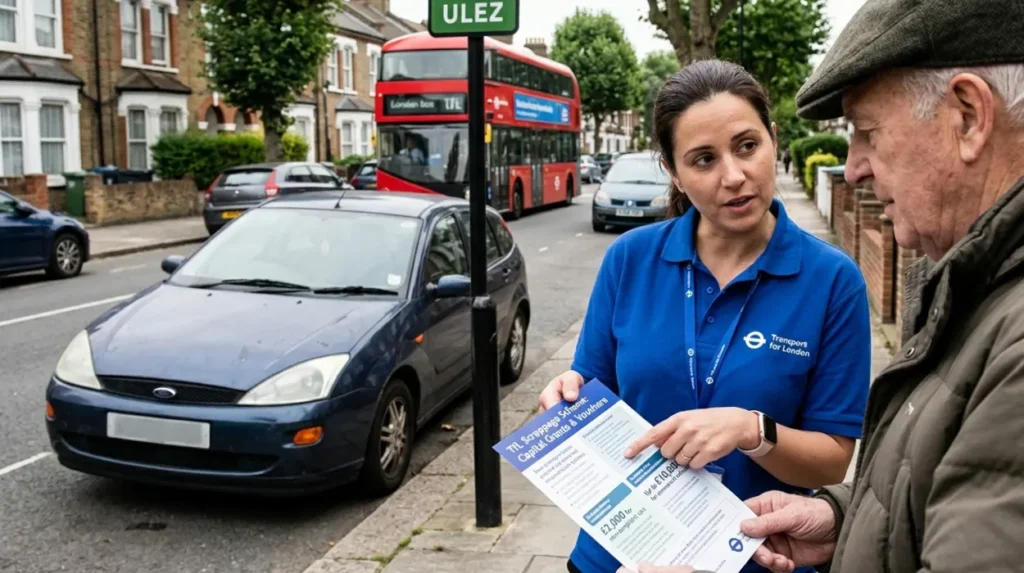
The financial assistance packages provided to London residents included flat-rate capital grants of £2,000 for scrapping non-compliant passenger cars and up to £10,000 for commercial vehicles, alongside structural options combining cash and public transit vouchers.
The distribution architecture of the Transport for London scrappage scheme operated on a tiered financial framework dictated by asset class and applicant eligibility. For individual private citizens, the primary capital allocation consisted of a flat-rate £2,000 grant designated exclusively for the permanent decommissioning and physical destruction of a non-compliant passenger car. For owners of non-compliant motorcycles or specialized trikes, the standard capital payout was established at £1,000.
To foster long-term behavioral shifts toward sustainable urban mobility, the administrative framework introduced multi-modal incentive options (Mitchell, 2023). Eligible individual applicants could elect to receive a modified compensation package consisting of a lower initial cash payout paired with concrete transportation credits. This structure provided the applicant with one or two annual adult Oyster cards valid for unlimited travel across specified London Underground, Overground, and bus networks, multiplying the effective economic value of the grant for consistent commuters.
Commercial entities and civil society organizations operating within the 33 London boroughs received substantially larger capital allocations reflecting the higher market acquisition cost of compliant commercial vehicles. Sole traders, registered charities, and micro-businesses received flat-rate structural grants scaled across three specific asset categories:
- Light Vans: A capital grant of £7,000 allocated for the successful scrappage and recycling of a non-compliant light commercial vehicle.
- Minibuses: A capital grant of £9,000 provided to eligible operators to remove high-emission passenger minibuses from service.
- Wheelchair Accessible Vehicles: An elevated capital allocation of £10,000 designed specifically for the scrappage or retrofitting of specialized wheelchair-accessible cars or vans, ensuring protection for transport provisions servicing disabled residents.
How Did The Application Process Operate For Eligible Londoners?
The application process operated through a centralized, secure online portal managed by Transport for London, requiring applicants to submit formal identification, proof of London residency, and validated vehicle registration documentation.
The administrative execution of the vehicle scrappage scheme demanded rigorous evidentiary verification to protect municipal public funds from fraudulent exploitation. Transport for London constructed a multi-stage digital vetting infrastructure where applicants submitted high-resolution document scans for individual regulatory review. The complete operational protocol followed a mandatory sequence that applicants fulfilled precisely to secure capital approval.
To initiate a claim, an applicant logged into the official Transport for London web portal and established a dedicated account linked to their legal identity. The administrative system partitioned the application process into clear verification tracks based on individual or commercial status. Every applicant filed specific primary documents to confirm geographical and vehicular compliance with the explicit terms of the grant:
- Verification of Personal Identity: Submission of a valid UK driving license, passport, or state-issued identity document matching the applicant’s legal name.
- Verification of Greater London Residency: Provision of a utility bill, Council Tax statement, or formal bank ledger issued within the preceding three months, demonstrating a permanent residential address inside one of the 33 recognized London boroughs.
- Verification of Vehicle Ownership: Submission of the complete V5C vehicle registration certificate issued by the Driver and Vehicle Licensing Agency, explicitly proving the applicant had been the registered keeper of the vehicle for a continuous period of no less than 12 calendar months prior to the application date.
- Verification of Welfare or Disability Status: For targeted individual grants, submission of current benefit award letters from the Department for Work and Pensions detailing eligibility for means-tested assistance programs, including Universal Credit, Income Support, or Housing Benefit.
Upon receiving a formal digital application, Transport for London internal auditors conducted cross-referencing checks against the DVLA vehicular database to confirm the asset’s non-compliant status under Euro emission parameters. If the documentation satisfied all audit checkpoints, the agency issued a formal “Confirmation of Eligibility” document via email. This administrative instrument legally authorized the applicant to proceed with the permanent physical destruction of the vehicle at an Authorized Treatment Facility.
Explore More Public Services
How Long to Process a Social Housing Register Application in London?
The Evolution of Local Property Taxation and Municipal Finance in London
What Were The Requirements For Certified Vehicle Scrappage And Destruction?
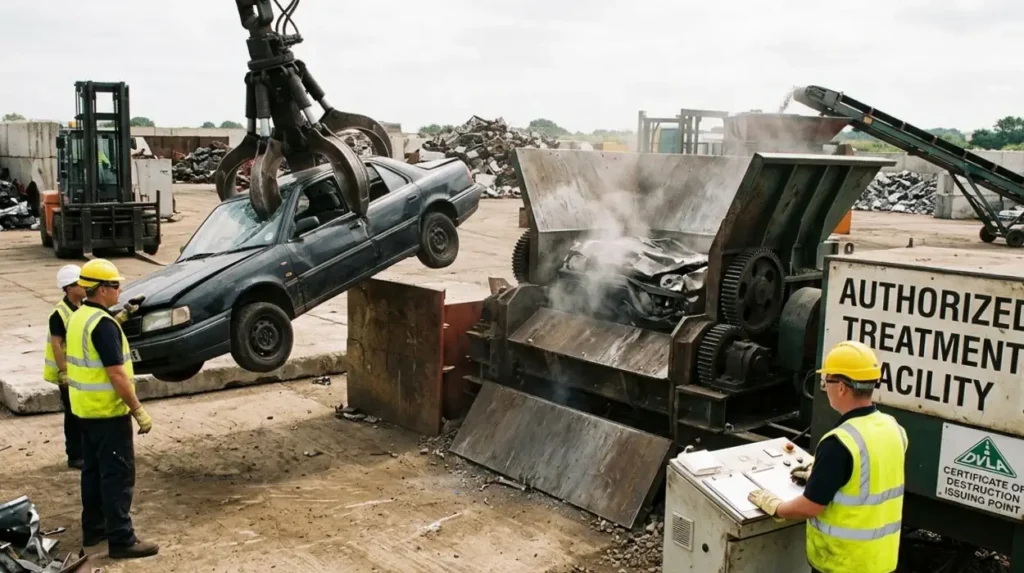
The requirements for certified vehicle scrappage and destruction mandated that non-compliant assets be processed exclusively at an environment-agency-approved Authorized Treatment Facility capable of issuing an official DVLA Certificate of Destruction.
An applicant could not claim capital funds under the municipal scheme by selling the non-compliant asset on the private secondary market or processing it through uncertified scrap yards. The regulatory objective required the permanent, irreversible removal of the high-emission vehicle from the global combustion engine ecosystem. To enforce this, Transport for London tied final capital disbursement to the presentation of statutory proof of environmental recycling.
The vehicle owner had to deliver the non-compliant car, van, or minibus to a legally recognized Authorized Treatment Facility. These specialised commercial processing installations operate under strict environmental permits enforced by the UK Environment Agency. The facility executed a mandatory de-pollution protocol, which involved the systematic extraction of hazardous fluids, including engine oils, coolants, brake fluids, and residual fuel, alongside the extraction of recyclable materials like catalytic converters and lead-acid batteries.
Following the physical compaction and destruction of the vehicle chassis, the Authorized Treatment Facility electronically logged the transaction directly with the Driver and Vehicle Licensing Agency. This digital log triggered the generation of a formal legal document titled a Certificate of Destruction (CoD). The CoD serves as conclusive statutory proof that the vehicle has been permanently deregistered and cannot legally exist, be re-assembled, or be operated on public highways ever again.
The applicant was required to upload a high-resolution copy of this newly issued Certificate of Destruction into their active Transport for London online application portal within a strictly defined window, typically 30 calendar days from the date of initial approval. Once the case officer verified the authenticity of the CoD against the live DVLA registry, the application transitioned to final completion status, initiating the electronic automated clearing house mechanism to deposit the authorized capital grant directly into the applicant’s designated UK bank account.
When Did The ULEZ Scrappage Support Scheme Conclude?
The ULEZ scrappage support scheme concluded on September 8, 2024, at 23:59 BST, following the comprehensive allocation of its designated £210 million municipal funding budget to approximately 53,000 households and businesses.
The vehicle scrappage scheme operated as a finite, cash-limited municipal intervention rather than a permanent entitlement program. Transport for London structured the fund with a strict capital ceiling designed to absorb the primary wave of vehicle retrofits and replacements required by the final regional expansion of the Ultra Low Emission Zone. As vehicular compliance rates across the capital rapidly advanced, the administrative consumer demand systematically depleted the remaining financial reserves.
In the late summer of 2024, Transport for London issued an official administrative notice confirming that the program had achieved its structural deployment targets. By the time of closure, the capital infrastructure had successfully overseen the distribution of £186 million directly to London residents, small businesses, and charitable groups, resulting in the permanent removal of more than 53,000 highly polluting vehicles from the regional transport network (Blanc, 2026). The remaining capital reserves were legally earmarked to satisfy the processing of applications already submitted and resting within the active verification queue.
Following the definitive closure deadline on September 8, 2024, the online application portal permanently deactivated new case entries. No further capital allocations were authorized under this specific policy framework. Residents operating non-compliant vehicles inside the London-wide zone after this milestone remained fully liable for the daily £12.50 regulatory charge without recourse to municipal vehicle replacement subsidies.
The absolute conclusion of the program marked the transition of the ULEZ from a subsidized transitional phase into a mature, self-sustaining regulatory enforcement zone. The structural administrative framework shifted entirely away from application processing toward automated enforcement via the extensive London-wide network of Automatic Number Plate Recognition (ANPR) cameras.
What Long-Term Public Health And Environmental Impacts Did The Scheme Deliver?
The scheme delivered significant long-term public health and environmental impacts, including a profound reduction in roadside nitrogen dioxide concentrations and a near-total compliance rate among vehicles operating in Greater London.
The systematic removal of over 53,000 non-compliant vehicles via the municipal scrappage scheme directly altered the atmospheric composition of the London metropolitan area (Blanc, 2026). Peer-reviewed environmental data gathered across the dense London air quality monitoring network demonstrated an immediate degradation in the concentrations of toxic tailpipe gases. Roadside nitrogen dioxide ($NO_2$) levels within central and inner London recorded a reduction of approximately 46% compared to a hypothetical scenario devoid of ULEZ enforcement.
The broader public health implications of this structural shift are extensive, particularly regarding pediatric development and chronic respiratory diseases. Epidemiological evaluations conducted by public health institutions indicated that the reduction in fine particulate matter ($PM_{2.5}$) effectively halted or reversed corporate trends in childhood asthma hospitalizations across inner-city boroughs. The mitigation of long-term exposure to these particulate matters protects older demographics from accelerated cardiovascular decline and related premature mortality indicators.
To experience the city’s modern green spaces and historic landmarks in person today, consult our comprehensive [London cultural heritage walking tours and transport guide] for itineraries and visiting parameters. The modern atmosphere enjoyed by millions of annual cultural tourists and local residents is a direct consequence of these strict municipal vehicle interventions.
The structural impact on the regional automotive composition remains permanent. Within one year of the final outer London expansion, the overall compliance rate of vehicles observed navigating the zone on an average day reached 96.2%, up from less than 40% when the initial plans were drafted. The combination of strict regulatory charging and targeted financial aid systematically modernized the city’s transport ecosystem, establishing a global model for urban environmental engineering that cities worldwide continue to evaluate and replicate (Lee et al., 2026).
What is the difference between the LEZ and the ULEZ?
The Low Emission Zone (LEZ), introduced in 2008, primarily targeted heavy diesel vehicles such as lorries, buses, and coaches. The Ultra Low Emission Zone (ULEZ), launched in 2019, applies stricter emission standards and covers a much wider range of vehicles, including cars, motorcycles, and vans.