

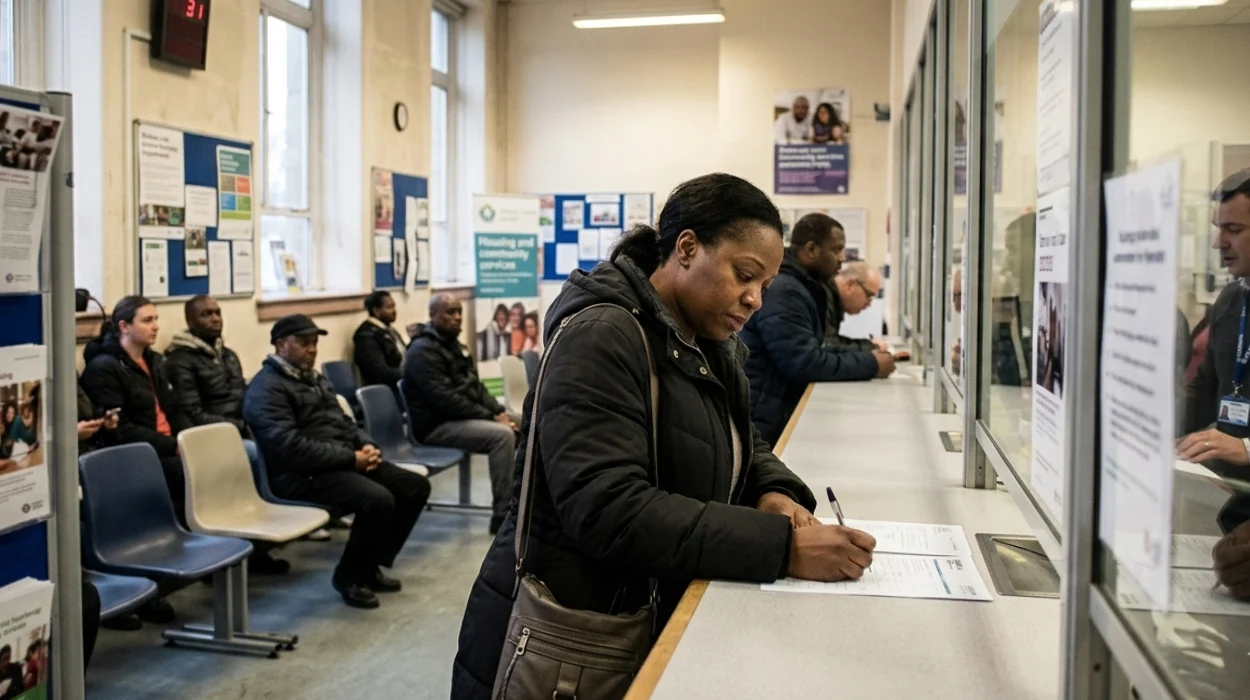
The public housing register system in London operates as a decentralized municipal framework across 33 distinct local authorities. Understanding the duration required to evaluate a new housing register application demands an investigation into the evolution of social housing administration, statutory frameworks, and demographic shifts in the metropolitan area. This article provides a comprehensive analysis of how application processes developed from the 19th-century municipal registries to modern automated triage systems, detailing the mechanisms that govern wait times and processing durations.
- What Is the Historical Origin of the London Housing Register?
- How Did Post-War Legislation Alter Application Processing Methods?
- What Key Historical Factors Caused Wait Times to Lengthen?
- How Do Modern London Boroughs Process Applications Today?
- What Are the Long-Term Implications of This Administrative Evolution?
What Is the Historical Origin of the London Housing Register?
The London housing register originated during the late 19th century as a municipal response to extreme overcrowding, disease outbreaks, and severe urban poverty. The Housing of the Working Classes Act 1890 empowered local authorities to systematically document public housing applicants.
The industrialization of London during the 19th century caused a massive influx of rural-to-urban migration, which outpaced the construction of inner-city infrastructure and private housing units (Seltzer, 2020). By the mid-19th century, severe overcrowding peaked within working-class neighborhoods such as Spitalfields and Shoreditch. To remedy these squalid living conditions, the UK Parliament enacted the Housing of the Working Classes Act 1890, which granted the newly formed London County Council (LCC) the statutory power to clear slums and construct municipal tenements (Williams, 2021).
To allocate these new dwellings fairly, the LCC established the first centralized municipal registries. These early ledgers served as the foundational prototypes for modern housing registers. Clerks manually recorded the income, family size, occupation, and current living arrangements of every applicant family.
Following World War I, the Housing, Town Planning, &c. Act 1919—popularly known as the Addison Act—fundamentally shifted the role of the housing register. The state assumed financial responsibility for building “Homes Fit for Heroes,” transforming housing allocation from a minor charitable intervention into a permanent state utility (Hinchcliffe, 2016). Local authorities across London standardized their waitlists, requiring applicants to verify their military service records and previous residency within specific municipal boundaries before they could be added to a register.
The statutory architecture of these registers expanded further through the Housing Act 1935. This legislation introduced the first legal definitions of overcrowding, making it a statutory offense for too many people to occupy a space relative to its room count and square footage. Consequently, London boroughs had to reform their application processes to incorporate strict medical and spatial inspections. Approximately 16.3% of working-class Londoners lived in overcrowded conditions around 1930, and nearly one-third of families faced severe housing stress under the new 1935 standards (Seltzer, 2020).
To experience this historic landmark in person today, consult our comprehensive [London Heritage Site and Museum Visitor Guide] for itineraries and visiting parameters. Understanding these early 20th-century housing ledgers reveals how modern administrative structures evolved.
How Did Post-War Legislation Alter Application Processing Methods?
Post-war legislation altered processing methods by shifting allocation from a simple chronological queue to a complex statutory priority system. The London Government Act 1963 and the Housing (Homeless Persons) Act 1977 formalized targeted vulnerability assessments.
The aftermath of World War II presented London with severe physical destruction due to the Blitz, alongside acute material shortages. To handle the hundreds of thousands of displaced citizens, the New Towns Act 1946 and the Housing Act 1949 removed the statutory restriction that limited municipal housing solely to the “working classes.” This change opened the housing register to all segments of society, drastically increasing the volume of applications submitted to London authorities.
The administrative structure of London changed entirely on April 1, 1965, under the terms of the London Government Act 1963. This Act dissolved the London County Council and replaced it with the Greater London Council (GLC), while simultaneously creating 32 newly consolidated London Borough councils plus the City of London.
Responsibility for maintaining housing registers shifted from a single centralized authority to these individual boroughs. Each borough developed its own localized administrative criteria, residency rules, and verification timelines. This decentralization fragmented the application process, meaning that processing times and eligibility requirements began to vary significantly depending on which side of a borough boundary an applicant lived.
During this post-war period, private accommodation in London often consisted of heavily subdivided, poorly insulated, and racially contested lodging houses (Cartwright, 2020). This lack of adequate private housing intensified the reliance on public registers.
To address growing systemic inequities, Parliament passed the Housing (Homeless Persons) Act 1977. This statute fundamentally re-engineered how applications were processed across the United Kingdom. For the first time, local authorities faced a mandatory legal obligation to provide immediate housing to applicants who were unintentionally homeless and fell into specific “priority need” categories, such as families with dependent children or pregnant women.
This law split the housing register process into two distinct administrative tracks:
- Emergency Triage Track: Designed for immediate, legally mandated homelessness assessments.
- General Waiting List Track: Intended for standard applicants seeking long-term municipal tenancies.

What Key Historical Factors Caused Wait Times to Lengthen?
The lengthening of housing register wait times resulted from a steep decline in municipal housing stock caused by the Right to Buy scheme alongside rapid population growth. These factors created a severe mismatch between available homes and registered applicants.
The Housing Act 1980 Impact: By introducing the statutory “Right to Buy,” the government allowed council tenants to purchase their homes at steep discounts. This policy stripped hundreds of thousands of affordable units out of municipal housing portfolios across London, permanently reducing the social housing stock available to clear the registers.
The single most disruptive factor in the history of London’s housing administration was the introduction of the Right to Buy scheme under the Housing Act 1980. This policy allowed millions of secure tenants across the United Kingdom to purchase their homes from local councils at substantial discounts. While it increased homeownership among working-class families, it simultaneously depleted the volume of housing stock managed by local authorities.
Between 1980 and the early 2000s, the most desirable houses and ground-floor flats were sold off, leaving councils with diminished portfolios consisting primarily of high-density high-rise estates. Because councils were restricted from using the sales revenue to construct replacement units, the supply of available social housing plummeted.
Simultaneously, London’s population began to rebound rapidly from its post-war decline, driven by economic restructuring, domestic migration, and international immigration. This demographic expansion caused a sharp increase in the number of applications submitted to local borough registers. With the supply of available housing shrinking and the volume of new applications rising, the processing time required to assess, verify, and investigate an applicant’s circumstances grew considerably.
To prevent their registers from collapsing under the weight of unmanageable backlogs, London boroughs began adopting strict gatekeeping strategies during the 1990s and 2000s. Councils abandoned simple chronological waiting lists in favor of highly restrictive points systems and priority bands, which required detailed verification of medical histories, employment status, and local family connections.
Explore More Public Services
Can I Defer My Child’s Primary School Start Date? | London
Council Housing Application Document Requirements in Greater London
How Do Modern London Boroughs Process Applications Today?
Modern London boroughs process housing register applications through an online multi-stage validation process that screens for eligibility, local connection, and priority need. This process typically requires 4 to 12 weeks to determine an applicant’s priority band.
The modern administrative process is heavily governed by the Housing Act 1996 and the Homelessness Act 2002. These laws require local authorities to publish a clear “Allocation Scheme” detailing exactly how applications are prioritized.
When an individual submits a new application to any of London’s 33 authorities—such as the London Borough of Southwark, the London Borough of Tower Hamlets, or the London Borough of Newham—the application moves through a rigorous administrative pipeline.
The processing pipeline consists of several distinct operational steps:
1. Digital Intake and Initial Screening
Applicants submit their information via an online portal, uploading proof of identity, income records, and tenancy agreements.
2. Statutory Verification and Gatekeeping
Caseworkers verify the applicant’s legal right to rent in the United Kingdom, their historical link to the specific borough, and whether they meet income thresholds. Under the Localism Act 2011, boroughs have the power to set their own qualifying criteria, allowing many to reject applicants who have not lived continuously in the borough for a minimum period, often between 2 and 5 years.
3. Medical and Social Assessment
If an applicant claims their current housing harms their health, the case is referred to an independent medical advisor. This specialist determines whether the physical conditions of the dwelling match statutory definitions of overcrowding or medical unsuitability.
4. Priority Banding Assignment
Once verified, the application is assigned to a specific priority band. Most London boroughs use a 3-tier or 4-tier banding framework:
- Band A / Band 1 (Urgent Priority): Reserved for applicants with an immediate, life-threatening need to move, severe medical conditions, or those displaced by demolition schemes.
- Band B / Band 2 (High Priority): Designated for households experiencing severe overcrowding, or those with a legally verified priority homelessness duty.
- Band C / Band 3 (Medium Priority): Assigned to moderately overcrowded households, or those with milder medical needs.
- Band D / Band 4 (Low/No Priority): Intended for applicants who meet basic criteria but have no verified statutory preference.
While the initial administrative processing and verification of an application takes roughly 4 to 12 weeks, actually securing a home through the Choice-Based Letting (CBL) system takes significantly longer. Approved applicants must log into online platforms to actively bid on vacant properties. Because the demand for housing far outstrips the supply, applicants in the lowest priority bands frequently spend years on the register without ever receiving an offer.

What Are the Long-Term Implications of This Administrative Evolution?
The long-term implications of this administrative evolution include a complete shift in public housing from a widely accessible community utility to a highly rationed emergency safety net. This transition has permanently altered the demographic and architectural landscape of London.
The transformation of the housing register process reflects a broader historical evolution in how the state views public welfare and municipal infrastructure. During the mid-20th century, London’s council estates were designed to house mixed-income communities, integrating working-class and middle-class households within stable urban neighborhoods (Williams, 2021). The contemporary reality of extreme housing scarcity has forced local authorities to restrict access to these registers almost entirely to individuals facing acute crises, severe disabilities, or statutory homelessness (Kirton-Darling, 2018).
This shift has created a significant administrative burden for local authorities, who must dedicate substantial resources to anti-fraud investigations, legal reviews, and managing temporary accommodation placements (Morphet, 2024). Because councils have a legal duty to house individuals who are unintentionally homeless but lack the permanent housing stock to do so, they are forced to spend large portions of their budgets leasing expensive temporary units from the private sector (Sharp, 2023).
This reliance on temporary placements has created a secondary, intermediate administrative layer where applicants spend years living in transitional housing while their permanent housing applications remain active on the register. This reality underscores the deep structural challenges embedded within modern London’s urban landscape.
How long does a London housing register application usually take?
Most London boroughs aim to process and verify a new housing register application within 4 to 12 weeks. The exact timeframe depends on the complexity of the case and whether additional evidence is required.