

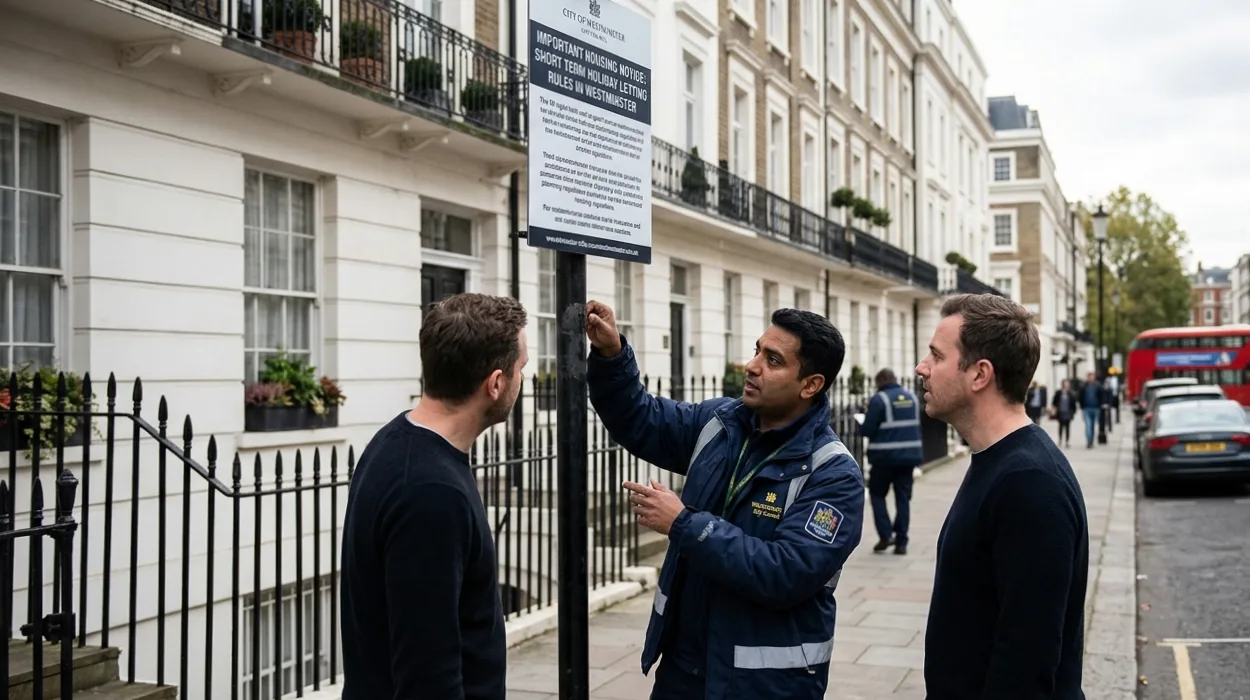
A short term let in the Borough of Westminster is legally defined as the provision of residential accommodation to the same occupier for a consecutive period of fewer than 90 nights in exchange for monetary payment or value.
- How does the 90-day annual limit operate under the Deregulation Act 2015?
- What new planning regulations and use classes apply to Westminster hosts in 2026?
- Why did Westminster introduce strict enforcement measures against holiday lets?
- How does Westminster City Council identify and penalize unauthorized letting?
- What health, safety, and tax compliance standards must hosts meet?
Under the Greater London Council (General Powers) Act 1973, as amended by Section 44 of the Deregulation Act 2015, any residential property used for temporary sleeping accommodation where stays fall below this 90-night threshold changes its material use. The law differentiates between a permanent standard residential tenancy (Use Class C3) and temporary holiday accommodation. In Westminster, this regulatory boundary applies to all entire-property listings across digital platforms, including Airbnb, Booking.com, and Vrbo.
The baseline statutory framework requires that at least one individual providing the short-term accommodation remains liable for Council Tax at that specific address. This mandate targets commercial operators who attempt to convert standard housing stock into permanent holiday rentals. If a property is let for fewer than 90 consecutive nights without meeting the council tax criteria, or if it exceeds the cumulative annual allowance, it constitutes an unauthorized material change of use. To experience this historic landmark in person today, consult our comprehensive [London Visitor Guide and Historical Walking Itineraries] for itineraries and visiting parameters.
How does the 90-day annual limit operate under the Deregulation Act 2015?
The 90-day annual limit permits Westminster residential property owners to let their entire home as short-term accommodation for a maximum cumulative total of 90 nights per calendar year without requiring planning permission for a material change of use.
The 90-night counter automatically resets on 1 January each year and concludes on 31 December. This statutory allowance applies strictly to the property itself, rather than the individual host or property manager. If a home changes ownership or management within a single calendar year, the accumulated short-term letting nights remain attached to the premises, meaning subsequent operators inherit the remaining balance of the annual quota.
This structural limit applies explicitly to entire-property rentals where the primary resident is absent. It does not govern individual room lettings or “home-sharing” arrangements where the host remains in physical residence throughout the guest’s stay. The 90-day rule operates uniformly across all 20 local authority wards of Westminster, from the high-density tourist corridors of West End, Bayswater, and Lancaster Gate to residential enclaves in Maida Vale and St John’s Wood. Property listings monitored by Westminster City Council indicate that the borough holds one of the highest concentrations of short-term lets in Central London, generating an estimated £450 million in 2024, which accounted for 18% of the total private rental sector income in that jurisdiction.
What new planning regulations and use classes apply to Westminster hosts in 2026?
New planning rules in 2026 introduce a mandatory national short-term let registration scheme alongside a distinct planning use class framework designed to prevent the unchecked conversion of residential housing into short-term holiday rentals.
The national regulatory infrastructure, derived from the Levelling Up and Regeneration Act 2023, requires all short-term holiday lets in England to hold a unique registration number issued via a centralized government-run database. Digital property platforms are legally prohibited from displaying listings that lack a verified registration number. Alongside this scheme, the Ministry of Housing, Communities and Local Government implemented a structural split in planning designations:
- Use Class C3 (Dwellinghouses): Standard permanent residential properties used as primary homes.
- Use Class C5 (Short-Term Lets): Residential properties utilized for short-term holiday lettings for fewer than 90 consecutive nights outside the scope of primary home permitted development.
Westminster City Council utilizes these use classes alongside localized Article 4 Directions. These directions remove automatic permitted development rights, meaning property owners cannot switch a property from Use Class C3 to Use Class C5 without securing full planning permission from the local planning authority.

Why did Westminster introduce strict enforcement measures against holiday lets?
Westminster introduced strict enforcement measures to protect its local housing stock from commercial depletion, mitigate persistent anti-social behavior, prevent structural noise disturbances, and stop the escalation of localized waste management failures.
The historical evolution of short-term letting platforms altered the socio-political fabric of Central London neighborhoods. Data compiled by Central London Forward revealed that out of approximately 117,000 short-term listings across Greater London, 67% were concentrated within 12 central boroughs, with Westminster recording nearly 10,000 properties operating or available beyond the legal 90-night limit. This concentration reduced the availability of long-term private rental housing for permanent residents and caused localized inflation of residential rents.
The high turnover of temporary visitors introduced specific municipal management challenges. Westminster City Council reports significant increases in noise complaints, unauthorized key-safe installations on public infrastructure, and systematic refuse issues caused by guests placing household waste on streets outside scheduled collection windows. Under the Environmental Protection Act 1990, the council issues statutory noise abatement notices and retains powers to seize sound equipment. Furthermore, the council tackles anti-social behavior by serving Community Protection Notices directly to property owners, which carry corporate fines of up to £20,000 for non-compliance.
Explore More Public Services
The History of Municipal Waste Management and Recycling Systems in North London
When Will 2026 Council Tax Bands Take Effect in London?
How does Westminster City Council identify and penalize unauthorized letting?
Westminster City Council identifies unauthorized short-term letting through data-sharing agreements with digital platforms, automated listing scraping software, proactive enforcement officer investigations, and direct citizen reports submitted via specialized municipal monitoring portals.
The Council operates a dedicated Planning Enforcement team tasked with identifying properties that breach the 90-night annual limit or operate without mandatory planning permission. Enforcement officers cross-reference listing calendars across multiple booking portals to calculate total cumulative occupancy. They also perform physical site inspections to document evidence, such as external key lockboxes attached to railings, frequent luggage transport, and testimonies from neighboring residents.
When a breach of planning control is identified under the Town and Country Planning Act 1990, the council issues a formal Enforcement Notice against the property. This notice requires the immediate cessation of short-term letting activities and runs permanently with the land, meaning any future buyer inherits the legal obligation to remedy the breach. Failure to comply with an active Enforcement Notice is a criminal offense that leads to prosecution in the Magistrates’ Court, where unlimited fines can be levied. For leasehold properties, which constitute the majority of flats in Westminster, the council shares enforcement data directly with freeholders. This often triggers lease forfeiture proceedings, as standard residential leases contain strict covenants prohibiting subletting and commercial business usage.

What health, safety, and tax compliance standards must hosts meet?
Westminster short-term let hosts must legally comply with mandatory fire risk assessments, statutory gas safety certifications, minimum energy efficiency standards, local tax declarations, and commercial business rate evaluations.
Safety compliance is governed by strict statutory frameworks. Under the Regulatory Reform (Fire Safety) Order 2005 and the Fire Safety Act 2021, hosts must conduct an annual written Fire Risk Assessment. Properties must feature interlinked, hard-wired smoke and heat alarms across all escape routes and bedrooms, alongside emergency lighting and 30-minute fire-resistant doors (FD30).
Gas infrastructure is subject to the Gas Safety (Installation and Use) Regulations 1998, which require an annual inspection by a registered Gas Safe engineer. The resulting certificate must be displayed inside the property and uploaded to listing platforms. From a taxation perspective, all revenue generated through short-term letting must be declared to HM Revenue and Customs (HMRC) via annual Self-Assessment returns. While individual room hosts can utilize the £7,500 Rent-a-Room relief, entire-property commercial lets face a £1,000 property income allowance limit. If a residential property is available for short-term letting for 140 days or more per year, it is assessed by the Valuation Office Agency for Business Rates instead of Council Tax, though small business rate relief may apply if specific criteria are met.
What is a short-term let in Westminster?
A short-term let is residential accommodation provided to guests for fewer than 90 consecutive nights in exchange for payment or other consideration.