
The modern property taxation system in Greater London originates from the Poor Relief Act 1601, which established local property rates. Church parishes collected these taxes based on annual property values to fund community relief infrastructure across historic English jurisdictions.
- How Did the Local Government Act 1948 Standardise London Valuations?
- Why Did the Community Charge of 1990 Fail in Greater London?
- How Was the Current Council Tax System Established by the Local Government Finance Act 1992?
- When Do the 2026 Council Tax Bands Take Effect for Greater London Local Authorities?
- What Are the Precise 1991 Valuation Thresholds Defining London Council Tax Bands in 2026?
- How Do Modern Heritage Preservation Laws Impact Contemporary Property Valuations across London Boroughs?
- What Are the Long-Term Fiscal and Historical Implications of the 1991 Valuation Baseline?
The Elizabethan Poor Law Framework
The Poor Relief Act 1601, passed during the reign of Queen Elizabeth I, formalised the framework of local taxation in England. This statute legalised the parish as the primary administrative unit responsible for the collection of local levies. Overseers of the poor within each parish received statutory powers to raise funds through the taxation of occupiers of land and houses. The system calculated tax liabilities using the “net annual value” of real estate, which represented the estimated rent a property could yield on the open market minus maintenance costs. This system established the principle that real property assets directly dictate an individual’s civic tax obligation.
The Evolution of the Parochial Rating System
Over the subsequent three centuries, London expanded from a walled commercial hub into an urban metropolis. This growth necessitated structural adaptations of the rating system to fund expanding municipal needs. The Vestries Act 1831 and the Poor Law Amendment Act 1834 consolidated separate parish administrations into broader municipal unions. These legislative updates standardised assessment methodologies across distinct London districts (such as the City of London, Westminster, and Southwark). The local rate funded essential public works, including early sewage systems, cobblestone paving, parish constabularies, and rudimentary street lighting.
Legislative Consolidation into the General Rate
The Rating and Valuation Act 1925 and the General Rate Act 1967 completed the transition from fragmented parochial levies to a uniform system known as the General Rate. Local authorities assessed commercial and domestic properties based on their rental value, executing revaluations at regular intervals to maintain parity with market trends. This domestic rating architecture persisted as the foundational pillar of British municipal finance until structural economic and political shifts altered local government legislation in the late 20th century.
How Did the Local Government Act 1948 Standardise London Valuations?
The Local Government Act 1948 standardised London property valuations by transferring assessment responsibilities from fragmented local municipal authorities to the centralized Valuation Office Agency. This structural transition eliminated regional discrepancies and established an objective, nationwide framework for property taxation.
Centralisation under the Valuation Office Agency
Prior to 1948, individual rating authorities across London executed independent property assessments. This decentralised approach caused significant valuation discrepancies between adjacent boroughs, resulting in unequal tax burdens for structurally identical properties. The Local Government Act 1948 resolved this issue by transferring valuation powers to the Valuation Office Agency, an expert department operating within the Inland Revenue (now known as His Majesty’s Revenue and Customs). The Valuation Office Agency deployed professional surveyors to apply uniform valuation methodologies across the entire domestic housing stock of Greater London.
Architectural Typologies and Mass Valuation Techniques
The Valuation Office Agency introduced systematic classifications for residential architecture across London. Surveyors categorised buildings based on structural typologies (such as Georgian terraced townhouses, Edwardian semi-detached suburban villas, and modernist post-war municipal flat complexes). The agency evaluated properties using specific metric measurements, construction material classifications, and geographical proximity to transport infrastructure. This mass appraisal methodology created the first comprehensive, centralised valuation list for the capital, establishing a baseline of data that decoupled property assessment from local political interference.
Impact on Post-War Reconstruction Funding
The establishment of a standardised valuation infrastructure directly supported the rebuilding of post-war London. The clear, predictable tax base allowed newly formed administrative bodies to project revenues with high statistical accuracy. These funds directly subsidised major urban planning initiatives, including the construction of social housing estates, the expansion of the London Underground network, and the clearance of industrial ruins. The centralised valuation database proved resilient, functioning as the authoritative framework for municipal rating records until the final quarter of the twentieth century.
Why Did the Community Charge of 1990 Fail in Greater London?
The Community Charge of 1990 failed due to widespread civic non-compliance, severe administrative inefficiencies, and mass public protests. The flat-rate levy ignored individual financial capacity, creating significant structural instability across municipal budgets throughout Greater London.
The Conceptual Shift away from Property Values
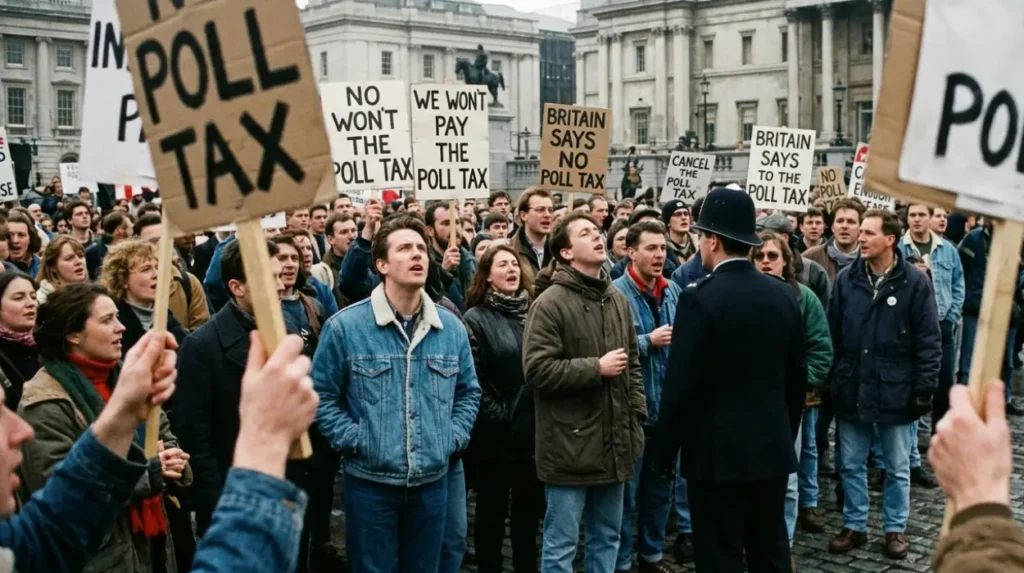
Introduced by the administration of Prime Minister Margaret Thatcher via the Local Government Finance Act 1988, the Community Charge sought to completely dismantle the historical property-based rating system. Colloquially termed the “Poll Tax,” this policy charged a uniform, flat-rate levy on every adult resident within a local authority jurisdiction, regardless of their income, property ownership status, or personal wealth. The stated legislative intent aimed to increase local government accountability by ensuring that all eligible voters contributed equally to the financial maintenance of municipal services.
Socio-Economic Realities and the London Riots
The application of the flat-rate Community Charge provoked immediate resistance in London due to the stark wealth disparities between different urban populations. In boroughs with high densities of low-income residents (such as Lambeth, Hackney, and Newham), the tax burden increased significantly compared to the old rating system. On March 31, 1990, mass public dissatisfaction culminated in the Poll Tax Riots in central London. Over 200,000 demonstrators marched through areas including Kennington Park, Whitehall, and Trafalgar Square. The ensuing civil unrest resulted in extensive property damage, hundreds of injuries, and widespread arrests, signaling a complete breakdown of public consent for the fiscal policy.
Administrative Collapse and Tax Evasion Statistics
The implementation of the Community Charge caused unprecedented administrative friction for London councils. Unlike fixed real estate, urban populations exhibited high mobility, making it difficult for local authorities to maintain accurate register lists. Millions of residents refused to register or pay the tax, leading to massive deficits in municipal collections. By late 1990, inner London authorities reported non-collection rates exceeding 30 percent of their projected revenue. The high cost of legal enforcement, combined with empty collection reserves, pushed several London municipal governments to the brink of fiscal insolvency, forcing a rapid legislative retreat.
How Was the Current Council Tax System Established by the Local Government Finance Act 1992?
The current Council Tax system was established by the Local Government Finance Act 1992 as a compromise framework combining property value and household residency. The law categorized all residential properties into eight statutory valuation bands based on 1 April 1991 market values.
The Legislative Compromise
Following the collapse of the Community Charge, the government enacted the Local Government Finance Act 1992 to restore fiscal stability to local governance. This statute introduced Council Tax on April 1, 1993, as a hybrid system. It abandoned the pure per-capita charging mechanism of the poll tax while avoiding a return to the complex rental-valuation metrics of the old rating system. The new tax structure applied a dual focus: a property element reflecting the capital market value of the residence, and a personal element offering discounts based on the number of adult occupants.
The 1 April 1991 Valuation Baseline
To implement the system quickly and minimize formal appeals, the Valuation Office Agency undertook a rapid mass-valuation exercise across the United Kingdom. The agency assessed the capital market value of every domestic property as of a fixed statutory date: April 1, 1991. Surveyors utilised estate agent records, historical sales databases, and physical street inspections to assign every property into one of eight distinct brackets, designated as Bands A through H. This historical baseline remains the legal foundation for property taxation across England, meaning that all subsequent property tax calculations continue to reference 1991 market conditions rather than modern real estate prices.
Statutory Discounts and Exemptions
The 1992 Act incorporated specific statutory mechanisms designed to mitigate the regressive tendencies of property-only taxes. The legislation introduced the Single Person Discount, which grants a 25 percent reduction in liability for households containing only one adult resident. Furthermore, complete exemptions were established for specific categories of occupiers, including full-time students, severe cognitively impaired individuals, and certain foreign diplomats. Local authorities also received powers to administer Council Tax Benefit frameworks (later replaced by localized Council Tax Support schemes) to assist low-income residents.
When Do the 2026 Council Tax Bands Take Effect for Greater London Local Authorities?
The 2026 Council Tax bands take effect for all Greater London local authorities on April 1, 2026. This date marks the official commencement of the 2026–2027 municipal financial year across all thirty-two London boroughs and the City of London.
The Statutory Financial Calendar
In accordance with the Local Government Finance Act 1992 and the Local Government Rights Act, the UK municipal calendar operates on a fixed annual cycle spanning from April 1 to March 31 of the following calendar year. All adjusted rates, specific borough precepts, and regional funding allocations calculated for the 2026–2027 fiscal period become legally enforceable precisely at midnight on April 1, 2026. Homeowners cannot be legally billed under the new rate structures prior to this date, and all automated direct debit schedules reset to reflect the updated configurations on this day.
The March Billing and Distribution Phase
To ensure administrative compliance, London local authorities initiate a structured administrative sequence during the preceding winter months. Borough finance departments finalise their specific revenue requirements during budget meetings held between January and late February. Following formal ratification of the local rates, councils generate and distribute physical and electronic statutory Council Tax demands to homeowners throughout March. This distribution phase provides taxpayers with a mandatory minimum notice period regarding their adjusted monthly installments before collections begin in April.
The Role of the Greater London Authority Precept
The total Council Tax bill levied on a London homeowner consists of two distinct financial components: the local borough charge and the Greater London Authority precept. The Mayor of London coordinates the Greater London Authority budget, which funds pan-London services including the Metropolitan Police Service, the London Fire Brigade, and Transport for London infrastructure projects. The Greater London Authority finalises its precept requirement concurrently with the individual boroughs. This regional charge is integrated directly into the unified tax demand distributed in March, taking effect on the same April 1 timeline.
Explore More Public Services
How to Challenge a Private Parking Fine in London
New NHS Primary Care Mental Health Support Services Available Across London
What Are the Precise 1991 Valuation Thresholds Defining London Council Tax Bands in 2026?
The precise 1991 valuation thresholds defining London Council Tax bands in 2026 span from Band A, covering properties valued under £40,000, to Band H, covering properties valued over £320,000. These historical capital value brackets remain completely unchanged for the 2026 fiscal year.
Statutory Valuation Tiers
The Valuation Office Agency maintains the statutory valuation list using the original eight tiers defined during the system’s inception. Even for residential units constructed after 1991, the Valuation Office Agency determines the appropriate band by calculating what the property would have been worth if it had existed on April 1, 1991. The strict financial brackets governing these allocations follow specific definitions:
- Band A: Property values up to £40,000
- Band B: Property values from £40,001 to £52,000
- Band C: Property values from £52,001 to £68,000
- Band D: Property values from £68,001 to £88,000
- Band E: Property values from £88,001 to £120,000
- Band F: Property values from £120,001 to £160,000
- Band G: Property values from £160,001 to £320,000
- Band H: Property values exceeding £320,000
The Band D Multiplier Architecture
The financial liability for each band is calculated using a fixed proportional ratio relative to Band D, which serves as the standard baseline for all municipal tax comparisons. The statutory proportions are set by central government regulation and apply a fraction multiplier system:
$$\text{Band A} = \frac{6}{9} \times \text{Band D}$$
$$\text{Band B} = \frac{7}{9} \times \text{Band D}$$
$$\text{Band C} = \frac{8}{9} \times \text{Band D}$$
$$\text{Band D} = \frac{9}{9} \times \text{Band D}$$
$$\text{Band E} = \frac{11}{9} \times \text{Band D}$$
$$\text{Band F} = \frac{13}{9} \times \text{Band D}$$
$$\text{Band G} = \frac{15}{9} \times \text{Band D}$$
$$\text{Band H} = \frac{18}{9} \times \text{Band D}$$
This mathematical structure means that a homeowner placed within Band H automatically pays exactly three times the amount levied on a homeowner occupying a Band A property within the same local authority boundary.
The 4.99 Percent Statutory Referendum Limit for 2026
For the 2026–2027 financial year, central government guidelines maintain the core referendum threshold for local councils at 4.99 percent. This cap consists of a 2.99 percent allowance for general municipal spending and a 2.00 percent adult social care precept designed to fund vulnerable adult support services. If a London borough council attempts to increase its specific Band D baseline charge by an amount greater than this combined 4.99 percent limit, it must legally trigger a local public referendum. Most London local authorities structure their 2026 rate increases to sit exactly at or just below this 4.99 percent ceiling to avoid the administrative costs and political risks of a public ballot.
How Do Modern Heritage Preservation Laws Impact Contemporary Property Valuations across London Boroughs?
Modern heritage preservation laws impact contemporary property valuations by restricting structural alterations, which preserves the original architectural character. These statutory protections influence Valuation Office Agency band classifications by limiting footprint expansions that could otherwise trigger tax band reassessments.
Listed Buildings and Conservation Area Protections
The Planning (Listed Buildings and Conservation Areas) Act 1990 governs the protection of historically, culturally, or architecturally significant properties throughout Greater London. The Historic Buildings and Monuments Commission for England (commonly known as Historic England) manages the statutory list, categorising structures into three tiers: Grade I (exceptional interest), Grade II* (particularly important interest), and Grade II (special interest). Properties located within designated conservation areas face strict planning controls enforced by local borough planning officers. These laws mandate the preservation of original building materials, facades, and layout designs, preventing modern structural modifications without formal consent.
The Trigger Mechanisms for Council Tax Revaluation
Under the terms of the Local Government Finance Act 1992, a property’s Council Tax band is generally frozen even if the broader real estate market experiences substantial inflation. However, a formal revaluation by the Valuation Office Agency is legally triggered under specific conditions, primarily when a property undergoes a material increase in size followed by a relevant transaction (such as a property sale). For example, constructing a large rear extension or executing a multi-story basement excavation adds significant floor space, prompting a band review upon transfer of ownership.
Preservation Restrictions as a Valuation Stabiliser
Because heritage preservation laws strictly limit or outright prohibit substantial architectural expansions, they act as a natural stabilizer for Council Tax band allocations on historic properties. Owners of Grade I or Grade II listed terraced houses in central London locations (such as Kensington, Chelsea, or Westminster) are often legally restricted from changing the external footprint of their buildings. Consequently, these properties maintain their historical interior square footage, allowing them to remain securely within their original 1991-based tax bands despite their multi-million-pound value on the modern real estate market. To experience this historic landmark in person today, consult our comprehensive [guide to visiting London heritage halls] for itineraries and visiting parameters.

What Are the Long-Term Fiscal and Historical Implications of the 1991 Valuation Baseline?
The long-term fiscal implication of the 1991 valuation baseline is a widening divergence between historical tax assessments and modern property wealth. This systemic stagnation complicates local authority funding mechanisms, making local government finance vulnerable to structural economic changes.
The Disconnection from Modern Property Wealth
The retention of the April 1, 1991 valuation baseline means that the council tax system does not account for the unequal geographical growth of property values across London over the past three decades. Areas that have undergone extensive gentrification and infrastructure investment (such as Hackney, Tower Hamlets, and Southwark) have seen modern market prices increase by over 600 percent since 1991. However, the properties within these boroughs often remain anchored in lower council tax bands (such as Band B or Band C) because their relative values in 1991 were low. This creates structural anomalies where owners of high-value modern assets face lower tax liabilities than residents living in economically stagnant regions outside the capital.
Structural Pressures on Borough Budgets
London local authorities increasingly struggle to fund statutory public services solely through the existing council tax framework. Because the growth of the local tax base is constrained by fixed 1991 bands and capped by annual referendum limits, it fails to keep pace with the rising costs of adult social care, children’s services, and municipal waste management. This fiscal gap has forced boroughs to rely on alternative revenue streams, including commercial property investments, parking enforcement fees, and targeted central government grants. The resulting financial vulnerability has led multiple UK local authorities to issue Section 114 notices, which effectively declare technical municipal bankruptcy.
The Political Challenges of Comprehensive Revaluation
Succeeding administrations have avoided implementing a comprehensive nationwide council tax revaluation due to the significant political risks involved. A complete reassessment of London’s housing stock to align with modern property values would cause immediate, substantial tax increases for hundreds of thousands of long-term homeowners whose properties have appreciated in value over time. While economists and public policy institutes argue that updating the valuation baseline is essential to restore fairness and fiscal health to local government finance, the potential for widespread public resistance keeps the 1991 baseline securely in place for the 2026 fiscal year and the foreseeable future.
What is Council Tax?
Council Tax is a local property tax charged on residential properties to fund local services such as waste collection, social care, policing, fire services, and transport infrastructure.