


London social housing safety regulations evolved from nineteenth-century public health crises to twentieth-century statutory frameworks. Modern compliance structures descend from pioneering Victorian interventions, post-war municipal building programs, and successive legislative acts that established the baseline definitions for habitable rental accommodation across the capital.
- How does the Social Housing Regulation Act 2023 alter local authority responsibilities?
- What strict timeframes does Awaab’s Law impose on London social housing repairs?
- How does the updated Decent Homes Standard affect housing criteria?
- What are the financial and operational implications for London borough councils?
- What long-term impacts will these safety standards have on London’s urban fabric?
The foundation of state-subsidized and regulated accommodation in London arose during the Industrial Revolution due to rapid urbanization and severe overcrowding. The Laboring Classes Dwelling Houses Act 1866 marked an early structural intervention, enabling local authorities to borrow public funds to construct housing for the working classes. Private philanthropic entities simultaneously established the first structured housing estates to address urban squalor. George Peabody, an American philanthropist, established the Peabody Donation Fund in 1862, which constructed thousands of model dwellings across London, including major developments in Spitalfields and Islington. These early structures introduced rudimentary sanitary standards, including communal running water and external ventilation shafts, which contrasted with the unregulated private tenements of the era.
The Housing of the Working Classes Act 1890 completely transformed municipal governance by granting the newly formed London County Council the authority to condemn slum properties and construct public housing directly. This legislation led to the development of the Boundary Estate in Shoreditch, which opened in 1900 as the first major council housing scheme in the world. The London County Council designed the estate with wide radial streets, brick construction, and dedicated laundry facilities to maximize hygiene and minimize fire transmission. To experience this historic landmark in person today, consult our comprehensive [Insert Anchor Text for Things to Do Article Here] for itineraries and visiting parameters. The estate established a precedent where structural engineering and public health combined to dictate housing design, a concept that expanded significantly following the conclusion of the First World War under the Housing, Town Planning, &c. Act 1919.
Post-war reconstruction shifted the regulatory focus from basic sanitation to structural volume and high-density urban planning. The Housing Act 1957 and the Housing Act 1985 consolidated local authority obligations, mandating that municipal landlords maintain the structural integrity of their properties. These statutes required councils to ensure that installations for the supply of water, gas, electricity, and sanitation remained in safe working order. Despite these legislative baselines, enforcement mechanisms remained decentralized, and standards varied significantly across different London boroughs. The introduction of the Decent Homes Standard in 2000 established a national target requiring all social housing to meet minimum statutory fitness standards, possess modern facilities, and provide thermal comfort. This standard governed social housing maintenance across the United Kingdom until systemic structural failures and tragic residential incidents necessitated the modern regulatory overhaul.
How does the Social Housing Regulation Act 2023 alter local authority responsibilities?
The Social Housing Regulation Act 2023 eliminates the systemic divide between economic and consumer regulation by granting the Regulator of Social Housing proactive enforcement powers. Local authorities face mandatory performance inspections, strict transparency audits, and continuous monitoring through standardized performance metrics.
The Social Housing Regulation Act 2023 fundamentally restructures the operational mandate of the Regulator of Social Housing, an independent non-departmental government body that oversees registered providers of social housing. Prior to this legislation, the regulator only intervened in consumer standard breaches when a high threshold of systemic risk or serious detriment to tenants was demonstrated. The 2023 Act revokes this limitation, authorizing the regulator to conduct routine, unannounced inspections of social housing stock managed by local authorities and housing associations. For landlords managing more than 1000 properties, these inspections occur on a strict four-year cycle, assessing maintenance delivery, complaint handling, and tenant governance structures.
A central mechanism of this updated regulatory regime is the mandatory collection and publication of Tenant Satisfaction Measures. Registered providers must report annually on 22 standardized metrics, which are divided into 12 subjective tenant perception surveys and 10 objective management data points. The objective metrics track critical safety indicators, including the proportion of homes with up to date gas safety checks, complete fire risk assessments, comprehensive asbestos management surveys, and compliant legionella risk assessments. London boroughs must publish these metrics openly, enabling tenants and the central regulator to identify underperforming authorities. Failure to meet these criteria permits the regulator to issue unlimited fines, mandate detailed performance improvement plans, or appoint independent managers to take control of a borough’s housing department.
The Act also introduces strict qualification requirements for senior housing managers across all London authorities. Under these provisions, housing executives and senior managers must possess formal professional qualifications from the Chartered Institute of Housing or an equivalent accredited body. This measure professionalizes the sector, ensuring that individuals overseeing multi-million-pound maintenance budgets understand building pathology, landlord-tenant law, and modern safety systems. The legislation shifts the legal burden onto local authorities, requiring them to demonstrate active compliance rather than waiting for tenant complaints to expose maintenance deficiencies.
What strict timeframes does Awaab’s Law impose on London social housing repairs?
Awaab’s Law introduces legally binding statutory deadlines that force social landlords to investigate and remediate structural hazards inside tenant properties. Landlords must initiate mandatory inspections within ten days and execute emergency repairs within a strict twenty-four-hour window.
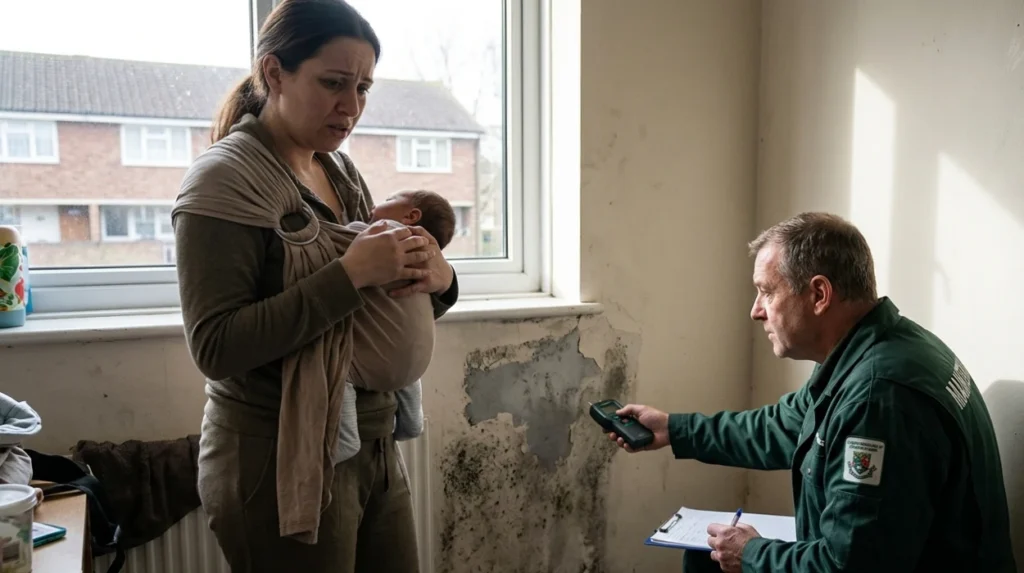
Awaab’s Law is enacted through the Hazards in Social Housing (Prescribed Requirements) (England) Regulations 2025, which implements section 10A of the Landlord and Tenant Act 1985. The legislation honors Awaab Ishak, a two-year-old child who died in 2020 from severe respiratory failure caused by prolonged exposure to environmental damp and mould in a housing association flat. Phase 1 of Awaab’s Law took effect on 27 October 2025, establishing an implied term in every social housing tenancy agreement across London. This term gives tenants the immediate legal right to sue their landlord for breach of contract if the statutory timelines for hazard resolution are breached.
The operational timeline under Phase 1 requires a social landlord to conduct a formal structural investigation within 10 working days of receiving a report of significant damp or mould. Following the conclusion of this assessment, the landlord must issue a comprehensive written summary of the findings to the tenant within 3 working days. If the inspection confirms the presence of a hazard that poses a significant risk to occupant health, the landlord must execute safety works to make the property secure within 5 working days of issuing the report. For critical emergency hazards, such as gas leaks, total loss of water supply, uncontained electrical faults, or structural collapses, the landlord must respond and make the hazard safe within 24 hours.
When a landlord cannot completely resolve a hazard within these statutory windows, further remediation must physically commence within a long-stop period of 12 weeks. If a property contains hazards that cannot be made safe within the designated timeframe, the local authority or housing association must provide suitable alternative accommodation at its own expense. Phase 2 of Awaab’s Law expands these precise timelines to encompass a broader spectrum of hazards, including excess cold, excess heat, structural instability, and electrical dangers. Phase 3 extends the framework to cover all remaining metrics evaluated under the Housing Health and Safety Rating System, ensuring total statutory coverage across the housing sector.
How does the updated Decent Homes Standard affect housing criteria?
The updated Decent Homes Standard establishes five definitive, outcome-focused criteria that all social properties must satisfy to remain legally occupiable. Dwellings must be entirely free from serious structural hazards, maintain comprehensive thermal comfort, and prevent damp propagation.
The modernized Decent Homes Standard completely replaces the outdated frameworks established at the turn of the millennium. Under the updated regulations, a property fails compliance if it contains a single Category 1 hazard as assessed by the Housing Health and Safety Rating System. The rating system evaluates 29 distinct environmental and structural risks, classifying any deficiency that poses an immediate threat to life or severe medical intervention as Category 1. This includes carbon monoxide exposure, dangerous wiring configurations, inadequate guarding on elevated balconies, and severe structural deformation of walls or ceilings.
The standard introduces a standalone criterion dedicated entirely to the total elimination of damp and mould. Properties fail automatically if damp conditions persist, regardless of whether the moisture levels trigger a maximum hazard score under the rating system. Landlords must implement mechanical ventilation systems, remediate broken guttering, and install damp-proof membranes to address root causes. Furthermore, the state of repair criterion shifts away from age-based asset tracking. A property now fails if any single key building component, including the external roof structure, primary masonry walls, windows, external doors, or central heating plants, is in disrepair.
Facilities and services criteria are also updated to ensure that homes function safely for modern occupants. Kitchen layouts must provide adequate, hygienic preparation space, and bathrooms must be located within the main thermal envelope of the building. Windows that present a falling risk to children must feature child-resistant restrictors that adults can override during an emergency evacuation. Thermal comfort standards are aligned with energy performance goals, mandating that the primary heating network efficiently distributes warmth throughout all rooms, eliminating the reliance on portable plug-in heaters.
Explore More Public Services
How to Appeal a Denied Blue Badge Application: Greater London
Council Bulky Waste Booking Portals and Collection Dates: South London
What are the financial and operational implications for London borough councils?
London borough councils face substantial capital reallocation requirements to address outstanding repair backlogs and maintain legal compliance under the updated standards. The Regulator of Social Housing confirms that maintenance expenditure across the social sector exceeds billions annually.
The implementation of these rigorous statutory obligations creates severe financial pressure for London local authorities, where older building stock and higher labor costs escalate remediation expenses. According to the Regulator of Social Housing Global Accounts, total expenditure on repairs and maintenance across the provider sector reached 10 billion pounds within a single financial year, with annual projections sustained at an average of 10.9 billion pounds. Nineteen major providers, many operating predominantly within the dense urban boundaries of London, account for 42 percent of the housing units nationwide. Their increased exposure to structural repairs directly impacts municipal capital allocations, forcing councils to reduce the development of new housing units to fund the retrofitting of existing stock.
Operationally, London boroughs like Waltham Forest, Southwark, and Hackney must restructure their responsive repairs departments to avoid litigation. Councils must transition from reactive tenant-led reporting to proactive stock condition surveys, using digital thermal imaging and moisture meters to identify hidden damp before it compromises resident health. The strict timelines mandated by Awaab’s Law require an extensive network of certified external contractors to supplement internal maintenance teams. If a council fails to secure sufficient trade capacity, it risks facing thousands of disrepair claims and court orders for specific performance, which forces the execution of repairs alongside the payment of tenant compensation.
The requirement to provide suitable alternative accommodation during protracted remediation projects presents an acute logistical challenge in London. Due to the severe shortage of temporary housing stock across the capital, boroughs are often forced to utilize commercial hotel spaces or expensive private rentals to house decanted families. This operational reality dramatically inflates the true cost of structural repairs. To manage these pressures, councils are rapidly adopting integrated data management systems that track tenant vulnerabilities, property age, maintenance history, and contractor performance on a single synchronized dashboard. This enables predictive maintenance scheduling, allowing authorities to optimize their budgets while remaining fully compliant with national safety laws.

What long-term impacts will these safety standards have on London’s urban fabric?
The updated safety standards will alter the architectural preservation, asset sustainability, and demographic distribution of London’s urban communities over the coming decades. Substandard municipal blocks face structural decommissioning, while surviving historical estates require deep technical retrofitting.
The strict enforcement of the Social Housing Regulation Act and the Decent Homes Standard will accelerate the regeneration of post-war housing developments across London. Many high-density estates constructed during the 1960s and 1970s utilize system-built concrete panels that suffer from inherent thermal bridging, poor insulation, and chronic interstitial dampness. Because the cost of retrofitting these structures to meet modern energy performance and safety metrics often exceeds the value of the asset, several local authorities are choosing to decommission and demolish non-compliant blocks. They replace them with modern, mixed-tenure developments built from high-performance materials that feature integrated heat networks, mechanical ventilation with heat recovery, and non-combustible external cladding systems.
For historically significant social housing, such as the late-nineteenth-century Peabody estates or early-twentieth-century cottage estates, the standards require specialized architectural interventions. Heritage preservationists and municipal engineers must collaborate to install internal wall insulation, draft-proofing, and secondary glazing without destroying the protected historic facades of these listed structures. This operational necessity ensures the survival of London’s architectural heritage while upgrading internal living conditions to contemporary health standards. The long-term preservation of these estates guarantees that low-income families can continue to reside within central London, preventing total economic displacement and maintaining social diversity within historic urban neighborhoods.
The long-term legal and regulatory frameworks established by these reforms provide an enduring template for the entire UK housing market. The Renters’ Rights Act 2025 creates the necessary statutory mechanisms to extend Awaab’s Law and the Decent Homes Standard directly into the private rented sector. This legislative convergence ensures that a single, unified standard of human habitability applies to all tenancies, irrespective of whether the landlord is a commercial corporation or a municipal borough council. By removing hazardous living conditions from the housing supply, these standards will reduce chronic respiratory illnesses, lower emergency healthcare expenditures, and elevate the baseline quality of urban life for generations of London residents.
What is social housing?
Social housing is affordable rented accommodation provided by local authorities or registered housing associations to eligible households.