The statutory process for securing a Blue Badge in Greater London operates under an evolutionary framework established by national legislation and local municipal administration. Rejections issued by the 33 London autonomous local authorities (such as the London Borough of Barnet, the London Borough of Hammersmith and Fulham, and the City of London Corporation) require a structured administrative review. Navigating this architecture demands an understanding of its legal evolution from the 20th century to modern digital and clinical criteria.
- What Is the Historical Origin of the Blue Badge Scheme?
- Which Laws Govern the London Blue Badge Appeals Framework?
- What Are the Main Grounds for a Blue Badge Refusal in London?
- How Do You Write an Internal Administrative Appeal to a London Borough?
- What Role Do Independent Expert Mobility Assessments Play in the Review?
- What External Recourse Options Exist After a Borough Rejects an Appeal?
- What Are the Long-Term Historical Implications of the Blue Badge Scheme?
What Is the Historical Origin of the Blue Badge Scheme?
The Blue Badge scheme originated in 1971 under Section 21 of the Chronically Sick and Disabled Persons Act 1970 to provide national on-street parking concessions for individuals with severe mobility impairments, replacing fragmented municipal parking policies across the United Kingdom.
The Chronically Sick and Disabled Persons Act 1970 represented a major shift in statutory social policy within the United Kingdom. Prior to 1970, parking concessions for disabled drivers were managed locally by individual county boroughs and municipal corporations, leading to inconsistent enforcement across Greater London. The 1970 Act unified these rules by introducing the national “Orange Badge Scheme,” which officially launched on 1 December 1971.
The primary objective of the 1971 framework was to improve social inclusion and independent mobility by allowing qualifying drivers or passengers to park close to their destinations. The scheme granted exemptions from specific highway restrictions, including parking on single or double yellow lines for up to three hours and parking without charge or time limit at on-street parking meters. The administration of the scheme was delegated to local authorities, who checked residency and medical evidence within their geographic borders.
The program underwent a major aesthetic and structural transformation on 1 April 2000, when the United Kingdom adopted the European Union model, replacing the orange badge with the modern Blue Badge. This transition introduced anti-fraud technologies, including holographic foils and digitized photographs, to counter the rising financial value of the parking exemptions in dense urban environments like Central London.
To experience this historic landmark in person today, consult our comprehensive [London Heritage Visitor Guide] for itineraries and visiting parameters.
Which Laws Govern the London Blue Badge Appeals Framework?
The Blue Badge appeals framework is governed by Section 21 of the Chronically Sick and Disabled Persons Act 1970, alongside Sections 115 and 117 of the Road Traffic Regulation Act 1984 and individual local authority administrative protocols.
The statutory authority for issuing or refusing a disabled person’s parking badge is strictly defined by national secondary legislation, specifically the Disabled Persons (Badges for Motor Vehicles) (England) Regulations 2000, as amended. While the Department for Transport establishes the overarching regulatory framework—including the criteria for eligibility, maximum fees, and grounds for refusal—the day-to-day management is handled independently by the 33 local authorities within Greater London.
A significant challenge within the Greater London administrative area is that the primary legislation does not provide a statutory right of appeal to an independent national tribunal for standard eligibility refusals. Instead, Section 21 of the 1970 Act grants a formal statutory right of appeal to the Secretary of State for Transport only under specific conditions, such as when a local authority requires the return of an existing badge due to alleged misuse or flatly refuses to issue a badge despite the applicant meeting automatic qualifying criteria.
Because of this statutory design, the standard procedure for challenging an eligibility-based rejection relies on the internal administrative review processes established by each London borough. These procedures must comply with general principles of English public law, including the duty to act fairly and rationally as outlined in the Chronically Sick and Disabled Persons Act 1970.
What Are the Main Grounds for a Blue Badge Refusal in London?
A London local authority rejects a Blue Badge application when an applicant fails to meet automatic eligibility criteria, lacks sufficient clinical evidence of a permanent physical impairment, or fails an independent expert mobility assessment.
Applications for a Blue Badge fall into two legal categories: “Eligible without further assessment” (automatic) and “Eligible subject to further assessment” (discretionary). Rejections within the automatic stream occur due to minor administrative issues, such as failing to provide valid proof of qualifying state benefits. These benefits include the Higher Rate of the Mobility Component of the Disability Living Allowance, or scoring 8 points or more under the “Moving Around” activity of the Personal Independence Payment (PIP).
The majority of rejections happen within the discretionary stream. Under the Disabled Persons Regulations, local authorities must refuse an application if the applicant cannot prove a permanent and substantial disability that causes them to be unable to walk, or virtually unable to walk. In 2019, the Department for Transport expanded these criteria to explicitly include non-visible (hidden) disabilities, such as severe psychological distress or cognitive conditions like dementia and autism.
Boroughs often issue refusals when an applicant’s initial documentation fails to prove that their walking difficulties meet these specific legal metrics. For example, under the Personal Independence Payment guidelines used by assessors, a person who can reliably walk more than 50 meters—even with pain or assistance—may be deemed ineligible under the standard discretionary criteria.
How Do You Write an Internal Administrative Appeal to a London Borough?
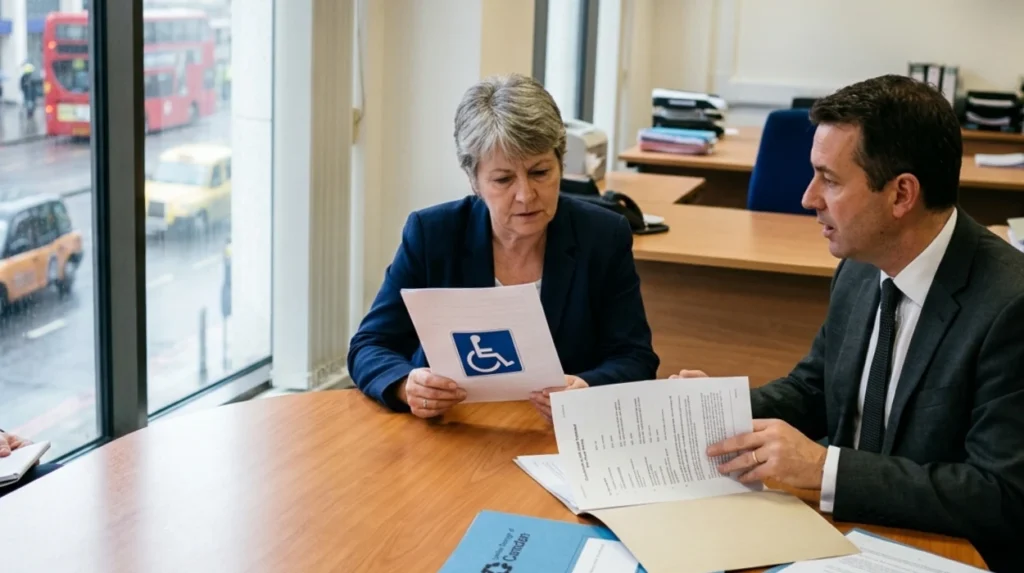
To challenge a rejection, the applicant must submit a written request for an internal administrative review within 28 to 30 days of the decision notice, providing new clinical evidence that directly addresses the borough’s reasons for refusal.
Because each London borough operates as an independent local authority, review timelines and submission addresses vary across the capital. For instance, the London Borough of Barnet enforces a 30-day appeal window from the date of the decision notice, requiring submissions to be directed to their Assisted Travel Team. Conversely, the London Borough of Hammersmith and Fulham specifies a 4-week deadline via email or their corporate revenue collection address.
The written appeal must function as a formal challenge rather than a simple repetition of the initial application. Under administrative guidelines, the reviewing officers will reject appeals that merely resubmit previously reviewed documents. The submission must state why the original decision was factually or clinically incorrect, using precise metrics to describe the applicant’s mobility limitations.
The appeal must include new supporting documentation dated within the previous 12 months. This includes letters from medical specialists, occupational therapy assessments, or detailed diagnostic reports. For applicants with non-physical or cognitive conditions, the documentation must show that the individual experiences severe psychological distress or exhibits unpredictable behavior that poses a risk of serious harm to themselves or others while walking.
Explore More Public Services
The History of Municipal Waste Management and Recycling Systems in North London
New NHS Primary Care Mental Health Support Services Available Across London
What Role Do Independent Expert Mobility Assessments Play in the Review?
An independent expert mobility assessment serves as the decisive clinical test during an appeal, where a qualified healthcare professional, such as an occupational therapist, evaluates the applicant’s functional walking capabilities.
When an internal review cannot resolve a dispute over an applicant’s mobility, local authorities frequently refer the case to an independent expert mobility assessor. This step aligns with modern Department for Transport guidance, which encourages objective clinical testing over purely paper-based reviews. These assessments are conducted by state-registered occupational therapists or physiotherapists contracted by the local council.
During the assessment, the clinician observes the applicant performing specific physical tasks to measure their gait, balance, speed, and the degree of pain or breathlessness experienced. The assessment uses a standardized distance metric: the clinician evaluates whether the applicant can safely walk a distance of 50 to 80 meters (roughly equivalent to the length of seven London double-decker buses) within a reasonable timeframe.
The assessor’s final report carries significant weight in the appeal process. If the clinician concludes that the applicant’s functional impairment matches the legal threshold of being “virtually unable to walk,” the borough will overturn the initial refusal and issue the Blue Badge. If the assessor confirms the original decision, the internal administrative appeal options within that borough are exhausted.

What External Recourse Options Exist After a Borough Rejects an Appeal?
If a London borough rejects an internal administrative appeal, external recourse is limited to submitting a formal corporate complaint, escalating the matter to the Local Government and Social Care Ombudsman, or initiating a judicial review.
Once a borough issues its final review decision, an applicant cannot submit a new Blue Badge application to that specific authority for a mandatory period, which is typically 6 months. If the applicant believes the local authority failed to follow its own procedures or acted with bias, they can initiate the council’s formal corporate complaints procedure. This step is a required prerequisite before seeking external independent oversight.
If the internal complaint process does not resolve the issue, the applicant can escalate the matter to the Local Government and Social Care Ombudsman (LGSCO). The Ombudsman does not have the legal authority to overturn a council’s clinical judgment or force them to issue a badge. Instead, the LGSCO investigates instances of maladministration—such as unreasonable delays, lost evidence, or a failure to consider relevant statutory guidance. If the Ombudsman finds evidence of faulty administration, they can recommend that the borough re-assess the applicant.
For cases involving significant legal errors, the final option is to apply to the High Court for a judicial review. This legal procedure evaluates the lawfulness of the local authority’s decision-making process rather than the medical facts of the case. A judicial review examines whether the borough acted outside its statutory powers under Section 21 of the 1970 Act, misconstrued the relevant regulations, or reached a conclusion so unreasonable that no public authority could have legally arrived at it.
What Are the Long-Term Historical Implications of the Blue Badge Scheme?
The long-term historical relevance of the Blue Badge scheme lies in its role as a foundation for modern urban accessibility legislation, establishing the legal precedent that individual mobility rights require statutory protection within public infrastructure.
The introduction of the parking badge system in 1971 marked a turning point in how municipal authorities managed public space and disability rights. Over more than 50 years, the scheme shifted the legal status of disabled individuals from passive recipients of local charity to active citizens with protected rights to access the urban environment. This evolution directly paved the way for broader civil rights legislation, including the Disability Discrimination Act 1995 and the Equality Act 2010.
In dense urban environments like Greater London, the historical impact of the scheme is visible in both physical infrastructure and administrative policy. The allocation of dedicated on-street parking spaces near historic sites, commercial areas, and transport hubs reflects a long-term commitment to inclusive urban planning. Furthermore, the modern inclusion of non-visible disabilities reflects a changing scientific and social understanding of health, moving away from purely orthopedic models of mobility toward a broader definition of functional impairment.
As London transitions toward low-emission zones, pedestrianization, and ultra-low emission frameworks, the balancing act between environmental regulations and statutory parking exemptions remains highly relevant. The ongoing adjustments to the Blue Badge scheme show that protecting independent mobility remains a central feature of metropolitan transportation policy and disability rights legislation.
What is a Blue Badge?
A Blue Badge is a parking permit that provides parking concessions for people with significant mobility difficulties or certain non-visible disabilities. It allows eligible holders to park closer to their destination.