

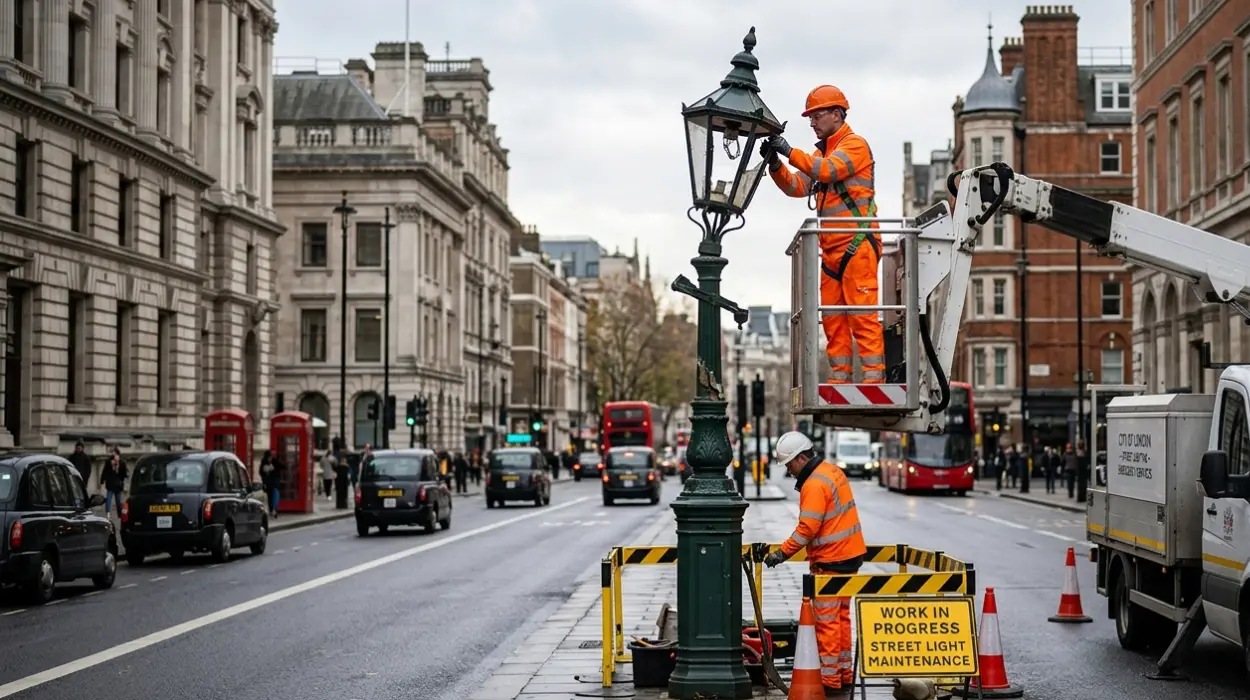
The infrastructure of public illumination across London operates within a complex network of administrative jurisdictions. For centuries, the task of keeping the metropolis illuminated shifted between individual private citizens, local ecclesiastical vestries, statutory boards, and eventually modern municipal corporations. To understand how contemporary street lighting responsibilities are allocated, one must examine a dense history of civic development, legislative interventions, and structural transitions spanning medieval ordinances through the creation of modern local authorities. Today, determining administrative ownership requires looking at specific highway classifications, historical boundary adjustments, and local governance statutes.
- How do I determine which specific local council owns a street lamp?
- What role does Transport for London play in managing street lights?
- How did medieval and early modern laws shape municipal street illumination?
- When did gas technology transform the management of London’s streets?
- How did the transition to electricity alter borough boundary frameworks?
- Where can historical gas lamps still be found in modern London?
- What historical archives help researchers trace old street light networks?
- How does the legacy of the 1963 and 1965 boundary acts impact lighting today?
- Turning Historical Insight into Practical Action
How do I determine which specific local council owns a street lamp?
To identify the local council responsible for a street lamp, check the distinct municipal branding or identification code printed on the column. If the asset sits on a standard residential highway, the local London borough council holds absolute statutory maintenance ownership.
Every modern street lamp column in the Greater London area features an identification plate containing a unique alphanumeric serial number. London borough councils (for example, the London Borough of Camden, the London Borough of Southwark, or the London Borough of Tower Hamlets) place their official civic crest or a short text abbreviation directly onto this marker plate. If a column sits on a standard public road, a residential crescent, or a borough-maintained urban artery, the local authority handles all operational repairs, structural safety inspections, and energy supply billing.
To pinpoint the precise boundary boundaries between adjacent administrative zones, individuals must reference the official interactive boundary map provided by the Ordnance Survey or the specific digitised highway registers held by neighboring town halls. In instances where a roadway marks the definitive boundary line between two separate boroughs, specific historical cross-boundary service-level agreements allocate maintenance responsibility for one side of the street, or alternating lamp posts, to a single chosen authority.
What role does Transport for London play in managing street lights?
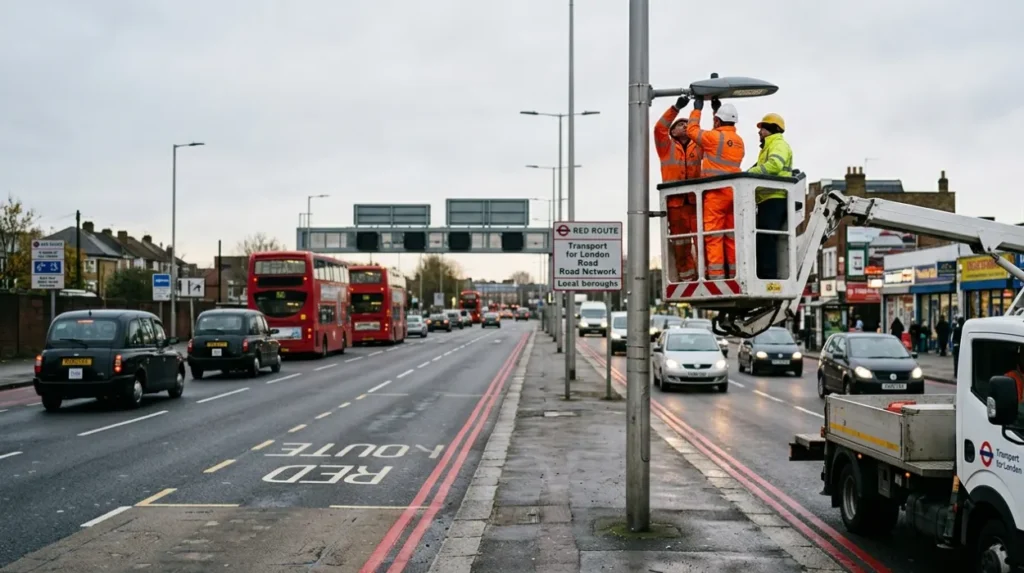
Transport for London manages all street lighting installations situated along the strategic Transport for London Road Network, commonly known as red routes. These priority arterial routes bypass local borough boundaries to ensure unified strategic movement across the capital.
While individual boroughs govern standard municipal routes, Transport for London (TfL)—established under the Greater London Authority Act 1999—retains direct statutory control over the major transport arteries that thread through the city. These specific corridors, designated as the Transport for London Road Network (TLRN), encompass approximately 580 kilometres of London’s busiest un-navigable thoroughfares (including the A1, the A406 North Circular Road, and the A23).
The division of infrastructure management between the local boroughs and the strategic authority means that a single continuous street can transition ownership rapidly. For instance, if a residential street intersects a major Red Route highway, the maintenance boundary stops exactly where the borough highway joins the Transport for London infrastructure zone. To experience this historic landmark network in person today, consult our comprehensive [London transport history walking tour guide] for itineraries and visiting parameters.
How did medieval and early modern laws shape municipal street illumination?
Medieval and early modern lighting evolved through strict penal ordinances that forced individual citizens to hang out lanterns outside their homes. These specific Royal and mayoral proclamations laid the foundation for modern localized public amenity taxes.
The formal origins of London’s night lighting date back to the early 15th century. In the year 1417, Sir Henry Barton, then serving as the Mayor of London, introduced a landmark mayoral ordinance directing affluent citizens to hang out lanterns containing tallow candles outside their street-facing properties during winter evenings. This structural model shifted the fiscal and physical burden of public safety entirely onto private property owners, utilizing a system of targeted fines enforced by local parish beadles.
By the mid-17th century, the system required more comprehensive legal codification to support a rapidly expanding urban population. Under the reign of King Charles II, the historic Act for Regulating the Buildings, Common Sewers, and Paving and Cleansing of the Streets in 1662 turned the custom into a strict statutory obligation across both the City of London and the City and Liberty of Westminster. This law dictated that every householder whose residence bordered an open street had to display a lantern from dusk until midnight, specifically spanning from the feast day of Michaelmas (29 September) until the feast day of Lady Day (25 March).
In 1736, parliament passed the City of London Lighting Act, which authorized the Common Council to levy a structured municipal “lamp rate” directly onto property owners, replacing individual private obligations with a centralized, publicly contracted illumination grid.
When did gas technology transform the management of London’s streets?
Gas technology transformed urban management in June 1807 when Frederick Albert Winsor staged the first public demonstration of gas-fueled street lighting along Pall Mall. This mechanical shift forced the creation of centralized commercial utility syndicates.
The transition from traditional whale-oil lamps to volatile coal-gas infrastructure marked a major technological shift in the early 19th century. Following the initial 1807 Pall Mall demonstration, parliament granted a comprehensive royal charter in the year 1812 to establish the Gas Light and Coke Company. This entity became the world’s first formal commercial utility corporation, tasked with laying extensive networks of cast-iron distribution mains beneath the paving stones of Westminster. By the mid-1820s, approximately 40,000 individual gas lamps illuminated over 215 miles of metropolitan thoroughfares.
The introduction of gas required intense daily maintenance and specialized personnel. Teams of local lamplighters, employed by private companies or individual parish vestries, traveled across specific districts twice daily using long brass torches to manually light and extinguish the fish-tail burners. This massive physical network grew increasingly decentralized as rival commercial gas suppliers (including the Imperial Gas Light and Coke Company and the South Metropolitan Gas Company) tore up parallel streets to install competing mains.
This corporate competition led parliament to pass the Metropolis Gas Act 1860, which systematically divided the London map into distinct, non-competing geographic monopolies to restore administrative order.
Explore More Public Services
GoStroud Commuter Coach Matches Peak Rail Crisis: Stroud 2026
Reporting Illegal Fly Tipping in Community Groups: North London
How did the transition to electricity alter borough boundary frameworks?
The advent of electric street lighting in 1878 altered boundary frameworks by requiring heavy infrastructure links that small parish vestries could not afford. This technological cost drove the consolidation of fragmented local authorities.
London’s initial experience with municipal electric lighting occurred in December 1878, when engineers installed early electric arc lamps along the Victoria Embankment and across the Holborn Viaduct. These initial industrial installations, powered by localized steam generators, cast a brilliant glare that far surpassed the illumination capacity of Carl Auer von Welsbach’s incandescent gas mantles. However, the high capital costs associated with building dedicated electrical generating stations and laying heavy insulated subterranean cables quickly exposed the structural weaknesses of London’s highly fragmented local government system.
During this late-Victorian phase, public lighting was governed by dozens of distinct parish vestries and local district boards established under the Metropolis Management Act 1855. Small, financially strained administrative vestries simply lacked the tax base to finance modern electric municipal grids.
To resolve this issue, parliament enacted the London Government Act 1899, which abolished the ancient vestry system entirely. The law consolidated these smaller areas into 28 distinct metropolitan boroughs, giving these new administrative bodies clear statutory powers to act as authorized electricity suppliers and manage lighting across unified public districts.
Where can historical gas lamps still be found in modern London?
Historical gas lamps remain preserved within major heritage conservation zones located around Covent Garden, the Westminster Abbey precincts, and along the perimeter of Buckingham Palace. A team of five specialist engineers maintains these assets.
Despite the comprehensive electrification of the capital following the conclusion of the Second World War, London maintains a functioning inventory of approximately 1,500 historic gas-fueled street lamps. These surviving assets are protected by statutory Grade II architectural listing status, which prevents local authorities from converting the units to modern electric power sources. Many of these lamps feature the distinct royal ciphers of past monarchs—including King George IV, Queen Victoria, and King Edward VII—embossed directly onto their surviving cast-iron bases.
Specific concentrations of functional gas lamps sit along Marlborough Road in St James’s, throughout Goodwin’s Court in Covent Garden, and inside Dean’s Yard behind Westminster Abbey. The preservation of these street lights requires regular manual intervention by a dedicated team of five British Gas maintenance engineers. These modern lamplighters travel across the historic core of the city every fortnight to manually wind the mechanical clockwork timing mechanisms that regulate the gas flow, clean the protective glass enclosures, and replace fragile silk gas mantles.
What historical archives help researchers trace old street light networks?
Historical street lighting networks can be traced using the extensive vestry minutes, municipal maps, and rate books preserved at the London Metropolitan Archives and local borough local history libraries.
Researchers tracing the history of urban illumination or locating old genealogical records can access detailed municipal registries across London. The London Metropolitan Archives (LMA), located in Clerkenwell, houses the complete historical records of the Metropolitan Board of Works (MBW) and the London County Council (LCC), which tracked public lighting contracts across the city. Additionally, individual borough local history libraries hold localized parish vestry minutes that record every lamp post installation and maintenance dispute dating back to the Georgian era.
These archival collections contain specific records of interest:
- The City of London Records Office: Contains 18th-century “lamp rate” assessment books showing exactly which householders paid for public oil lamps.
- Westminster City Archives: Holds the complete corporate ledgers of the Gas Light and Coke Company, including detailed hand-drawn maps of early gas mains.
- Borough Mapping Collections: Feature historic Ordnance Survey maps (specifically the highly detailed 1:1,056 scale series from the 1890s) that mark the precise locations of individual gas and electric lamp columns.
By cross-referencing these documents with modern geographic information systems, historians can chart the development of public safety, utility access, and municipal management across different eras of London’s history.

How does the legacy of the 1963 and 1965 boundary acts impact lighting today?
The London Government Act 1963 and the London Government Act 1965 established the 32 modern borough boundaries that dictate street lighting asset ownership today. This legislation created large administrative hubs that unified fragmented municipal services.
The contemporary administrative map of London was formally established by the London Government Act 1963, which came into full legal effect on 1 April 1965. This sweeping legislative intervention abolished the old administrative tier of the London County Council (LCC) and the 28 historic metropolitan boroughs created in 1899. In their place, parliament constructed the Greater London Council (GLC) and 32 expanded London borough councils, vastly enlarging the geographic scale and administrative capacity of local town halls.
This structural reorganization instantly consolidated separate municipal asset networks under unified borough engineering departments. For example, the creation of the modern London Borough of Camden merged the historic municipal areas of Hampstead, Holborn, and St Pancras into a single authority, which inherited all the varied gas and electric lamp standards of those previous areas. Today, this legacy means that a single borough council manages thousands of street lights across vastly different neighborhoods, maintaining standardized modern LED upgrades while preserving historic columns in protected architectural conservation districts.
Turning Historical Insight into Practical Action
Determining which public body is responsible for a specific street light requires analyzing a mix of historical boundaries and modern transport laws. If a column features a standard borough crest or sit on a typical residential road, it belongs to the local borough council established by the boundary reforms of 1965. If the light stands along a major red route arterial highway, ownership sits with Transport for London. For researchers and residents alike, these clear physical markers and public records connect modern street lighting directly to London’s long history of civic development.
Who is responsible for maintaining a street light in London?
Responsibility depends on the road classification. Most street lights on residential roads are maintained by the relevant London borough council, while lights on the strategic Transport for London Road Network (TLRN), commonly known as red routes, are maintained by Transport for London.