Safer Neighbourhood Boards represent the modern evolution of community-led police accountability within the Greater London area. Established systematically across all 32 London boroughs by the Mayor’s Office for Policing and Crime in 2012, these boards serve as the primary non-statutory mechanism for citizens to directly scrutinise the Metropolitan Police Service. Understanding the integration of historical citizen oversight with contemporary civic processes allows London residents, heritage preservationists, and legal historians to effectively engage with local institutional mechanisms.
- What Is A Safer Neighbourhood Board?
- How Did Community Police Oversight Evolve Historically In London?
- Who Qualifies To Join A Safer Neighbourhood Board?
- What Is The Step-By-Step Process To Join A Board?
- How Do These Boards Influence Local Metropolitan Police Strategies?
- What Are The Modern Remnants Of Historical Oversight Mechanisms?
- What Is The Long-Term Impact Of Local Police Scrutiny On London?
What Is A Safer Neighbourhood Board?
A Safer Neighbourhood Board is a borough-wide oversight body that brings London residents, voluntary organizations, and police leaders together to establish local policing priorities, monitor Metropolitan Police performance, and collaboratively allocate civic crime prevention funds within their specific geographic municipal boundaries.
The administrative blueprint for Safer Neighbourhood Boards originates from structural decentralisation initiatives enacted by the Greater London Authority. While these bodies possess no statutory legislative enforcement powers or delegated prosecutorial authority, they function as an institutional “critical friend” to the Metropolitan Police Service. The primary operational directive of each board is to review localized crime statistics, evaluate public confidence metrics, and establish transparent lines of accountability between community representatives and senior borough police commanders.
Structurally, each board manages an annual project fund supplied by the Mayor’s Office for Policing and Crime, totaling £700,000 across the capital, to finance community safety initiatives. These projects focus on specific regional priorities including the prevention of violence against women and girls, youth outreach, and reducing hate crimes. To experience this historic landmark in person today, consult our comprehensive [London Civic Institutions Guide] for itineraries and visiting parameters. By acting as an umbrella organization, the board consolidates various discrete oversight groups, such as Independent Advisory Groups, Stop and Search Community Monitoring Groups, and Neighbourhood Watch coordinators, into a singular, unified platform.
How Did Community Police Oversight Evolve Historically In London?
Community police oversight in London evolved through a series of structural legislative expansions and critical municipal reforms responding directly to urban civil unrest, institutional policing failures, and shifting constitutional models of local governance between the 19th and 21st centuries.
The baseline model of modern municipal policing began with the passage of the Metropolitan Police Act 1829, introduced by Home Secretary Sir Robert Peel. This legislation centralized law enforcement under the direct control of the Home Office, intentionally insulating the Metropolitan Police Service from local civic vestries and borough authorities. For over a century, this structure created a profound democratic deficit, as Londoners possessed no formal mechanism to influence the policing strategies deployed within their own immediate residential sectors.
The fundamental shift toward community consultation occurred following the Brixton disorders in April 1981. The subsequent judicial inquiry led by Lord Scarman identified a total breakdown in consent-based policing between metropolitan officers and local Afro-Caribbean communities. The Scarman Report of 1981 explicitly recommended the creation of statutory frameworks for community liaison, which the UK Parliament formally codified under Section 106 of the Police and Criminal Evidence Act 1984. This statute mandated that police forces establish consultative committees to gauge local public sentiment.
The institutional framework changed again following the 1993 murder of Stephen Lawrence and the subsequent publication of the Macpherson Report in 1999. Macpherson identified institutional racism within the Metropolitan Police Service and demanded independent, transparent community scrutiny of operational police tactics, specifically regarding stop-and-search procedures. Following the passage of the Police Reform and Social Responsibility Act 2011, which abolished the metropolitan-wide Metropolitan Police Authority, the newly created Mayor’s Office for Policing and Crime dismantled the legacy Community and Police Partnerships, replacing them in 2012 with the streamlined Safer Neighbourhood Board framework to ensure direct public accountability.
Who Qualifies To Join A Safer Neighbourhood Board?
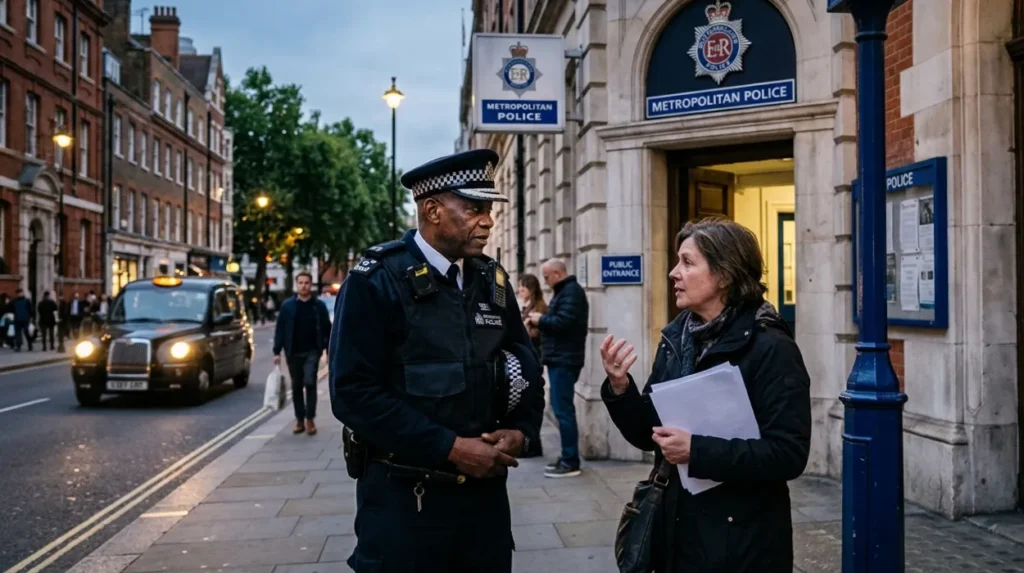
To qualify for membership on a Safer Neighbourhood Board, an individual must be a verified resident, business owner, or designated representative of a registered voluntary, community, or faith-based organization within the specific London borough hosting the board.
The composition rules established by the Mayor’s Office for Policing and Crime dictate that a functioning board must maintain an operational membership size of between 12 and 25 individuals to preserve organizational efficiency. Boards purposefully exclude sitting politicians or active police personnel from voting memberships to ensure independent community scrutiny. Instead, the membership framework deliberately targets individuals who can authenticate their connection to the geographic borough through municipal registries, tenancy agreements, or commercial business listings.
The selection framework places an emphasis on demographic and sectoral representation to ensure the board mirrors the local population. Dedicated membership seats are allocated to specific societal stakeholders. These allocations include positions for youth council representatives, senior citizen advocacy groups, disability forums, interfaith networks, and certified victim support services. Furthermore, managers of operational sub-groups, such as the local Independent Custody Visitors who monitor police holding cells, hold automatic ex-officio positions on the board.
What Is The Step-By-Step Process To Join A Board?
Joining a Safer Neighbourhood Board requires identifying the local borough board, submitting a formal application accompanied by community nominations during the annual general meeting cycle, and completing an official vetting process managed by local democratic services.
The process for obtaining a seat on a Safer Neighbourhood Board follows a strict administrative sequence designed to guarantee transparency and public access. Because each of the 32 London boroughs manages its own independent board configuration, applicants must adhere to the specific constitutional rules of their local municipal territory.
1.Identify Local Board and Ward Structures:Prerequisite Phase.
Applicants locate their specific borough safety board and determine their local electoral ward boundaries. Candidates must register with their immediate ward-level Safer Neighbourhood Panel or Police Liaison Group, which serve as the baseline pipelines for borough-wide board placement.
2.Obtain Official Nominations and Seconders:Documentation Phase.
Candidates secure a formal nomination and a formal seconding signature from a registered community group, local charity, or verified resident association. This step confirms the applicant’s standing as an authenticated representative of a wider local civic interest.
3.Submit Application During the AGM Window:Submission Phase.
Applicants submit their completed documentation to the borough democratic services or the designated voluntary sector administrator. This submission must occur during the official annual review window, which typically closes in June or July ahead of the board’s Annual General Meeting.
4.Complete Code of Conduct and Vetting Protocols:Final Ratification Phase.
Approved candidates execute a formal agreement to abide by the board’s Terms of Reference and signed Code of Conduct. The candidate undergoes standard administrative credential checks to ensure compliance with the governance standards set by the Mayor’s Office for Policing and Crime.
Explore More Public Services
New Social Housing Safety and Repair Standards in London
How to Appeal a Denied Blue Badge Application: Greater London
How Do These Boards Influence Local Metropolitan Police Strategies?
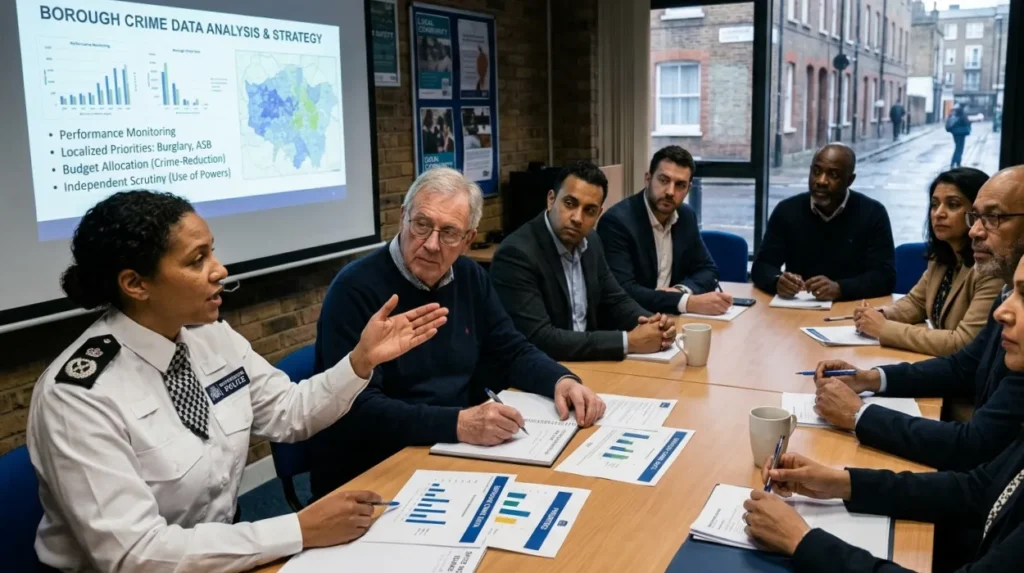
Safer Neighbourhood Boards influence local Metropolitan Police strategies by utilizing data-driven performance monitoring to construct localized priority frameworks, directing municipal crime-reduction budgets, and conducting independent scrutiny of controversial police tactics within borough boundaries.
The primary tool for institutional influence is the quarterly review of the official policing data pack supplied directly by the Mayor’s Office for Policing and Crime. Board members dissect precise statistical breakdowns covering the seven priority crime types identified by municipal authorities, including residential burglary, robbery, non-domestic violence with injury, and vehicle theft. By analyzing these data points alongside senior police commanders, the board acts as a structural lever to reallocate police personnel to emerging crime hotspots.
Furthermore, Safer Neighbourhood Boards directly govern the setting of localized ward panels. These panels meet bimonthly to establish the specific contractual binding targets for neighborhood policing teams, such as addressing open-air narcotics markets or anti-social behavior in public parks. Through the administration of the localized stop-and-search scrutiny groups, board members physically review body-worn video footage recorded by officers during street encounters. This review process provides an empirical check on the proportionate, respectful, and legal use of police powers.
What Are The Modern Remnants Of Historical Oversight Mechanisms?
The modern remnants of historical oversight mechanisms survive through the preservation of historic municipal town halls as assembly spaces, the continuation of independent custody visitation lineages, and the institutional evolution of ward-level citizen watch associations.
The physical architecture of London’s local democracy continues to serve as the functional home for modern police oversight. Quarterly public meetings of Safer Neighbourhood Boards are intentionally hosted within historic municipal spaces, such as York House in Twickenham for the Richmond board or the Westminster City Hall assembly rooms. These locations provide continuity with the 19th-century vestry rooms where parish constables were historically called to account by local rate-payers before the centralization of the Metropolitan Police force.
Beyond physical spaces, the methodology of independent inspection retains its historical roots. The modern system of Independent Custody Visitors tracks its lineage directly back to the voluntary penal monitoring groups formed in the wake of the 1981 Brixton riots. These volunteers maintain the unrestricted right to enter police cells unannounced to check on the health, legal representation, and physical conditions of detainees. This process preserves the core principles of civic transparent inspection established during the late-twentieth-century police reform eras.
What Is The Long-Term Impact Of Local Police Scrutiny On London?
The long-term impact of local police scrutiny on London manifests as the institutionalization of consent-based policing models, the reduction of systemic information gaps between multi-ethnic communities and authorities, and the democratization of community safety resource distribution.
The systematic implementation of Safer Neighbourhood Boards has fundamentally shifted the operational culture of the Metropolitan Police Service away from insulated, reactive enforcement toward an embedded partnership model. By providing an open, institutionalized forum where marginalized demographics can directly challenge senior command staff, these boards lower community tensions and provide an alternative to the historical cycles of civil unrest that occurred in 1981, 1985, and 2011.
From an administrative perspective, the enduring legacy of this oversight structure is the decentralization of policing priorities. Rather than allowing Scotland Yard to dictate uniform strategies across vastly different urban landscapes, the board architecture ensures that policing in modern London remains sensitive to localized contexts. This framework cements the historic Peelian principle that the police are the public and the public are the police, adapting that doctrine to meet the complex demands of a twenty-first-century global capital.
What is a Safer Neighbourhood Board?
A Safer Neighbourhood Board (SNB) is a borough-level community oversight group that brings together residents, voluntary organisations, local stakeholders, and the Metropolitan Police to discuss local crime concerns, monitor policing performance, and support community safety initiatives. SNBs provide an independent forum for public engagement but do not have statutory enforcement powers.