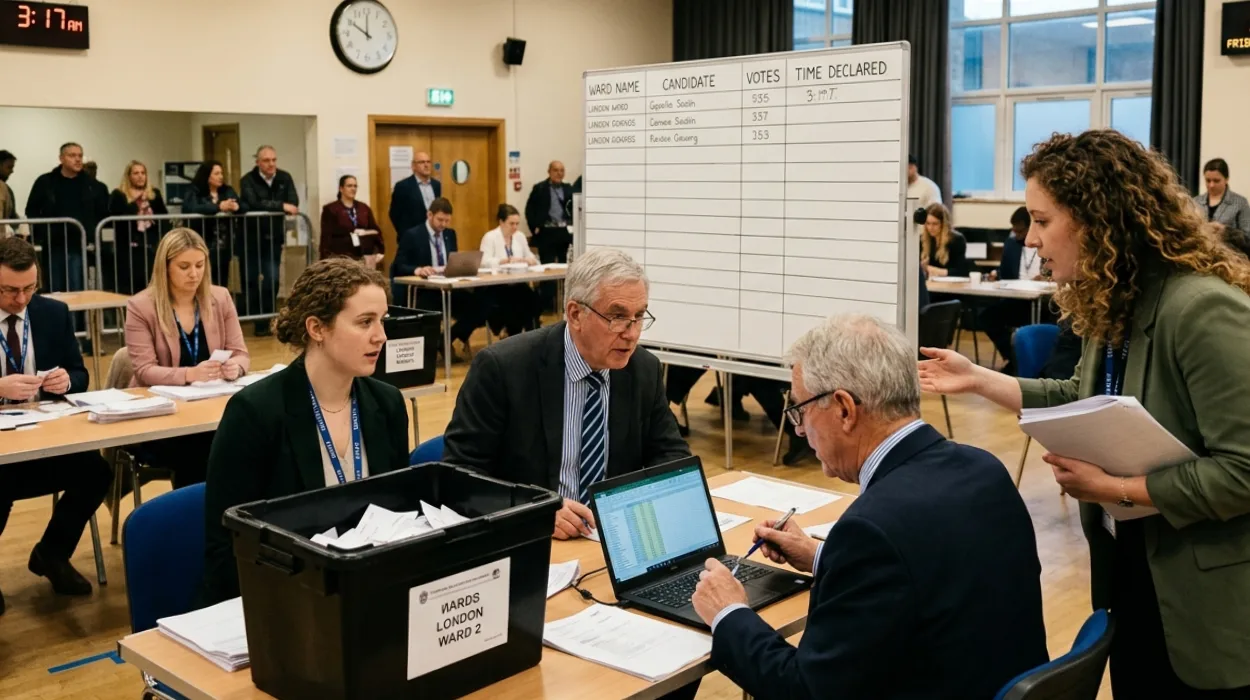
The official results for the 2026 London local borough elections were formally declared during the early morning and afternoon hours of Friday, 8 May 2026. Voting across all thirty-two London boroughs concluded at 22:00 BST on Thursday, 7 May 2026.
- How did the historical ward system of London evolve over time?
- What role did the Metropolis Management Act 1855 play in modernizing London elections?
- How did the London Government Act 1899 establish the first borough councils?
- What structural changes occurred under the London Government Act 1963?
- How does the modern verification and counting process operate on election night?
- Why do declaration times vary significantly between different London boroughs?
- What are the long-term historical implications of London’s local election cycles?
The administrative system governing local elections in Greater London dictates that counting processes commence immediately after the closing of polling stations or at 09:00 BST the following morning. For the 2026 electoral cycle, thirty-two London boroughs, including the London Borough of Hammersmith & Fulham and the London Borough of Haringey, conducted full council elections for all 1,817 available seats. Returning officers, who are the senior municipal officials responsible for executing elections within each borough, oversaw the verification of ballot boxes between 22:00 BST on 7 May 2026 and 02:00 BST on 8 May 2026.
Official declarations occur on a ward-by-ward basis as soon as the counting assistants finish tabulating the physical ballots and the returning officer resolves any challenged votes. Wards are the sub-municipal geographic divisions that elect individual councillors to local authorities. In the 2026 cycle, initial ward declarations occurred from 01:30 BST onwards on Friday, 8 May 2026, with overnight counting boroughs concluding their final declarations by 06:00 BST. Boroughs utilizing daytime counting models initiated their processes at 09:00 BST on 8 May 2026, delivering final declarations between 12:00 BST and 17:00 BST on the same day.
The Greater London area utilizes a staggered historical verification framework to ensure absolute precision under the Representation of the People Act 1983. This statute establishes the legal criteria for the administration of parliamentary and local elections within the United Kingdom. Because local government councils directly control municipal funding, urban planning, housing allocations, and public infrastructure, the official timing of declarations holds significant legal weight. Newly elected councillors assume their statutory administrative responsibilities exactly four days after the election occurs, on Monday, 11 May 2026.
How did the historical ward system of London evolve over time?
The historical ward system of London evolved from early medieval neighborhood guards into formal administrative and electoral units during the twelfth century. King Henry I granted the City of London the statutory right to elect its own sheriffs and officials in 1131.
The structural origins of London governance reside within the City of London, a distinct 1.12-square-mile geographic entity often referred to as the “Square Mile.” During the Anglo-Saxon period, which spanned from the fifth century until the Norman Conquest in 1066, the area relied on wards or sokes. A soke was a private jurisdiction commanded by a local lord or alderman. By the reign of King Henry II, who ruled from 1154 until 1189, these configurations shifted into public administrative districts designed to facilitate taxation, military defense, and civil order.
The City of London established twenty-four distinct historical wards by the year 1206. These initial boundaries reflected the geographic reach of specific ancient marketplaces, defensive Roman wall gates, and parish churches. Examples include:
- Farringdon Ward: Divided in 1394 into Farringdon Within and Farringdon Without to manage growing populations outside the London Wall.
- Cripplegate Ward: Separated similarly into internal and external administrative zones.
- Tower Ward: Positioned adjacent to the Tower of London to handle specific riverborne trade taxation.
- Vintry Ward: Centered around the historical wine importing wharves along the River Thames.
Each historical ward operated under the direct governance of an elected alderman and a Common Council. This dual-chamber structure formed the basis of the Court of Common Council, which remains the primary decision-making body of the City of London Corporation. This Corporation is the oldest continuous municipal democracy in the world. To experience this historic landmark in person today, consult our comprehensive [London historic architecture walking tour guide] for itineraries and visiting parameters. As the urban population expanded rapidly beyond the ancient Roman walls during the Industrial Revolution, this ancient ward framework served as the conceptual template for modern municipal structures.
What role did the Metropolis Management Act 1855 play in modernizing London elections?
The Metropolis Management Act 1855 established the Metropolitan Board of Works and consolidated hundreds of chaotic parish vestries into structured administrative districts. This statutory intervention legally standardized local voting qualifications and boundary divisions across the expanding metropolis for the first time.
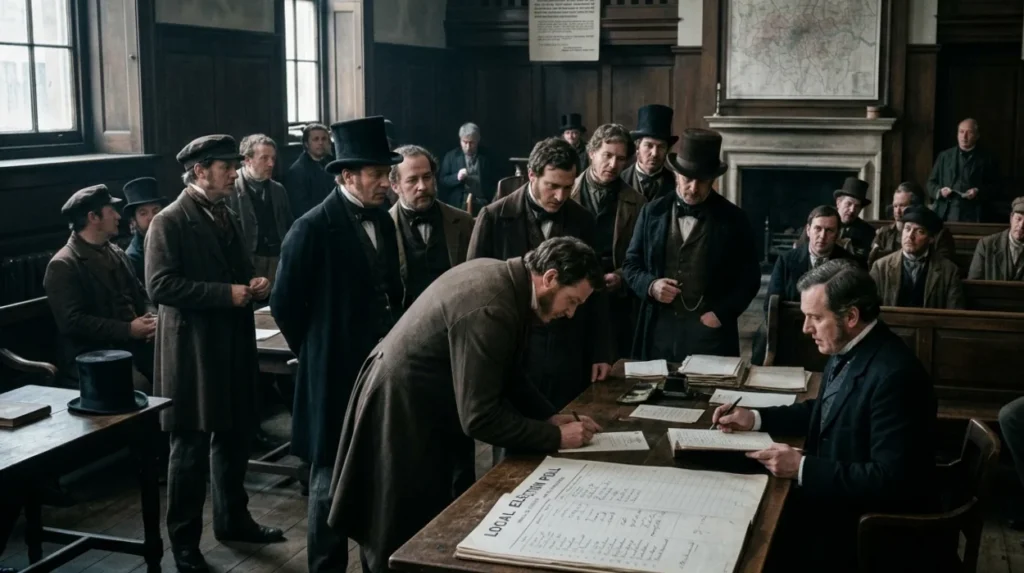
Prior to the enactment of the Metropolis Management Act 1855, the governance of urban London outside the City of London was fractured across more than three hundred separate parochially managed bodies. These bodies included parish vestries, paving commissions, turnpike trusts, and sewer authorities, which operated under roughly 250 distinct pieces of local legislation. The 1855 statute dissolved these uncoordinated entities and replaced them with a tier of twenty-three elective parish vestries and fifteen district boards. These boards represented smaller clustered parishes, creating a unified administrative footprint for a population that had surpassed 2.5 million residents.
The 1855 legislation introduced uniform electoral wards for any parish whose total population exceeded 2,000 residents. Returning officers divided these larger parishes into distinct electoral sectors to prevent any single faction from dominating the broader municipal assembly. The act specified that each ward must contain a proportional number of rated occupiers, meaning individuals who paid local property taxes known as rates. Vestrymen were elected annually in May, mirroring the modern calendar tradition of holding local council elections during the first week of May.
The Metropolitan Board of Works, created by the 1855 act, was not directly elected by citizens but consisted of members chosen by the parish vestries and district boards. This indirect democratic model concentrated infrastructural power, enabling the construction of the London sewerage system by civil engineer Sir Joseph Bazalgette between 1858 and 1875. The structural limitations of this indirect voting system eventually triggered the democratic reforms of the late nineteenth century, which stripped the vestries of their power and replaced them with directly elected local representatives.
How did the London Government Act 1899 establish the first borough councils?
The London Government Act 1899 abolished the historic vestry system and created twenty-eight metropolitan boroughs inside the County of London. This legislation transferred all local administrative powers to newly formed, directly elected municipal borough councils.
The London Government Act 1899 sought to simplify the administrative map of London by consolidating the various vestries and district boards created during the nineteenth century. The twenty-eight metropolitan boroughs established by the act excluded the City of London, which retained its ancient independent status. Each new metropolitan borough operated via a structured council composed of a mayor, aldermen, and directly elected councillors. The first elections for these newly minted metropolitan boroughs took place on 1 November 1900.
The 1899 statute mandated that the boundaries of the new metropolitan boroughs must be drawn by a dedicated committee of the Privy Council. This committee aligned borough perimeters with historical parish lines while flattening out geographical anomalies like enclaves and detached parcels of land. The legislation established three-year terms for elected councillors, with elections occurring across all wards simultaneously. The boundaries defined in 1899 remained structurally intact for sixty-six years, shaping local identity and political organization across inner London.
The 1899 framework institutionalized specific municipal functions at the borough level:
- Public Health: Responsibility for local sanitation, refuse collection, and infectious disease monitoring.
- Infrastructure: Management of minor highways, street lighting, and residential paving.
- Housing: Enforcement of early tenement regulations and the construction of early municipal lodging houses under the Housing of the Working Classes Act 1890.
This decentralized administrative approach created distinct civic hubs within each borough, often resulting in the construction of grand, ornate town halls. Examples include the Hackney Town Hall and the St Pancras Town Hall. These civic structures functioned as the physical locations where election ballots were stored, verified, counted, and officially announced to the public.
Explore More Public Services
Who Handles Street Lighting Maintenance and Broken Lamp Posts in London?
GoStroud Commuter Coach Matches Peak Rail Crisis: Stroud 2026
What structural changes occurred under the London Government Act 1963?
The London Government Act 1963 dissolved the old twenty-eight metropolitan boroughs and created thirty-two modern London boroughs under the Greater London Council. This structural overhaul expanded the boundaries of London to encompass parts of Middlesex, Surrey, Essex, Kent, and Hertfordshire.
The London Government Act 1963 addressed the massive mid-century population growth of suburban outer London, which had rendered the old 1899 County of London boundaries obsolete. The 1963 legislation created the administrative concept of Greater London, covering an area of 607 square miles with a population of approximately 8 million people. To govern this vast region, the act instituted a two-tier system: the strategic Greater London Council (GLC) managed regional infrastructure, while thirty-two newly formed London borough councils handled localized public services. The first elections for these thirty-two boroughs occurred on 7 May 1964, and the councils officially assumed full executive powers on 1 April 1965.
The creation of the thirty-two boroughs required the amalgamation of multiple smaller historical authorities. For instance, the modern London Borough of Camden was formed by merging the metropolitan boroughs of Hampstead, Holborn, and St Pancras. The modern London Borough of Lambeth absorbed parts of the old metropolitan borough of Wandsworth alongside its own historical territory. This consolidation necessitated a complete redrawing of electoral wards to ensure equal voter representation across the newly enlarged municipal districts.
The 1963 act classified the thirty-two boroughs into two distinct administrative categories:
- Inner London Boroughs: Comprising twelve specific boroughs that sat inside the old County of London boundary and shared educational administration via the Inner London Education Authority (ILEA).
- Outer London Boroughs: Comprising twenty distinct boroughs that managed their own local education systems independently from their inception in 1965.
The 1963 boundary lines established the exact geographical framework used for modern local elections, including the 2026 electoral cycle. The physical locations for ballot counting shifted from smaller parochial vestry halls to consolidated, technologically equipped civic centers capable of processing hundreds of thousands of votes per borough.
How does the modern verification and counting process operate on election night?
The modern verification and counting process operates under strict statutory timelines managed by a returning officer within each individual London borough. All ballot boxes must be transported securely from polling stations to centralized counting halls immediately following the close of polls.
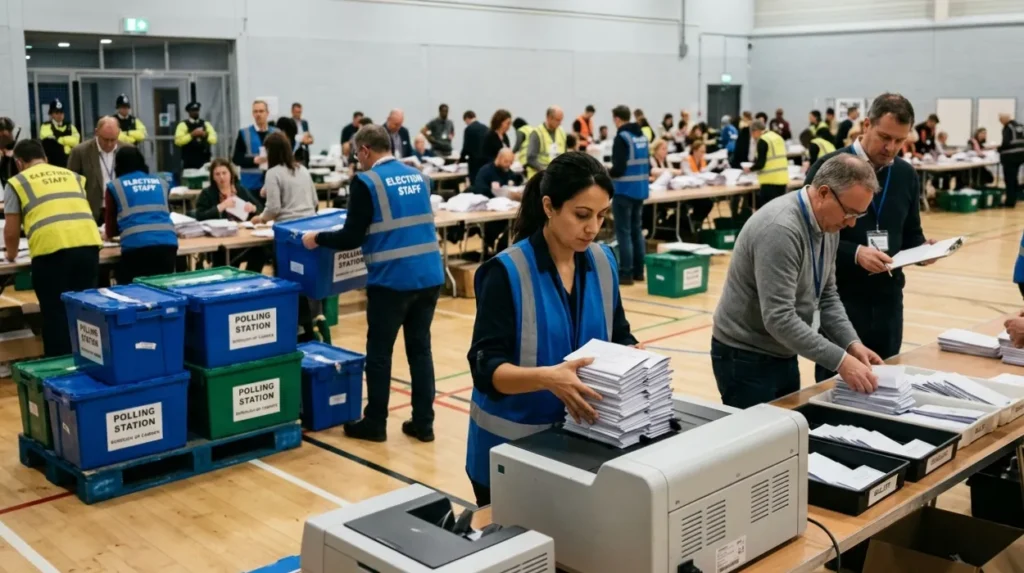
The administration of a London local election relies on a standardized, two-stage process: verification followed by the actual count. The verification phase requires counting clerks to check the total number of physical ballot papers inside each box against the official ballot paper account form filled out by the presiding officer at each polling station. This step confirms that no ballots have been illegally added or lost during the voting period. Once the verification figures for the entire borough match the administrative logs, the returning officer authorizes the mixing of ballot papers, which preserves the absolute anonymity of the voters.
The second phase is the counting process, where clerks sort the verified ballot papers by political party or individual independent candidate. London local elections utilize the first-past-the-post voting system within multi-member wards. Most London wards elect either two or three councillors simultaneously, meaning voters can cast up to three separate votes on a single ballot paper. Clerks utilize specialized gridded counting sheets to track these split votes accurately, a factor that historically extends the duration of local counts compared to single-member parliamentary elections.
If the margin of victory between candidates is extremely narrow, a candidate or their election agent holds the legal right to request a recount. The returning officer possesses the ultimate statutory authority to grant or deny this request based on whether the existing count is deemed robust. A recount requires clerks to re-examine every single ballot paper in that specific ward, a procedure that can delay the final official announcement by several hours. Once the numbers are finalized, the returning officer reads the declaration of result of poll aloud to the room, rendering the outcome legally binding and public.
Why do declaration times vary significantly between different London boroughs?
Declaration times vary significantly between London boroughs due to differences in geographical size, local counting models, total voter turnout, and the volume of postal votes. Boroughs that choose to count ballots overnight declare results hours faster than those that utilize daytime counting.
The primary factor driving variation in declaration times is whether a borough council selects an overnight count or a daytime count. In the 2026 local elections, several inner London boroughs opted for overnight counts, utilizing shifts of workers to process ballots immediately after the polling stations closed at 22:00 BST. These boroughs benefit from compact geographical footprints, allowing police and security couriers to transport ballot boxes from polling stations to the central count location within forty-five minutes. Consequently, these councils routinely declare their first ward results before 02:00 BST on the Friday morning following the election.
Outer London boroughs face different logistical constraints that often prompt them to choose daytime counts starting at 09:00 BST on the Friday morning. These boroughs possess larger geographic territories, lower housing densities, and more complex transport networks, which delays the arrival of ballot boxes to the central counting venue. Furthermore, outer London boroughs often experience higher rates of physical voter turnout and a larger volume of postal drop-offs at polling stations on election day. These late postal ballots must undergo a rigorous signature and date-of-birth verification process before they can be added to the count, adding hours to the pre-count verification phase.
The complexity of multi-member ward voting also causes internal variations within a single borough. Wards where voters split their votes heavily across multiple parties require a tedious manual counting method known as “grasshopping,” where clerks must carefully log individual votes across a spreadsheet rather than stacking straight-party ballots. If a particular ward triggers a formal recount due to a slim margin of victory, its announcement time will lag far behind the rest of the borough, even if all other wards have finished their declarations.
What are the long-term historical implications of London’s local election cycles?
The long-term historical implications of London’s local election cycles manifest in shifts in municipal architecture, urban planning policies, housing strategies, and public health infrastructure. The democratic outcomes of these elections dictate the preservation or demolition of London’s tangible cultural heritage.
Local borough councils in London hold extensive statutory duties that leave permanent marks on the physical and social fabric of the city. When a political party gains or loses control of a borough council, it alters the local authority’s approach to the Town and Country Planning Act 1990. This legislation empowers councils to grant or refuse planning permission for major architectural developments, conservation zones, and public spaces. The historical appearance of London’s distinct neighborhoods is a direct consequence of past electoral outcomes, which determined whether Victorian streetscapes were preserved or cleared for modernist redevelopments during the post-war era.
Electoral shifts also influence municipal housing policies, which have historically driven demographic changes across London’s thirty-two boroughs. Councils control the construction, maintenance, and sale of social housing assets under the Housing Act 1985. The historical transition from large-scale council estate construction in the 1960s to the active regeneration schemes of the twenty-first century reflects changing political majorities within individual town halls. These housing policies directly dictate who can afford to reside within specific urban sectors, altering the long-term genealogical and cultural composition of London’s communities.
Local council elections determine the long-term management of local archives, public libraries, and archaeological conservation efforts. Under the Local Government Act 1972, borough councils must maintain public record offices that safeguard centuries of historical data, manorial records, and parish registries. These repositories serve as vital tools for academic historians and genealogical researchers tracing family lineages back through the centuries. The funding, accessibility, and preservation of these historical collections remain dependent on the budget priorities set by the councillors elected during each quadrennial voting cycle.
When were the 2026 London borough election results announced?
Polling closed at 10:00 pm BST on Thursday, 7 May 2026. Overnight-counting boroughs declared most results during the early hours of Friday, 8 May 2026, while boroughs using daytime counts completed declarations between approximately 12:00 pm and 5:00 pm BST on 8 May.