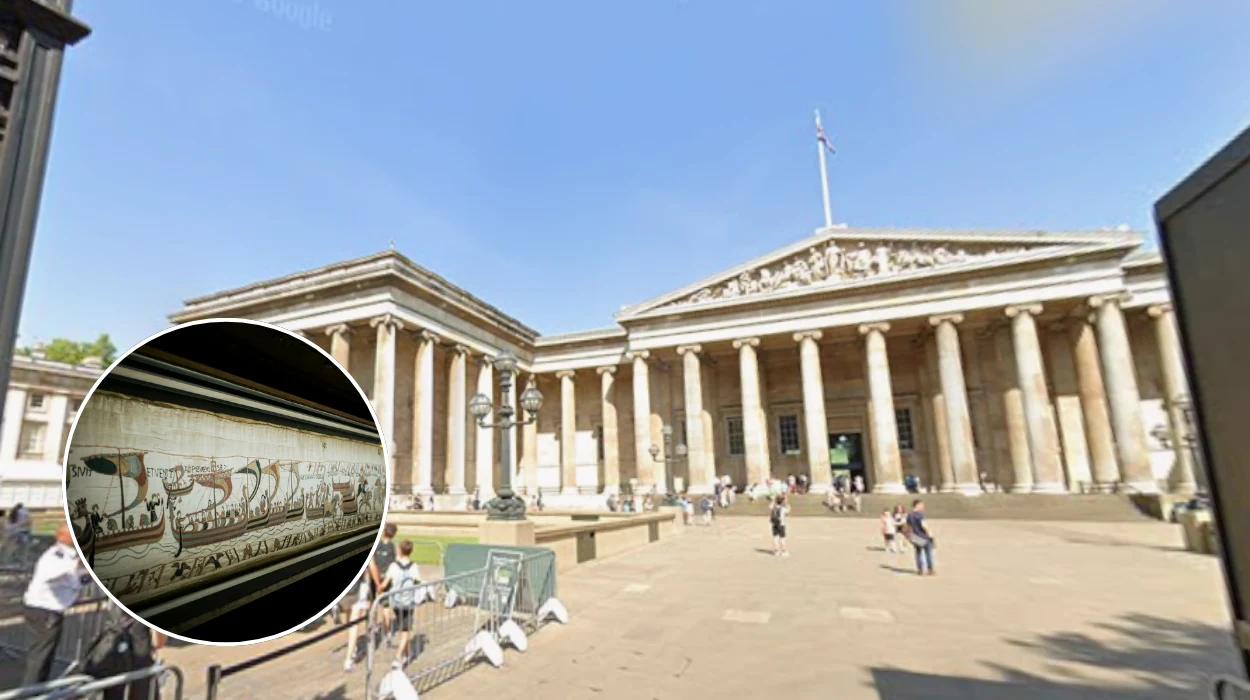
Key Points
- The historic Bayeux Tapestry has officially returned to English soil for the first time in over 900 years, arriving under tight security at the British Museum.
- Transported in secrecy, a dedicated delivery lorry arrived at the central London museum in the early hours of Friday morning, 10 July 2026.
- The masterpiece measures approximately 70 metres in length and 50 centimetres in height, intricately documenting the historic 1066 Norman Conquest of England.
- Experts believe the iconic embroidered cloth was originally crafted in England, potentially serving as a work of humorous political propaganda.
- Ticket demand has broken all historical records for the British Museum, generating upwards of £2.4 million in sales within the first 24 hours of general admission release.
- An estimated 7.5 million visitors are projected to view the artifact during its highly anticipated exhibition, which is scheduled to officially open on 10 September.
- Before public unveiling, the artifact will undergo extensive, highly delicate condition and conservation assessments by specialist teams.
- The masterpiece has been housed at the Bayeux Tapestry Museum in Normandy, France, since 1983, which has temporarily closed its doors for a comprehensive architectural renovation.
London (The Londoner News) July 10, 2026 – The legendary Bayeux Tapestry has officially arrived back on English soil after a historic absence spanning more than 900 years, sparking unprecedented public interest across the United Kingdom. Moving under the cover of darkness to ensure maximum security, a specialized transport lorry delivered the priceless medieval masterpiece to the British Museum in central London during the early hours of Friday morning. The highly anticipated return has triggered an extraordinary surge in public enthusiasm, with administrative records confirming that approximately 7.5 million British citizens and international tourists are expected to secure tickets to view the historic embroidered cloth in person.
- Key Points
- When Did the Bayeux Tapestry Arrive at the British Museum?
- What Are the Physical Dimensions and Features of the Bayeux Tapestry?
- Where Was the Bayeux Tapestry Originally Made?
- How Did the Public Respond to the Launch of Ticket Sales?
- What Do Members of the British Public Say About the Exhibition?
- What Official Statement Did the British Museum Release Online?
- What Did Museum Director Dr Nicholas Cullinan Say About the Event?
- What Are the Next Steps for the Tapestry Before Opening Day?
- Where Was the Tapestry Previously Kept and Will It Return to France?
When Did the Bayeux Tapestry Arrive at the British Museum?
As reported by Alan Johnson, Social News Reporter of MyLondon, the iconic embroidered artifact made its low-profile entry into the capital in secrecy as Friday dawned. Observers noted that a large commercial vehicle transported the fragile textile directly to the loading bays of the British Museum, where specialized curatorial teams were waiting to receive it.
The arrival marks the culmination of years of complex international cultural diplomacy and delicate logistical planning. For centuries, the historical narrative of the cloth has been tied to continental Europe, making its physical presence back within the boundaries of the United Kingdom a momentous occasion for historians, academics, and the general public alike.
What Are the Physical Dimensions and Features of the Bayeux Tapestry?
In a detailed descriptive assessment published by Alan Johnson of MyLondon, the physical scale of the historic artifact remains as breathtaking as its historical narrative. The tapestry measures approximately 70 metres in length and stands roughly 50 centimetres tall. It functions as a continuous, panoramic visual chronicle of one of the most transformative eras in the shared history of England and France.
According to the documentation compiled by MyLondon, the tapestry features a staggering array of detailed embroideries, including:
- 58 distinct historical scenes that systematically outline the political tension and military movements of the era.
- 626 individual characters, each meticulously stitched to showcase contemporary medieval dress, armor, and social stature.
- 202 horses depicted in various stages of cavalry maneuvers, transit, and active warfare.
Where Was the Bayeux Tapestry Originally Made?
Though long preserved in France, historical consensus highlights a fascinating dual identity regarding the origin of the artifact. As reported by Alan Johnson of MyLondon, the iconic embroidered piece documents the brutal conquest of England by William, Duke of Normandy, culminating in the seminal Battle of Hastings in 1066. However, academic analysis referenced in the MyLondon coverage indicates that the cloth is widely believed to have been physically manufactured in England itself.
Furthermore, historical researchers have long posited that the creators embedded subtle elements of wit into the design. The MyLondon report highlights that the textile is widely considered to have been structured as a “humorous propaganda piece,” allowing the vanquished Anglo-Saxon artisans to weave hidden critiques, ironies, and satirical commentary into the borders and scenes of the Norman victory.
How Did the Public Respond to the Launch of Ticket Sales?
The announcement that the tapestry would be available for public viewing in London triggered an immediate commercial frenzy. As reported by Alan Johnson, Social News Reporter of MyLondon, when general admission tickets officially went on sale last week, the British Museum recorded the single biggest day of ticket sales in its entire institutional history.
The immediate financial and logistical scale of the public response has stunned industry analysts. According to internal data published by MyLondon, the museum successfully generated more than £2.4 million in ticket revenue within the first 24 hours of the box office opening. Online ticketing queues regularly swelled to capacity, with tens of thousands of hopeful attendees waiting hours for a chance to secure entry.
What Do Members of the British Public Say About the Exhibition?
Public excitement has reverberated heavily across digital spaces and community forums, highlighting the deep cultural connection many citizens feel toward the artifact. As highlighted in the report by Alan Johnson of MyLondon, an excited Reddit user utilizing the handle u/Inevitable-Debt4312 prompted a massive public discussion in the AskUK subreddit by asking: “Will you be viewing the Bayeux Tapestry?”
The responses gathered from the online community reveal a mixture of dedication, local pride, and nostalgic awe. As documented in the MyLondon article:
- One eager commentator stated: “I’m well looking forward. Sat in an online queue this morning for nearly an hour to get tickets for a date in October.”
- A second individual shared their long-term dedication to the art form itself, declaring: “Heck yea! I got membership to ensure I got a ticket and I am going in September! Saw it in France and it was amazing. I even taught myself the tapestry’s style of embroidery.”
- A third dedicated museum supporter remarked on the expected logistical density of the galleries, exclaiming: “100%. I’m a British Museum member, so booked my tickets a couple weeks ago. Excited to see it, even though it’s going to be rammed. Really one to enjoy and soak in, since you won’t be able to take a single picture without someone’s head in the way.”
- Reflecting on the national significance of the display, a fourth forum participant noted: “Got my ticket today, was in an a queue for 6 hours. The tapestry is about us, Britons, what we wore, ate, played and fought 1000 years ago. Everyone should go see it.”
What Official Statement Did the British Museum Release Online?
The institutional enthusiasm matching the public fervor was made clear through official communication channels. In an authorized statement published on its official digital platforms, as cited by Alan Johnson of MyLondon, the British Museum emphasized the unprecedented historical weight of the event, stating:
“It is the first time the tapestry has been displayed in the UK since it was made almost 1,000 years ago – and is expected to be one of the most popular events in the Museum’s history.”
The museum’s statements underscore that hosting the piece is not simply an standard seasonal exhibition, but rather a monumental repatriation of heritage, allowing the modern British public to view an artistic mirror of their own ancestral origins.
What Did Museum Director Dr Nicholas Cullinan Say About the Event?
To contextualize the monumental nature of this loan, the leadership of the institution has expressed profound gratitude and excitement. As reported by Alan Johnson of MyLondon, the British Museum Director, Dr Nicholas Cullinan OBE, spoke explicitly regarding the cultural and artistic magnitude of the arriving display. Dr Nicholas Cullinan OBE stated that:
“The Bayeux Tapestry is one of the most important cultural artefacts from the Medieval world and has been a source of inspiration and wonder for generations.”
Expanding upon the sheer scale of the logistical achievement and the emotional resonance it carries for the nation, Dr Nicholas Cullinan OBE added:
“It’s difficult to capture just how extraordinary the opportunity to display the tapestry in the UK for the first time in 1000 years is. I’m glad we’ll now all be able to share in that excitement as people book their tickets and travel to London to take part in what is undoubtedly going to be one of the biggest cultural events the British Museum has hosted – one for the ages.”
Explore more History of London News:
Medieval Alleyways of Old London Explained | City of London
Why London’s Famous Streets Were Built | Central London
What Are the Next Steps for the Tapestry Before Opening Day?
Though the physical object has successfully arrived at its destination in London, the public will have to wait exactly two months before the exhibition gallery doors officially open. As detailed by Alan Johnson of MyLondon, the tapestry is scheduled to begin public display on 10 September 2026.
In the intervening weeks, the fragile linen and wool structure will be subjected to rigorous conservation protocols. According to the MyLondon news report, the artifact will undergo extensive, highly detailed condition checks overseen by top-tier international textile conservators. Following these precise safety evaluations, technicians will meticulously mount the 70-metre cloth inside a highly specialized, climate-controlled, custom-designed showcase to preserve the fibers from atmospheric degradation during its high-traffic London run.
Where Was the Tapestry Previously Kept and Will It Return to France?
The long-term residency of the piece remains firmly anchored in Normandy, where it has been safeguarded for decades. As reported by Alan Johnson of MyLondon, the historical cloth had previously been continuously displayed at the specialized Bayeux Tapestry Museum in Normandy, France, where it had resided since 1983.
The temporary relocation to the United Kingdom was made possible due to architectural developments across the English Channel. The MyLondon report clarifies that the original French facility has officially closed its doors to the public to undergo a comprehensive, multi-million-euro structural renovation. Once the British Museum exhibition concludes its run, the legendary tapestry will safely return to France to take up its permanent residency within the walls of a completely modernized, newly constructed Bayeux Tapestry Museum.