Key Points
- Extreme Warning Raised: The London Fire Brigade (LFB) has elevated the wildfire risk level to “extreme” across the capital, effective from Saturday until at least Monday.
- Weather Triggers: The escalation is driven by a prolonged heatwave, sustained dry conditions, and critical wind speeds and directions that could cause fires to spread exponentially.
- Public Bans and Restrictions: Fire officials are urging an absolute ban on disposable barbecues in public parks and open spaces, alongside strict warnings regarding the disposal of cigarettes and litter.
- Call to Local Authorities: Landowners and local councils have been instructed to implement immediate land management measures, including cutting back dry grass and creating strategic fire breaks near residential properties.
- Historical Context: The warning follows a pattern of increasingly devastating summer blazes in Greater London, including the destruction of 16 homes in Wennington in July 2022 and a massive 20-acre fire in Dagenham’s Beam Valley Country Park in July 2025.
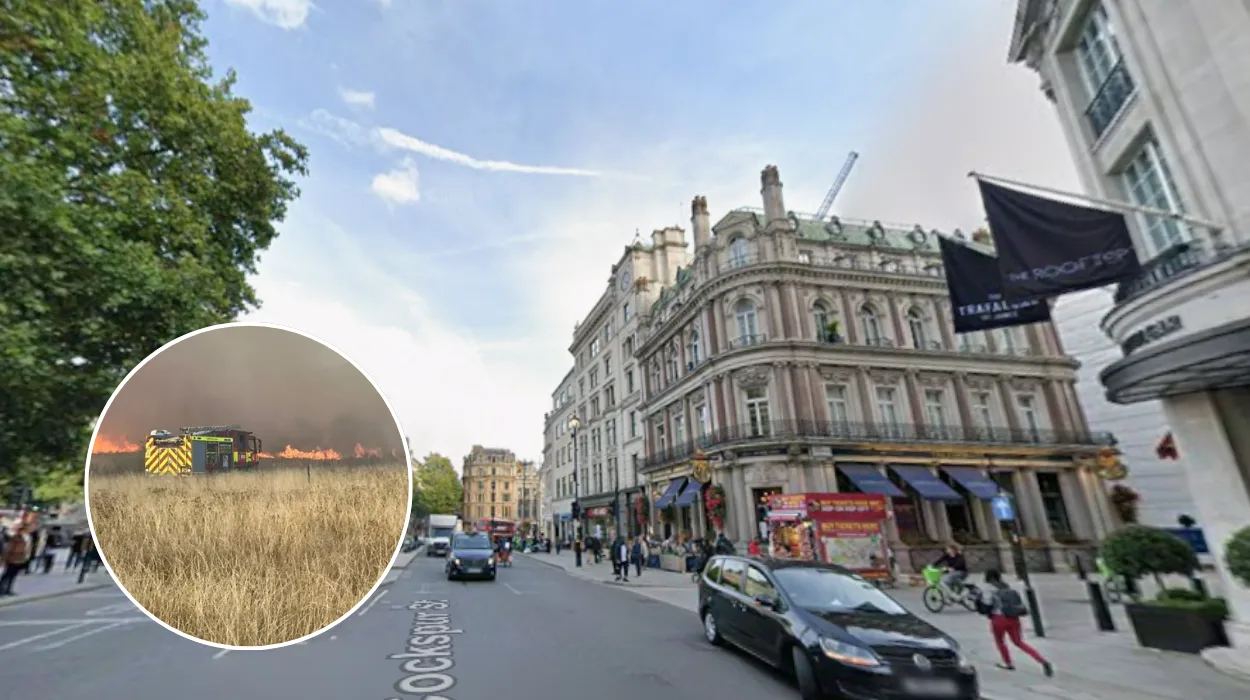
London (The Londoner News) July 10, 2026 – Greater London has been placed under an “extreme” wildfire risk warning ahead of the weekend as an intense heatwave continues to bake the capital, prompting emergency officials to implement urgent public safety measures. The London Fire Brigade (LFB) officially raised the threat assessment level from Saturday morning through to at least Monday night, citing a perilous combination of consecutive days of scorching temperatures, parched vegetation, and volatile wind patterns. With millions of residents and tourists expected to flock to the city’s green spaces, emergency services are on high alert, warning that any spark could instantly trigger an uncontrollable, fast-moving blaze in close proximity to densely populated residential areas.
- Key Points
- Why Has an ‘Extreme’ Wildfire Risk Warning Been Issued for London?
- What Public Restrictions Are in Place Across London This Weekend?
- What Actions Must Landowners and Councils Take to Prevent Fires?
- How Do Human Actions Directly Trigger UK Wildfires?
- Which Past London Wildfires Have Caused the Most Damage?
- How Is the London Fire Brigade Preparing for the Weekend?
The heightened alert reflects deep anxieties within emergency services regarding the vulnerability of London’s urban-wildland interfaces. Officials have made direct appeals to the public, landowners, and local government bodies to mitigate risks immediately. The LFB has explicitly requested that citizens refrain from using disposable barbecues in parks, extinguish smoking materials with absolute certainty, and carry litter home. Concurrently, local councils are being forced to rapidly deploy land-management teams to chop down overgrown grass and establish emergency fire breaks—gaps in vegetation designed to stop the progress of a fire—especially where open fields abut housing estates.
Why Has an ‘Extreme’ Wildfire Risk Warning Been Issued for London?
The decision to escalate the risk profile to “extreme” is the result of a data-driven assessment compiled by specialist fire meteorologists. As reported by environment correspondent Fiona Harvey of The Guardian, the meteorological metrics tracking fuel dryness—referring to how moistureless grass, twigs, and undergrowth have become—have reached critical thresholds after weeks of negligible rainfall. When these conditions coincide with high ambient temperatures, the microclimate of London’s parks alters, transforming scenic landscapes into highly combustible fuel beds.
Furthermore, fire safety analysts point out that wind dynamics play a massive role in this weekend’s warning. As detailed by home affairs editor Mark Easton of BBC News, the LFB explicitly cited wind speed and wind direction as the primary catalysts that could turn a minor, localized grass fire into a multi-hectare disaster. A steady wind not only provides a continuous supply of oxygen to a flame but physically bends the fire forward, allowing radiant heat to dry out and ignite vegetation ahead of the front line, causing the fire to “leap” rapidly across open terrain.
What Public Restrictions Are in Place Across London This Weekend?
In response to the extreme threat matrix, the LFB has issued a strict set of operational mandates aimed at civilian behaviour, which remains the leading cause of wildfires across the United Kingdom. Writing for the Evening Standard, transport and environment reporter Ross Lydall noted that the brigade is treating the upcoming 48-hour window as a critical public safety emergency.
As reported by legal and public policy specialist Emily Pennink of The Independent, Assistant Commissioner Tom Goodall of the London Fire Brigade issued a direct, uncompromising statement to the public: “We want everyone across the city to enjoy the continuing heatwave but this must be done responsibly. The latest wildfire risk assessment indicates that if grassfires were to break out, the chance of them spreading more rapidly due to the weather conditions is greater.”
To counter this, Goodall detailed the specific interventions required from everyday Londoners, stating: “With so many of London’s parks and open spaces close to properties and communities, it is vital the public take as much care as possible to prevent these fires starting in the first place. That means no disposable barbecues in parks and open spaces, taking rubbish home with you if no bins are available and ensuring your cigarettes are discarded properly.”
How Can Residents Safely Barbecue at Home?
For those choosing to remain within their private properties, the fire brigade has updated its domestic safety protocols to prevent residential structures from catching fire. As recorded in the official LFB press dispatch by communications officer Chris Long, Assistant Commissioner Tom Goodall further warned: “If you’re having a barbecue at home, make sure it is on level ground and away from decking, fences, trees and balconies.” Balconies, in particular, have become a major point of failure in urban fire safety, as rising thermal currents can carry embers upwards, igniting plastic cladding or outdoor furniture on higher floors.
What Actions Must Landowners and Councils Take to Prevent Fires?
The onus of protecting the capital this weekend does not fall solely on individual behaviour; institutional landowners are facing immense pressure to secure their perimeters. Reporting for The Daily Telegraph, senior city reporter Robert Mendick noted that the LFB has issued actionable directives to both private estate owners and local municipal councils.
These bodies are legally and operationally responsible for vast tracts of common land, heathlands, and municipal parks that weave through London’s boroughs. The LFB has instructed these entities to ensure they are actively managing their acreage by:
- Creating Strategic Fire Breaks: Ploughing or cutting wide strips of land down to the bare soil to interrupt the continuous path of fuel.
- Cutting Grass Back Aggressively: Prioritising the mowing of perimeter fields, particularly where open grassland directly borders residential fences, schools, and infrastructure hubs.
- Increasing Litter Patrols: Removing discarded glass bottles rapidly, which can act as magnifying lenses under intense sunlight, concentrating solar rays to the point of ignition.
How Do Human Actions Directly Trigger UK Wildfires?
While catastrophic wildfires in places like Australia or California are frequently ignited by lightning strikes, the operational reality within the United Kingdom is vastly different. As reported by science editor Tom Whipple of The Times, historical data from the LFB confirms that the vast majority of wildfires occurring within the Greater London boundary are directly caused by human error, negligence, or deliberate arson.
The issue is compounded by the phenomenon known as the urban-wildland interface. Unlike remote wilderness areas, London’s green spaces—such as Hampstead Heath, Richmond Park, and Hackney Marshes—are completely surrounded by high-density housing and transport networks. Consequently, a single discarded cigarette thrown from a car window or a poorly extinguished disposable barbecue grill can rapidly escalate, transition into an urban firestorm, and directly threaten human life within minutes.
Explore more Local London News:
World Cup: South London Pubs Open Till 2am | Lewisham 2026
BBC Forecasts Three Days of Intense Thunderstorms Post Heatwave: London 2026
Which Past London Wildfires Have Caused the Most Damage?
The current “extreme” warning is informed by a series of near-fatal precedents that have rewritten the LFB’s tactical playbook over the last four years. The capital is no longer unaccustomed to large-scale wildfire emergencies, which were once considered unique to southern Europe.
What Happened in Wennington in July 2022?
The benchmark for modern wildfire destruction in London occurred during the historic, record-breaking heatwave of July 2022. As meticulously documented by social affairs correspondent Dave West of Inside Housing, a fast-moving grass fire swept across dried heathland in the village of Wennington, east London. Fed by unprecedented temperatures and dry winds, the fire breached the residential boundary, destroying 16 homes, obliterating historic structures, and requiring a total evacuation of the area. The incident marked the first time in modern history that a British wildfire destroyed an entire row of suburban housing.
How Severe Was the Dagenham Beam Valley Park Fire in July 2025?
The threat returned with equal ferocity just last year. As reported by crime and emergency services reporter Rebecca Speare-Cole of Sky News, in July 2025, a massive wildfire erupted within the Beam Valley Country Park in Dagenham. The flames rapidly ripped through eight hectares (approximately 20 acres) of parched parkland. According to eyewitness accounts and emergency logs published by Sky News, the intensity and trajectory of the fire forced local police to execute emergency evacuations, forcing dozens of residents to temporarily flee their homes as thick black smoke blanketed the district and embers rained down on nearby rooftops.
How Is the London Fire Brigade Preparing for the Weekend?
With the extreme risk window opening on Saturday, the internal posture of the LFB has shifted to a maximum readiness footing. Reporting for the Financial Times, UK policy reporter Jasmine Cameron-Chileshe noted that senior officers are “constantly monitoring” real-time weather feeds and fuel-moisture indexes provided by the Met Office.
The brigade has strategically repositioned specialized wildfire suppression units—including high-volume pumps and all-terrain vehicles capable of traversing rugged, unpaved parklands—to outer London boroughs where the concentration of open heathland is highest. Command structures have also streamlined mutual-aid agreements with neighbouring county fire services, ensuring that if a wildfire breaks out and threatens to overwhelm local stations, additional resources can be deployed across county lines without bureaucratic delay.
Emergency operators are reiterating that if any member of the public spots smoke or a small flame in a park or field this weekend, they must not attempt to investigate or extinguish it themselves. Instead, they must immediately dial 999, provide a precise location using landmarks or digital mapping applications, and retreat to a safe distance upwind from the threat.